

The honest answer: Malpractice laws matter—but not as much as doctors think, and not in the way most people assume.
Most physicians obsess over “lawsuit hellholes” and “tort reform states” when they look at jobs. I’ve watched residents cross entire regions off their list because they heard “it’s super litigious there.” That’s simplistic. And in many cases, wrong.
If you’re choosing where to practice, malpractice climate should be on your list—but it should not be in your top three deciding factors. And when it does factor in, you need to look at the right signals, not folklore from the call room.
Let’s break this down into what actually affects your day-to-day life—and your risk.
1. How Much Do Malpractice Laws Really Change Your Risk?
Here’s the blunt truth: your personal risk of being sued depends far more on what you do and how you practice than which state line you’re standing behind.
Yes, there are differences in claim rates by state. Yes, some specialties in some regions get hammered more than others. But zoom out.
- High-risk specialties (OB/GYN, neurosurgery, CT surgery, EM, ortho, anesthesia) = higher risk everywhere
- Outpatient primary care, psych, path, radiology, derm = lower risk everywhere
- Urban, high-volume, lower-resourced safety-net environments = more risk than a boutique suburban practice, regardless of state
Most physicians dramatically overestimate both:
- The chance they’ll be sued
- The chance that a lawsuit will financially ruin them
Here’s what actually protects you most:
- Practicing within standard of care
- Good documentation and communication
- Reasonable patient volumes and staffing
- Solid malpractice coverage with tail
Malpractice laws can tweak the edges—how much is paid out, how stressful the process is, whether meritless cases are quickly thrown out—but they don’t flip the game board.
2. The Big Legal Levers That Actually Matter (Summarized)
You don’t need to be a lawyer. But you do need to know the 4–5 legal levers that change the malpractice climate in a meaningful way.
1. Damage Caps (especially non-economic)
Some states cap non-economic damages (pain and suffering) at a fixed amount, sometimes only in med-mal cases, sometimes more broadly.
That affects:
- How attractive your state is to plaintiff attorneys
- The size of potential “nuclear” verdicts
- How much your carrier worries and prices your premiums
States without caps can see the occasional eye-popping headline verdict. That doesn’t mean your personal odds of a giant verdict are high—but the ceiling is higher.
2. Pre-suit Requirements
Things like:
- Mandatory expert opinions before filing
- Medical review panels
- Certificate-of-merit requirements
These mostly filter out completely frivolous suits and delay the timeline. They don’t immunize you, but they improve signal-to-noise.
3. Joint-and-Several Liability Rules
This determines how much you can be on the hook if multiple defendants are sued (hospital, other doctors, device manufacturers, etc.). In some states, if someone else is broke or dismissed, you can get stuck with more of the bill.
It’s nuanced. You won’t personally negotiate this, but it affects how carriers view risk and sometimes who gets named in suits.
4. Statutes of Limitation and Repose
How long after an incident can someone sue?
- Shorter windows = more legal certainty, less open-ended risk
- Longer windows (especially for peds cases) = you may deal with cases from a decade ago
Again, doesn’t change your daily practice much, but it affects background risk.
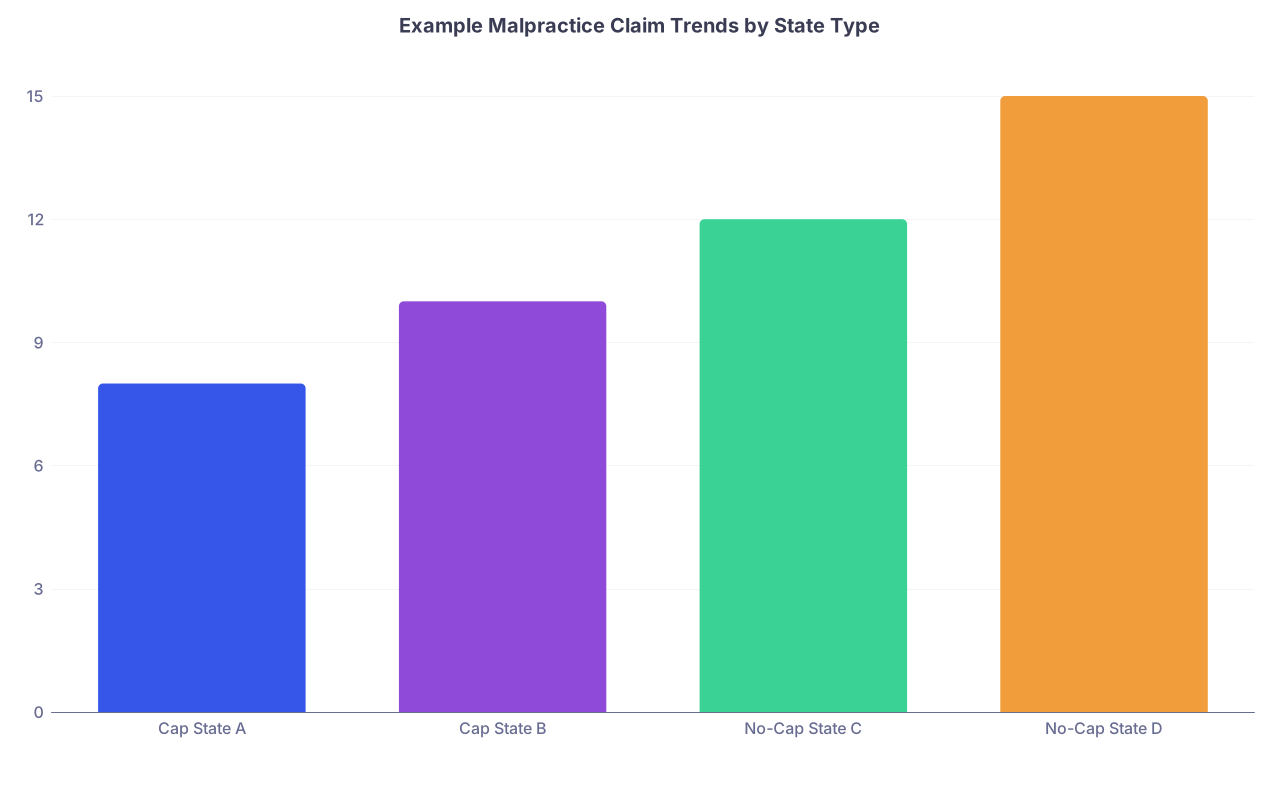
| Category | Value |
|---|---|
| Cap State A | 8 |
| Cap State B | 10 |
| No-Cap State C | 12 |
| No-Cap State D | 15 |
3. What Malpractice Laws Don’t Do (That People Assume They Do)
Let me kill a few myths that float around lounges and Reddit threads.
Myth 1: “Tort reform states don’t get sued.”
Wrong. You can and will still get sued. Caps don’t block claims; they cap awards. You’ll still spend time on depositions, chart reviews, and defense.
Myth 2: “Bad malpractice laws = I’ll lose everything I own.”
Not if you’re properly insured and not committing obvious malpractice. Between policy limits, hospital coverage, settlement dynamics, and bankruptcy protections, true personal financial devastation is rare. Painful, yes. But the nightmare scenario most people imagine is not the norm.
Myth 3: “If I go to a ‘good’ tort state, I don’t have to worry.”
You still need:
- Tight documentation
- Good consent processes
- Clear communication
- To not shortcut safety steps because “my state is physician-friendly”
If you practice sloppily in a “friendly” state, you’ll still hate life when discovery hits.
4. Malpractice Laws vs Everything Else That Makes a Place Good to Work
This is where most people get it backwards.
If you’re choosing where to practice, stack malpractice laws against other variables that actually shape your day-to-day happiness.
| Factor | Impact on Day-to-Day Life |
|---|---|
| Malpractice Law Climate | Medium |
| Call Schedule | Very High |
| Staffing & Support | Very High |
| Compensation Model | High |
| EMR & Workflow | High |
| Leadership & Culture | Very High |
You can be in a “perfect” tort-reform state and still be miserable if:
- Your group dumps unsafe patient volumes on you
- The hospital culture is toxic
- You’re doing 1:3 home call with real cases every night
- Admin pressures you to cut corners but holds you responsible when something breaks
On the flip side, I’ve seen happy physicians in supposedly “litigious” states like New York, California, and Illinois because:
- Their systems are well run
- They have great support staff
- Their colleagues have their back
- They’re fairly paid and reasonably scheduled
Bottom line: malpractice climate is a background factor. Work environment is a foreground factor. Don’t invert those.

5. When Malpractice Laws Should Sway Your Decision
There are situations where the malpractice environment really does matter more, and you shouldn’t ignore it.
1. You’re in a Very High-Risk Specialty
If you’re:
- OB/GYN doing high-risk obstetrics
- Neurosurgery
- Cardiac or trauma surgery
- Emergency medicine in a busy urban center
Then:
- Premiums vary wildly by state and region
- Caps and claim frequency matter more
- Catastrophic outcomes are more common and more likely to generate big suits
In that case, yes: put malpractice climate higher on the list. Especially if you’re comparing two similar jobs in different states.
2. You’re Joining a Barebones Startup, Independent Group, or Locums-Heavy Lifestyle
If your job situation includes:
- Questionable or minimal coverage
- You buying your own tail
- A lot of procedural or high-risk work without institutional backing
Then:
- You should care about both premiums and legal climate
- You want clarity on coverage limits, tail, and defense strategies
3. You Have Almost-Equal Offers in Different States
If everything else is basically equal:
- Similar schedule
- Similar compensation
- Similar culture
Then sure—let malpractice environment break the tie. No reason to ignore a physician-friendlier setting when the rest is even.

| Step | Description |
|---|---|
| Step 1 | Compare Job Offers |
| Step 2 | Let Laws Matter More |
| Step 3 | Focus on Job Details |
| Step 4 | Choose Better Job Environment |
| Step 5 | Use Laws as Tiebreaker |
| Step 6 | Same Specialty Risk? |
| Step 7 | Big Difference in Tort Climate? |
| Step 8 | Big Difference in Job Quality? |
6. What You Actually Need to Ask About Malpractice Before Signing
Don’t just Google “Is State X physician-friendly?” and call it a day. Ask specific questions about your actual job.
Here’s the short list you should go through with any recruiter, group leader, or hospital:
Who provides my malpractice coverage?
- Hospital, group, or do I buy my own?
- Which carrier?
What are the limits?
Typical: $1M / $3M or $2M / $4M. If they’re lower than local norms, that’s a flag.Is it claims-made or occurrence?
- Claims-made = you’ll almost certainly need tail when you leave
- Occurrence = better for you, but more expensive for whoever’s paying
Who pays for tail coverage?
- Fully covered by employer, shared, or all on you?
- This can be a 5–6 figure hit if you’re in a high-risk field
What’s the group’s actual malpractice history?
Ask specifically:- “How many claims in the last 5–10 years?”
- “Any catastrophic payouts?”
- “How are physicians supported during a case?”
Do they settle quickly or fight everything?
You want a rational approach:- Defend good cases
- Settle clear errors strategically
But not: “We settle everything fast to make it go away,” because that can paint a target on your back.

7. State-Level Climate: How to Research It Without Becoming a Lawyer
If you really want to sanity-check a state’s malpractice environment, here’s the fast track:
Look up: “[State] medical malpractice tort reform summary”
You’re looking for:- Non-economic damage caps (yes/no + amount)
- Pre-suit requirements
- Statute of limitations
Pull a quick premium comparison for your specialty
Use:- Specialty association surveys
- State medical society resources
- Insurance broker summaries
Ask local physicians directly
Ask two questions:- “Do you feel the malpractice climate affects how you practice?”
- “Have malpractice issues pushed people out of the state?”
You’ll get a cleaner, more reality-based picture than by reading a law firm’s marketing blog.

| Category | Base Premium | Additional Tail/Fees |
|---|---|---|
| IM - State X | 10000 | 2000 |
| IM - State Y | 12000 | 3000 |
| OB - State X | 60000 | 10000 |
| OB - State Y | 90000 | 15000 |
8. Where Malpractice Laws Fit in the “Best Places to Work” Equation
If I had to create a simple ranking of what should matter most when choosing where to work as a doctor, it’d look something like this:
- Workload + schedule + call
- Culture, leadership, and collegiality
- Compensation and benefits
- Support: staffing, APPs, consultants, tech, EMR
- Geography and family/life preferences
- Malpractice coverage details for your exact job
- State malpractice climate and tort laws
Yes—malpractice laws are on the list. But they’re not the first filter. If you flip that order, you’ll optimize for a theoretical risk problem and ignore the things that actually burn people out: relentless call, poor staffing, and bad leadership.

FAQ: Malpractice Laws and Choosing Where to Practice
1. Should I completely avoid states without malpractice damage caps?
No. Lack of caps doesn’t automatically make a state a bad place to work. It raises the ceiling for large verdicts, but your personal experience will be shaped more by your specialty, job environment, and malpractice coverage than that single legal feature. If the job is excellent and coverage is strong, a no-cap state can still be a very reasonable choice.
2. How much higher are malpractice premiums in “bad” states?
It depends almost entirely on your specialty and locale. For many lower-risk fields (IM, peds, psych), the differences may be a few thousand dollars a year and often paid fully by your employer. In high-risk fields like OB or neurosurgery, the difference between a friendly and unfriendly state can be tens of thousands per year—and that’s where it matters more, especially if compensation doesn’t keep up.
3. Is it safer to work outpatient only if I’m worried about malpractice?
Outpatient tends to carry fewer catastrophic events and lower claim severity, but it’s not a free pass. Missed cancers, delayed diagnoses, and med errors still lead to suits. If you prefer outpatient anyway, yes, it’s generally lower risk. But don’t choose your entire career based only on trying to dodge lawsuits—you’ll end up boxed into work you hate.
4. Do malpractice suits usually go to trial and make the news?
No. Most cases settle quietly or are dropped. The news focuses on weird, huge, or outrageous verdicts, which massively distort your risk perception. For many physicians, the worst part is not a public trial, but the slow, grinding process: depositions, second-guessing, and emotional stress. That’s why good coverage and institutional support matter more than the headline legal environment.
5. What’s the one malpractice-related question I should always ask in an interview?
Ask: “Can you walk me through exactly how malpractice coverage works here—who pays, what the limits are, whether it’s claims-made or occurrence, and who pays for tail when I leave?” Then shut up and listen. A confident, transparent answer is a good sign. Vague, dismissive, or evasive answers are a bright red flag.
6. If I’m risk-averse, should malpractice laws be a top-three factor in my decision?
Even if you’re very risk-averse, I’d still keep malpractice laws below things like workload, safety climate, and coverage specifics. What you can do is: favor states with clearer, more physician-friendly laws when comparing roughly equal offers; choose lower-risk practice settings; and negotiate strong malpractice terms into your contract. That combination will protect you far more than simply moving to a “tort reform” state and hoping for the best.
Open your top two or three job descriptions right now and add a line to your comparison sheet: “Malpractice: carrier, limits, tail, state climate.” Fill it in. If you can’t, email or call the recruiter today and get those details in writing before you go any further.


