
The generic “submit ERAS on day one or you’re doomed” advice is outdated—and if you were sick and fell behind on rotations, it can be dangerous.
If you’re behind on key rotations because of illness, and you’re staring at the ERAS calendar thinking, “I’m going to get crushed,” you’re not. But you do need a different playbook than your classmates who cruised through fourth year.
This is that playbook.
1. First, define the exact problem you’re in
Do not start by panicking about dates. Start by describing your situation in one brutal, specific sentence.
Something like:
- “I’m a 4th-year applying IM, I missed 6 weeks with mono, and my sub-I is now in October.”
- “I’m switching to psych after a hospitalization during my surgery rotation; I have zero psych letters and my psych elective is in November.”
- “I had COVID twice, my Step 2 CK was delayed, and my only specialty letter is from a non-Home PD.”
You need to know three things right now:
- What rotations are unfinished or rescheduled?
- When will you realistically finish the most important ones?
- Which core application pieces are missing or weak?
Do a 10-minute audit. Literally write this out:
- Target specialty (and if you’d consider a backup).
- Rotations completed in that specialty.
- Rotations scheduled in that specialty, with months.
- Letters you already have (name, department).
- Letters you can get after upcoming rotations.
- Step 1: P/F or score. Step 2 CK: taken / scheduled / TBD.
You’re not “behind” in some vague way. You’re behind in very specific ways—maybe in sub-I timing, letters, or Step 2. The fix depends on which of those is your bottleneck.
2. How much does ERAS submission timing actually matter now?
You’ve probably heard variations of:
- “If you’re not in on opening day, forget it.”
- “Programs fill all their interview spots the first week.”
- “Late apps go straight in the trash.”
That used to be closer to true. It’s less true now.
Here’s the real hierarchy for most specialties:
- Complete application by the MSPE release date (around Oct 1) is ideal.
- Complete application within the first 1–3 weeks after that is still very viable, especially with strong letters and Step 2.
- Applying significantly later (after late October/November) gets risky, varies a lot by specialty, and may require a targeted strategy.
Timing matters, but quality still wins over slightly earlier mediocrity.
If your illness means:
- Your strongest letter is coming from an October sub-I.
- Or your only real specialty exposure is a November elective.
- Or your Step 2 is scheduled for late September.
Then rushing to submit on the first possible day with a half-baked application can hurt you more than a 2–4 week delay with a stronger file.
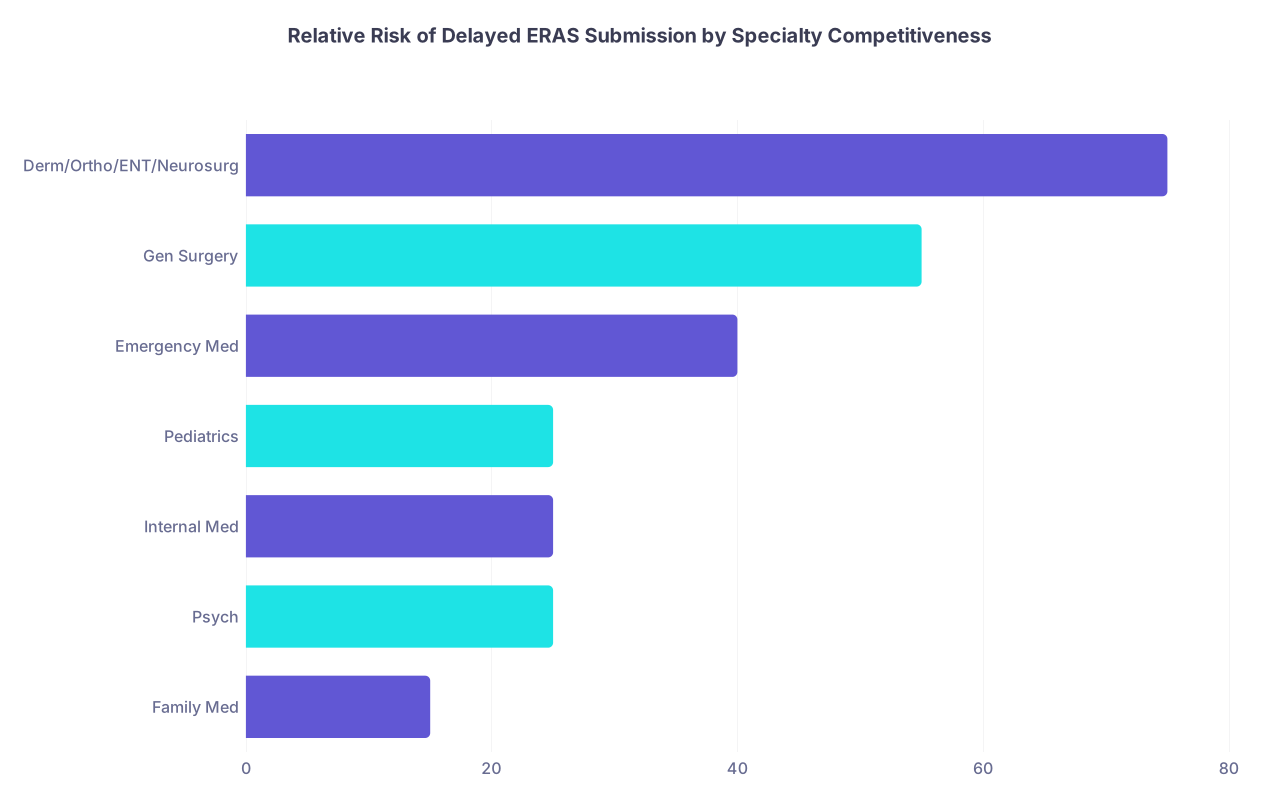
| Category | Value |
|---|---|
| Family Med | 15 |
| Psych | 25 |
| Internal Med | 25 |
| Pediatrics | 25 |
| Emergency Med | 40 |
| Gen Surgery | 55 |
| Derm/Ortho/ENT/Neurosurg | 75 |
Interpretation: the more competitive the specialty, the more delay hurts you if everything else is equal. But if delay lets you transform a weak app into a solid one, that tradeoff can be worth it.
3. Prioritize what must be strong before you hit “submit”
When you’re behind from illness, you don’t have the luxury of improving everything. You need to pick what actually moves the needle.
For ERAS, the big levers:
- Step 2 CK score and availability
- Specialty-specific letters of recommendation
- Evidence you understand the specialty (sub-I, audition, relevant elective)
- A coherent story that includes your illness, without sounding unstable
Step 2 CK: delay ERAS or not?
Use this rule of thumb:
- If you’re in a moderately or highly competitive specialty (EM, anesthesia, rads, surgery, certain IM fellow-track programs) AND:
- Your Step 1 is pass/fail or low, or
- You had a long illness gap that might spook them
…then a strong Step 2 score becomes your lifeline.
If your Step 2 date is:
- Before mid-September with score back by Oct 1-ish → do whatever it takes to keep that date. You can still be “on time.”
- Late September / early October with score mid/late October → you’re on the bubble. You need to decide if submitting early without a score helps or hurts you.
- After mid-October → practically speaking, you’re a “late” applicant for some specialties unless you’re applying more broadly to less competitive fields.
If you expect a clearly better-than-average Step 2, it can absolutely be worth letting programs see that score—even if it means you’re not technically “day one.”
If you expect mediocre or marginally improved Step 2, you gain less from delaying. In that situation, getting your file in earlier (with other strengths) may be smarter.
Letters of Recommendation: when is it worth waiting?
Programs don’t just want any letters. They want the right letters:
- At least one (ideally two) in your specialty
- From people who actually saw you work recently
- Where possible, at least one from someone with a recognizable title (PD, APD, division chief)
If your illness pushed your only real specialty rotation to:
- September → You can still usually get a letter uploaded early/mid-October. That’s fine.
- October → Now you’re in tradeoff territory. A stellar late October letter might still be better than 3 mediocre non-specialty letters on September 15.
- November or later → You’re probably dealing with an off-cycle strategy (more on that below).
4. Adjusting your ERAS timeline: specific scenarios and what to do
Let me walk through the common messes I see after illness, and what I’d actually do in each.
Scenario A: You’re applying Internal Medicine, sub-I moved to October
Facts:
- Step 2: taken in August, score back in September (solid).
- One generic IM letter from 3rd-year ward attending.
- Your strongest potential IM letter will come from an October sub-I.
What I’d do:
- Submit ERAS around MSPE release with what you have:
- Personal statement done.
- CV polished.
- At least two letters loaded (one generic IM, one from another core).
- Email key programs (especially your home and top choices) early October:
- Let them know you’re on an IM sub-I.
- Ask your sub-I attending/PD to prioritize your letter by mid-late October.
- Add that October letter as soon as it hits ERAS:
- Programs often continue reviewing and sending invites through November/December.
- Have your dean’s letter/School MSPE explicitly explain your illness and schedule shift:
- “Student X missed six weeks due to medically documented illness; performance has been consistently strong before and after recovery.”
IM is relatively forgiving. A high-quality October letter + on-time application is usually better than one perfect but late November application.
Scenario B: You’re applying EM, Step 2 is late, and you lost an EM rotation to illness
Facts:
- One EM rotation in September with SLOE potential.
- Step 2 CK scheduled mid/late September.
- Your second EM rotation got canceled or moved to late in the year.
Emergency Medicine is more timing-sensitive and SLOE-heavy.
What I’d do:
- Do NOT wait for some hypothetical second EM rotation if it’s post-ERAS peak season.
- Make it your life’s mission to:
- Crush that September EM rotation.
- Get a strong SLOE turned in ASAP (many EM places are used to this rhythm).
- Submit ERAS as complete as possible by Oct 1:
- Include your first SLOE.
- Step 2 will follow—but by then, programs may have already pre-screened you based on SLOE + Step 1 + MSPE.
- Contact your home EM and advisor directly:
- Ask bluntly: “With my delayed Step 2 and this single SLOE, should I apply this cycle or seriously consider delaying a year?”
- In EM, a weak or incomplete SLOE package is sometimes worse than waiting a year and re-entering with a strong one.
Scenario C: You switched specialties after illness (e.g., from surgery to psych)
Facts:
- You were on a surgery-heavy track, then illness hit.
- During or after that, you realized you don’t want surgery at all.
- You have psych interest but almost no psych rotations or letters.
- Your first psych elective is October or November.
This is where forcing this cycle can wreck you.
What I’d strongly consider:
- If your psych elective is October and you can get:
- One great psych letter in October/early November.
- A personal statement that explains your story and fit.
- Solid Step scores.
You might manage a late, targeted cycle if you:
- Apply mostly to less competitive psych programs.
- Use your dean and psych clerkship director to advocate for you.
- Accept you may get fewer interviews and rank fewer programs.
But if your psych elective is November or later, and you have zero psych letters by late October?
I’d seriously think about:
- Pushing your psych-heavy rotations earlier next year.
- Taking a “gap year” or delayed graduation if your school allows.
- Building a strong psych portfolio (rotations, maybe research or relevant work).
- Entering the match the following cycle.
Is that fun? No. But matching into the wrong specialty or washing out of the match altogether is worse.
5. Illness disclosure: how and where to explain the gap
Stopping rotations for illness is not a character flaw. But if you leave a mysterious 6–10 week gap with no explanation, programs will invent their own stories. Those stories are rarely kind.
You want:
- Brief.
- Clear.
- Fact-based.
- Reassuring.
Places to address it:
- Dean’s letter / MSPE – ideal place for the “official” explanation.
- ERAS experiences or Additional Information section – a short note if needed.
- Personal statement – only if your illness genuinely shaped your perspective, not just as damage control.
Sample language (tweak as needed):
During my third year, I experienced a significant medical illness that required a six-week leave from clinical rotations. This was fully treated, I’ve been medically cleared without restrictions, and I returned to complete all core requirements. The experience reinforced my commitment to patient care and has not limited my ability to meet the demands of residency.
Notice what this does:
- Names the issue (medical illness, defined interval).
- Signals resolution (treated, cleared, no restrictions).
- Avoids oversharing details.
- Reassures them about stamina and reliability.
Do not:
- Write a three-paragraph saga about your hospitalization.
- Rage at the system or your insurance.
- Sound like your health is still precarious if it’s not.
If your illness is chronic and still active, talk to your school’s disability office and a trusted attending or PD about how to frame that honestly while emphasizing how you’re functioning successfully now.
6. Talk to the three people who can actually help you
If you were sick and fell behind, you should not be making this ERAS strategy alone.
You need three conversations, ideally this week:
Your school’s designated advisor / dean / career office
- Ask direct questions:
- “How have other students here done when they applied with delayed rotations?”
- “Would you recommend I apply this year or delay?”
- “Will you explicitly mention and contextualize my illness in my MSPE?”
- Ask direct questions:
A faculty mentor in your chosen specialty
- Not just any attending. Someone who knows the match in that field.
- Ask:
- “If I apply with one specialty letter and a late rotation, how will programs at your level see that?”
- “Realistically, how many programs should I apply to in my situation?”
- “If I waited a year and did X, Y, Z, how much would that change my competitiveness?”
-
- Before your sub-I or elective starts, tell them:
- You’re behind from illness.
- You’re depending on this rotation for a critical letter.
- Ask if they’re comfortable writing a letter on a tight turnaround if you perform well.
- Before your sub-I or elective starts, tell them:
I’ve seen students transform their odds simply because they had one PD who picked up the phone and personally vouched for them to a few programs. You don’t get that without asking.
7. When it’s smarter to delay your entire ERAS cycle
No one wants to hear this, but sometimes the safest way to “adjust your ERAS timeline” is to move it an entire year.
You should strongly consider delaying a cycle if:
- Your key specialty rotations are November–February and:
- You have zero recent letters in your chosen specialty.
- You cannot get those moved up.
- Your Step 2 CK is not yet taken, and:
- You’re still recovering physically or cognitively.
- A rushed exam is likely to produce a weak score that will follow you forever.
- Your health is not stable yet:
- You’re still in and out of appointments, inpatient stays, or rehab.
- You would not safely tolerate a residency schedule this year.
What a delay can buy you:
- Strong specialty letters from 2–3 rotations.
- A Step 2 score that actually reflects your ability.
- Time to do a research block, teaching year, or chief-like role.
- A compelling, calm story instead of a frantic scramble.
| Situation | Apply This Year | Delay A Year |
|---|---|---|
| Step 2 done, solid score | ✅ | |
| At least 1–2 specialty letters by Oct | ✅ | |
| Key specialty rotations in Sept–Oct | ✅ | |
| No specialty letters until Nov–Dec | ✅ | |
| Health still unstable / frequent care | ✅ |
8. Concrete steps you can take this week
To make this less theoretical, here’s what I’d tell you to do in the next 7 days if you’re behind from illness.
Map your actual calendar:
- Write out every rotation from now through February.
- Mark which ones are in your chosen specialty.
- Mark when realistic letters could be written and uploaded.
Decide your Step 2 strategy:
- Confirm your date.
- Decide: take as scheduled, push later (with consequences), or accelerate studying to ensure it’s a strength.
Draft your “illness explanation” blurb:
- 3–5 sentences.
- Show it to your advisor for feedback.
Schedule meetings with your dean/advisor and at least one specialty mentor:
- Bring your rotation map and a list of programs/regions you’re considering.
Outline a Plan A and Plan B:
- Plan A: Apply this year → list target submission week, letters expected, number of programs.
- Plan B: Delay a year → list what you’ll do with that year to improve (extra rotations, research, teaching, etc.).
Email or talk to your upcoming attendings:
- Let them know you’re counting on a timely letter.
- Ask if that’s feasible if you do well.
This way, you’re not “hoping it works out.” You’re making an informed, deliberate decision about your ERAS timing.
9. How illness actually looks from the PD side
I’ve sat in discussions where PDs looked at a file with a medical leave and said, almost verbatim: “If they’ve recovered and their recent performance is strong, I don’t care that they got sick.”
What does worry them?
- Unexplained long gaps.
- Messy, inconsistent performance after the illness.
- Signs that the student still can’t handle full-time clinical work.
- Vague or evasive mention of “personal issues” with no clear resolution.
On the flip side, what reassures them:
- Strong recent clerkship and sub-I evaluations.
- A Step 2 score that doesn’t look like you’re barely hanging on.
- Letters that explicitly say, “X is ready for residency and performed at the level of our interns.”
Your job now is to engineer your application so it screams: “Yes, I got sick. I recovered fully. Here’s the proof.”
FAQ (exactly 4 questions)
1. If I submit ERAS “incomplete” (e.g., without Step 2 or a key letter), can programs still review me?
Yes. Programs can review your application with whatever is there at the time. Some will pre-screen without Step 2 if Step 1 is strong or P/F and the rest looks good. But many programs set auto-filters that require a Step 2 score or a minimum number of letters, so you can get auto-sorted into a lower-priority pile. That’s why you should decide strategically if an earlier but partial application is better than a slightly later but clearly stronger one.
2. How late is “too late” to apply in the same cycle if I was delayed by illness?
For most non-ultra-competitive specialties, applying by late October with a reasonably complete application can still yield interviews, especially from community and mid-tier academic programs. By mid-November, your chances drop quickly unless you have strong connections, are in a less competitive field, or your school/mentors are advocating directly. Past November, most people who haven’t already applied are better off planning for the following cycle.
3. Will taking an official leave of absence for illness permanently hurt my residency chances?
Not automatically. What matters more is how transparently it’s explained and what your performance looks like afterward. A clearly documented, time-limited medical leave with full recovery and strong clinical work after is usually acceptable. Where people get into trouble is with multiple unexplained leaves, ongoing instability, or persistent academic problems after coming back. Get your dean and mentors to frame your leave clearly and emphasize your successful return.
4. Should I apply with my original specialty and a “backup” because I lost time to illness?
Only if you can produce a minimally credible application in both fields—meaning at least one letter and some actual exposure in each. A half-baked backup can look desperate and confuse PDs. If your illness made your original specialty realistically out of reach this year (for example, surgery with no late sub-I and weak metrics), it’s usually better to either commit fully to a backup you can stand behind or delay a year to apply properly in your primary choice. Straddling both poorly is how people end up unmatched.
Open your calendar right now and map your remaining rotations, Step 2 date, and possible letter timelines on a single page—then decide whether you’re building a stronger “apply this year” plan or a deliberate “delay one year” plan, instead of drifting into the deadline.