The preferred ERAS window is not a suggestion. It is the game. If you missed it, you are playing from behind—especially in competitive specialties. But late does not automatically mean dead. It means you need a salvage plan that is ruthless, specialty-specific, and honest.
This is that plan.
I am going to walk you through, specialty tier by specialty tier, what to do if you are submitting after the preferred ERAS submission window (or you already did and are now staring at silence).
We will break specialties into:
- Tier 1: Ultra-competitive
- Tier 2: Competitive but realistic
- Tier 3: Less competitive / more forgiving
- Tier 4: Safety / true backup options
And for each: what you can still fix this cycle, what is likely already gone, and when you should pull the ripcord and pivot to a new strategy.
Step 1: Face the Calendar and the Reality
You cannot salvage anything until you define “late.”
For ERAS, the critical bottleneck is interview invitations, not the Match date. Programs front-load screens and invites early. If you are outside that window, you must assume you are competing for the last 10–30% of interview slots.
Typical rough pattern for many specialties (NRMP + anecdotal program reports):
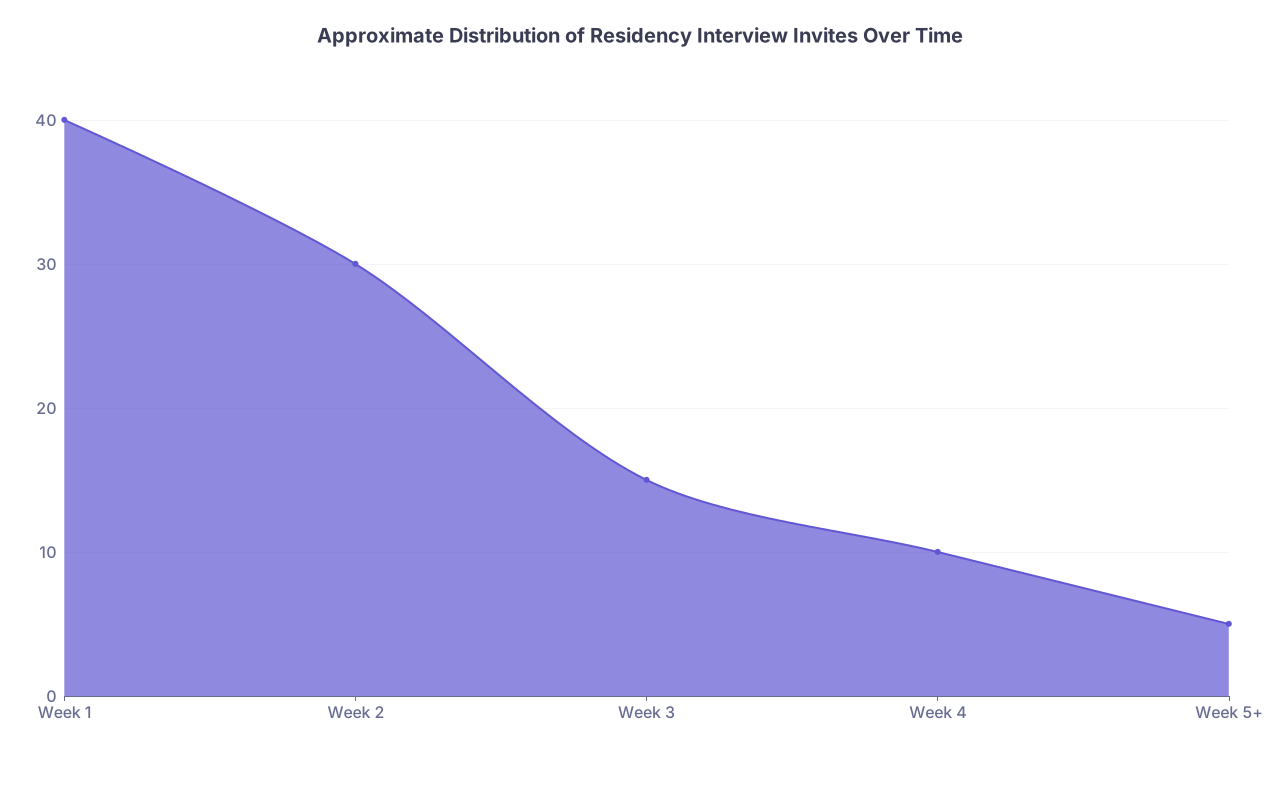
| Category | Value |
|---|---|
| Week 1 | 40 |
| Week 2 | 30 |
| Week 3 | 15 |
| Week 4 | 10 |
| Week 5+ | 5 |
- On opening day / within first week: You are in the main wave.
- 2–3 weeks later: You are late but still in the game.
- 4+ weeks later: You are scraping leftover capacity and cancellations.
So first: identify your category.
- Look at:
- ERAS open and first-transmission date for this year.
- The day your application became complete (LORs + CS forms + transcript + scores).
- Put yourself into one of three timing buckets:
- Slightly late: complete within 1–2 weeks of first release
- Moderately late: 3–4 weeks after release
- Very late: >4 weeks after release
Your salvage strategy changes dramatically based on that.
Step 2: Know Your Specialty Tier
Not all lateness is equally lethal. A late application in Family Medicine is annoying. A late application in Plastic Surgery is basically a different sport.
Here is a simple, useful breakdown:
| Tier | Examples | General Competitiveness |
|---|---|---|
| 1 | Derm, Plastics, Ortho, ENT, Neurosurgery, Rad Onc, Integrated Vascular, IR | Ultra-competitive |
| 2 | EM, Anesthesia, Gen Surg, OB/GYN, Urology, Radiology, Ophtho | Competitive |
| 3 | IM (categorical), Peds, Psych, Neuro | Moderate / forgiving |
| 4 | FM, IM prelim/transitional, community prelim surgery | Most forgiving |
We will walk tier-by-tier, but before that, there are a few universal moves.
Step 3: Universal Salvage Moves (Regardless of Specialty)
These are the non-negotiables if you are late.
3.1 Fix “Complete” Before Fixing “More”
If you are late and also incomplete, you are handing programs a reason to ignore you.
Your priority list today:
USMLE/COMLEX scores uploaded
- Step/Level 2 CK/CE must be in if Step 1 is Pass-only and your specialty cares about numbers.
- If your Step 2 score is pending and your Step 1 is weak or marginal for your specialty, email PDs telling them the expected release date and that you will update.
-
- You need 3 strong LORs uploaded (4 is ideal for some surgical fields).
- Stop waiting for the “perfect” letter from a slow attending if it means incomplete status. Use your best 3 now, add the late one as a bonus when it arrives.
Personal statement and program signaling
- One solid primary statement per specialty.
- If you have signals (tokens, preference signaling), use them intelligently right now. Do not sit on them.
3.2 Aggressive but Targeted Emailing
If you are late, you must communicate. Silent late applicants are bottom of the pile.
You are going to:
- Email program coordinators and PDs for:
- Home program
- Any place you rotated
- Geographic ties
- Programs you signal or heavily want
Keep it short and surgical:
- Who you are
- Your connection to them (rotation / region / mentor / shared institution)
- That your application is now complete and you remain highly interested
- One line highlighting something that makes you “worth the risk” (strong Step 2, home student, prior research with their faculty, etc.)
Do not send a 6-paragraph manifesto. Nobody has the time.
3.3 Expand Your Program List—Strategically
If you are late, your number of applications has to compensate.
Rough rule of thumb:
- If you were planning 40 applications and are now moderately late in a competitive field → go to 60–70.
- If you are very late in a Tier 1 specialty and were planning 60 → you are now basically doing a dual-application strategy (more on that later) and may need 80–100+ including backups.
Use filters:
- Community vs university
- Newer programs
- Programs in less popular regions (Midwest, rural South, etc.)
- Lower-known university affiliates
This is how people salvage a Match when they are not first in line.
Tier 1: Ultra-Competitive Specialties – Harsh but Honest Strategy
Derm, Plastics, Ortho, ENT, Neurosurgery, Rad Onc, Integrated Vascular, IR.
If you are very late for Tier 1 and you have no elite metrics or home support, you are not “salvaging” so much as “buying a lottery ticket.” I have seen people match from behind here—but they had one or more of:
- A home program relentlessly advocating
- 250+ Step 2 scores and a stack of publications
- Significant research years with household names
- Prior strong audition rotations with LORs from big names
If You Are Slightly Late (1–2 Weeks)
You can still act like this is a normal year—just with less margin for error.
Your action list, now:
Double down on home and away programs
- Email your home PD. Not a generic note. Explicitly acknowledge your slightly delayed completion if it was avoidable (“My final letter just came in and my application is now complete. I remain highly committed to training here…”).
- Contact any attendings you rotated with and ask (politely) if they would be willing to reach out to programs you are strongly interested in.
Optimize your signals / preference
- Every signal must go to a program where:
- You have at least some realistic chance (do not waste on the #1 national name if your numbers are average).
- You have a tie, rotation, mentoring connection, or strong alignment in research/topic.
- Every signal must go to a program where:
Tighten your materials
- Tier 1 PDs are allergic to fluff. Your CV, statement, and experiences must scream:
- Technical interest in the field
- Evidence of commitment (research, electives, relevant QI)
- Team fit (sports, leadership, operating room exposure, etc.)
- Tier 1 PDs are allergic to fluff. Your CV, statement, and experiences must scream:
Apply intelligently wide
- You should already be at the higher end of application counts. If you are slightly late, bump your planned number by 10–20%.
If You Are Moderately or Very Late (3+ Weeks)
You need two plans running simultaneously:
- Plan A: Still try for your dream specialty.
- Plan B: Actively build a parallel route that leads back to that specialty later—or gives you a satisfying career if you do not reapply.
That usually means:
- Dual applying into a Tier 3/Tier 4 specialty (IM, prelim IM, FM, TY, etc.), or
- Planning intentionally for a research year + reapplication if that is realistic for you.
Concrete steps:
Have the “reality” meeting
- Meet with:
- Your specialty advisor
- A PD in your home department
- A dean or advisor who actually knows the Match and is willing to be blunt
- Ask directly: “Given my timing and numbers, what are my realistic odds this year if I apply only to [Derm/Ortho/etc.]?”
- Meet with:
Decide: Dual apply or go all-in and accept likely SOAP/reapply
- If your board scores and CV are average for that field and you are very late, I recommend dual applying.
- If you have standout metrics and strong letters, you may still bet on a focused single-specialty application—but you are intentionally accepting higher risk.
Email like your chances depend on it (they do)
- You cannot just hit “submit” late in Derm or Ortho and wait.
- You draft a tight template and customize 2–3 lines for each program (connection, interest, or fit).
- You lean hard on home mentors to email PDs on your behalf.
Prepare your plan for a non-match
- Have your research mentors, prelim/TY programs, or IM/FM programs teed up early.
- Identify SOAP-safe programs now.
- Treat this like an expected scenario, not a surprise.
Tier 2: Competitive Specialties – Salvageable With Smart Changes
EM, Anesthesia, Gen Surg, OB/GYN, Urology, Radiology, Ophtho.
Late here hurts, but it is not necessarily fatal if you:
- Expand your list
- Get loud (professionally)
- Accept some geographic and program-type compromises
If You Are Slightly Late
Your path:
Increase your volume by 20–30%
- If you planned on:
- 35 EM → go to ~45–50
- 30 Anesthesia → go to ~40
- 25 Gen Surg → go to ~35–40
- If you planned on:
Prioritize mid-tier academic and strong community programs
- The top 10–20 national name-brand programs in any of these fields fill early from on-time, high-stat applicants and aways.
- Your best late-game wins are:
- Mid-level university-affiliated
- Solid community programs, especially outside coastal hotspots
Targeted messaging
- For EM, Anesthesia, Surgery, OB: programs value fit and team mentality.
- Use email + statements to emphasize:
- Prior rotations in similar environments
- Comfort with volume and acuity
- Professionalism, reliability, and coachability (programs care about this more than you think)
If You Are Moderately or Very Late
You are not out, but your margin is thin.
Immediate triage of your list
- Sort your programs into:
- Must-have geographic / life priority
- Realistic academic / community mix
- Long-shot “reach”
- Start by securing enough “realistic” programs, then add reach if you have budget.
- Sort your programs into:
Serious conversation about dual application
- Examples:
- Late OB/GYN → consider adding some IM, FM, or TY programs.
- Late Gen Surg → add more prelim surgery, TY, or IM prelim spots.
- Late EM (in the current shaky EM market) → consider Anesthesia, IM, or FM as parallel options if your risk tolerance is low.
- Examples:
Maximize any late-available rotations or shadowing
- I have seen people pick up October/November home sub-I’s or ED shifts, impress an attending, squeeze out a strong letter, and have that attending email PDs in November.
- Late letters still help. Programs are reading applications all season.
Proactive communication when you see silence
- If a program you really like has not responded by the time invite season is clearly underway, send a short interest email:
- Remind them of your tie or specific reason for interest.
- Brief mention of any updates (new score, new abstract, new leadership role).
- If a program you really like has not responded by the time invite season is clearly underway, send a short interest email:
Tier 3: IM, Peds, Psych, Neuro – Where Lateness Is Annoying, Not Catastrophic
Internal Medicine (categorical), Pediatrics, Psychiatry, Neurology.
Here, your profile matters more than your exact day of submission—as long as you are not nonstop months late.
Programs in these fields routinely send interview invitations well into the fall. Many are still looking at new applications in November and even early December.
Slightly or Moderately Late
You still have a very normal path ahead.
Your move set:
Make your application very clean
- Board scores, clerkship grades, and professionalism comments are front and center.
- Red flags matter more than timing here.
- Fix typos, ensure all experiences are described clearly, and make your personal statement tight and specific to the specialty.
Apply to a sufficient range of programs
- If your stats are average:
- IM: 30–40 programs minimum, more if you are regionally constrained
- Peds: 25–35
- Psych: 30–40
- Neuro: 25–35
- If your scores or transcript are weak or you are late → add 10–15 more.
- If your stats are average:
Geographic flexibility wins
- Some regions are over-applied (West Coast, major coastal metros).
- If you are late and picky, expect pain.
- If you are late but flexible (Midwest, South, less dense cities), you can still have a strong interview season.
Email strategically, not desperately
- Home programs, places where you have rotations, and geographic ties still matter.
- But you do not need to cold-email 80 PDs. That comes across as noise.
Very Late (4+ Weeks)
Now you are in delayed-review territory, but not in a disaster zone.
Your priorities:
Apply broadly now, not later
- Do not trickle in applications over weeks. Submit fully and aggressively when you are ready.
- Programs sometimes batch-review new applicants; you want to be in the first “late batch,” not the last.
Prepare to respond fast
- Late applicants cannot afford to miss or delay scheduling interview offers.
- Check email constantly. Use a dedicated folder and alerts.
- Have a system to track invites and quickly decide which to accept.
Exploit updates
- Late Step 2 improvement
- New publications
- New leadership roles or awards
- These can be sent as update letters to a carefully chosen subset of programs (not all 60).
Tier 4: FM, TY, IM Prelim, Community Prelim Surgery – True Salvage Options
If you are truly late or you decide your primary specialty attempt is sliding off the rails, these programs become your “guarantee a contract” lifeline.
Many of these programs:
- Review applications later
- Have more spots
- Are more flexible on timing and some academic metrics
Late Primary Application + Parallel Safety Strategy
If you are late to a more competitive field, your backup strategy often involves:
- Family Medicine (broad, high-need, lots of programs)
- Transitional Year (for people wanting a provisional year before reapplying)
- IM prelim (1-year internal medicine)
- Community prelim surgery (for people chasing surgery long-term)
Here is how to use them properly, not lazily.
Decide your real goal
- Do you want:
- A full career in FM / Psych / etc. if you do not reapply?
- A 1-year foothold (TY / prelim) while regrouping and strengthening your portfolio?
Your answer changes which backup programs make sense.
- Do you want:
Apply to a meaningful backup set
- “Token” backup applications (e.g., 4 TYs) are functionally useless.
- If you are serious:
- FM: 15–25 programs as a parallel track
- TY: 15–20 (more if you are limited geographically)
- IM prelim: 15–25, depending on flexibility
Be honest but smart in your personal statement
- For TY / prelim: it is acceptable to say you are interested in [Derm/Surg/etc.] but are seeking broad clinical training and strong foundation.
- Do not bash your primary specialty or sound like you are using them as a consolation prize. Programs want residents who are present and engaged.
Contact these programs early
- If you are late in your primary specialty but early enough in your backup field, you may actually look like a normal applicant to them.
- Use that. You are not “late” everywhere simultaneously unless you choose to be.
Timeline Reality Check: When To Stop Waiting and Start Pivoting
You cannot salvage anything if you stay in denial until February.
Here is a rough reality line I use with students:
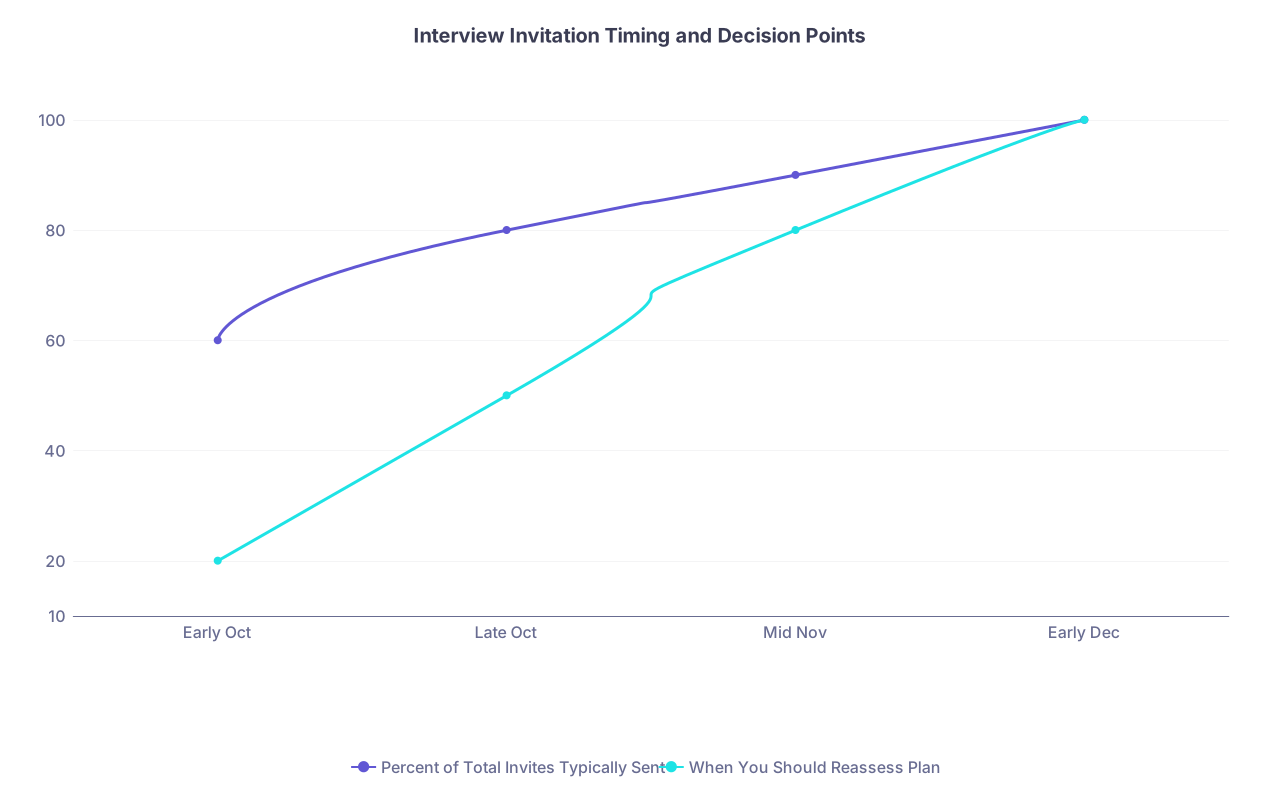
| Category | Percent of Total Invites Typically Sent | When You Should Reassess Plan |
|---|---|---|
| Early Oct | 60 | 20 |
| Late Oct | 80 | 50 |
| Mid Nov | 90 | 80 |
| Early Dec | 100 | 100 |
Use this:
By late October:
- If you have zero interviews in a competitive specialty and only a handful of applications → expand now.
- If you already applied broadly and still have nothing → you are in trouble. Start backup conversations.
By mid-November:
- Fewer than:
- 3–4 interviews in Tier 1
- 4–5 in Tier 2
- 5–6 in Tier 3
- → you should be actively planning for SOAP or a structured reapplication year.
- Fewer than:
By early December:
- Do not assume “more invitations are coming later.”
- Late invites happen, but they are not a strategy.
- Use December and January to:
- Identify research positions
- Build a PGY-1 backup plan
- Prepare strong SOAP materials
How To Communicate About Being Late (Without Sounding Like a Mess)
You do not lead with an apology for timing. You lead with value and then add context only if needed.
Sample Email Template You Can Adapt
Subject: MS4 Applicant – [Your Name] – Interest in [Program Name]
Dr. [PD Last Name] / [Program Coordinator Name],
My name is [Name], an MS4 at [School]. I recently completed my ERAS application to [Specialty] and have applied to [Program Name]. I am very interested in your program because [1–2 specific reasons: prior rotation in your region, particular patient population, curriculum feature, or research focus].
My application became complete slightly later in the season than I intended due to [new Step 2 score / final letter / late transcript], but it is now fully available for review. I have [brief highlight: strong Step 2, X publications in Y, leadership role, etc.] and would be grateful for consideration for an interview.
Thank you very much for your time.
Sincerely,
[Name], [School], AAMC ID: [ID]
Do not over-explain. Do not write an essay about how busy you were. Programs care that you are now complete and serious, not about the drama.
Specialty-Tier Salvage Examples (Concrete Scenarios)
Let me walk through a few real-world styled scenarios and how I would fix them.

Scenario 1: Late Ortho Applicant
- Tier: 1 – Ultra-competitive
- Timing: Application complete 3.5 weeks after release
- Stats: Step 2: 246, multiple ortho research projects, no away rotations due to personal circumstances, no home ortho program
Salvage steps:
- Still apply in Ortho, but dual apply to IM prelim and TY.
- Maximize ortho applications (80+), focusing on:
- Community-heavy ortho programs
- Newer residencies
- Regions with lower applicant density
- Have research mentors email PDs of 5–10 realistic ortho programs.
- Build strong IM prelim and TY applications with honest statements:
- Interested in MSK, procedural medicine, and possibly reapplying to Orthopedics after a solid PGY-1 year.
- Plan early for:
- SOAP if unmatched
- Ortho research year positions
This is not ideal. But it is a rational salvage.
Scenario 2: Late Internal Medicine Applicant
- Tier: 3 – Moderate
- Timing: Application complete 4 weeks late due to delayed Step 2
- Stats: Step 1: Pass, Step 2: 231, average clinical grades, no major red flags
Salvage steps:
- Apply to 45–55 IM programs with a mix of:
- Community
- University-affiliated non-elite
- Geographic flexibility (especially Midwest/South)
- Email:
- Home IM program
- Programs in cities where you have family ties
- Clean, specific personal statement showing:
- Long-term interest in IM
- Some subspecialty or academic curiosity, but not obsessively fellowship-focused in a way that sounds unrealistic
- Be extremely responsive to interview invites.
- If by mid-November interviews are <5, then:
- Add 10–15 additional community IM or FM programs.
- Talk explicitly with advisors about SOAP safety.
This person often still matches solidly, even with late completion.
Scenario 3: Slightly Late OB/GYN Applicant with Average Scores
- Tier: 2 – Competitive
- Timing: 1.5 weeks late (waiting on one LOR)
- Stats: Step 2: 232, no research, good clinical comments, one strong OB away rotation
Salvage steps:
- Submit now with 3 letters, add the 4th later instead of waiting anymore.
- Expand applications from 30 → 45–50 programs, focusing on:
- Community and community-university hybrid programs
- Less saturated regions
- Ask away-rotation attending to email 3–5 programs where they know faculty personally.
- Draft a backup plan if interviews look weak by November:
- Add 10–15 FM or IM programs if necessary, depending on risk tolerance.
When Skipping This Cycle Is Actually the Smart Salvage
Sometimes the least stupid move is not “panic and blast more late applications.” It is: pause, rebuild, and come back with a first-wave, high-power application next year.
You should seriously consider not applying or withdrawing from this cycle if:
- You are very late to a Tier 1 specialty
- Your metrics are already marginal for that field
- You have no strong home or mentor support advocating for you
- You can realistically improve your application dramatically in 1 year with:
- Research
- Higher Step 2 / new exam scores (for COMLEX, etc.)
- Additional degrees or projects
- Stronger LORs from dedicated time in the field
In that case, a research year, prelim/TY year, or structured clinical year can be a better salvage than gambling this cycle and walking into SOAP without a plan.

| Step | Description |
|---|---|
| Step 1 | Late ERAS Applicant |
| Step 2 | Apply Broadly, Likely OK |
| Step 3 | Strong Metrics & Support? |
| Step 4 | Plan Research/PGY-1 + Reapply |
| Step 5 | Apply + Dual Apply Backup |
| Step 6 | Stay Course, Minor Expansion |
| Step 7 | Add Backup Specialty + More Programs |
| Step 8 | Specialty Tier |
| Step 9 | Very Late? |
| Step 10 | Interviews by Nov? |
A Word About SOAP (If Things Really Go Sideways)
SOAP is not a plan. SOAP is a safety net. But if you are late and your cycle is thin, you must treat it as part of the strategy.
Prepare now:
- Have a SOAP-ready personal statement for IM / FM / TY.
- Know which “SOAP-safe” programs historically go unfilled in your regions of interest.
- Clarify with your dean’s office what support they provide during SOAP week.
Do not wait until Match Week to learn how SOAP works. That is how you end up in a place or position that does not fit you at all.

What Actually Matters Most If You Are Late
Not magical wording in an email. Not a perfectly poetic personal statement.
What matters:
- How broad and realistic your program list is.
- How effectively you use mentors to advocate for you.
- How ruthlessly honest you are with yourself about your odds in your chosen tier.
You missed the preferred ERAS window. That is done.
What you do next—today, this week, this month—decides whether this is a minor handicap or the moment you start a smarter, longer game.
Key Takeaways
- Lateness hurts most in Tier 1 and least in Tier 4; your salvage strategy must match your specialty’s competitiveness.
- Expand applications intelligently, use mentors to advocate, and communicate concisely with programs; silence and denial are what kill late applicants.
- If your odds this cycle are objectively poor, a planned backup (dual application, research year, or PGY-1 with reapplication) is a smarter “salvage” than blind optimism.