Most physicians doing international mission work are leaving CME credit on the table—and risking bad documentation when audited.
If you’ve done a week in Guatemala, a month in Malawi, or an annual trip to Haiti, and your CME log shows zero credit for it, something’s broken. Not the work. The paperwork.
Let me walk you through how to fix that.
1. First reality check: Mission work doesn’t magically equal CME
You do not get CME credit just because you got on a plane and treated patients for free. That’s harsh, but it’s how most accrediting and licensing bodies think.
They care about:
- Is there a defined educational activity?
- Are there clear learning objectives?
- Is there structured teaching, supervision, or self-directed learning?
- Is there documentation (agenda, certificate, sign-in, reflection, etc.)?
So if your “mission” was: land on Sunday, clinic Monday–Friday, improvise everything, no lectures, no structured debrief, no documentation—then you might get credit, but you’ll have to work for it on the back end and maybe classify it as self-directed learning or quality improvement.
If instead your experience looks like:
- Pre-trip online modules on tropical medicine
- Daily teaching rounds and case-based discussions
- Local grand rounds or in-country teaching sessions
- A post-trip debrief and evaluation
Now you’re on solid ground for CME. The key is to shape your mission work into an “educational activity” before you go.
2. Step 1: Clarify who you actually need CME credit for
Before you start chasing documentation, you need to know whose rules you’re playing by. These are rarely identical.
Typical buckets:
- State medical board (for license renewal)
- Specialty board (ABIM, ABFM, ABEM, ABS, etc. – for MOC/MOL)
- Hospital or health system (credentialing, privileging)
- Employer or group (contractual CME requirements)
- DEA / controlled substance prescriber requirements (for opioid CME, etc.)
Do this today:
- Pull up your last license renewal notice or log in to your state board portal.
- Note:
- Total CME hours required
- Time frame (e.g., every 2 years)
- Required types (Category 1 vs 2, live vs enduring, state-specific topics)
- Do the same for your specialty board.
You’re trying to answer: If my mission trip generates CME, where can I apply it? And: Do they even accept mission-based CME or self-directed learning?
3. Step 2: Understand the basic CME categories you’re working with
If you’re in the US, you’re usually dealing with AMA PRA Category 1 Credit™ and Category 2. Other systems (e.g., EACCME in Europe, RCPSC in Canada) have analogous structures.
Here’s the rough breakdown:
| Credit Type | Typical Use Case |
|---|---|
| AMA Cat 1 (live) | Accredited courses, conferences |
| AMA Cat 1 (enduring) | Online modules, recorded content |
| AMA Cat 2 | Self-study, reading, QI projects |
| MOC Part 2 | Lifelong learning activities |
| MOC Part 4 | Quality improvement projects |
Where mission work usually fits:
- Category 1 if:
- Your mission organization or sponsoring institution has accredited CME for specific activities on the trip (some big ones do).
- Category 2 if:
- You’re doing self-directed reading, guideline reviews, and reflection tied to your mission work.
- MOC Part 4 or QI if:
- You systematically changed a process, implemented a protocol, tracked outcomes, and reflected.
If you assume it’s all Category 1 without backing, you’ll get burned in an audit.
4. Step 3: Before you go — set up the CME framework
This is where most people fail. They go, they work, they come back, then try to reverse-engineer CME.
Do this before your flight:
A. Ask the mission organization the right questions
You want clear answers to:
- “Is any part of this trip accredited for CME? If so, by whom and for how many hours?”
- “Will we receive formal CME certificates or transcripts?”
- “Do you provide an agenda or schedule that outlines educational sessions?”
- “Has your program been accepted for CME by other physicians in the past?”
If they mumble something vague like “I think you can probably count it,” assume they have no formal CME setup.
B. If there’s no formal CME, create your own structure
You can still extract legitimate CME value:
Identify your learning goals:
- “Understand management of severe malaria in resource-limited settings”
- “Improve diagnostic approach to TB in absence of advanced imaging”
- “Learn current WHO guidelines for maternal hemorrhage management”
Plan specific educational activities:
- Pre-trip reading (articles, guidelines, book chapters)
- A short teaching session you’ll give or attend
- Daily debriefs where cases are reviewed in a structured way
- A mini QI project (e.g., implementing a triage algorithm, tracking its use)
Decide how you will document:
- Reading logs
- Notes from teaching sessions
- A simple “mission education journal”

| Step | Description |
|---|---|
| Step 1 | Plan Mission |
| Step 2 | Request CME Details |
| Step 3 | Define Learning Objectives |
| Step 4 | Plan Readings and Teaching |
| Step 5 | Create Documentation Template |
| Step 6 | Formal CME Available |
If you walk into the trip with a blank slate, you’ll walk out with vague memories and weak documentation.
5. Step 4: During the mission — what to document in real time
Here’s the part people skip when they’re exhausted at night. Do it anyway. Ten minutes a day.
You need three types of documentation:
1. Activity log (what happened)
Keep a simple daily log, either in a notebook or a note app:
- Date
- Location
- Educational activity:
- Teaching rounds (topic, duration)
- Case conference or group discussion (topic, key cases)
- Formal lectures or sessions
- Procedures supervised/learned that required significant teaching time
- Time spent (realistic, not inflated)
Example entry:
03/12/26 – Rural clinic, Northern Uganda
07:30–08:15: Teaching rounds with local physician on management of severe pediatric malaria (case-based).
12:30–13:00: Informal but structured review of WHO guidelines for postpartum hemorrhage with team, led by OB/GYN.
Do not try to reconstruct this 2 months later. You will forget specifics and undercut your own credibility.
2. Learning content (what you actually learned)
List key sources and concepts:
- WHO guideline on X
- Local protocol for Y
- Specific technique or workaround for limited-resource setting
This helps you justify that time as “educational” vs pure service.
3. Reflective notes (how your practice will change)
A few lines per impactful day:
- “Will incorporate simplified sepsis screening in my US urgent care shifts.”
- “Plan to reduce unnecessary labs for pedi diarrhea, using clinical criteria we used here.”
Boards and licensing bodies love this “change in practice” language. Use it.
6. Step 5: After you return — converting experience into credit
You’ve flown home, you’re tired, your email’s a disaster. This is the danger zone. You have a 2–4 week window before your memory fades.
Do this while the jet lag is still fresh:
A. Collect all official documents
From the mission or sponsoring institution:
- Any official agendas or schedules
- Certificates of participation
- Letters of involvement or appointment (e.g., “volunteer faculty,” “visiting consultant”)
- Emails confirming your role in teaching or training
If they don’t have a certificate template, ask for a letter on official letterhead that states:
- Your name
- Dates and location of trip
- Role (clinician, teacher, trainer)
- Types of educational activities you participated in (rounds, teaching sessions, etc.)
- Approximate hours of those activities
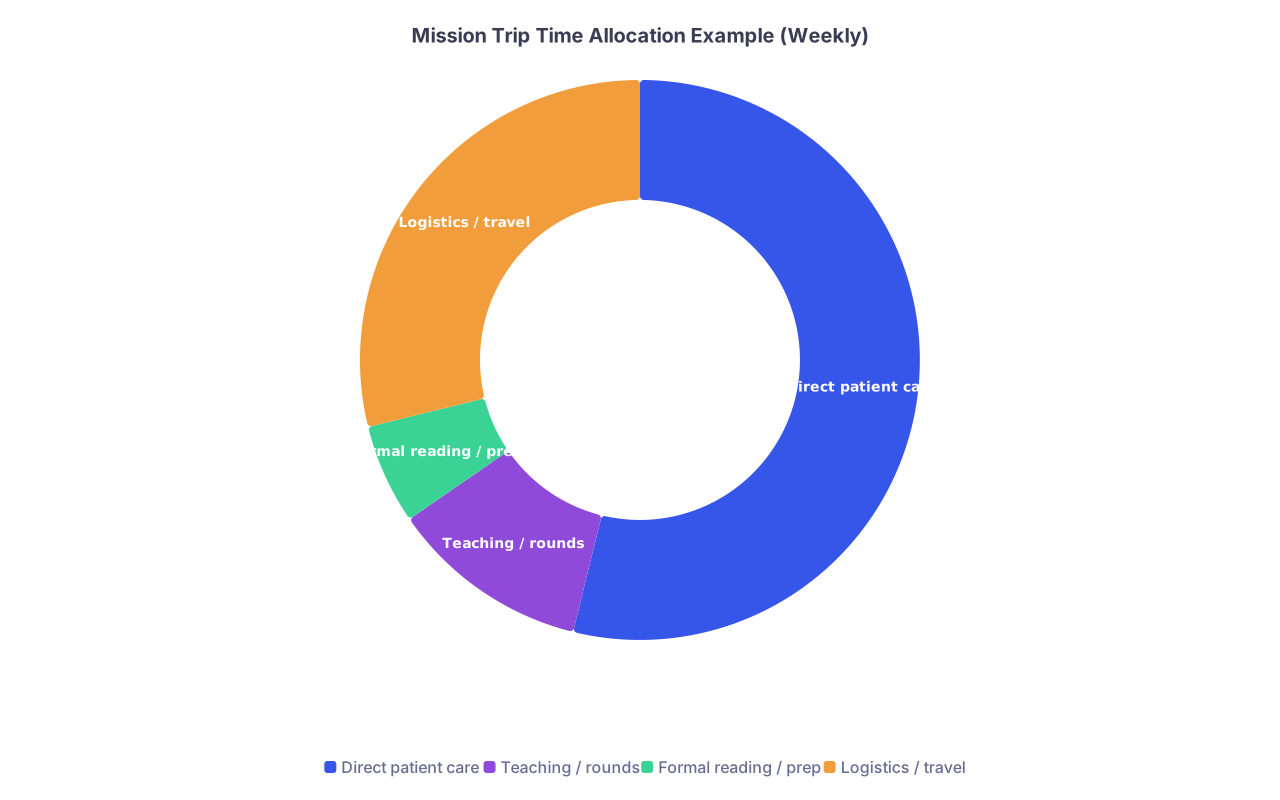
B. Classify your hours
You’re going to sort what you did into buckets.
| Category | Value |
|---|---|
| Direct patient care | 28 |
| Teaching / rounds | 6 |
| Formal reading / prep | 3 |
| Logistics / travel | 15 |
Only some of that is defensible as CME.
Typically:
- Category 1: Only if there was accredited CME. If so, just use the certificate hours.
- Category 2:
- Time spent in structured teaching rounds (where there was explicit teaching, not just work)
- Time spent in formal reading/prep closely tied to the mission work
- Time spent in structured debrief or case review sessions
Be conservative and honest:
- If teaching rounds were 45 minutes but 20 were chaos, log 30 minutes as educational.
- Don’t count “clinic time” as educational unless there was real, deliberate teaching going on.
C. Document in the language boards and auditors understand
When you enter these credits in your CME tracker or state board form, use clear, boring, audit-proof language:
- “Self-directed learning: Review of WHO guidelines on malaria and sepsis in preparation for clinical work in rural Uganda. 4 hours.”
- “Case-based teaching rounds and debrief sessions during international clinical service, focusing on maternal health in low-resource settings. 6 hours Category 2.”
Avoid dramatic mission language. Stick to what you learned and how.
7. Using mission work for MOC and QI credit
This is where international work can be a gem—if you design it right.
A. MOC Part 2 (lifelong learning)
If your board accepts:
- Self-assessment modules
- Structured reading with reflection
- Accredited international courses
You can often fold in:
- A structured reading list with a documented reflection
- Any formal teaching course or workshop done on-site
Check your board’s portal. Many have a “self-directed PIM” or “personal improvement project” option.
B. MOC Part 4 (quality improvement)
If during your mission you did any of these, you’re in business:
- Implemented a new triage system
- Standardized a protocol (e.g., for preeclampsia management)
- Introduced checklists for procedures
- Tracked before-and-after outcomes, even basic (number of delays, medication errors, etc.)
You need:
- Baseline description (“Before intervention, triage was unstructured, average wait time ~3 hours, frequent missed high-acuity cases”)
- Intervention description
- Data (even small samples)
- Reflection (“What changed,” “What did not,” “What I’d do differently”)
Then translate this into your board’s Part 4 application language.
8. Documentation you should keep for at least 6–7 years
If you’re ever audited, you want to be able to pull a simple folder and be done with it.
Digital or physical, keep:
- Mission organization’s letter or certificate
- Trip schedule / agenda
- Your daily education log
- Reading list and any notes
- QI project notes and basic data (if applicable)
- Copies of anything submitted to your board or state for this credit
That’s your defense file. Build it once, reuse the model for every future trip.
9. Common scenarios and what you should do
Let’s hit the real-world versions I’ve seen:
Scenario 1: “I’ve already done three trips and documented nothing.”
You’re not starting from zero, but you can’t fake specifics.
Do this:
- Write a one-page summary per trip:
- Dates, location, approximate role and scope.
- Rough estimate of teaching and reading time (conservative).
- Classify some of that as Category 2 self-learning, but don’t max it out.
- Going forward, tighten your documentation; don’t rely on reconstruction.
Scenario 2: “My mission org says it’s CME but I got no certificate.”
Push back, politely but firmly.
Tell them exactly what you need:
- “I need a letter on letterhead that states my name, the dates, location, my role, and the approximate hours of structured educational activities (teaching rounds, conferences). Our state board and specialty board may ask for it during audit.”
If they hesitate, offer to draft a template for them.
Scenario 3: “My hospital will give me CME funds only for Category 1, not 2.”
Fine. Then your strategy shifts:
- Look for mission organizations partnered with US academic centers that do accredit certain components.
- Add on a pre-trip or post-trip accredited online course in tropical medicine or global health. Use your travel time as the context, not the credit.
- Use mission-related learning as Category 2 for your license/board, and Category 1 from more traditional sources to keep your job happy.
Scenario 4: “I’m in training (resident/fellow). Does this still matter?”
Yes, for two reasons:
- Some programs will give you elective credit or scholarly credit if you structure the experience properly. You’ll need:
- Educational objectives
- Preceptor evaluation
- Defined teaching sessions or project
- You’re building a habit. If you learn to treat mission work like a legitimate educational activity now, your documentation life gets a lot easier as an attending.
10. Quick comparison: mission work vs traditional CME conference
| Feature | Mission Work | CME Conference |
|---|---|---|
| Structure | Variable, often informal | Highly structured |
| Built-in CME credit | Sometimes, often not | Almost always |
| Documentation provided | Depends on org | Certificates, agendas, transcripts |
| Educational depth | High, but context-specific | Broad, topic-based |
| Credit extraction work | High (you do more) | Low (they do more) |
Both are valuable. One just demands more intentional planning on your end.
11. How to talk about mission-based CME to skeptics
If a credentialing committee, auditor, or colleague implies that your mission work is “just charity” and not “real CME,” do not argue philosophy. Argue structure.
Describe it like this:
- “During this two-week period, I participated in daily case-based teaching rounds with local and visiting faculty, reviewed current WHO guidelines for [conditions], and implemented a small process improvement project on [topic]. I documented my learning objectives, activities, and reflections, and have letters from the host institution.”
That sounds like CME. Because it is.
Do not lean on emotion. Lean on educational design and documentation.
12. A basic template you can steal for your next trip
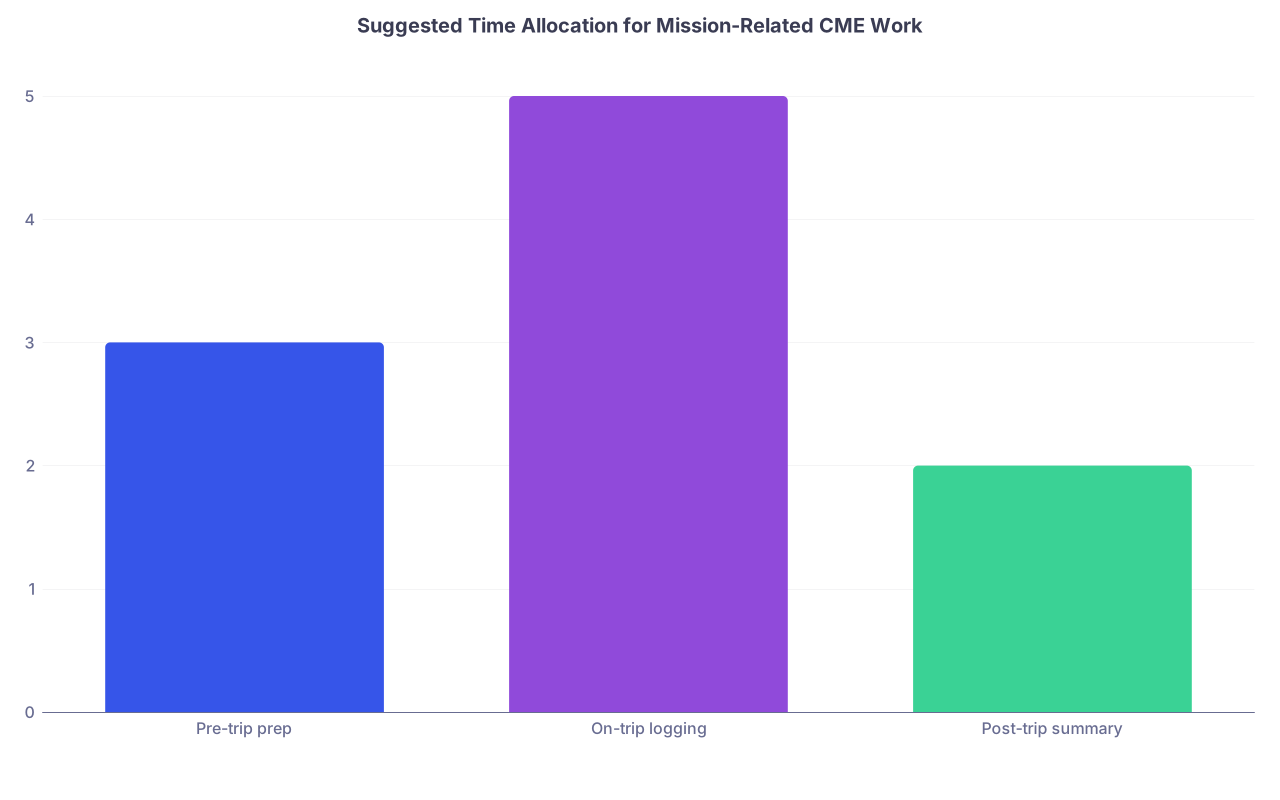
Here’s a barebones structure you can adapt:
Pre-trip (2–4 hours)
- Identify 3–5 learning objectives
- Select 3–5 key readings or guidelines
- Log reading time and main takeaways
During trip (10–15 minutes per day)
- Daily log of:
- Educational activities
- Teaching topics
- Approximate time
- Short reflection on “what I learned” or “what I’d change at home”
- Daily log of:
Post-trip (1–2 hours)
- Summarize key learning points
- Document any planned changes in your practice
- Classify hours into Category 2 / MOC as appropriate
- File all documentation in one place
| Category | Value |
|---|---|
| Pre-trip prep | 3 |
| On-trip logging | 5 |
| Post-trip summary | 2 |
This isn’t heavy. It’s just deliberate.
FAQ (exactly 4 questions)
1. Can I count all my mission trip hours as CME since I’m constantly learning?
No. “I learned a lot” is not a category of CME. You can only reasonably count the hours where there was deliberate, structured learning or reflection—teaching rounds, case conferences, targeted reading—not the entirety of clinic time.
2. What if my mission organization is outside the US and uses a different CME system?
Many licensing boards accept international CME if it’s from a recognized accreditor (e.g., EACCME). Get clear documentation of the accrediting body and hours. If it doesn’t map cleanly to AMA Category 1, you can usually still log it as Category 2 self-education with proper documentation.
3. Will my board or state actually question mission-based CME in an audit?
Sometimes. They’re less suspicious of clearly structured, well-documented activities. If you have a coherent log, letters from the host institution, and conservative hour estimates, you’re on solid ground. What sets off alarms is big, round numbers and vague descriptions like “clinic work, 40 hours CME.”
4. Is it worth the effort to document mission work as CME instead of just using standard courses?
Yes, if you’re doing these trips anyway. You’re already investing time and energy. Turning that into legitimate CME credit:
- Reduces pressure to attend expensive conferences.
- Honors the real learning you’re doing.
- Strengthens your professional narrative around global health.
Open your calendar and identify your next (or most recent) mission trip date. Right now, create a simple one-page “Mission CME Log” for that trip—with sections for objectives, daily activities, and reflections—and commit to filling it out every evening of the trip or retroactively for the last one before you forget the details.