
The usual CME advice is written for people who are not walking zombies from 3 a.m. feeds. Most of it is useless for new parents.
You don’t have a time-management problem. You have a bandwidth problem. So you need a different playbook.
This is that playbook.
Step 1: Get Brutally Clear on the Actual Requirement
Most stressed-out new parents in medicine are guessing about their CME. Or remembering some half-heard thing from orientation. That’s how you end up overdoing it or missing something.
You cannot afford vague here. You are sleep deprived and interrupted every 11 minutes.
Here’s what you verify, in writing (not in your memory):
- Your state medical board requirements
- Your specialty board MOC/CME requirements (if applicable)
- Your hospital/health system requirements (if they track CME separately)
- DEA/controlled substance–specific CME (opioids, pain, etc.) if your state requires it
Do this once, do it properly, and then you stop thinking about it every week.
Go to your:
- State medical board website (look for “continuing education” or “license renewal”)
- ABIM/ABFM/ABOG/etc. site for board-related CME/credits/MOC
- Hospital CME office or staff intranet
Then build yourself a simple cheat sheet. Something like:
| Category | Amount | Cycle Length | Notes |
|---|---|---|---|
| State License CME | 50 hrs | 2 years | 2 hrs opioid training |
| Specialty Board | 100 pts | 5 years | Mix of CME + MOC activities |
| Hospital Requirement | 25 hrs | 1 year | Submitted via internal portal |
| DEA/Opioid Training | 8 hrs | One-time | Accepts specific courses |
Tape that to your wall or save it as “CME Reality Check” in your files.
Now you know:
- Total needed
- Real deadlines
- Any special content (opioids, ethics, child abuse, implicit bias, etc.)
This clarity alone will lower your background stress.
Step 2: Decide Your Strategy for This Season of Life
Newborn at home? You are not “optimizing lifelong learning.” You are surviving the next 6–12 months without losing your license or burning out completely.
So this season’s priorities change:
- Minimum time spent
- Maximum flexibility
- Zero travel unless paid and easy
- Asynchronous > live
- Mobile-friendly > desktop-only
- Short segments > long blocks
You basically want:
- On-demand video/audio CME
- Short modular content (5–20 minutes each)
- Platforms that auto-report credit and store your certificates
If you are in the first 3 months postpartum or adoption, I’d tell you bluntly:
Aim for “bare minimum to stay compliant” and no more. This is not your year to collect 100 extra credits “just in case.”
Step 3: Convert Requirements into a Concrete Plan
You’ve got your numbers. Now you translate them into something your half-asleep brain can handle.
Let’s say:
- You need 50 hours CME every 2 years
- You’re 9 months into your cycle and still need 30 hours
- You just had a baby
Panic says: “No way.” Math says: it’s possible if you structure it.
Here’s the basic formula I use with new parent physicians:
Remaining CME hours / Remaining months = Monthly target
Then, Monthly target / 4 = Weekly bite-size
Example:
- 30 hours left
- 9 months left → ~3.5 hours per month
- 3.5 hours / 4 weeks → ~1 hour/week
One hour a week is not crazy. Even with a newborn. If you break it down.
Now decide where those hours will come from:
- One 60-minute block on a specific day?
- Three 20-minute chunks?
- Fifteen 4-minute micro-lectures across the week?
Match this to your real life, not your fantasy life.
If your baby does a semi-predictable long nap 1–2 times a week, that’s where one chunk goes. If you commute by train, that’s another place. If nights are impossible, do not plan nights. Be honest.
Step 4: Ruthlessly Choose the Right CME Formats
Some CME formats are basically designed to make new parents fail. Multi-day conferences. Long evening grand rounds. Stuff that requires childcare gymnastics and functional adult energy at 7 p.m.
Skip those for now unless:
- Your institution pays for it
- You have guaranteed reliable childcare
- You are using PTO for it and want to get out of the house
- It fulfills a rare requirement (e.g., specific state-mandated course only offered live)
What works best for new parents:
On-demand video CME platforms
These are your core. Think things like:- Specialty-specific boards review platforms that also offer CME
- General CME video libraries with 0.25–1.0 credit per module
- Hospital or system online CME library
Podcast-style audio CME
Great for:- Commutes
- Stroller walks
- Night feeds (if your brain can handle it)
Short written CME (case-based, Q&A, point-of-care)
Good for:- 10 minutes between patient rooms
- Pumping sessions if you’re postpartum and pumping at work
- A couple of extra credits squeezed out of normal reading
Point-of-care CME attached to your existing work
Many systems will let you claim CME for:- Looking up UpToDate/DynaMed
- Completing certain QI projects
- Attending required institutional modules (sometimes CME-approved)
Those last ones are gold because you’re already doing the work. You just need to document it properly.
Step 5: Build a System That Survives Sleep Deprivation
You can’t rely on memory. You can’t rely on motivation. You need a dumb, simple system that keeps going when you’re wiped.
Here’s the basic structure that works:
One CME home base
A single document/note (Google Doc, Apple Note, Notion page, whatever) with:- Your requirement table
- Links to your CME platforms
- Your license/board deadlines
- Running log of what you completed and where it’s stored
Auto-saving and auto-reporting
Favor CME providers that:- Store certificates indefinitely
- Auto-report to state boards/ABMS/hospital when possible
- Email you a receipt immediately
A simple naming convention for files
Example:CME_Opioid_2hrs_2026-01-10.pdf
Keep them all in one cloud folder:CME > Certificates.Micro-reminders, not huge goals
Instead of “Catch up on CME this month” (which your brain will ignore), use:- Calendar block: “CME 20 min – watch 1 video”
- Phone reminder: “Start UpToDate CME logging”
Reality-based scheduling
You probably have 2–3 predictable windows:- One nap time on your day off
- Commute
- A protected admin hour at work (if you’re lucky)
Put CME there. Not “after baby bedtime” if you’re collapsing at 8:30 p.m. every night.
Step 6: Use Work to Earn CME Without Extra Hours
If you are still going to clinic, hospital, or call, you can make your normal work generate CME.
Common options:
- Point-of-care CME on clinical question lookups (UpToDate, DynaMed, some journals)
- M&M conferences that are CME-approved
- Grand rounds (in person or recorded)
- Required institutional training that quietly has CME credit attached
- Quality improvement projects that include CME/MOC Part 4
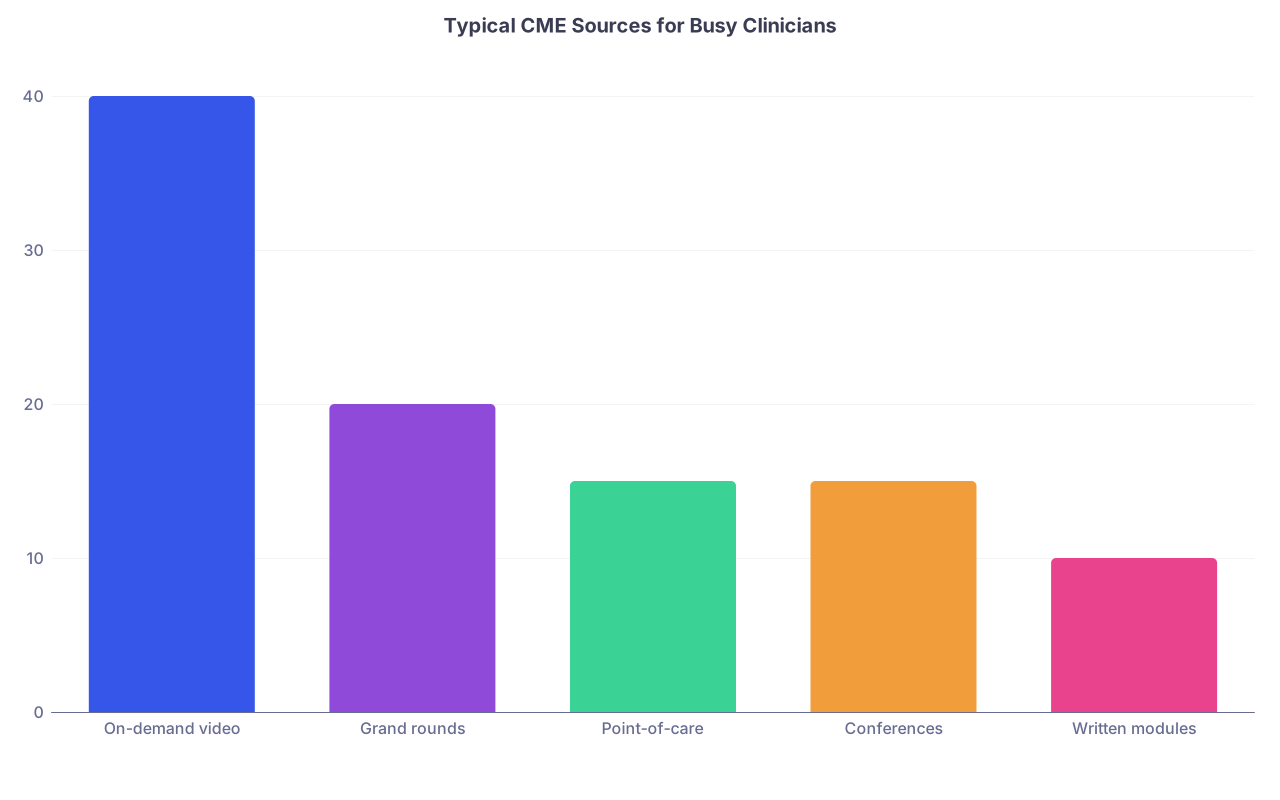
| Category | Value |
|---|---|
| On-demand video | 40 |
| Grand rounds | 20 |
| Point-of-care | 15 |
| Conferences | 15 |
| Written modules | 10 |
That bar chart is what I see in real life for busy attendings with kids: most of their credit comes from on-demand material and built-in work activities, not big fancy conferences.
Talk to:
- Your hospital CME office
- Your department admin
- Colleagues with kids 1–2 years ahead of you
Literally ask: “Where are you actually getting your CME from now that you have kids?” You’ll get better answers than any marketing email.
Step 7: Respect the Special Stuff (Opioids, Ethics, etc.)
Some states and boards require:
- Opioid/pain management CME
- Domestic/intimate partner violence
- Child abuse reporting
- Ethics/professionalism
- Implicit bias or cultural competency
These are landmine areas. People miss them because they’re buried in fine print, then they’re stuck in a last-minute scramble.
Strategy:
- Identify required “special topics” early
- Knock them out with dedicated online modules that explicitly state they fulfill your state/board rule
- Save those certificates in a clearly-labeled folder or section in your CME home base
Do these even if you’re tired. They’re often only 2–4 hours and will save you a future license-renewal headache.
Step 8: Build a “CME While Parenting” Routine
Let’s make this concrete. Here are two real-world patterns I’ve seen work.
Scenario A: Newborn, unpredictable schedule, mostly outpatient
- Monday: 20 minutes of on-demand video during lunch, door closed
- Wednesday: Claim CME from 3–4 UpToDate searches you were doing anyway
- Weekend: One 30–40 minute grand rounds recording while baby naps on your chest
This will get you roughly 1.5–2 hours per week if you stick to it. That’s plenty over several months.
Scenario B: Postpartum, on leave now but returning to full-time soon
- Weeks 1–6 postpartum: Forget CME unless you absolutely must do a required state module. Sleep and recovery first.
- Weeks 6–12: Two short modules per week – 15–20 minutes each. Usually doable during one nap or an evening when you’re surprisingly awake.
- Return to work: Flip to Scenario A pattern, plus occasional audio CME on your commute.
And if one week collapses? Fine. You don’t “catch up” by torturing yourself the next week. You just restart the pattern. This consistency matters more than micro-failures.
Step 9: Avoid Common Traps That Crush New Parents
Let me be blunt about a few mistakes I see over and over.
Overcommitting to a big conference “to get it all done”
Conferences are great if:- Travel is easy
- Childcare is secure
- Your brain isn’t mush
Otherwise, you spend thousands, get interrupted, attend half the sessions, and feel worse.
Ignoring CME until 3 months before license renewal
This is where panic happens. And resentment. Suddenly your one free weekend becomes “CME prison.” Do 20–60 minutes a week instead.Not logging CME as you go
Completing CME is half the job. Being able to prove you completed it is the other half. If you wait to organize it all at the end of the cycle, you’ll lose documents, forget logins, and swear a lot.Picking “aspirational” content you don’t actually care about
Right now you want:- Straightforward, clinically relevant topics
- Clear teaching
- No fluff
If a platform bores you to tears, drop it and pick another. You’re already exhausted; don’t add dull.
Step 10: Use Simple Tools and Automations
You do not need a complicated app stack, but a few smart moves help:
Calendar recurring events:
- “Wednesday lunch – 20 min CME”
- “First Friday – check CME total”
Email folder:
- Create “CME Confirmations” label/folder
- Auto-filter any email with “CME certificate” or “credit” into it
Cloud folder:
CME > Certificates > 2024-2026 cycle- Drag every PDF there immediately after download
One-note CME log that looks like this:
- 2024-11-03 – UpToDate – 1.0 AMA PRA Cat 1 – Opioid management topic – Certificate saved
- 2024-11-17 – Grand Rounds: Heart Failure Updates – 1.0 – Hospital CME – Auto-reported

| Step | Description |
|---|---|
| Step 1 | See CME Requirement |
| Step 2 | Pick Platform |
| Step 3 | Schedule 20-60 min block |
| Step 4 | Complete Module |
| Step 5 | Download or Auto-save Cert |
| Step 6 | Log in CME Note |
| Step 7 | Check Progress Monthly |
That’s it. That’s your loop. No complexity. Just repetition.
Step 11: Talk to Your Program/Hospital If You’re Truly Underwater
If you’re a resident or fellow and just had a baby, you might also be facing internal education requirements, not just CME.
If you’re sinking, say something early:
- To your PD or APD
- To your chief resident
- To the CME office if it’s a strict institutional thing
Be specific:
- “I just returned from parental leave; I’m behind on our required online modules and my ABP CME. I have about X hours to make up. What’s the minimum I need to prioritize for this year, and can any deadlines be shifted?”
People are usually more flexible than you think if they know the situation before the deadline passes. After the deadline, everything becomes a problem.
Same goes for attendings:
- If your hospital requires in-person sessions during times you’re solo parenting, ask: “Is there an on-demand or recorded option that still counts for credit?”
Step 12: Give Yourself Permission to Be “Good Enough” at CME This Year
There will be seasons when you’re crushing it: journals read, cutting-edge courses, conferences, teaching others.
This is not that season.
New baby at home? Your CME strategy is:
- Compliant
- Efficient
- Short
- Boringly reliable
That’s fine. Your baby will not be this little forever. Your sleep will not be this bad forever. Your brain capacity will come back.
Right now, your job is to:
- Keep your license and board in good standing
- Stay reasonably current on what actually affects your patients
- Not sacrifice the tiny slivers of recovery you get
Quick Recap: If You Remember Nothing Else
- Get the real numbers for your CME and special topic requirements and put them in one visible place.
- Pick low-friction formats (on-demand video, audio, point-of-care) and convert them into 20–60 minute weekly habits that match your actual life with a baby.
- Log and store everything as you go so renewal time is just “attach documents,” not “archaeological dig through old emails.”
That’s how you meet CME requirements as a new parent: not with heroics, just with a sane, repeatable system that survives 3 a.m. wakeups.