
Most residency applicants ruin the “Professional Interests” section by treating it like a brain dump instead of a signal.
Let me be blunt: programs use that tiny block of text to decide if you are directionless, generic, or actually going somewhere. It is one of the most under-coached, over-wasted sections of the ERAS CV.
You want it to do three things simultaneously:
- Show you have a coherent, plausible career direction.
- Align you with what this specialty and this program value.
- Give interviewers specific, high-yield hooks they can ask you about.
If your current “Professional Interests” looks like “medical education, research, underserved medicine, global health, quality improvement, leadership,” I already know your application coaching came from the Twitter hive mind and not from someone who has actually sat on selection committees.
Let me break this down specifically.
What Programs Actually Read This Section For
Program directors are not reading your “Professional Interests” for inspiration. They are scanning for risk and fit.
Here is what is going through their minds while they skim that paragraph in 3–5 seconds:
- Does this applicant have any coherent career trajectory or are they just listing buzzwords?
- Does this sound compatible with our program’s strengths, or will they feel frustrated here?
- Is this a person we could see as a chief resident, fellow, junior faculty, or local leader?
- Do their interests help us “sell” them at rank meeting? (e.g., “She’s very into addiction medicine—we have a strong addiction program, this is a good match.”)
If your section is vague, overstuffed, or contradictory, it triggers doubts:
- “Wants physician-scientist track” but zero real research experience → credibility issue.
- “Strong interest in rural primary care and global surgery” for a high-powered urban academic surgery program → mismatch.
- Ten unrelated interests → lack of focus, maybe lack of self-awareness.
Your goal: a short, sharp, internally consistent snapshot that makes sense relative to the rest of your file.
The Core Rule: Specific, Coherent, Anchored
You want three pillars:
- A clear primary direction.
- 1–2 secondary but related interests.
- Concrete anchors that show this is based in reality, not fantasy.
Think of it as a 3-layer structure:
- Layer 1: Who you see yourself as clinically (your likely niche within the specialty)
- Layer 2: The academic or system-level angle (education, QI, health services research, leadership, advocacy, etc.)
- Layer 3: The population or context (underserved, rural, immigrant health, LGBTQ+ health, veterans, etc.)
When these align, you signal clarity.
Bad example (what I see all the time):
Professional Interests: Medical education, global health, underserved populations, research, quality improvement, health policy, leadership.
What this actually communicates: “I copied the entire menu board and have no idea what I will actually pursue.”
Now a competent version for Internal Medicine:
Professional Interests: Academic general internal medicine with a focus on addiction medicine and complex care. I am particularly interested in improving transitions of care for patients with substance use disorders through quality improvement and health services research, and in teaching residents and students in this space.
Notice the difference:
- Primary: academic general IM with addiction / complex care.
- Secondary: QI + health services research and education, but both clearly tied to that clinical area.
- Plausible, not grandiose. Very easy to connect to actual experiences.
Stepwise Process: How To Build Your Professional Interests Section
Step 1: Decide your primary clinical identity
No, you do not need a 100% locked-in fellowship plan. You do need something more specific than “I like everything.”
By specialty:
- Internal Medicine: hospitalist, academic generalist, primary care, cards/onc/pulm-crit (if you have strong fellowship signals), addiction, geriatrics, health systems.
- Pediatrics: general pediatrics, complex care, NICU/PICU, adolescent medicine, behavioral/developmental, child advocacy.
- Surgery: academic general surgery, trauma/critical care, surgical oncology, rural surgery, minimally invasive surgery.
- OB/GYN: generalist, MFM, Gyn Onc, complex family planning, academic OB education.
- Psychiatry: consult-liaison, addiction, child/adolescent, community psychiatry, women’s mental health.
- EM, Anesthesia, Neuro, etc: similar logic.
You are not signing a contract. You are stating your current best direction, backed by your experiences.
If you truly have no idea, pick the direction most consistent with:
- Your electives and sub-Is.
- Your research or scholarship.
- What you actually talk about when someone asks, “So what do you see yourself doing?”
Step 2: Choose 1–2 related secondary interests
Secondary interests should be:
- Clearly connected to your primary focus.
- Feasible in the environment of most residency programs.
- Visible to some degree in your existing CV.
High-yield secondary buckets:
- Medical education (especially if you have peer teaching, curriculum work, or leadership).
- Quality improvement / patient safety.
- Health disparities / health equity.
- Health services research / outcomes research.
- Community engagement / advocacy.
- Global health (only if you have more than a 2-week tourism “mission trip”).
- Informatics / digital health.
- Leadership / administration.
Tie them directly to your clinical focus. Not just “QI,” but “QI in perioperative outcomes.” Not just “education,” but “residency curriculum for inpatient addiction care.”
Step 3: Anchor with concrete experience
Your statement will be much stronger if it matches visible pieces of your application:
- If you say “addiction medicine,” I should see: a rotation, a research project, an advocacy activity, or a longitudinal clinic.
- If you mention “medical education,” I should see: teaching roles, peer tutor, curriculum committee, OSCE facilitator, something.
- If you bring up “rural health,” show: rural electives, growing up rural, ongoing clinic work, not just a single week in a small town.
Programs do not require perfect alignment, but obvious dissonance will hurt you.
Template Variations That Actually Work
You do not need prose poetry. You need 2–4 clean sentences. Here are working templates and then we will dissect them.
Template 1: Academic-leaning applicant
I am pursuing a career in academic [specialty], with a clinical focus on [niche / population]. My interests include [scholarly area] and [education / QI / policy] as tools to improve [specific patient or system outcome]. I hope to contribute to [type of program/setting] that values [feature tied to your direction, e.g., interdisciplinary care, resident education].
Example – Pediatrics:
I am pursuing a career in academic general pediatrics with a focus on children with medical complexity and technology dependence. My interests include health services research and quality improvement to reduce preventable hospitalizations and improve care transitions for these patients. I hope to work in a tertiary care children’s hospital that values interdisciplinary, family-centered care and resident education.
This reads like someone who has actually seen this patient population and understands the work.
Template 2: Clinically focused, not heavily research-driven
My long-term goal is a career in [clinical setting: community, hospital-based, rural, etc.] [specialty], caring for [population / condition]. I am particularly interested in [1–2 system-level themes: QI, patient safety, population health, education], and in helping develop [type of initiative] within my future practice.
Example – Family Medicine:
My long-term goal is a career in community family medicine, caring for medically underserved adults and children. I am particularly interested in chronic disease management, behavioral health integration, and population-level quality improvement, and in helping develop team-based care models to improve access and continuity in safety-net clinics.
Solid. Clear. Not pretending to be a physician-scientist.
Template 3: Fellowship-leaning, but still open
This one requires that your application already contains solid signals toward that fellowship.
I am interested in a career in academic [specialty] with likely subspecialty training in [fellowship], focusing on [disease area / patient group]. My professional interests include [research area or QI angle] and [education / advocacy], with the goal of [specific long-term aim that is believable for an early-career faculty member].
Example – IM → Cardiology:
I am interested in a career in academic internal medicine with likely subspecialty training in cardiology, focusing on heart failure and advanced therapies. My professional interests include outcomes research and implementation of multidisciplinary care models to reduce readmissions and improve quality of life for patients with advanced heart failure, as well as teaching residents and students on the inpatient cardiology services.
This is the sort of language I see from people who end up at strong academic programs.
Common Mistakes That Instantly Cheapen This Section
Let me go through the repeat offenders.
1. Buzzword salad
“Global health, health policy, medical education, leadership, advocacy, underserved care, research.”
If it reads like you combed a MedEd blog and dumped all the “good” words into a sentence, it screams inauthentic. Pick 2–3 genuine themes and build around those.
2. Contradictory settings without a connecting thread
Example:
“I am interested in both rural family medicine and academic hospitalist work in a tertiary care center.”
You need a bridge. Otherwise you look aimless.
Try:
“I am exploring careers in both rural family medicine and academic hospital medicine, united by a focus on improving care transitions for high-risk patients and reducing preventable readmissions.”
Now there is at least a thematic backbone.
3. Overclaiming research or academic identity
If your “research” is a single poster where you were the 12th author, do not describe yourself as pursuing a “physician-scientist career leading a translational research laboratory.” You will be asked about this. It will be awkward.
Better:
“I hope to integrate clinical work with involvement in clinical research and quality improvement initiatives related to [X], contributing as a collaborator within an academic team.”
Honest. Ambitious but not ridiculous.
4. Empty “leadership” claims
“Leadership” is rarely a core professional interest. It is a trait, not a direction. Better to say:
“I am interested in residency education and, over time, in program leadership and curriculum development.”
That tells me you are thinking down the line toward APD/PD roles, not just writing “leadership” because it sounds good.
5. Generic “helping underserved populations” with no specificity
Everyone claims this. Programs tune it out unless you make it concrete.
Example upgrade:
Weak:
“I am interested in working with underserved populations.”
Better:
“I am interested in primary care for immigrants and refugees, with a focus on improving access to mental health services and language-concordant care.”
Now I know what you mean by underserved. And I can actually imagine your clinic.
Aligning With Specific Programs Without Sounding Fake
You do not rewrite your interests for every program. That is transparent and frankly not worth the time. But you can tune the way you present them to better resonate.
Two levels:
- Global ERAS CV “Professional Interests” – the core version, stable across programs.
- Program-specific echoes – small tweaks in your personal statement or supplemental responses that pick up the same themes but emphasize what that program offers.
Look at a program’s website:
- Are they heavily into QI? Value-based care? Global health track? Research track? MedEd?
- Do they advertise certain patient populations or clinical niches?
- Do they highlight resident scholarly output? Chief pathways? Combined tracks?
Now map your existing interests honestly:
- If they have a strong Addiction Medicine focus and you do as well → emphasize that link explicitly somewhere (personal statement, supplemental application).
- If they are big on MedEd and you have real teaching experience → make sure your MedEd interest is not buried.
But do not invent. Faculty can tell when your “interest” showed up only after you opened their website.
How This Section Ties Into Interview Day
If you do this right, your “Professional Interests” becomes a script generator for interviews.
You want 3–5 “talk points” that can spin into a 2–3 minute answer each:
- “Tell me more about your interest in [niche clinical area]. What sparked that?”
- “You mentioned QI in the ERAS – what kind of projects have you been involved with?”
- “I see you are interested in MedEd. What kind of teaching have you done so far?”
- “You wrote about immigrant health – what has that looked like for you in practice?”
So when you craft the section, think:
“Can I give a specific story or example for each element I am naming here?”
If you cannot talk for 90 seconds, with some detail, on a stated interest, cut it. Or demote it.
Example Transformations: Bad → Good
Let us do some live surgery on real-world style entries.
Internal Medicine – unfocused
Original:
Professional Interests: Hospital medicine, primary care, global health, health disparities, medical education, research, quality improvement, leadership.
Reworked:
I am interested in a career in academic hospital medicine with a focus on caring for socially and medically complex patients. My professional interests include health disparities and quality improvement, particularly around safe transitions of care and reducing readmissions. I also enjoy teaching and hope to be involved in resident and medical student education on the wards.
Same person. Much more believable.
Emergency Medicine – too generic
Original:
Professional Interests: Emergency medicine, global health, critical care, ultrasound, medical education, administration.
Reworked:
I plan to pursue a career in academic emergency medicine with a focus on resuscitation and critical care in the ED. I am particularly interested in point-of-care ultrasound and in developing curricula to improve resident competency and comfort with ultrasound-guided procedures. Over time, I hope to contribute to departmental quality and patient safety initiatives.
Notice: global health and “administration” disappeared. If they were not actually central in the rest of the file, cutting them improves focus.
Psychiatry – buzzword-heavy
Original:
Professional Interests: Community psychiatry, child and adolescent psychiatry, forensics, global mental health, advocacy, research, education.
Reworked:
I am interested in a career in community psychiatry, working with adolescents and young adults with serious mental illness. My interests include developing collaborative care models between primary care and psychiatry, advocacy to improve access to early intervention services, and teaching trainees in community-based settings.
We narrowed to community + youth + systems of care. That is an actual direction.
Quick Comparison: Weak vs Strong Signals
| Aspect | Weak Version | Strong Version |
|---|---|---|
| Scope | 6–8 unrelated areas | 1 primary, 1–2 clearly related secondary areas |
| Specificity | “underserved,” “research,” “leadership” | Named populations, methods, or settings |
| Alignment | Contradictory goals | Cohesive narrative across interests and experiences |
| Credibility | Claims not reflected in CV | Each interest tied to at least one visible activity |
| Interview Utility | Hard to generate questions | Obvious 3–5 question prompts for faculty |
How This Plays Out By Competitiveness Level
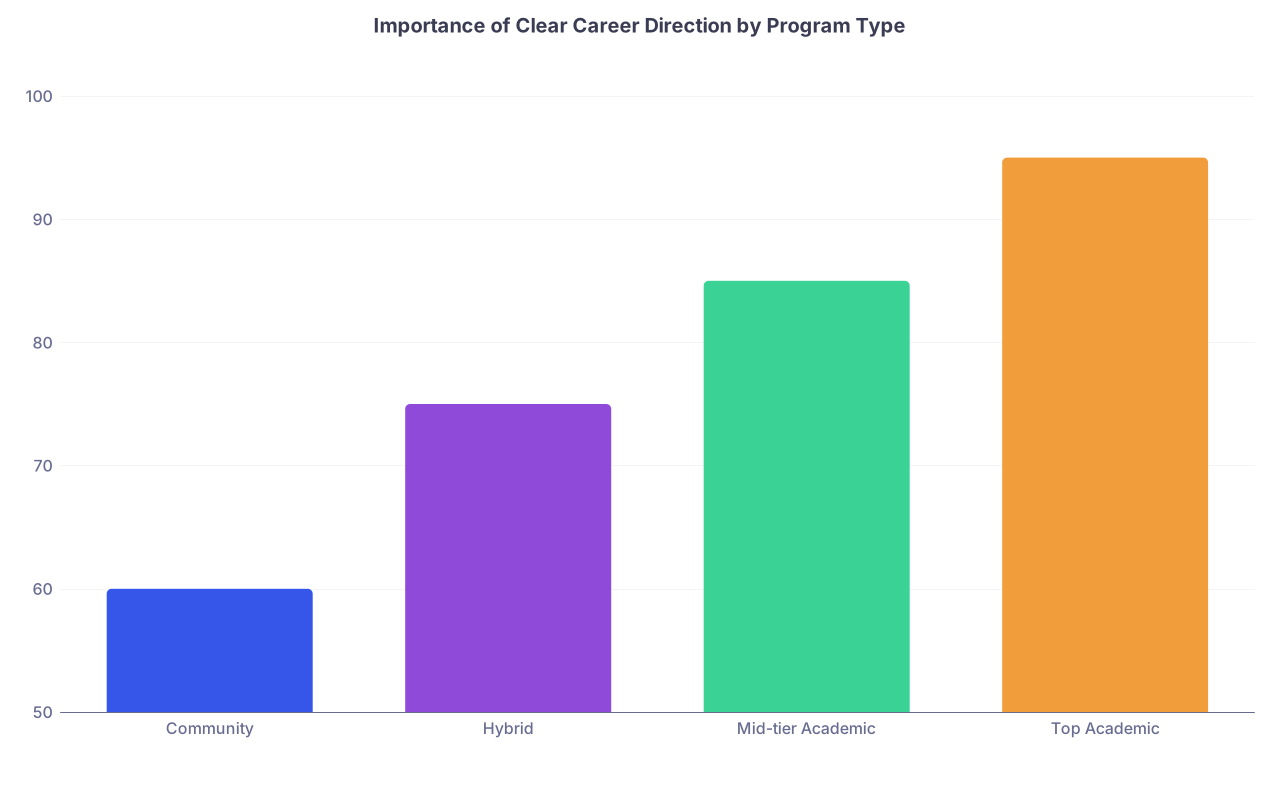
| Category | Value |
|---|---|
| Community | 60 |
| Hybrid | 75 |
| Mid-tier Academic | 85 |
| Top Academic | 95 |
This is not real data, but it reflects reality I have seen:
- Community programs care more about reliability, work ethic, and being easy to work with. They still like clarity, but they will not obsess over your niche.
- Hybrid and mid-tier academic programs use your interests to decide if you will actually use their scholarly infrastructure.
- Top academic programs are almost allergic to directionless applicants. They want early signs you could be faculty material.
So if you are aiming high academic, your professional interests section cannot be an afterthought. It is part of your “future junior faculty” pitch.
Integrating With The Rest Of Your Application
Think of your application like a story arc. The “Professional Interests” is the epilogue hinting at what happens next.
You want:
- Personal statement: origin story + most important experiences + why this specialty.
- Experiences section: evidence (research, QI, teaching, advocacy, clinical niches).
- Professional Interests: concise forecast – where all this is going.
If you say in your personal statement that you are deeply drawn to palliative care, and your interests section never mentions serious illness care, but lists global health and basic science research, something is off. Commit to a primary lane and be consistent.
Visualizing the Process

| Step | Description |
|---|---|
| Step 1 | Review CV and experiences |
| Step 2 | Select primary clinical direction |
| Step 3 | Choose 1-2 related secondary interests |
| Step 4 | Check alignment with actual activities |
| Step 5 | Draft 2-4 sentence paragraph |
| Step 6 | Remove buzzwords and weak claims |
| Step 7 | Test - can I talk about each interest for 90 seconds? |
| Step 8 | Finalize for ERAS |
That loop at the end is where most people fail. They keep interests they cannot actually discuss in detail. Then they get grilled on interview day.
A Few Specialty-Specific Mini-Examples
To give you some concrete models you can adapt.
Internal Medicine – community-focused
I plan to pursue a career in community internal medicine, caring for adults with complex chronic disease in underserved settings. I am particularly interested in team-based primary care models, integration of behavioral health into primary care, and clinic-level quality improvement to improve hypertension and diabetes control.
General Surgery – academic-leaning
I am interested in a career in academic general surgery with a focus on emergency general surgery and trauma. My professional interests include outcomes research related to perioperative care pathways and resident education in high-acuity settings, with the long-term goal of contributing to trauma systems development.
OB/GYN – generalist track
My long-term goal is a career as a generalist OB/GYN in a safety-net hospital, providing full-spectrum obstetric and gynecologic care to diverse, underserved patients. I am especially interested in family planning, disparities in maternal morbidity and mortality, and resident and student education on labor and delivery.
Psychiatry – academic subspecialty-leaning
I am pursuing a career in academic psychiatry with a focus on early psychosis in adolescents and young adults. My interests include implementation of coordinated specialty care models, community outreach to reduce duration of untreated psychosis, and teaching trainees in both inpatient and outpatient settings.
Each of these could be copied onto a slide at rank meeting next to your photo and nobody in the room would be confused about who you are trying to become.
FAQ (exactly 4 questions)
1. What if I genuinely have no idea what niche or fellowship I want yet?
Then you focus on direction, not subspecialty labels. Instead of saying “I want to do GI or Cards or Heme-Onc,” you frame broader but still coherent interests: complex inpatient medicine, transitions of care, chronic disease management in primary care, etc. You can write: “I am currently most drawn to [broad area], with emerging interests in [X and Y], and hope to explore these further in residency.” That is honest and still far better than a random list of trendy topics.
2. Is it bad if my stated interests change during residency? Will programs feel misled?
No. Everyone expects growth. Programs get annoyed only when the initial statement was obviously inflated or insincere. If you write a grounded, plausible description based on your real experiences, and then pivot because you discover new passions in residency, nobody will care. What matters now is that you can articulate a believable trajectory from the data they have: your med school years.
3. How long should the “Professional Interests” section be on ERAS?
Think 2–4 sentences. Enough to show primary direction, 1–2 connected secondary interests, and a sense of practice setting, but not a second personal statement. If it spills beyond a short paragraph, you are probably listing too many interests or repeating things that belong in your personal statement. Concise and sharp beats long and fuzzy.
4. Should I explicitly name the program or city in my professional interests?
Generally, no. The ERAS “Professional Interests” section goes to every program. Do not write “I hope to practice academic medicine in Boston” unless you are happy for that to be read by programs in Texas and California. If you want to signal geographic preference or a perfect match to one program, use the personal statement (if they allow a tailored version) or supplemental application questions, not the global interests section.
Three things to remember:
- Treat the “Professional Interests” section as a signal, not filler. It tells programs whether you are headed somewhere specific or just collecting buzzwords.
- Anchor everything you claim in actual experiences and keep your scope tight: one primary direction, one or two logically related secondary themes.
- Write it so that every single phrase can turn into a confident, concrete answer on interview day. If you cannot talk it, do not write it.