
Your CV does not look as “ruined” as your 2 a.m. brain is telling you.
Let me say that flat out. You switched specialties late. Your CV looks scattered. You feel like every other applicant has been surg-onc or derm-or-bust since M1 and you’re the indecisive mess with research in three different fields and letters from the “wrong” people.
You’re not alone. And no, you’re not automatically doomed.
I’m going to walk through what actually matters to program directors when they see a late specialty switch, how bad it can look (in the real world, not in your catastrophe brain), and exactly how to reframe and repair your CV so it tells one coherent story instead of five partial ones.
We’re in the residency match and applications phase here. The train is moving. You don’t have five years to reinvent yourself. You need strategy, not vibes.
First: How Bad Does This Look, Really?
Let’s be painfully honest first, so we’re not sugarcoating anything.
A late specialty switch can raise concerns in program directors’ heads like:
- “Does this person actually know what they want?”
- “Are they going to bail on our specialty or our program?”
- “Is this an impulse or a thoughtful decision?”
- “Why do their experiences not line up with what they’re applying for?”
They’re not evil. They’re just risk-averse. They’re filling a small number of spots with people they’ll be stuck with for 3–7 years. They don’t want chaos.
But here’s the key: they’re not reading your CV like a prosecutor. They’re scanning it like a pattern-matching machine.
If they can see a coherent narrative and evidence you understand and are committed to the specialty, they’ll move on. If they can’t, you’re in trouble.
Late switchers land spots every year. I’ve seen:
- A surgery-to-psychiatry switch in September of M4 who matched at a solid academic psych program.
- An OB/GYN-to-IM switch with lots of women’s health research who matched IM by reframing all that as population health and continuity of care.
- A radiology-to-EM switch who used radiology research to show systems-thinking and diagnostic skills.
The students who crash and burn are usually the ones who do nothing to fix the “scattered” problem. They just fire off generic apps and hope no one notices.
So the question isn’t “Am I screwed?”
It’s “How fast can I rewrite the story my CV is telling?”
What Program Directors Actually Care About (More Than Your Perfectly Aligned CV)
You’re imagining they want a CV where every line screams ONE SPECIALTY since birth. They don’t.
They care more about:
- Can you do the work? (grades, exams, clinical performance)
- Are you going to show up, not cause drama, and finish the program?
- Do you understand this specialty specifically, not some vague “I like helping people” nonsense?
- Do your letters and experiences support that?
The late switch part only becomes a red flag if:
- It’s not explained coherently, and
- Your CV looks like you’re still undecided or flailing.
Let’s be blunt. A CV like this:
- M1–M3: 3 ortho research projects, ortho interest group president, ortho away rotation
- M4: suddenly applying psych with zero psych letters, one psych elective in October
…looks bad if you don’t fix it. It screams “Plan A failed, so I panicked.”
But if by the time apps go out you have:
- Clear explanation in your personal statement
- A psych sub-I with strong evaluation
- 2–3 letters from psych faculty who know you
- Transferable skills from your ortho stuff reframed (team-based care, managing complex patients, working under pressure)
Now it looks less like “plan A died,” more like “I found a better fit and here’s the evidence I belong here.”
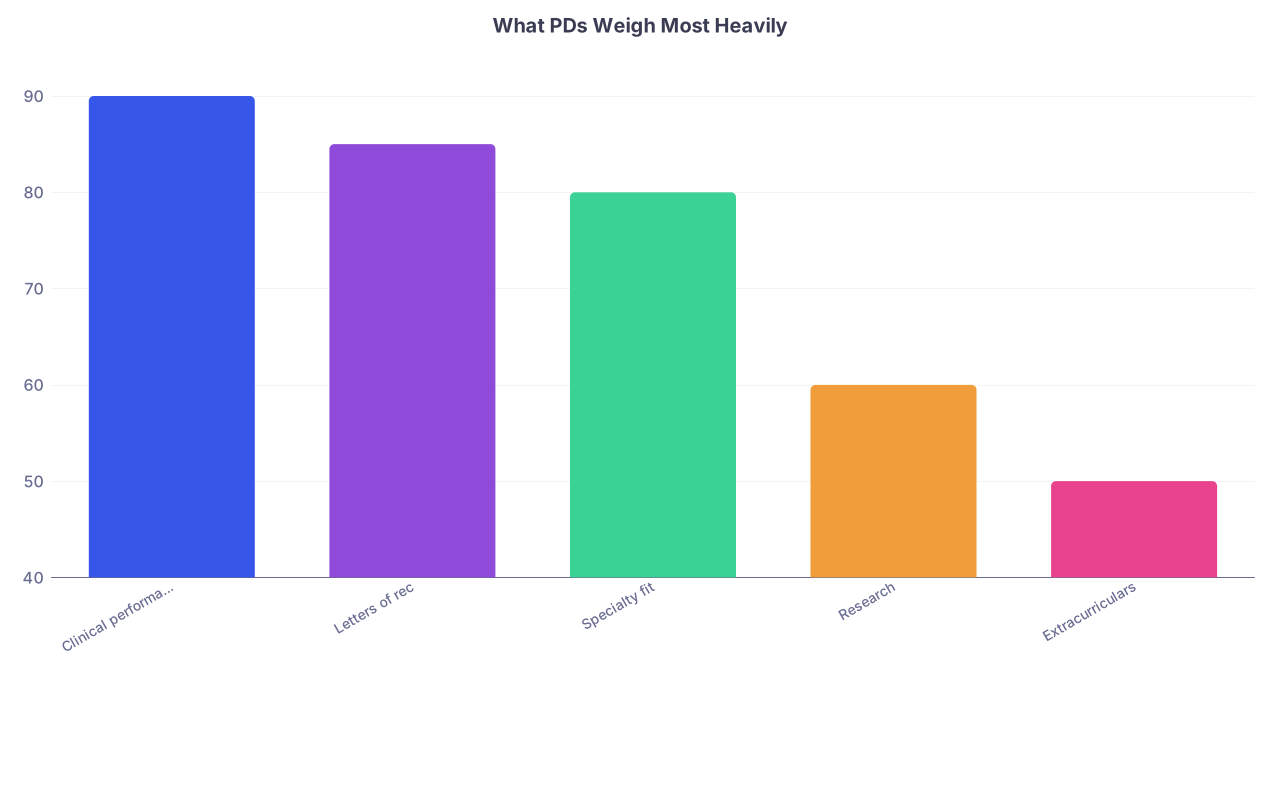
| Category | Value |
|---|---|
| Clinical performance | 90 |
| Letters of rec | 85 |
| Specialty fit | 80 |
| Research | 60 |
| Extracurriculars | 50 |
Your CV is not a legal record of past sins. It’s a marketing document. It’s allowed to emphasize some parts and quietly background others.
Step 1: Own the Switch (Stop Hiding It)
The worst thing late switchers do? Pretend it didn’t happen. They send out:
- A generic personal statement
- A CV that screams a different specialty
- No explanation of the pivot
Then wonder why they get silence.
You need a clear, concise narrative for your switch. Not a sob story. Not an apology tour. A narrative.
Basic skeleton for your reasoning (that you can tweak to your actual truth):
- What you thought you wanted originally (brief).
- What changed – specific experiences, not vague “I realized I like people.”
- What you’ve done since realizing the new direction to confirm commitment.
- Why you’re confident this specialty is the right long-term fit.
Example (surgery → internal medicine):
- “I originally pursued surgery because I loved acute interventions and the OR environment.”
- “During my clerkships, I noticed I was most energized by complex diagnostic problems and longitudinal relationships on internal medicine.”
- “After that, I deliberately chose an inpatient medicine sub-I, a continuity clinic elective, and joined an outcomes project in heart failure to confirm this fit.”
- “Those experiences made it clear that internal medicine aligns better with how I like to think and work day to day.”
That’s calm. Deliberate. Not “I got a bad eval in surgery and panicked.”
You can weave this into:
- Your personal statement
- Your ERAS “experiences” descriptions
- Interviews when they inevitably ask, “Tell me how you became interested in X.”
Hiding it makes them fill in the blanks with the worst assumptions. You’ve felt that in your own head. Don’t let them do the same.
Step 2: Reframe “Scattered” Experiences Into a Coherent Story
Right now, your CV probably looks like this in your nightmares:
- Research in Specialty A, 2 posters
- Volunteer work vaguely related to Specialty B
- Leadership in club for Specialty C
- Clinical evaluations: strong in some unrelated thing
- Random jobs and teaching
It feels like chaos. But most of that is fixable with reframing.
Ask this question for every experience:
“How does this help me as a future [new specialty] resident?”
Then rewrite your ERAS bullets to highlight that angle.
Example 1: Old neurosurgery research → new neurology application
Instead of:
- “Assisted in neurosurgical outcomes research on brain tumor resection techniques.”
You write:
- “Analyzed postoperative neurologic outcomes in patients with brain tumors, gaining deeper exposure to neurologic deficits and recovery patterns.”
Same project. Different framing.
Example 2: Old EM volunteer → new family medicine application
Instead of:
- “Volunteered in ED intake, assisting with triage and logistics.”
You write:
- “Supported ED intake by gathering histories and counseling anxious patients, reinforcing my interest in front-line, patient-centered care and communication.”
You’re not lying. You’re emphasizing what aligns.
| Original Focus | New Specialty | Weak Description | Strong Reframed Description |
|---|---|---|---|
| Ortho research | Internal Med | Studied joint replacements | Evaluated perioperative medical comorbidities in joint replacement patients |
| Derm clinic | Psych | Shadowed dermatology clinic | Observed impact of chronic skin disease on mood, coping, and patient identity |
| Surg interest group | FM | Led surgery club meetings | Organized case discussions emphasizing multidisciplinary care and follow-up |
If a line truly has zero relevance and isn’t impressive on its own? It can quietly shrink or disappear. You don’t need to showcase every random 3-hour volunteer gig from M1.
Step 3: Patch the Glaring Holes… Fast
Some things you can’t fake or spin forever. If you’re applying to a new specialty, program directors are going to subconsciously look for:
- At least one sub-I / acting internship in that specialty
- At least 2 letters from that specialty (3 is better)
- Some kind of exposure that shows you actually understand what the job is
If you don’t have those yet, your priority list is pretty simple:
- Get a sub-I or heavy elective in the new specialty ASAP.
- Show up there like your residency depends on it (because it kind of does).
- Get letters from faculty who actually saw you work.
- Ask them to explicitly address your late switch and back you up.
You want letters that sound like:
- “Although the applicant came to this specialty later in training, they’ve shown a mature and clear understanding of what our field entails.”
- “They approached this rotation with intention knowing they were confirming a specialty choice, and they impressed our entire team.”
Do not underestimate how powerful a strong, specific letter from someone in the specialty is in countering the “scattered” vibe.
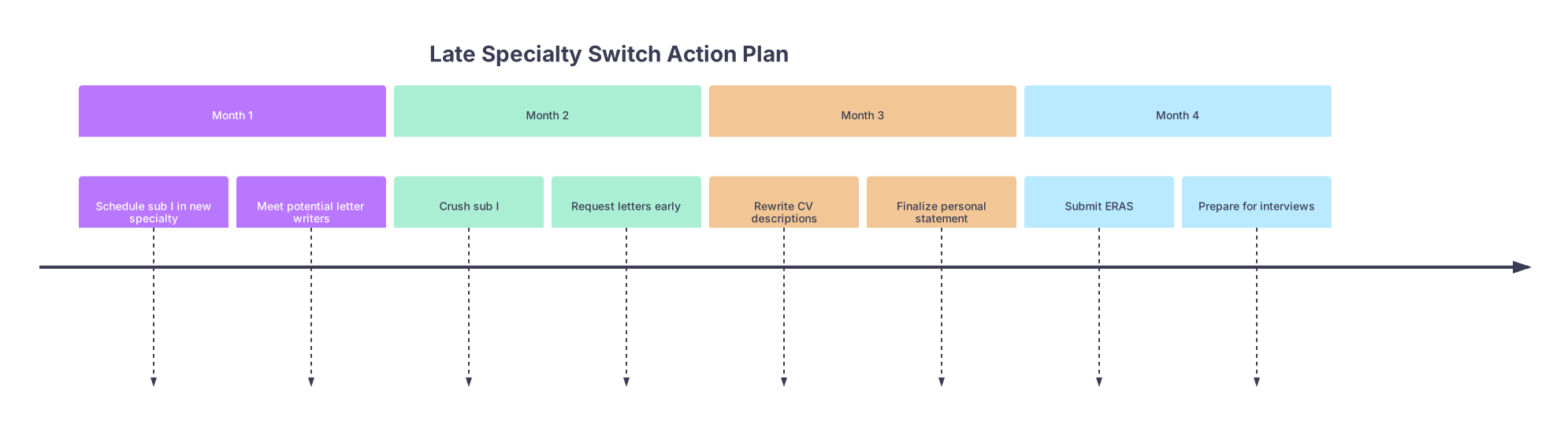
If you’re already past ideal timing, fine. Still do the best version of this you can with the months you’ve got.
Step 4: Stop Broadcasting Indecision Everywhere
One subtle way late switchers hurt themselves: their CV still looks like they’re hedging.
Things that scream “I still don’t know what I want”:
- Applying to two unrelated specialties with totally generic essays
- Leaving old interest group leadership in another field as the first thing in the experiences list
- Personal statement that could apply equally to IM, EM, FM, and psych with zero specialty-specific content
You need to do the opposite:
- Order experiences so new specialty–relevant things are near the top.
- Tailor your personal statement brutally to this one field. Name it. Describe it. Use concrete examples from it.
- Don’t brag about “always exploring many fields” like that’s inherently positive. It’s not, right now. You’re selling focus.
If you are dual applying, you have to commit to two separate narratives, not one mushy “I like everything.” That’s extra work, but less costly than looking confused in both.
Step 5: How to Talk About This in Interviews Without Sounding Like a Flight Risk
You’re terrified they’ll ask, “So you used to be interested in X. What happened?”
They will. So script it now.
Bad answers sound like:
- “I just changed my mind.”
- “I realized I didn’t like the lifestyle.”
- “My scores weren’t competitive for X, so I thought this might work.”
That’s how to get quietly dropped.
Better structure:
- Start with what you liked about the previous field (so you don’t sound flaky or bitter).
- Explain what you noticed you were consistently drawn towards that was more aligned with this new specialty.
- Highlight specific rotations/cases that crystallized it.
- Emphasize what you did afterward to confirm, not just react.
- End with a strong, forward-looking statement about your commitment.
Example (rads → EM):
“I was initially drawn to radiology because I liked pattern recognition and the diagnostic side of medicine. On my EM rotation, though, I noticed that what really energized me was being at the bedside in those critical moments, combining rapid decision making with team-based care. After that, I did an EM sub-I and an ultrasound elective, and I kept finding that this is the environment I want to be in long-term. I feel much more settled in this decision than I ever did before, and I’m excited about building a career in EM.”
You’re not apologizing. You’re explaining.

| Step | Description |
|---|---|
| Step 1 | Old interest |
| Step 2 | What you liked |
| Step 3 | What felt missing |
| Step 4 | New specialty exposure |
| Step 5 | Actions to confirm fit |
| Step 6 | Current strong commitment |
Step 6: Real Talk – When a Scattered CV Actually Is a Big Problem
I’m not going to pretend there are zero consequences. Sometimes the late switch is genuinely hard to overcome:
- You have almost no rotations, letters, or exposure in the new specialty.
- Your old specialty stuff doesn’t translate well and eats your whole CV.
- You decided extremely late (like post-ERAS) and have no time to pivot.
- Your underlying pattern looks like chronic indecision and quitting, not “exploration → clarity.”
In those cases, your options may be:
- A research year in the new specialty to rebuild your story.
- Applying broadly, including prelim / transitional year + reapply later.
- Considering closely related fields where your current experience is more acceptable.
But even then, the “scattered” look isn’t the core issue. The issue is simply lack of convincing evidence you’ll thrive in that field. That’s fixable with time and strategy, not self-loathing.
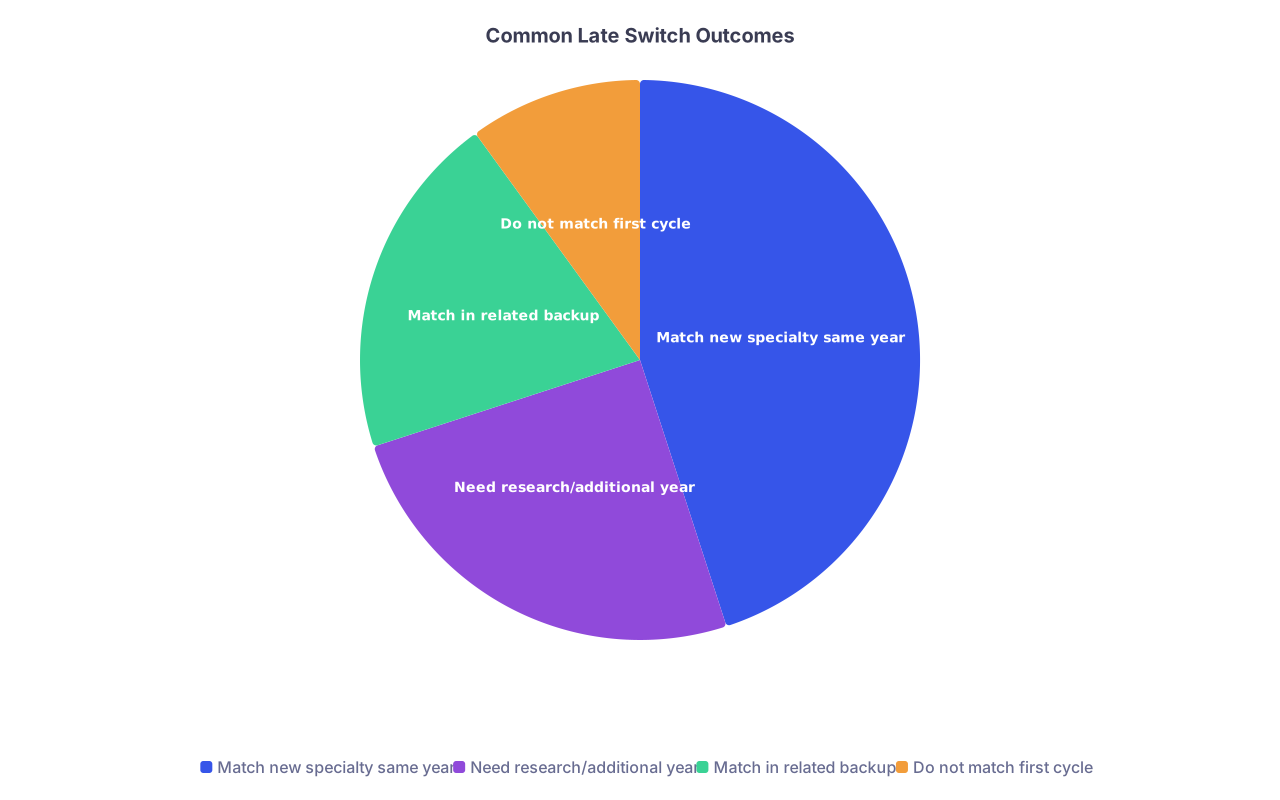
| Category | Value |
|---|---|
| Match new specialty same year | 45 |
| Need research/additional year | 25 |
| Match in related backup | 20 |
| Do not match first cycle | 10 |
(That breakdown isn’t exact for every specialty, but the point stands: plenty of people do land where they want, even switching late.)
Quick Reality Check Before You Spiral Again Tonight
You’re looking at your CV and just seeing chaos. Old interests. Dead ends. “Mistakes.”
Program directors, though, will see what you put in front of them:
- A clearly labeled, well-framed story about why you belong in this specialty now
- Or a confusing pile of semi-random experiences and a vague essay that says nothing
Same raw data. Different outcome.
You can’t go back and un-join that interest group or un-do that research. But you can:
- Reframe
- Reorder
- Re-explain
- And then get at least a couple of high-yield new experiences that anchor the whole story
That’s how you turn “scattered” into “explored broadly, then chose wisely.”
FAQs
1. Should I delete old specialty-specific experiences from my CV so programs don’t know I switched?
No. Deleting everything looks weird and leaves you with a thin CV. The goal isn’t to erase your past; it’s to contextualize it. Keep the strongest, most meaningful experiences and rewrite their descriptions to highlight skills and insights that translate to your new field. You can drop low-impact, irrelevant items, but don’t gut your whole history just because it’s not perfectly on-brand.
2. How many letters do I realistically need from my new specialty to avoid looking like a desperate switcher?
Aim for at least two solid letters from your new specialty, three if you can pull it off. If you have a phenomenal letter from your prior field from someone who knows you well, that can absolutely stay as your third or fourth letter. But if all your letters are from your old specialty and none from the new one, you’re basically waving a flag that you haven’t really tested or committed to this direction yet.
3. Do I have to explicitly talk about my late switch in my personal statement, or can I just focus on the new specialty?
If your CV makes it obvious you were heading somewhere else (research, leadership, away rotations all in another field), you should address it briefly. Ignoring it forces programs to guess, and their guesses won’t be flattering. You don’t need a long confession—just a clear, concise explanation of how you got from “there” to “here” and what you’ve done to confirm that this is the right fit.
4. What if I’m switching very late and can’t get a sub-I or major elective in time—am I totally screwed?
Not totally, but it’s harder. You need to be aggressive and creative: grab any shorter electives, clinics, or even research-in-the-new-field opportunities you can find; get letters from whoever in the specialty has actually seen you do real work, even if it’s a brief rotation; and be brutally clear in your narrative. You may need to apply more broadly, consider preliminary or transitional options, or even plan for a dedicated year to build a stronger specialty-specific profile if this cycle doesn’t pan out. It’s not game over—just a longer game.