
It’s late. You just exported your ERAS application to PDF “one last time,” and your eyes keep drifting to the Honors and Awards section. It looks… thin. Two real items and a bunch of white space. Your brain starts doing dangerous math: “If I move ‘Dean’s List’ into awards… maybe put that shadowing certificate there… maybe call that month as ‘Student of the Month’ an honor…”
Stop. This is exactly where people start turning an otherwise solid application into something that quietly irritates program directors.
Let me walk you through the ways applicants routinely mess up the Honors and Awards section—because I’ve seen plenty of PDs scroll through ERAS, snort, and say, “This again?” You do not want to be that applicant they roll their eyes at.
The Core Problem: Confusing “Things I Did” With “Honors I Earned”

Program directors are not mad because you do not have a wall of trophies. They’re annoyed when you pretend you do.
Honors and Awards = selective recognition you earned.
Not “stuff you participated in.” Not every pat on the head you ever got.
If you remember just one rule, use this:
If nearly everyone who does the same thing gets the same “certificate,” it’s not an honor.
Common offenders that applicants incorrectly list as “Honors/Awards”:
- Certificate for attending some weekend ultrasound workshop
- Participation certificates for conferences or poster days
- Generic “completion” awards for preclinical courses or electives
- Random online course “badge” or MOOC completion
- “Thank you” certificates from free clinics or organizations you just volunteered with once
Those belong in Experiences, Education, or nowhere at all. Throwing them into Honors makes you look insecure and a bit disingenuous.
Pitfall #1: Inflating Minor Stuff Into Major Awards
This is probably the single most annoying pattern.
You know the applicant is trying too hard when:
- “Community Service Certificate – Volunteer Day 4 hours”
- “Recognition Award – Completion of ACLS”
- “Completion Award – Medical Spanish Course”
None of those are honors. They are either expected competencies or routine participation.
Here’s the internal PD reaction: “If you think this is an honor, you probably don’t have any real honors.” That is not the thought you want to trigger.
Ask yourself these questions before adding anything:
- Did I compete against others or was there selective judgment involved?
- Would my classmates say, “Whoa, nice” or “Yeah, we all got that”?
- Would I feel comfortable if an attending reading this asked, “So… how many people got this?”
If the honest answer is “almost everyone got it,” it doesn’t belong.
Typical “inflation” mistakes
- Calling required skills “certifications/honors”
- BLS, ACLS, PALS: basic requirements, not honors.
- Listing attendance as achievement
- “Attendee – National Internal Medicine Conference” under Honors. No. That’s Activities or left out entirely.
- Turning course grades into awards
- “High Pass in Surgery, Honors in Pediatrics” as awards. Those belong under Education or maybe in a short academic summary, not as standalone awards unless your school literally designates year-end formal awards for this (like “Outstanding Performance in Pediatrics Clerkship – 1 of 120”).
If you’re padding this section, PDs notice. They read hundreds of applications; their pattern recognition is brutal.
Pitfall #2: Mislabeling Routine Academic Distinctions
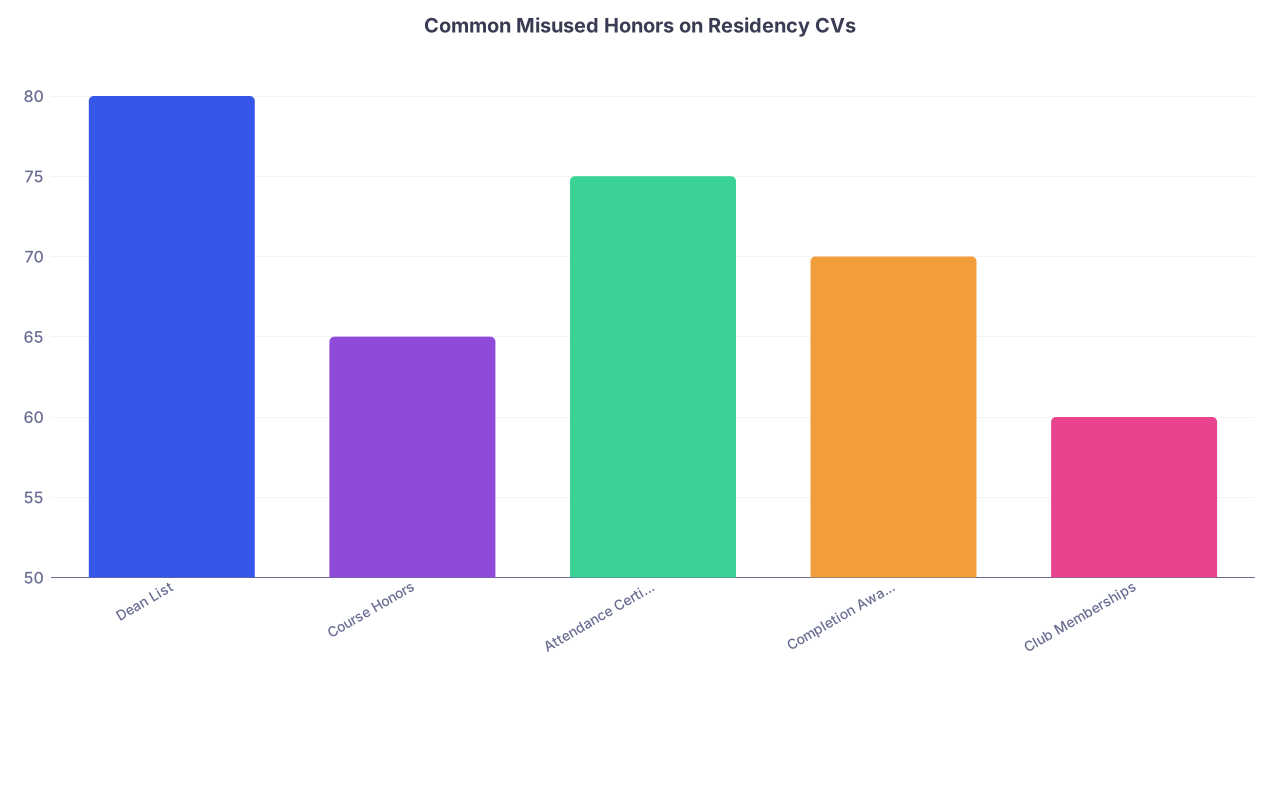
| Category | Value |
|---|---|
| Dean List | 80 |
| Course Honors | 65 |
| Attendance Certificates | 75 |
| Completion Awards | 70 |
| Club Memberships | 60 |
Let’s talk about Dean’s List, Honor Roll, and “Top 10% of Class”–type things.
These can be real honors. They can also be a mess if you present them badly.
Common mistakes:
Vague labeling that sounds inflated
“Academic Excellence Award” (when it’s just Dean’s List that 40% of the class got)
If the official name is “Dean’s List,” use that exact name. Don’t rebrand it.Listing the same thing four different times
“Dean’s List – MS1”
“Dean’s List – MS2”
“Dean’s List – MS3”
“Dean’s List – MS4”That looks like you’re stretching. Combine it: “Dean’s List (MS1–MS4)” with one line of description if absolutely needed.
Implying competitive selectivity where none exists
Writing “Top Student – Anatomy Course” because you got the highest test grade in your small group, not the whole class. That reads as misleading.
Be precise and modest. If your school does not officially rank, do not invent rank-sounding honors like “Top 10%” unless an official letter or MSPE language backs it up.
If your school does have serious honors:
- AOA
- Gold Humanism Honor Society
- Graduation with Distinction / with Honors
- Named scholarships based on academic performance or leadership
These are absolutely appropriate. Just do not mix them with fluff.
Pitfall #3: Turning Responsibilities Into “Awards”
This one screams “I don’t understand what an honor is.”
Things I regularly see shoved under Honors that absolutely are not:
- “Chief Scribe – XYZ Emergency Department”
- “Lead Tutor – Anatomy”
- “President – Internal Medicine Interest Group”
- “Team Captain – Intramural Basketball”
Those are leadership roles. They belong in Experiences (Leadership, Work, Extracurricular). Calling them awards sounds like you either don’t know the difference or are trying to manufacture prestige.
I’ve heard PDs say verbatim: “If they list being club president as an award, they probably overestimate themselves.”
Do you want that stuck in someone’s head while they’re hovering over the “interview” or “reject” button? No.
Pitfall #4: Not Understanding What PDs Actually Care About

Honors and awards matter, but they’re not magic keys.
Here’s the blunt truth:
- AOA / Gold Humanism: PDs care. Signals reliability and strong performance.
- National or institutional scholarships: Impressive if competitive and clearly described.
- Major research awards or best-presentation awards at serious conferences: Good plus.
- “Participation” anything: Mostly ignored; mild annoyance if miscategorized.
- Local club “MVP” or “Volunteer of the Month”: Very low yield, sometimes eye-roll territory if embellished.
PDs use this section to quickly answer:
- Did this person stand out among peers in any meaningful, verified way?
- Is there a pattern of excellence (academics, service, leadership)?
- Does what they call “honors” match my sense of that word?
If your section is packed with low-value items, PDs mentally discount the entire thing. Then your genuinely good items get ignored because they’re buried in noise.
Pitfall #5: Terrible Formatting and Incomplete Context
Even when the content is solid, people still manage to irritate readers with how they present it.
Common presentation mistakes:
No dates or vague timing
“Outstanding Medical Student Award”
When? MS1? MS4? During clerkships? PDs want to know when you were achieving.No issuing body
“Excellence in Research Award” from whom? Your school? A department? A regional organization? Some random online “conference”? If it’s not clear, it feels sketchy.Overly dramatic or grandiose language
“Prestigious Outstanding Physician of the Future Award”
If the organization named it, fine. But do not add adjectives or editorial spin in your description.No context of scale
“Best Poster Award – Internal Medicine Research Day”
That’s actually decent. But PDs will want to know: out of how many?Small, honest one-liner is enough: “Selected as best poster out of 45 submissions.”
Do not write a paragraph for each item; this is not a personal statement. Two lines per entry is usually the upper limit before it becomes obnoxious.
Pitfall #6: Mixing High-Value and Embarrassingly Low-Value Items
This mistake is subtle but deadly.
Example:
- Alpha Omega Alpha (AOA)
- Gold Humanism Honor Society
- “Certificate of Appreciation – Health Fair Volunteer”
- “Perfect Attendance Award – Preclinical years”
See the problem? The top two are excellent. The bottom two cheapen the whole list.
Think of this section like a curated shelf, not a junk drawer. The presence of trivial stuff tells the reader your judgment is off, or you’re desperately trying to look more decorated than you are.
If you have 2–4 genuinely strong honors, that is enough. Don’t tack on four mediocre items to “bulk it up.” Thinning it out can actually make you look stronger.
I’d rather see:
- Alpha Omega Alpha Honor Medical Society
- Gold Humanism Honor Society
- Best Student Research Presentation – [Institution] Research Day (1st place of 40 presentations)
…than those plus three more lines of fluff.
Pitfall #7: Including High School or Non-Relevant Undergrad Awards
You’re applying to residency, not college.
Here’s the usual mistake:
- “Valedictorian, [High School Name]”
- “National Merit Finalist”
- “AP Scholar with Distinction”
- “High School Science Fair Champion”
Unless you cured something in high school, leave it. You should almost never be listing high school accolades in a residency application.
For undergrad, be selective:
Acceptable if clearly substantial:
- Phi Beta Kappa
- Summa / Magna / Cum Laude
- Major national scholarships or fellowships
- Highly competitive national-level awards
Borderline-to-useless:
- Random departmental book prize nobody outside the department has heard of
- Residential hall “RA of the semester” awards
- Every local leadership “certificate” you ever got
If your medical school honors section looks sparse and you want to include one or two major undergrad distinctions, fine. But if half your honors are from undergrad or earlier, it hints that you stopped standing out when things got harder.
Pitfall #8: Vague, Misleading, or Over-Puffed Descriptions
| Type | Annoying Version | Better Version |
|---|---|---|
| Scholarship | “Highly prestigious scholarship awarded to top students” | “Merit-based scholarship awarded to 5 of 160 students for academic performance” |
| Poster Award | “National award-winning research presentation” | “Best resident/fellow poster – Regional Internal Medicine Conference (1 of 60 posters)” |
| Volunteer Recognition | “Outstanding humanitarian award” | Probably omit or move to service description if minor |
Watch for these red flags in your own writing:
- Using words like “prestigious,” “highly selective,” or “nationally recognized” when the organization isn’t well-known
- Hiding low scale behind dramatic language: “Recognized for excellence” instead of “department-level award given yearly to one MS3”
A grounded, modest description almost always reads better than a puffed-up one. PDs are allergic to spin. They’ve seen applicants try to turn a modest local certificate into “international recognition” more times than you think.
Pitfall #9: For International Grads – Over-Translating or Over-Equating
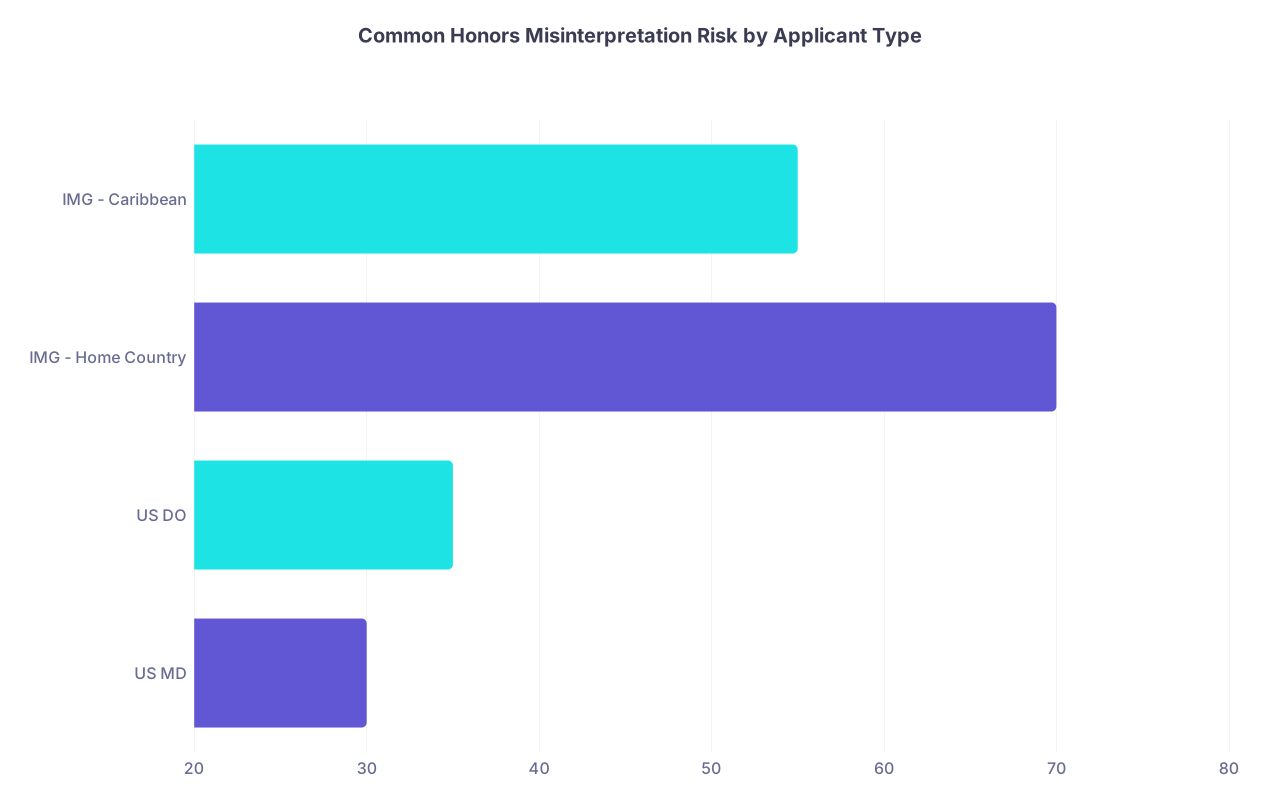
| Category | Value |
|---|---|
| US MD | 30 |
| US DO | 35 |
| IMG - Home Country | 70 |
| IMG - Caribbean | 55 |
If you’re an IMG, this section can help you a lot—or hurt you if you mis-handle it.
Frequent mistakes:
- Translating every small local recognition as if it were equivalent to AOA
- Using phrases like “top-ranked medical student in country” when that’s not rigorously defined
- Listing grade categories (like “First Division,” “Distinction”) as separate awards instead of part of your transcript or narrative
Here’s how to keep credibility:
Use original titles plus a short, factual explanation:
“University Gold Medal – Awarded to top graduating medical student (1 of 150)”Don’t create American-sounding labels for foreign systems:
Avoid “Dean’s List” if that’s not what your school calls it.Be very careful with “top X%” statements. Have actual documentation or official language backing it up.
When PDs feel something is being oversold, they mentally downrank the whole application. You need them trusting your judgment, not doubting every line.
Pitfall #10: Leaving Real Honors Undersold or Hidden
It’s not just about avoiding fake-looking honors. Another mistake: burying real ones.
Examples I’ve seen:
- Truly competitive school-wide leadership awards thrown into an experience description and never listed in Honors
- Major national scholarships mentioned in a research section line instead of highlighted
- High-level university medals or ranks included only in personal statements
If something required:
- A formal selection process
- Being better than a significant number of peers
- Competing at institutional, regional, or national level
…it probably belongs clearly labeled as an honor/award.
The error here is the opposite of padding: you’re so allergic to self-promotion that you hide the good stuff. Don’t do that. Clean, honest, and unexaggerated is not bragging. It’s clarity.
How to Clean Up Your Honors and Awards Section (Step-by-Step)

| Step | Description |
|---|---|
| Step 1 | List all items |
| Step 2 | Delete pure participation |
| Step 3 | Remove duties titled as awards |
| Step 4 | Group duplicates like Dean List |
| Step 5 | Rank by true selectivity |
| Step 6 | Cut lowest value fluff |
| Step 7 | Clarify dates and awarding body |
Here’s a quick triage process that will keep you out of trouble:
Write down everything you were planning to include
No editing yet. Just a raw list.Cross out anything that is purely attendance or completion
Conferences, workshops, basic life support courses—gone from Honors.Cross out anything that is actually a role, not an award
Club president, chief scribe, captain, etc.—move these to Experiences.Combine repetitive items
Multiple Dean’s List entries → one combined line.Sort remaining items by how selective they really were
If you don’t know how many people got it, find out—or downgrade its perceived weight in your head.Cut the bottom-tier fluff
If you have more than ~5–7 items, keep the strongest 3–7 and delete the trivial ones. Quality over volume.Add clear, modest context to each
Who gave it? When? Rough scale (if it helps and you can be honest)?
Do this, and you’ll already be ahead of a depressing chunk of applicants.
FAQ (Exactly 3 Questions)
1. I only have one or two real honors from med school. Should I add smaller things just to fill the section?
No. A short, clean section beats a bloated, embarrassing one every time. One line saying “Alpha Omega Alpha Honor Medical Society” is far more powerful than six lines of “attendance certificates” and participation awards. PDs don’t penalize you for not having a long list; they do quietly judge you for trying to fake one.
2. Can I include undergrad honors like Phi Beta Kappa or Summa Cum Laude?
Yes, if they’re substantial and you’re light on med school honors. Keep it to 1–3 major undergrad items: Phi Beta Kappa, major national scholarship, Summa/Magna Cum Laude. Don’t drag in high school awards or minor college club superlatives. Make sure med school recognitions, if present, appear first.
3. How do I know if an award is “important enough” for this section?
Sanity check it this way: if a busy program director skimmed your application in 30 seconds and saw this item, would it reasonably impress them or at least signal something meaningful (academic strength, leadership, service, professionalism)? If you feel a little sheepish imagining explaining it out loud to an attending, it probably doesn’t belong. Err on the side of fewer, stronger, clearly explained honors.
Key takeaways:
Honors and Awards should showcase selective recognition, not every certificate you’ve ever collected. PDs are turned off by padding, exaggeration, and mislabeled roles. Keep this section lean, honest, and clearly contextualized—and let your real achievements, however few, speak without all the noise.