
The way most people “recover” their CV after a leave of absence or academic setback is wrong. They hide, minimize, and hope programs will not notice. Programs always notice.
The goal is not to hide. The goal is to rebuild—deliberately—so your file tells a coherent story: “Yes, I hit a wall. Then I did something about it. And here is the evidence.”
Here is exactly how to do that.
Step 1: Get Clear On What You Are Fixing
Before you start stacking new lines on your CV, you need to define the damage. Not emotionally. Strategically.
There are only a few types of hits that matter for residency:
- Course failures or repeats
- USMLE/COMLEX failure(s) or low scores
- Leave of absence (personal, medical, academic, professionalism-related)
- Remediation or professionalism concerns
- Major gap in productivity (a “blank year”)
Each of these creates a different problem in a program director’s head:
- “Is this person reliable?”
- “Can they pass boards?”
- “Will they struggle under stress?”
- “Is there a professionalism risk?”
You rebuild your CV by giving hard evidence that answers those questions in your favor.
So first, write down:
- What exactly is the setback? (E.g., “Step 1 fail then pass with 216”; “LOA, July 2023–Jan 2024, personal health.”)
- When did it happen? How long did it last?
- What is your current status? (Back in good standing? Cleared for full-time training? Passed Step 2?)
You need this clarity before you decide what to add to your CV.
Step 2: Decide Your Rebuilding Strategy
You are rebuilding in three lanes:
- Academic / Board Signal – “I can handle the cognitive load.”
- Professional / Reliability Signal – “I show up, follow through, and function in a team.”
- Trajectory Signal – “My recent performance is strong and trending up.”
You can not fix the past. You can overpower it with better recent data.
Here is the brutal truth: a single failure or LOA is survivable if your most recent 12–18 months look excellent. That recent window is where you are going to load your CV.
Think in terms of a 6–18 month “rebuild plan,” depending on how close you are to applying.
Step 3: Fix the Academic Signal
If your setback involved failing courses, boards, or an LOA for academic reasons, your first job is to show you are no longer an academic risk.
A. Board-Related Setbacks
If you failed Step 1, Step 2, COMLEX, or scored low, you must have:
- A clear upward trend on the next exam
- Visible, documented work that explains that improvement
Concrete moves:
Structured Board Prep with Documentation
Do not just say “I studied harder.” Put things on your CV that prove intentional work:
- Tutor or structured course (e.g., “Boards and Beyond comprehensive review,” “UWorld self-assessment program”)
- Tutoring others (after you have passed) – shows mastery
- Participation in a board review group with defined responsibilities
On your CV:
- “Co-leader, Step 2 Study Group, University X, Jan–Jun 2025 – Organized weekly sessions, created question bank schedules, facilitated review of 2,000+ practice questions.”
Honors / High Pass in Clinical Rotations After the Setback
Programs care more about how you did after the problem.
Prioritize:
- Medicine, surgery, EM, and core rotations
- Acting internships / sub-internships in your chosen specialty
If you had a failure early and then 6–8 straight honors / high passes later, that goes a long way.
Formal Learning Plan
If your school put you on an academic plan and you completed it successfully, that is good data. Put structured elements on your CV:
- “Academic Skills Program, School of Medicine X – Completed intensive learning and test-taking strategies curriculum; ongoing mentorship with learning specialist.”
That sounds small. It is not. It signals: “I took corrective action, I complied, and it worked.”
B. Course Failures / Remediation
If you failed a preclinical course or clerkship:
- Repeat and pass with strong feedback.
- Ask for specific written comments that highlight reliability, improvement, or professionalism.
- If the school allows, get a brief letter from the course/clerkship director that directly comments on your improvement.
You can reference this in your personal statement and MSPE, but also reflect it indirectly in your CV through:
- TA roles
- Tutoring
- Committee involvement related to curriculum or assessment
Those tell a quiet story: you went from struggling student to contributor.
Step 4: Fill the Gap: What To Do During or After a Leave of Absence
A leave of absence by itself is not fatal. An empty leave is.
Programs worry most when they see “Leave of absence: 12 months” with nothing else on the CV for that period.
Your job is to fill that time with structured, legitimate activity. Does not have to be glamorous. It has to be real and sustained.
A. Types of Activities That Actually Help
Here are activities that strengthen your residency application during or after a leave:
- Research positions (paid or volunteer)
- Quality improvement (QI) projects
- Clinical research assistant / coordinator roles
- Teaching or tutoring (MCAT, undergrad sciences, Step prep)
- Public health or community health initiatives
- Administrative roles in healthcare organizations
- Formal coursework (MPH classes, biostats, clinical research methodology)
Avoid informal, vague entries like “self-study,” “personal reading,” or “informal shadowing 3 hours/week.” Weak signal. Looks like filler.
B. How To Find Real Positions Quickly
You don’t need a brand-name NIH fellowship. You need a legitimate position with continuity and output.
Here is a simple, ruthless outreach protocol:
Make a 15–20 faculty target list in your school or nearby institutions in your intended specialty or adjacent fields.
Send a short, direct email (do not write a life story):
- 3–4 sentences
- Attach your CV
- Mention specific skills (REDCap, Excel, data entry, basic stats, literature review)
Example:
Subject: Medical student available for research/QI assistance
Dear Dr. Patel,
I am a fourth-year medical student at University X, currently on a leave of absence and seeking a 6–12 month research or quality improvement position in internal medicine. I have experience with REDCap, chart review, and basic statistics in R, and I am available full-time. My CV is attached.Would you be open to a brief conversation about ways I could contribute to your ongoing projects?
Sincerely,
…Expect a low response rate. Send widely. Follow up once after 7–10 days.
Say yes to the first decent, structured opportunity you get.
You are not trying to find the perfect project. You are trying to show:
- You used your leave to work
- You stayed connected to medicine
- You produced something (abstract, poster, paper, QI implementation)
Step 5: Build Concrete CV Lines That Matter
You do not rebuild your CV with vague fluff. You rebuild with entries that have:
- Clear role
- Defined timeframe
- Tangible outputs

A. Research and Scholarly Work
Target: At least 1–2 genuine outputs (poster, abstract, paper) between the setback and application.
On your CV, list like this:
- Research Assistant, Department of Cardiology, University Y
July 2024 – Present- Conducted chart reviews of 250+ patients with heart failure for outcomes study on readmissions.
- Managed REDCap database and performed initial descriptive statistics.
- Co-authored abstract submitted to ACC 2025.
Do not write: “Assisted with various research tasks.” That means nothing.
B. Quality Improvement (QI)
Programs love QI when it is real and implemented.
Examples:
- “Reduced missed follow-up appointments by 15% in resident clinic through reminder workflow redesign.”
- “Implemented standardized handoff checklist on night float; tracked and reported reduction in adverse events.”
Put QI in its own section or under “Research and Quality Improvement.”
| Activity Type | Strength for CV | Time to Show Impact |
|---|---|---|
| Formal research | Very High | 6–12 months |
| QI project | High | 3–9 months |
| Teaching/tutoring | Moderate-High | 3–12 months |
| Extra rotations | High | 2–6 months |
| Coursework/MPH | Moderate | 6–24 months |
C. Teaching and Mentoring
Teaching is an underused way to show maturity after a setback.
Options:
- Tutor junior med students in subjects you once struggled with
- Lead a review series before exams
- Tutor MCAT/undergrad sciences
- Serve as near-peer mentor in student success programs
Frame it clearly:
- “Peer Tutor, Medical Physiology, University X – Led weekly review sessions for 15 first-year students; developed practice exam questions and answer keys.”
Programs read that and see: someone who reflects on learning, takes responsibility, and gives back.
Step 6: Optimize the Timeline View of Your CV
One of the biggest mistakes I see: people bury their best “recovery” work at the bottom of the CV.
Your recent 12–18 months must be the star of the show.
A. Make the Post-Setback Period Look Dense and Intentional
Look at your CV month by month. For each month since the setback, can you show at least one of these?
- Ongoing employment or research role
- Active project (QI, community, scholarly)
- Coursework or structured training
- Clinical responsibilities (rotations, observerships, externships)
If not, fix it. You do not have to fill every week. You should not have 6-month blank holes.
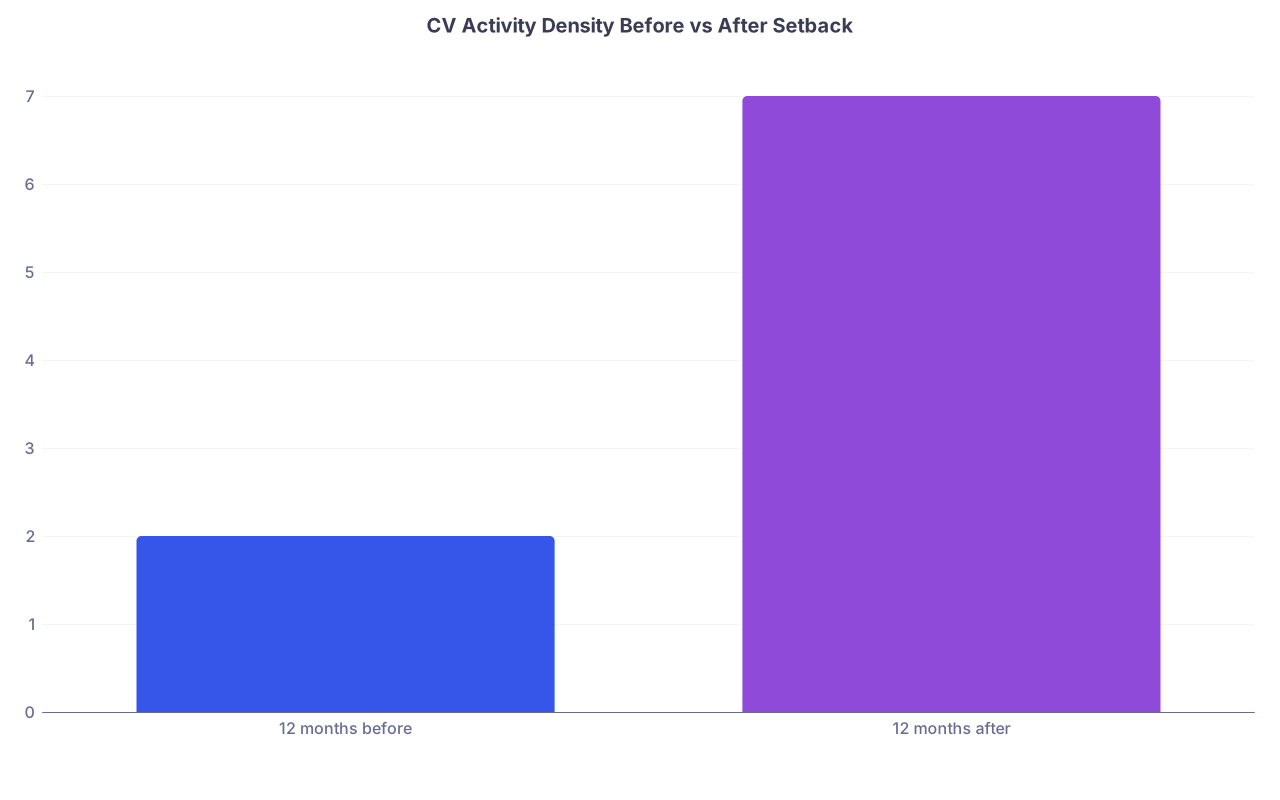
| Category | Value |
|---|---|
| 12 months before | 2 |
| 12 months after | 7 |
If you had 2 substantial entries in the year before your setback and now you have 7 in the year after, that is a very clear narrative: you turned things around.
B. Use “Relevant Experience” Sections Strategically
You are allowed to organize your CV to highlight your strengths.
Examples:
- Clinical Experience
- Research and Quality Improvement
- Teaching and Leadership
- Additional Training and Certifications
Do not hide your best recent work under “Other.” Bring it up.
Step 7: Address the Elephant Directly (Without Over-Explaining)
Your CV is only one piece. Programs will also see:
- MSPE (Dean’s Letter)
- Personal statement
- Possibly a “leave of absence” explanation box in ERAS
You cannot control all of those, but you can make them consistent.
How To Frame a Setback in One Clean Paragraph
Use this formula:
- One sentence: What happened (brief, factual).
- One to two sentences: Why it is not an ongoing risk (treatment completed, stable situation, supports in place).
- Two to three sentences: What you did afterward that supports readiness (performance, projects, outcomes).
Example for a Step failure with LOA:
During my second year, I experienced a major depressive episode that resulted in a leave of absence and an initial unsuccessful attempt at Step 1. I engaged in treatment, worked closely with student affairs, and returned once I was stable and cleared for full-time training. Since my return, I passed Step 1 and Step 2 on the first attempt, honored four core clerkships, and spent a dedicated year in outcomes research, leading to two abstracts and one manuscript under review. This period forced me to build sustainable habits, seek help early, and develop the resilience I now bring to residency.
On your CV, you do not need to repeat the whole story. Just make sure:
- The leave dates on the CV line up with what you say elsewhere.
- The entries after the leave show exactly the growth you claim.
Step 8: If You Are Already in the Match Cycle
Some of you are reading this with ERAS already submitted or interviews coming. Too late for a 12-month rebuild. Not too late to strengthen.
Focus on three immediate upgrades:
1. Micro-Scholarly Outputs
Talk to your current mentor about:
- Rapid abstract submissions
- Case reports
- Short communications / letters to the editor
You will not get a Nature paper in time. You can get “Abstract accepted to Regional Meeting X, Spring 2026.”
Put it on your CV as “submitted” or “accepted” as soon as it is real.
2. Updated Experiences Section
If you start a legitimate ongoing role, add it:
- “Research Assistant, Department of Neurology – Oct 2025–Present.”
Programs like to see that you are doing something now, not just coasting to graduation.
3. Strong Letters That Speak to the Recovery
Choose letter writers who:
- Know about your setback
- Can honestly say you are functioning at or above the level of your peers
- Will explicitly comment on your reliability, professionalism, and clinical performance
You cannot put their words on your CV, but their letters will either reinforce or contradict your “rebuild” story. Make sure they reinforce.
Step 9: Specialty Strategy: Aim, Adjust, or Pivot
Not every specialty will treat your setback the same. You must be realistic.
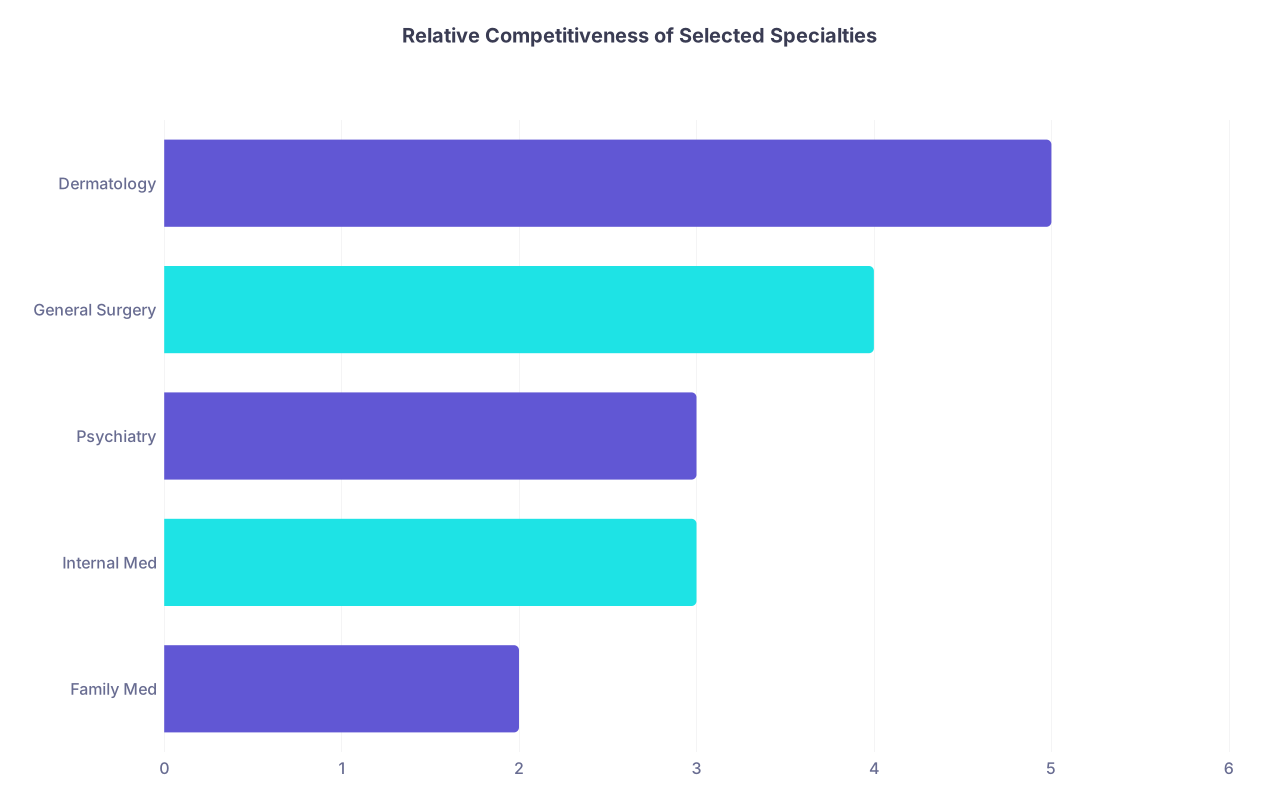
| Category | Value |
|---|---|
| Family Med | 2 |
| Internal Med | 3 |
| Psychiatry | 3 |
| General Surgery | 4 |
| Dermatology | 5 |
(Scale 1 = least competitive, 5 = most competitive.)
If you have a significant academic blemish:
- Matching into dermatology, plastics, neurosurgery becomes very unlikely unless your rebuild is extraordinary and you have strong institutional backing.
- IM, FM, psych, peds, and some surgical prelims are more realistic with a strong recovery story.
This is not pessimism. It is triage.
If you are set on a competitive specialty:
- Consider a research year (or two) with major output at a big-name center.
- Be open to applying more broadly, including less competitive specialties as backups.
- Use away rotations / sub-Is strategically to get champions in the field.
If you are flexible:
- Choose a specialty where your post-setback strengths matter: long-term patient relationships, communication skills, QI, teaching.
- Have your mentor and dean be very frank with you about target specialties and program tiers.
Step 10: Build a Simple Rebuild Roadmap (6–18 Months)
You are overwhelmed? Fine. Here is a concrete layout you can adapt.
Scenario A: You Have 12–18 Months Before Applying
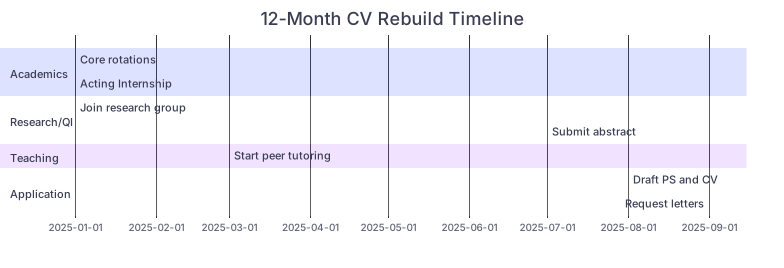
| Task | Details |
|---|---|
| Academics: Core rotations | a1, 2025-01, 6m |
| Academics: Acting Internship | a2, after a1, 3m |
| Research/QI: Join research group | b1, 2025-01, 9m |
| Research/QI: Submit abstract | b2, 2025-07, 3m |
| Teaching: Start peer tutoring | c1, 2025-03, 6m |
| Application: Draft PS and CV | d1, 2025-08, 2m |
| Application: Request letters | d2, 2025-09, 1m |
Non-negotiables:
- Strong performance in all remaining core rotations
- At least one acting internship in your target specialty with excellent evals
- Ongoing research/QI with at least one concrete output
- Some visible teaching or mentorship activity
Scenario B: You Have 6 Months or Less
You compress:
- Focus like a laser on current rotation performance (honors, strong evals)
- Start a small, fast QI project with a clear metric
- Draft your personal statement around your recovery arc
- Secure letters that explicitly address your current readiness
This is not the time to dabble in three new clubs. You need depth in a few high-yield areas, not breadth.
Step 11: Common Pitfalls That Kill a Rebuild
I have seen people sabotage their recovery more than once with the same mistakes.
Avoid these:
Pretending it did not happen
- Programs already know. Silence looks evasive.
Over-explaining or oversharing personal details
- You do not need your full psychiatric history on display. Focus on functional outcomes.
-
- “Attended webinar series,” “informal observer,” “shadowed neighbor’s clinic 2 hours/week.” Weak.
Starting too many things, finishing nothing
- One completed QI project beats five “ongoing” projects that never produce a single poster.
Letting the gap stay empty
- If you are on leave now, you need to be working on something structured: research, work, course, or formal treatment plan that leads to documented stability.
Step 12: How To Know If Your Rebuild Is Working
You are not going to get an email saying, “Congratulations, your CV is now acceptable.”
So use some proxies:
- Have you eliminated blank months on your CV after the setback?
- Do you have at least 2–3 strong, recent letters that explicitly praise your reliability and clinical performance?
- Do your last 12–18 months of grades show an upward or strong stable trend?
- Do you have at least 1–2 tangible scholarly outputs (accepted or under review)?
If you can answer yes to most of these, your rebuild is on track.
Quick Reality Check
You cannot erase a leave of absence, a failed exam, or a rough semester. Programs will see it.
What you can do is make them say, “That was then. This is clearly different.”
A well-rebuilt CV does three things:
- Shows sustained productivity after the setback
- Demonstrates academic and professional stability
- Tells a coherent story backed by real work, not excuses
Do not chase perfection. Chase evidence.