
The worst way to “improve your CV” during dedicated Step study is to chase shiny extras and sabotage your score. You are not building a résumé; you are building a story. And during dedicated, your Step score is still the loudest chapter.
Let me walk you through how to strategically add to your CV without wrecking your exam performance—week by week and, when it matters, day by day.
3–4 Months Before Dedicated: Set the Rules of the Game
At this point, you should not be “adding activities.” You should be designing constraints. Decide now what you will and will not do once dedicated starts.
Step 1: Define your non‑negotiables
Before you touch your CV, answer three questions:
- What is your realistic Step target for your specialty?
- What is your actual baseline (NBME/UWorld self‑assessments)?
- Where is your CV already strong, and where is it weak?
Pull up your current CV and mark:
- Research entries
- Leadership roles
- Teaching / tutoring
- Volunteering / advocacy
- Presentations / posters
- Work experience
Now compare that to your specialty’s culture. A few quick examples:
| Specialty | Step Emphasis | Research Need | Leadership/Service Emphasis |
|---|---|---|---|
| Dermatology | Very High | Critical | Moderate |
| Orthopedics | Very High | Strong | Moderate |
| Internal Med | High | Helpful | Moderate |
| Pediatrics | Moderate | Helpful | High |
| Psychiatry | Moderate | Helpful | Moderate |
If you are aiming at derm with a thin research section and shaky baseline scores, your “CV building during dedicated” is actually: lock down Step, then squeeze in tightly scoped, high‑yield tasks.
If you are aiming at peds with a strong Step baseline and a thin service record, you can afford small, consistent service or QI tasks that do not derail studying.
Step 2: Build a capacity budget, not a wish list
You get a fixed amount of cognitive bandwidth. Pretending otherwise is how people burn out and tank both Step and their mental health.
At this point, you should:
- Estimate your study hours per day during dedicated (be honest: 8–10 hours is the max usable for real humans).
- Cap your CV‑related work at:
- 2–4 hours per week if your baseline NBMEs are weak
- 4–6 hours per week if your baseline is solid and you test well
Never plan daily CV tasks during dedicated. Plan one or two specific blocks per week. Everything else waits.
6–8 Weeks Before Dedicated: Choose One Main CV Lane
Now that you know your limits, you pick one primary CV lane to push during dedicated. Not three. One.
At this point, you should decide:
- “I will be the research person.”
- Or, “I will be the teaching person.”
- Or, “I will be the QI / systems / advocacy person.”
Picking one lets you make small but meaningful moves that add up.
Good vs bad CV goals for dedicated
You need contained, low‑friction projects that move your CV without spiraling into time sinks.
| Type | Good Dedicated Goal | Bad Dedicated Goal |
|---|---|---|
| Research | Finish data analysis for 1 project | Start new prospective study |
| Writing | Draft 1 case report | Write full original research alone |
| Teaching | Weekly 1‑hr Step review group | Run a full multi‑week new course |
| Leadership | Wrap up a small QI initiative | Launch a new student organization |
| Volunteering | 2 hrs/week stable clinic role | Unstructured, variable events |
Your litmus test:
“Can this be done in 1–2 predictable blocks per week, without emergencies?”
If the answer is no, it is a bad dedicated‑period project.
2 Weeks Before Dedicated: Lock in Your Micro‑Projects
This is where most students mess up. They walk into dedicated with a vague promise: “I’ll keep doing a little research and maybe some volunteering.” That is how you end up doing a chart review at 11 p.m. instead of finishing UWorld.
At this point, you should:
Pick 1–2 micro‑projects max. Examples:
- Finalizing data and drafting figures for an existing study.
- Writing the first draft of a case report you already have data for.
- Running a once‑weekly 1‑hour group tutoring session for pre‑clinicals.
- Completing a very narrow QI project (e.g., audit and simple intervention with pre‑defined endpoints).
Define the scope in writing.
Literally write:- What “done” looks like.
- How many weeks you will touch it.
- How many hours per week.
Negotiate expectations with mentors.
Email your PI or supervisor something like:“Dedicated for Step starts on [date]. I can give 2–3 hours per week during that window. My specific goal is [X: complete data cleaning / draft intro + methods]. After the exam, I can ramp back up. Does that work on your end?”
If a mentor pushes back and expects more during dedicated, that is a red flag. I have watched students try to “be a team player” and end up with a mediocre Step score and a half‑finished paper that never sees PubMed.
During Dedicated: The Week‑by‑Week CV Strategy
Now we get to the part you actually care about: what to do during those 4–8 brutal weeks.
Global rule: Step work first, CV work last
Non‑negotiable pattern:
- Morning to late afternoon: Step.
- Late day / early evening: decompress + optional CV block.
- Never flip this. You are not “earning” Step time by doing research; it is the other way around.
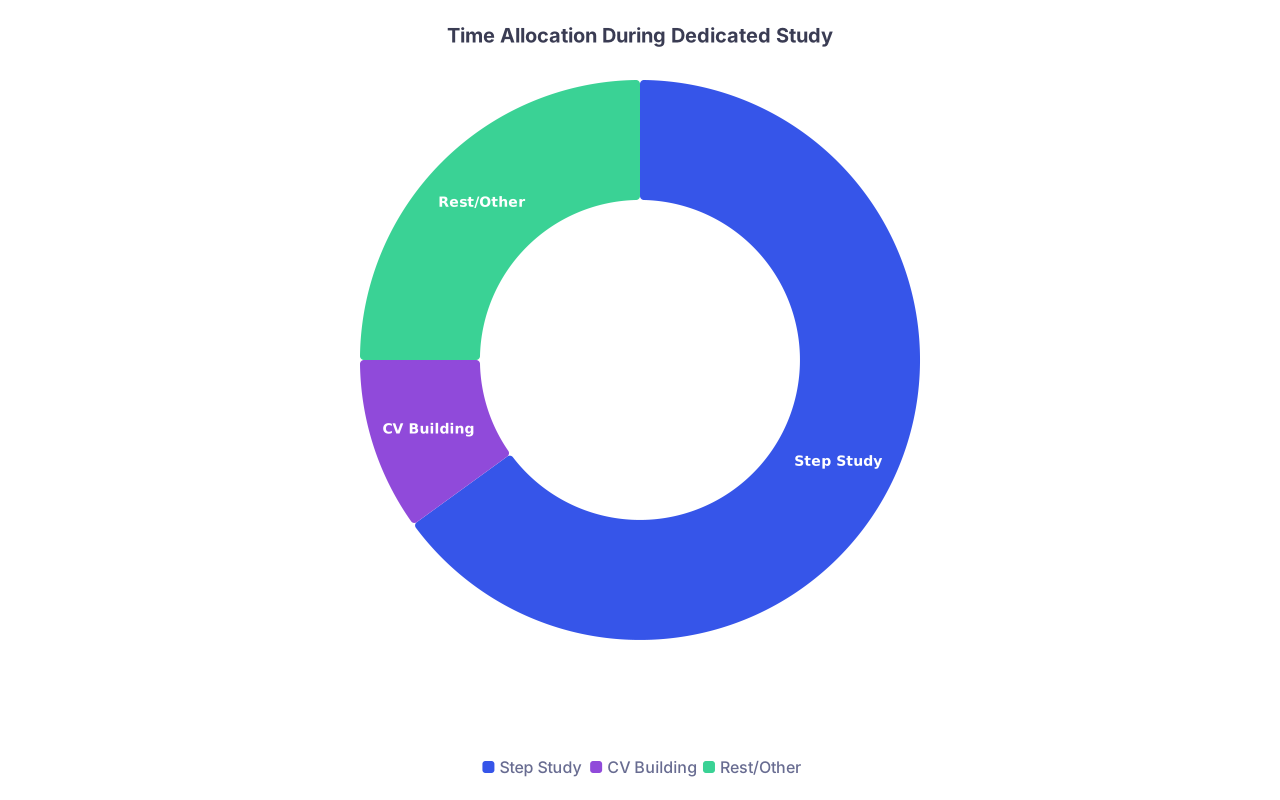
| Category | Value |
|---|---|
| Step Study | 65 |
| CV Building | 10 |
| Rest/Other | 25 |
Aim for something like this distribution across a typical dedicated week.
Week 1 of Dedicated: Stabilize, Do Almost Nothing Extra
At this point, you should be proving to yourself that your study schedule is realistic.
Your priorities:
Get your daily Step rhythm consistent:
- Question blocks
- Review time
- Anki / flashcards
- Content gaps
Limit CV actions to:
- Quick, low‑cognitive tasks:
- Responding to 1–2 important emails.
- Confirming timelines with your PI.
- Skimming a manuscript you already know well.
- Quick, low‑cognitive tasks:
Try this Week 1 template:
- Mon–Fri:
- 8–10 hours Step work.
- 0–30 minutes CV admin (if absolutely needed).
- Sat:
- Slightly shorter study day + 60–90 minutes CV work only if your study targets were met all week.
- Sun:
- Light review + proper rest. No intense CV work.
If by the end of Week 1 you are already behind on UWorld/NBMEs and exhausted, your CV work for the rest of dedicated should be zero. Yes, really. Your “CV boost” becomes a strong Step performance.
Weeks 2–3: Introduce Controlled CV Blocks
If your Week 1 went reasonably well, you can now add one predictable CV block per week.
At this point, you should:
- Block a single 2‑hour chunk on the same day every week:
- Example: Saturday 3–5 p.m. or Sunday 10–12 a.m.
- Define exactly what will happen in that block before the week starts.
Sample Week 2–3 plan by CV lane
If your lane is research:
Week 2:
- Aim: Clean dataset for one analysis.
- Block: Saturday 3–5 p.m.
- Task list:
- Finish missing data checks.
- Finalize variable names.
- Email co‑author with specific questions.
Week 3:
- Aim: Run main analysis and export tables/figures.
- Block: Sunday 10–12 a.m.
- Task list:
- Run pre‑planned models only.
- Create 1–2 key tables.
- Save outputs clearly for post‑Step writing.
If your lane is teaching:
Week 2:
- Aim: Run 1 small review session for underclassmen.
- Block: Wednesday 7–8 p.m.
- Task list:
- Night before: spend 20–30 min picking questions.
- Keep to 1 hour, hard stop.
Week 3:
- Aim: Repeat with a different topic.
- Same time, same cap.
The point is structure. No ad‑hoc favors. No “oh, I’ll just jump on one more Zoom call.”
Weeks 4–5: Consolidate, Then Decide Whether to Push or Pause
This is the danger zone. Step fatigue is real. Your scores might plateau or even dip slightly. This is the exact moment you are most at risk of making dumb CV decisions.
At this point, you should:
Reassess with data:
- Look at your last 2 NBMEs.
- Are you on track for your target specialty?
- Are you mentally hanging on or fraying?
Make a binary decision:
- If NBMEs are on target and you feel stable → keep your 1 weekly CV block.
- If NBMEs are lagging or you feel fried → pause all CV work until the exam.
Good Week 4–5 moves if you are stable
Focus on completion signals that clearly improve your CV:
- Turn a draft into a submitted abstract.
- Convert rough notes into a near‑final case report draft.
- Finalize a QI project summary: background, intervention, outcome data.
Each week, one 2–3 hour block, maximum. No stacking.
Bad Week 4–5 moves (things I have watched ruin scores)
- Saying yes to a “quick” new chart review.
- Agreeing to lead a new teaching initiative.
- Taking on more clinic or volunteer shifts “because people are short‑staffed.”
If something new shows up in Week 4–5, your default answer is:
“I am in dedicated Step study and can commit again after [exam date].”
Final 1–2 Weeks Before Step: Shut It All Down
You do not “finish a paper” the same week you take a high‑stakes exam. That fantasy is how people end up scrolling PubMed at midnight while panicking over cardiology.
At this point, you should:
- Stop all CV blocks.
- Send a brief update to mentors:
- “I will be off email through [Step date] to focus on the exam. After that, I plan to [resume writing / finish analysis / move the manuscript forward].”
Your entire mental world should now be:
- Exam logistics
- Test strategy
- Sleep
- Nutrition
- Light exercise
- Minimal, necessary communication
No “just one more edit.” No “I’ll squeeze in the abstract.” That is how burnout locks in.
The Day of Step: Nothing CV‑Related
This should be obvious. But I have seen students revising abstracts in the parking lot.
On test day:
- Phone off or on Do Not Disturb.
- Email closed.
- All CV thoughts are deferred to Future You.
Burning mental energy on anything else is self‑sabotage.
1–7 Days After Step: Controlled Decompression and Smart CV Moves
The day after Step, your brain is mush. You are not cranking out meaningful scholarship.
At this point (Day 1–2 post‑Step), you should:
- Rest.
- Move your body.
- Sleep.
- Do easy life admin (laundry, groceries, clean your inbox lightly).
Day 3–7 post‑Step is your sweet spot for low‑intensity, high‑yield CV work before rotations or sub‑Is hit again.
Post‑Step Week Plan
Use a 3–4 hour daily cap on anything cognitively heavy.
Aim for:
2–3 days focused on finishing highest‑yield CV items:
- Turn that almost‑done case report into a full draft to send to a mentor.
- Format and submit the abstract you already outlined.
- Write up the QI project into a short presentation or poster format.
2–3 days focused on:
- Updating your CV with:
- “USMLE Step [X] taken [date] – score pending” (later update the actual score).
- “Data analysis completed” or “Manuscript in preparation” where accurate.
- Drafting bullet points for ERAS based on the work you just finished.
- Updating your CV with:
This is a quiet, powerful week for your future application. You finally have time, and the stakes are lower.
1–3 Months Before ERAS Submission: Convert Work Into Bullet‑Ready Achievements
Now your Step score is back. Rotations are active again. Applications are on the horizon.
At this point, you should:
Translate effort into outcomes.
Ask for:- Formal titles: “Research assistant,” “Project co‑lead,” “Small group facilitator.”
- Clear deliverables: posters, abstracts, manuscripts, curriculum sessions.
Shape each activity for ERAS with this formula:
Role + Action + Scope + Outcome
Examples:
- “Research assistant – Retrospective cohort study of 300 patients with [condition]; performed data cleaning and multivariable regression analyses; co‑authored abstract accepted to [meeting].”
- “Small group facilitator – Led weekly 1‑hour Step 1 review sessions for 10 pre‑clinical students; designed board‑style questions and provided structured feedback.”
Be honest but not timid.
If you truly did the analysis, say so. Do not undersell with vague “helped with research.”
How This Actually Helps Your Residency CV (Without Killing You)
If you follow this timeline, you end up with:
- A Step score that actually keeps you in the game.
- 1–2 real, finished outputs:
- A submitted or accepted abstract.
- A manuscript in serious draft form.
- Documented teaching or QI with results.
You avoid the worst CV sin: a long list of half‑started, half‑finished “projects” that make you look scattered in interviews.
And you also avoid the worst wellness sin: crawling into sub‑Is already burned out because you tried to be superhuman during dedicated.
What You Should Do Today
Do not overthink this. Take 25 minutes.
- Open your calendar for your dedicated period.
- Block off:
- Daily Step time.
- One 2‑hour CV block each week during Weeks 2–4 only.
- Then open your CV and pick one lane (research, teaching, or QI/advocacy).
- Write a 2–3 sentence email to the mentor in that lane setting hard limits on your availability during dedicated.
If that email feels uncomfortable, send it anyway. That small boundary protects your Step score, your sanity, and, ironically, your future CV.