
Most residency applicants waste their non‑clinical experience. Program directors do not trust what they cannot understand.
Let me be blunt: “Software Engineer, JP Morgan, 2018–2021” dumped into ERAS with three vague bullet points does almost nothing for you. Clinical directors are not going to reverse‑engineer what that means at 11:45 pm while skimming 80 applications in a row.
Your job is not to show that you had a tech, finance, or military life. Your job is to translate it into residency‑relevant evidence: reliability, judgment, pattern recognition, leadership, execution under pressure. If the PD has to do translation in their head, you already lost.
I will walk you through how to:
- Strip your non‑clinical work down to its competencies
- Rebuild it in clinical language PDs recognize
- Avoid the red flags that make non‑traditional applicants look risky
- Write concrete bullets that sound like medicine, not LinkedIn
1. How Program Directors Actually Read Non‑Clinical Work
Forget what your premed advisor told you. Program directors are not “impressed” by brand names alone. They care about two things:
- Can you function safely on Day 1 of residency?
- Are you worth the risk compared with a totally straightforward applicant?
Non‑clinical work cuts both ways.
They see:
- Potential big upside: maturity, resilience, systems thinking, leadership.
- Potential big downside: rusty clinical skills, divided priorities, “career tourist.”
So when a PD sees “Google, Investment Banking, Captain – US Army” their brain starts scanning for:
- Did this delay training so long their knowledge is stale?
- Do they jump careers when bored?
- Did they actually lead, or just hold a fancy title?
- Does any of this map to team‑based patient care?
If your CV does not answer those questions inside the bullets, they default to the safest interpretation: nice background, but not worth the uncertainty.
Your task is to pre‑empt that skepticism.
2. The Translation Framework: From “Job Description” to “Residency Competency”
Stop thinking “what did I do?” and think “what did this prove about how I operate?”
There are six buckets PDs subconsciously grade you on. Everything non‑clinical needs to land in one or more of these.
| Residency-Relevant Area | What PDs Look For | Non-Clinical Evidence Examples |
|---|---|---|
| Reliability & Work Ethic | Show up, finish work | Shift work, deployment tempo, sprints |
| Teamwork & Communication | Function in teams | Cross-functional projects, platoons |
| Leadership & Ownership | Take responsibility | Leading squads, teams, client accounts |
| Cognitive Rigor & Problem Solving | Handle complexity | Data analysis, trading, systems design |
| Stress Tolerance & Judgment | Perform under pressure | Production outages, combat, market days |
| Systems & Process Thinking | Improve care delivery | Process improvement, QA, SOPs |
Every bullet under your tech / finance / military role should clearly speak to at least one of these. Ideally two.
Here is the mental algorithm:
- Write down the raw tasks in your old job.
- For each task, ask: What was hard about this? Where was the risk? Who relied on me?
- Translate that into: reliability, leadership, high‑stakes decision making, complexity handling, process improvement.
- Convert it into measurable, concrete bullets in plain language.
We will go through tech, finance, and military separately. The patterns are similar, but the typical traps are different.
3. Tech Background: From “Developer” to “Systems Thinker Under Pressure”
The biggest problem with tech experience on ERAS? It reads like generic corporate fluff. PDs see “Agile,” “stakeholders,” “roadmap” and instantly tune out.
You want to pull out what actually matters for medicine: debugging under time pressure, maintaining reliability, collaborating in diverse teams, owning outcomes, communicating complex concepts simply.
What tech experience signals – when written correctly
- You understand systems and failure modes (yes, this is directly relevant to patient safety and quality).
- You can iterate, measure, and improve workflows.
- You can handle on‑call pressure and urgent triage of problems.
- You have experience with structured feedback and code review (analogous to clinical supervision).
What to stop writing
Bad bullets I have actually seen from tech‑background applicants:
- “Implemented cloud-native microservices improving scalability.”
- “Collaborated with cross-functional stakeholders to align on product roadmap.”
- “Utilized Agile methodology to drive deliverables.”
This gives a PD absolutely nothing clinically relevant. It might as well be lorem ipsum.
How to translate it
You rewrite around risk, volume, and responsibility.
Example: Software Engineer → Residency‑friendly bullets
- Old: “Built and maintained microservices for customer data platform.”
- New: “Maintained a high‑volume data system used by ~5 million users, triaging and resolving time‑sensitive failures during off‑hours to restore function within strict uptime targets.”
What this now says to a PD: this person has actually been the one everyone calls at 2 am when something breaks. That sounds a lot like cross‑cover.
Another one:
- Old: “Led migration of analytics stack to cloud infrastructure.”
- New: “Coordinated a multi‑team migration of a critical analytics platform, creating checklists and contingency plans that reduced deployment errors by 40% and avoided service downtime.”
Now we are talking: checklists, risk mitigation, error reduction. That is language straight out of patient safety literature.
You see the pattern. Emphasize:
- Scale: “high‑volume,” “large user base,” “multi‑team.”
- Risk: “time‑sensitive,” “critical,” “strict uptime,” “avoided data loss.”
- Process: “checklists,” “standard operating procedures,” “incident reviews.”
Example ERAS entry – Tech
Experience Type: Work Experience
Title: Software Engineer (Site Reliability Focus)
Organization: Major Consumer Technology Company
- Provided primary on‑call support for a large‑scale production system used internationally, prioritizing and resolving time‑critical failures to meet strict reliability targets.
- Led post‑incident reviews that identified recurrent failure patterns and implemented process changes, reducing repeat incidents by 35% over 12 months.
- Mentored junior engineers on systematic troubleshooting and communication during outages, emphasizing clear status updates to nontechnical stakeholders.
Every one of those bullets can map cleanly in a PD’s mind to residency behavior.
4. Finance Background: From “Analyst” to “High‑Pressure Decision Maker with Accountability”
Finance experience makes a lot of PDs nervous for one simple reason: they assume you left a very high salary for medicine and might leave again. You must counter that by showing long‑term commitment and by highlighting transferable skills.
Done correctly, finance can be an asset: real responsibility, handling uncertainty, working in fast cycles, dealing with demanding seniors and clients.
What finance experience can prove
- You can handle high‑pressure, time‑sensitive situations.
- You are comfortable making decisions with incomplete data.
- You have serious work ethic and tolerance for long hours.
- You can manage complex information quickly and communicate concisely.
The common mistakes
Bad ERAS‑style bullets from finance:
- “Built DCF and LBO models to support M&A transactions.”
- “Collaborated with senior bankers to pitch strategic alternatives.”
- “Conducted sector coverage and prepared client presentation materials.”
Again, it sounds like a business school brochure. No PD will unpack it.
Translate into clinical concepts
You want to emphasize:
- Volume and intensity.
- Accountability.
- Judgment and triage.
- Communication under time pressure.
Example: Investment Banking Analyst → Translated bullets
- Old: “Executed M&A transactions in the healthcare sector.”
- New: “Worked 70–90 hour weeks on time‑sensitive transactions, managing multiple concurrent workstreams and delivering error‑free analyses under intense scrutiny from senior partners and clients.”
Now it reads like someone who can survive q4 call and still function.
Another one:
- Old: “Built financial models to assess transaction scenarios.”
- New: “Synthesized large, incomplete data sets into concise recommendations with clear risk profiles, often within 24–48 hours, to support multi‑million‑dollar decisions.”
That is basically a consult note framed in finance language.
Addressing the “flight risk” concern
Somewhere in your application (personal statement or description) you should very briefly anchor why medicine, not just career tourism:
- “After 3 years in investment banking, including healthcare deals, I committed to medicine and have pursued continuous full‑time clinical and academic work since 2019.”
No drama, just a clean pivot story.
Example ERAS entry – Finance
Experience Type: Work Experience
Title: Investment Banking Analyst – Healthcare Group
Organization: Bulge‑Bracket Bank
- Managed parallel workstreams on multiple healthcare transactions, consistently delivering high‑accuracy analyses in 70–90 hour work weeks with tight, unpredictable deadlines.
- Consolidated complex financial and operational data into brief written and verbal updates for senior decision makers, tailoring communication to nontechnical audiences.
- Anticipated and corrected potential errors by instituting personal checklists and peer reviews, preventing mistakes in materials used in client negotiations.
Again, this is all now residency‑relevant: workload, communication, error prevention.
5. Military Background: From “Rank and MOS” to “Leadership, Discipline, and Risk Management”
Military service is the easiest of the three to use well, and paradoxically, one of the most misused. Many applicants rely on rank and branch alone to carry the weight. It does not.
PDs love concrete, credible leadership and resilience. The military can prove both, if you stop hiding behind acronyms.
What military experience signals strongly
- You understand chain of command and team structure.
- You have led people, not just projects.
- You have trained, supervised, and evaluated subordinates.
- You have operated with real consequences for mistakes.
What goes wrong
I see this a lot:
- “Served as Platoon Leader for XYZ unit, responsible for training and operations.”
- “Managed logistics for battalion-level operations.”
- “Deployed to [location], participating in multiple missions.”
All true. All vague. All a missed opportunity.
Translate with specificity, but in civilian language
Avoid acronyms and jargon. A PD may have never met anyone from your MOS.
Focus on:
- Number of people you led.
- Scope of responsibility (equipment, missions, locations).
- Training, supervision, and evaluation.
- Risk and safety.
Example: Army Officer → Translated bullets
- Old: “Platoon Leader responsible for training and readiness.”
- New: “Led a 38‑soldier platoon, overseeing training, performance evaluations, and daily operations, with direct responsibility for safety and readiness during field exercises.”
Now a PD sees: direct people leadership, evaluation, safety culture.
Another:
- Old: “Managed maintenance and accountability of equipment.”
- New: “Maintained accountability and operational readiness of equipment valued at approximately $8 million, achieving zero reportable losses across 3 years.”
That is an error‑free record with real stakes.
Combat or deployment experience can be framed carefully:
- “Planned and executed over 40 mounted patrols in a deployed environment, balancing mission objectives with safety considerations and adapting plans in response to rapidly changing conditions.”
Again, this is pattern recognition, risk management, and leadership under pressure. Very relevant to acute care specialties.
Example ERAS entry – Military
Experience Type: Military Service
Title: Platoon Leader, Infantry
Organization: United States Army
- Commanded a 38‑soldier platoon, supervising training, evaluations, and daily operations while maintaining unit readiness and safety during field exercises and live‑fire ranges.
- Oversaw maintenance and accountability of weapons and vehicles valued at approximately $8 million, completing 3 years of command without reportable loss or safety violations.
- Led over 40 patrols in a deployed setting, coordinating with partner units and adjusting plans in response to evolving ground conditions while prioritizing team safety.
That is the kind of thing that makes PDs think “this intern can run a code team someday.”
6. Structuring These Experiences on ERAS So PDs Actually Read Them
You can do everything right in content and still lose because of structure. PDs skim. Brutally.
General rules for ERAS entries
- Use 2–4 bullets, not 7.
- Lead with the most residency‑relevant responsibility or accomplishment.
- Avoid buzzwords that sound like corporate training slides.
- Use numbers sparingly but strategically (hours, people led, volume, percentage improvement).
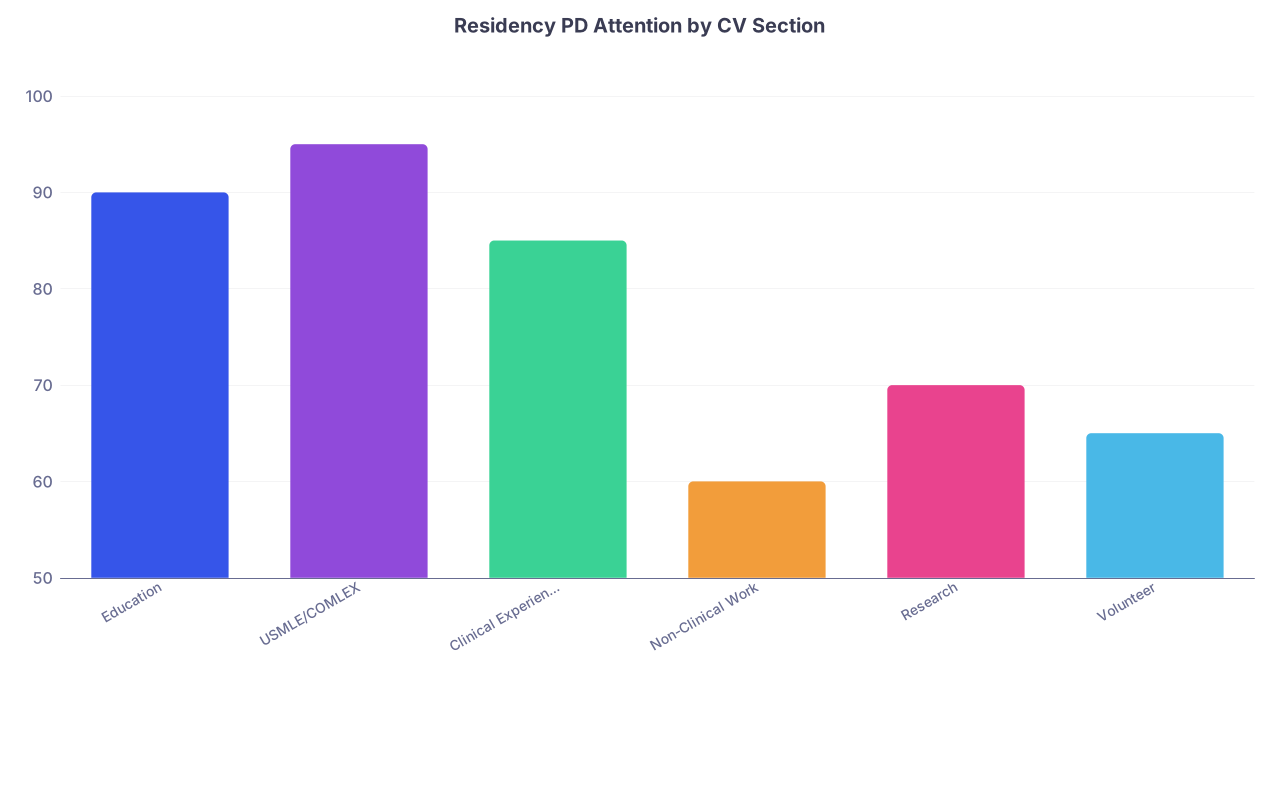
| Category | Value |
|---|---|
| Education | 90 |
| USMLE/COMLEX | 95 |
| Clinical Experiences | 85 |
| Non-Clinical Work | 60 |
| Research | 70 |
| Volunteer | 65 |
Interpretation: PDs do read non‑clinical work, but with less attention and more skepticism. Make it easy.
ERAS formatting specifics
- “Experience Type” should match what it actually was (e.g., Work, Military, Research). Do not hide military service as “Volunteer.”
- The “Most Meaningful” designation can absolutely be used for non‑clinical work if it truly shaped your professional identity. If you do this, tie it explicitly to how you now show up in medicine.
- Location and dates: be consistent. Gaps look much worse than non‑clinical work.
7. Handling Gaps, Long Detours, and the “Why Medicine Now?” Problem
If you did 8 years in tech or 10 years active duty, PDs will worry about clinical rust and long‑term commitment.
You address this in two places:
- The chronology (no unexplained gaps).
- The narrative (personal statement or experience descriptions).
Chronology: no shadows, no surprises
Every year from college onward must be visibly accounted for on ERAS. If you have a year that looks “empty,” fill it honestly:
- “Full‑time caregiving for family member with serious illness”
- “Full‑time software engineering role, Mid‑size Health Tech Company”
Do not try to hide something behind vague entrepreneurship or “consulting” unless it was real, structured work.
Narrative: one pivot, not five
You do not need a dramatic “epiphany story.” You do need:
- A coherent explanation of when you committed to medicine.
- Evidence you have acted consistently since then.
Bad: “I explored various paths before realizing my true calling in medicine.”
Better: “After 6 years as an Air Force officer, I committed to medicine in 2018 and have since pursued full‑time clinical, academic, and community health work.”
Then your CV needs to show exactly that: clinical experiences, research, volunteering starting 2018, not more corporate wandering.
8. Adapting Your Translation to Specific Specialties
Not every specialty values the same traits equally. You can slant your bullets without falsifying anything.
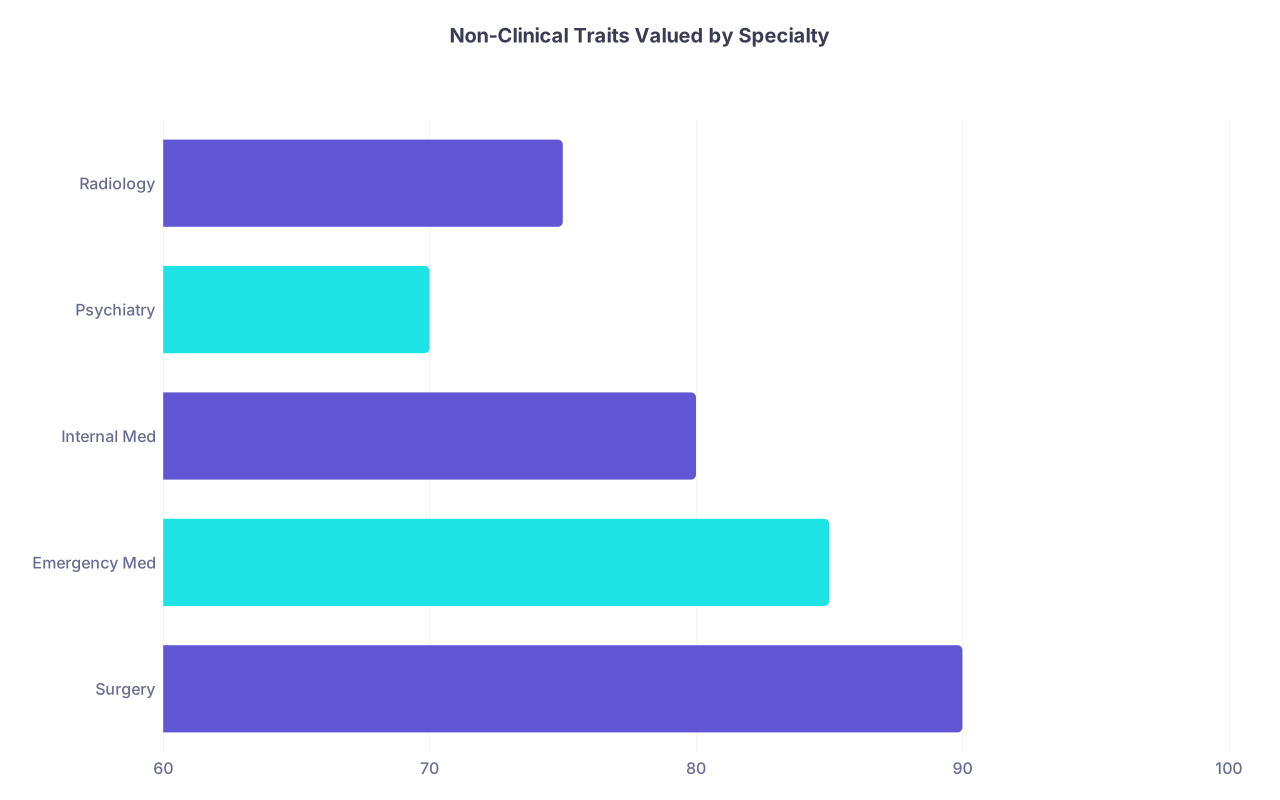
| Category | Value |
|---|---|
| Surgery | 90 |
| Emergency Med | 85 |
| Internal Med | 80 |
| Psychiatry | 70 |
| Radiology | 75 |
(This reflects how strongly PDs in these fields tend to value broadly defined maturity, systems thinking, and leadership.)
Surgical specialties
Highlight:
- Operating under pressure.
- Manual or technical work.
- Owning outcomes and details.
From tech: on‑call outages, meticulous debugging, code review.
From military: weapons maintenance, field operations, checklists.
From finance: extreme attention to detail in high‑stakes situations.
Internal medicine / subspecialties
Highlight:
- Pattern recognition, data analysis, systematic thinking.
- Longitudinal responsibility, follow‑through.
- Communication with diverse stakeholders.
From tech: analytics, root‑cause analysis, process improvement.
From finance: longitudinal client coverage, complex models into simple recommendations.
From military: long‑term command of units, training and mentorship.
EM / critical care
Highlight:
- Rapid triage, time‑pressured decision making.
- Comfort with incomplete data.
- Team leadership in acute settings.
From tech: incident response, on‑call triage, severity prioritization.
From military: patrol leadership, deployment decisions, real‑time adjustments.
From finance: trading floor or live deal fire drills, quick calls with incomplete information.
Psychiatry
Highlight:
- Interpersonal skills, conflict management.
- Team leadership and communication.
- Resilience and insight from non‑clinical life.
Military is particularly strong here: leading diverse teams, managing morale, exposure to trauma. But tech and finance also give you high‑conflict situations (difficult clients, cross‑functional tension) that you can frame as complex interpersonal work.
9. Phrases and Constructions That Work (And Ones That Hurt You)
Let me hand you some language. Use it, mix it, but keep it concrete.
Strong, residency‑friendly phrases
- “primary point of contact for…”
- “triaged and prioritized…”
- “maintained accountability for…”
- “led a team of X people…”
- “developed and implemented checklists / protocols…”
- “reduced [error/outage/defect] rates by X%…”
- “delivered high‑accuracy work under time pressure / long hours…”
- “conducted after‑action reviews to identify contributing factors and preventive steps…”
These are the backbone of clinical work, just wearing civilian clothes.
Phrases that make you sound like corporate wallpaper
Strip these unless absolutely necessary:
- “leveraged synergies”
- “optimized stakeholder engagement”
- “aligned interests of cross‑functional partners”
- “drove strategic initiatives”
- “utilized Agile methodologies”
They make you sound like you copied from a resume template, not like someone PDs can imagine on rounds.
10. Putting It All Together: A Before‑and‑After CV Snapshot
Let me give you a concise comparison. Same applicant, two versions.
| Aspect | Before (Common Mistakes) | After (Residency-Ready) |
|---|---|---|
| Tech Bullet | Built microservices for data platform | Maintained high-volume system, resolved outages |
| Finance Bullet | Built DCF models and pitch books | Synthesized complex data under 24–48h deadlines |
| Military Bullet | Platoon Leader responsible for training | Led 38 soldiers, supervised evaluations & safety |
| Tone | Buzzwords, vague responsibilities | Concrete, risk- and outcome-focused |
| PD Impression | “Nice, but irrelevant corporate career” | “This person has handled pressure and risk” |
These shifts are not subtle. They reframe your identity from “former X now trying medicine” to “experienced professional bringing proven competencies to residency.”
FAQ (exactly 4 questions)
1. Should I list short non‑clinical jobs (3–6 months) that are not obviously impressive?
If they fill a real gap in your timeline, yes, but keep them lean. One short, honest bullet is enough: “Worked full‑time as a support technician while completing prerequisite coursework.” Do not overinflate “3 months of sales” into a leadership role. PDs smell that instantly and it hurts trust.
2. Can I make my non‑clinical job a “Most Meaningful” experience on ERAS?
Yes, if you can convincingly tie it to how you function in medicine now. For example, a multi‑year military deployment that shaped your leadership and resilience is absolutely “Most Meaningful.” But then the description must explicitly connect that experience to how you approach patients, teams, or learning today. If you cannot make that bridge in a few sentences, choose something else.
3. How far back should I go with non‑clinical work on my residency CV?
In general, keep it to college onward. Pre‑college jobs (lifeguard, barista, camp counselor) can be useful if they fill clear gaps or if you had sustained leadership responsibilities, but do not flood the application with them. Long, substantive careers (5–10+ years) before medicine should be fully represented; a series of short high‑school jobs should not.
4. Will a long non‑clinical career hurt my chances compared with a traditional student?
It can, if you present it lazily. If your CV looks like: long non‑clinical work, minimal recent clinical exposure, and a vague personal statement, PDs will see risk. If instead you show: (1) a well‑translated prior career with clear leadership and reliability, (2) several years of consistent, recent clinical and academic engagement, and (3) a coherent pivot story, many programs will see you as an asset. I have seen 35‑ to 40‑year‑old former engineers, officers, and bankers match very well when they do the translation work properly.
Key takeaways:
- Non‑clinical work does not speak for itself. You must translate it into residency‑relevant competencies with concrete, risk‑ and outcome‑focused bullets.
- Strip out corporate and military jargon, replace it with language about responsibility, volume, pressure, safety, and teamwork that PDs instantly recognize.
- Present a clean timeline and a single, coherent pivot to medicine, backed by recent clinical engagement, so your prior career reads as an asset, not a liability.