
The story you have in your head about what makes a “strong residency CV” is probably out of date by at least five years.
The 10‑Year Shift: From “Well‑Rounded” To “Data‑Heavy”
Over the last decade, residency CV expectations have shifted in three measurable ways:
- More lines. Applicants now report significantly more entries in research, leadership, and “scholarly activity” than a decade ago.
- More quantification. Programs increasingly favor CVs that show outputs and impact (posters, publications, QI metrics) over vague roles.
- More stratification by specialty. The gap in CV expectations between dermatology/ortho/rads and family medicine/pediatrics has widened, not narrowed.
The data from NRMP Program Director Surveys, ERAS statistics, and match outcomes paint a clear picture: what used to be “excellent” around 2014 is now “average to slightly above average” in 2024 for competitive programs.
Let me quantify this before moving into practical “how to improve your CV” advice.
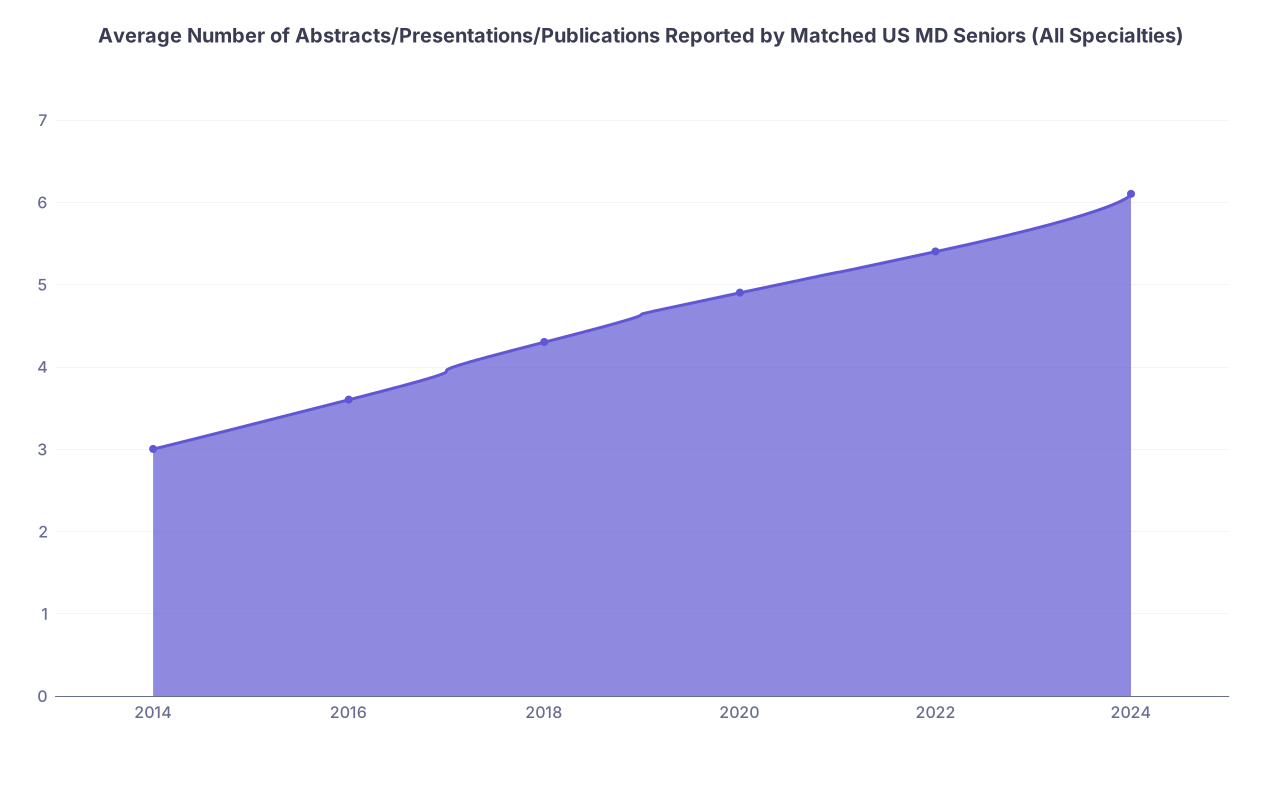
| Category | Value |
|---|---|
| 2014 | 3 |
| 2016 | 3.6 |
| 2018 | 4.3 |
| 2020 | 4.9 |
| 2022 | 5.4 |
| 2024 | 6.1 |
That trend line is not subtle. Programs are getting used to thicker CVs.
What Has Actually Changed On Residency CVs?
1. Research Output: The Inflation Problem
Ten years ago, a US MD senior applying to a moderately competitive specialty with 3–4 scholarly items (a couple of posters, maybe one low‑impact publication) looked strong. Now they look average.
The NRMP’s “abstracts, posters, and publications” data over the last decade shows steady inflation, especially in competitive specialties.
| Specialty Group | ~2014 Mean | ~2024 Mean |
|---|---|---|
| Primary Care (FM, IM, Peds) | 2–3 | 4–6 |
| Mid-tier (IM subs, EM, Anes) | 3–5 | 6–9 |
| Highly Competitive (Derm, Ortho, Rad Onc, PRS) | 6–8 | 12–20+ |
The data shows two things:
- Absolute numbers are up. Even primary care applicants now commonly show 4–6 research items.
- The shape of those items has changed. Multi‑author, multi‑poster “CV padding” from a single project is more common.
Programs have adjusted. They know most students are attached to several projects and often appear on multiple outputs from the same dataset. So they are asking more granular questions:
- Did you design the project or just join late?
- Did you present the poster or are you author #11?
- Can you actually explain the methods and limitations?
Translation for you: the expectation is no longer “have research.” The expectation is “be able to defend and discuss at least one or two substantial projects in detail, ideally with visible output.”
If your CV shows 8 items but you cannot clearly explain any of them, experienced faculty can tell within 90 seconds.
2. Step 1 Pass/Fail: Ripple Effect On The CV
Step 1 going pass/fail did not make the process “holistic” in a gentle, forgiving way. It reweighted the other quantifiable parts of your file. That includes your CV.
Before pass/fail:
- Step 1 three‑digit score was the main screening lever.
- CV mattered more at the interview / rank stage.
After pass/fail:
- Step 2 CK and CV are now the cleanest numerical differentiators.
- Programs pay more attention to productivity, leadership, and “fit signals” encoded in your experiences.
You can see this in program director survey responses, where a larger share now report “perceived commitment to specialty” and “evidence of professionalism and leadership” as highly important. Those aren’t vague buzzwords if you know how they are operationalized. On your CV, they show up as:
- Longitudinal involvement (2–4 years) in one or two activities rather than 15 one‑off experiences.
- Concrete roles: QI lead, clinic coordinator, curriculum developer, not just “member.”
- Specialty‑aligned work: dermatology clinic volunteer for 3 years, not 1‑month dermatology interest group attendance.
In other words, the CV has become a proxy test for seriousness and follow‑through once Step 1 stopped being that blunt signal.
3. The Explosion Of “Scholarly But Not Quite Research”
Ten years back, “scholarly activity” mostly meant classical research.
Now programs have quietly expanded what they will accept as evidence of academic engagement:
- Quality improvement projects with measured outcomes
- Educational projects (curriculum, workshops, OSCE redesign)
- Clinical pathway development
- Implementation projects using dashboards and metrics
Why? Because it maps to what hospitals actually need. Residents who can execute a QI cycle, interpret a run chart, or build a small database that compares pre‑ and post‑intervention outcomes are far more valuable than residents who simply remember p‑values.
I routinely see strong applicants with:
- 1–2 traditional research projects
- 2–4 QI or educational projects, each with at least one poster or grand rounds presentation
- Clear before/after metrics displayed in their ERAS descriptions (“reduced average clinic no‑show rate from 18% to 11% over 6 months”)
These applicants are not just padding. They are showing they understand the language of improvement.
If you want a modern, data‑savvy CV, this is the direction to lean.
How Programs Now Parse A CV (Data‑Driven Reality)
Program directors are not reading your CV line by line like a novel. They are scanning for certain patterns and counts. The data shows consistent weighting for a few categories.
, Leadership & Service, Specialty Commitment, Other Activities](https://cdn.residencyadvisor.com/images/articles_svg/chart-relative-weight-of-cv-domains-in-program-director--6206.svg "Relative Weight of CV Domains in Program Director Decision-Making")
| Category | Value |
|---|---|
| [Research/Scholarly Output](https://residencyadvisor.com/resources/cv-improvement-residency/research-output-and-match-odds-how-many-entries-actually-matter) | 35 |
| Leadership & Service | 25 |
| Specialty Commitment | 25 |
| Other Activities | 15 |
These percentages are not official from NRMP; they are a reasonable synthesis of PD survey patterns and how PDs actually talk in meetings.
What they look for, quickly:
Research/Scholarly Output:
- Count of items
- Evidence of genuine contribution
- At least one or two outputs you can talk about technically
Leadership & Service:
- Roles with responsibility (budget, people, systems)
- Duration (multi‑year vs. one‑off)
- Evidence of outcomes, not just participation
Specialty Commitment:
- Aligned research, volunteering, and electives
- Membership and actual activity in specialty interest groups
- Home and away rotations (for some fields)
Other Activities:
- Unique experiences that suggest maturity or resilience
- Athletics, arts, entrepreneurship—only matter if they show commitment and performance, not novelty alone
Weak CVs in 2024 usually fail on quantification and coherence. They list 25 small items with no measurable outcomes and no clear specialty narrative.
Ten‑Year Trend Line By Specialty: How High Is The Bar Now?
Let me be concrete. Here is an approximate comparison between “matched” CV profiles circa 2014 versus 2024, based on NRMP data and actual application review experience.
| Specialty | 2014 Typical | 2024 Typical |
|---|---|---|
| Family Medicine | 1–2 research items, 3–5 activities | 3–5 research/QI items, 6–8 activities, some leadership |
| Internal Medicine | 2–3 research, maybe 1 pub | 4–7 research/QI, 1–2 pubs or national posters |
| Emergency Med | 1–2 research, strong clinical EM exposure | 3–5 scholarly items, multiple EM‑focused activities, leadership |
| General Surgery | 3–4 research items, 1 pub | 6–10 items, 2+ pubs or multiple national presentations, sustained surgical interest |
| Dermatology | 5–7 research items, derm‑aligned | 10–20+ items, several derm‑specific, 3+ pubs, heavy derm exposure |
You do not have to love this escalation. I do not particularly like it either. But pretending it is not happening is how applicants end up badly miscalibrated.
If you are building or revising your CV now, you are competing against the 2024 column, not the 2014 nostalgia.
How To Actually Improve Your CV Now (Based On The Data)
Let me shift from description to prescription. Here is what the numbers and real‑world outcomes say will move your CV from “fine” to “competitive” in this current environment.
1. Consolidate Around Fewer, Deeper Projects
The data: Applicants with 6–10 “scholarly items” that all stem from 2–3 deep projects tend to perform better in interviews than applicants with 15 shallow, unrelated activities. Program directors explicitly rate “depth and continuity” as more important than “sheer count” in surveys.
Practical strategy:
Pick 2–3 core domains to build around:
- One primary research or QI project (preferably specialty‑aligned)
- One longitudinal service / leadership role
- One “other” sphere (education, advocacy, tech, etc.)
For each domain, aim for measurable outputs:
- Poster or talk
- Small manuscript or case report
- Local or national presentation
- Documented metrics (for QI)
Then structure your CV to highlight those domains up front. Do not bury your strongest experiences midway down a list of 20 minor items.
2. Quantify Outcomes Ruthlessly
The data shows that applications with quantified achievements are rated more highly, even when the underlying activity is similar. Anecdote: I have seen two almost identical QI projects in the same program:
- CV A: “Participated in quality improvement project to reduce central line infections.”
- CV B: “Co‑led QI project on CLABSI prevention; implemented new checklist and nursing education; CLABSI rate decreased from 3.2 to 1.4 per 1,000 line‑days over 9 months.”
Same hospital. Same intervention. One applicant sounded like a bystander; the other sounded like a physician in training.
Where to add numbers:
- Research: sample size, effect size, confidence intervals, response rates.
- QI: baseline vs. post‑intervention rates, timeframes, percentage improvements.
- Leadership: number of people supervised, budget size, event attendance.
- Teaching: number of sessions, learner levels, pre/post test improvements if you have them.
Rewrite your CV entries so that at least 30–50% of them contain quantifiable outcomes or scale. That moves you into the “modern” expectation range.
3. Align Your CV With Your Target Specialty (More Than You Think)
Over the last decade, one of the clearest changes is how strongly specialty‑specific CVs correlate with match success in competitive fields. Derm applicants with 3 derm‑aligned projects and 2 derm away rotations are in a different category from those with generic research and minimal derm exposure, even if their publication counts are similar.
You do not need everything to be specialty‑themed, but the data favors applicants who show:
- At least one major research/QI project in the target specialty or closely related field.
- Sustained clinical involvement: clinics, shadowing, electives, sub‑internships.
- Leadership in a specialty interest group or national organization chapter.
If your CV is currently scattered, ask a blunt question: “If a reviewer reads only my CV, would they immediately guess my intended specialty?” If not, you have work to do.
4. Use “Scholarly But Practical” Projects To Close Gaps
Not everyone will land 5 R01‑level research projects. That is fine. The data from program director comments shows a growing appreciation for:
- Quality improvement cycles that actually change a clinic metric
- Clinical database creation or audit projects
- Educational tools—OSCE checklists, simulation curricula, structured feedback forms
These can be launched and completed faster than formal research and still count as scholarly if you:
- Define the problem numerically (baseline data)
- Implement a structured intervention (PDSA, for example)
- Measure post‑intervention change
- Share results (department meeting, poster day, local conference)
From a CV standpoint, such projects often generate:
- 1 CV entry for the project itself
- 1–2 additional entries for presentations or posters
- A clear story to tell in interviews about impact and data
This is an efficient way to raise your “scholarly output” line count without fake inflation.
5. Trim The Noise: Outdated “Nice To Have” Items
Some common CV features have lost relative value over ten years. They are not useless, but they do not move the needle much now, especially in crowded fields:
- Short‑term overseas trips framed as “global health” without sustained engagement or follow‑up work.
- Generic pre‑med volunteer activities that stopped after M1.
- One‑hour shadowing experiences parsed into separate CV entries.
- Unrelated undergraduate clubs that do not show leadership or distinction.
The data is brutal here: screens are quick. If your CV is full of noise, the important signals are harder to find. You are better off:
- Collapsing minor activities into a single consolidated entry (“Various undergraduate volunteering experiences, 2015–2018, ~150 total hours”).
- Emphasizing duration and leadership in the few activities that did matter.
Programs now expect a medical‑school‑focused CV. Ten‑year‑old pre‑med fluff will not help you beat someone whose recent 4‑year story is tight and quantifiable.
6. Match Your CV To ERAS Structure And Filters
Over the last decade, programs have become much more aggressive in using ERAS filters and structured data. That changes what “good CV design” means.
Practical implications:
Use ERAS experience types correctly: “Research,” “Volunteer,” “Work,” “Leadership,” “Teaching.” Mislabeling to game the system is usually obvious.
Make your “experience title” fields informative, not cute. Program coordinators and PDs often skim only these first:
- Bad: “Making a Difference”
- Good: “Lead Coordinator, Student‑Run Free Clinic (Operations + QI)”
In “Most Meaningful” experiences, maximize the 1020 characters with specific metrics and clear narratives. This is where depth wins.
Do not duplicate identical text across multiple entries. Programs are sensitive to copy‑paste padding.
I see a lot of students spending 10 hours finessing a PDF CV that no one will seriously use, while under‑optimizing the structured ERAS entries that actually drive review and filters. Reverse that priority.
7. Think In Distributions, Not Outliers
One wrong mental model I see constantly: applicants comparing themselves to outliers on Reddit or SDN—someone with 40 publications and a PhD—and drawing the conclusion, “I am doomed.”
The better way is to think in terms of distributions. Picture a boxplot of research items for your specialty: minimum, quartiles, median, and maximum.
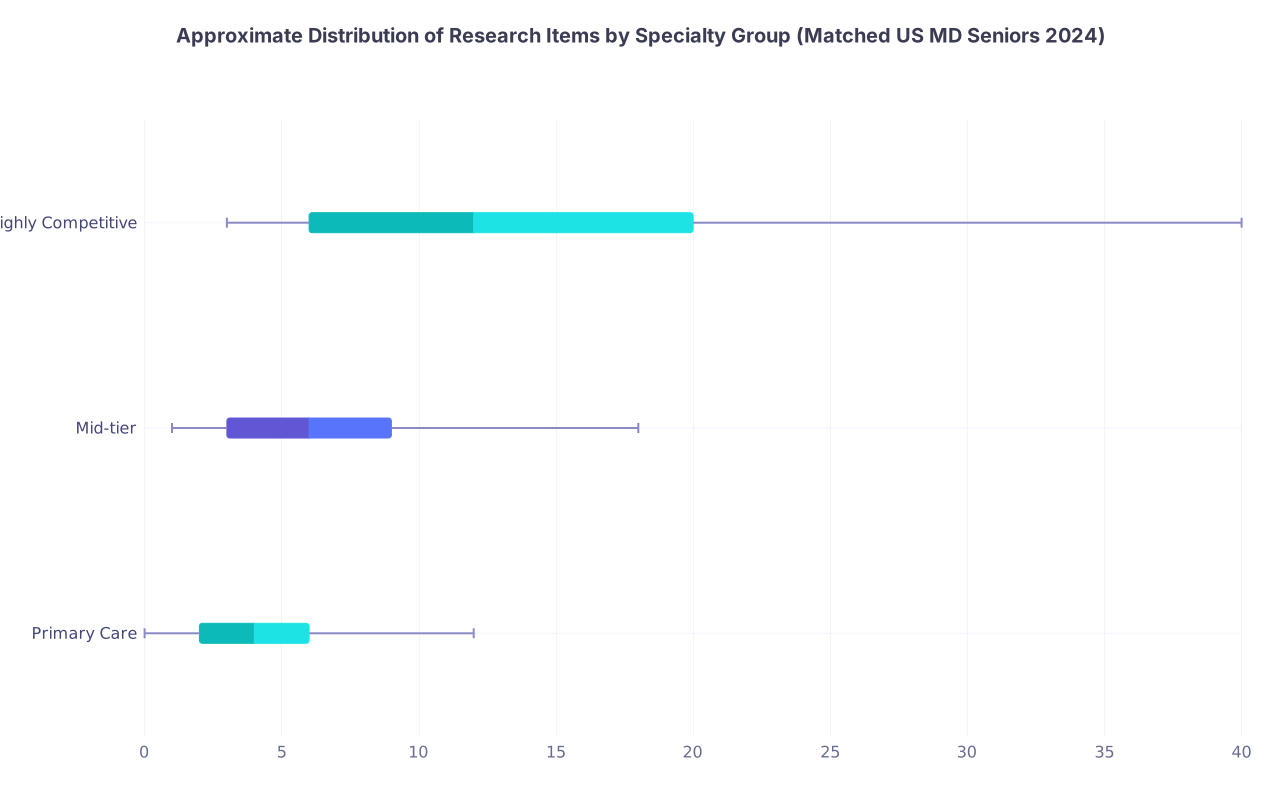
| Category | Min | Q1 | Median | Q3 | Max |
|---|---|---|---|---|---|
| Primary Care | 0 | 2 | 4 | 6 | 12 |
| Mid-tier | 1 | 3 | 6 | 9 | 18 |
| Highly Competitive | 3 | 6 | 12 | 20 | 40 |
Where you want to be:
- At or above the median for your specialty group on research/scholarly items.
- Above median for depth and quantification of outcomes.
- Coherent and clearly specialty‑aligned.
You do not need to hit the maximum. Programs know those extremes exist and often see diminishing returns beyond a certain point. A well‑balanced CV in the 50–75th percentile range, with strong narrative coherence, beats a 99th percentile publication count with chaotic, unfocused activities more often than applicants think.
Putting It Together: A 2024‑Ready CV Blueprint
If I distill all of this into a data‑informed blueprint for a strong CV in the current decade, it looks roughly like this for a US MD applicant targeting a moderately competitive field:
4–7 research/QI/educational projects
- At least one closely linked to your target specialty
- 2–3 posters or presentations
- 1–2 publications or manuscripts submitted/in‑preparation (honestly labeled)
5–8 core activities
- 1–2 leadership roles with real responsibility (budget, people, systems)
- 1 long‑term clinical service or community project (2+ years)
- 1 teaching or mentoring role with clear scope (number of sessions, learners)
Every major entry quantified where possible
- Before/after metrics for QI
- Counts and sample sizes for research
- Hours, people, budget, or other scale indicators for leadership/service
Clear specialty signal
- Multiple experiences, across categories, pointing in the same direction
- Enough variety to show you are not one‑dimensional, but not so much that your narrative blurs
If you are significantly below that profile and applying in the next year or two, focus your remaining time on:
- Launching one good, measurable QI or education project you can complete.
- Converting existing work into outputs (posters, presentations, brief manuscripts).
- Rewriting your current CV entries to be leaner, more quantified, and more clearly aligned with your specialty.
The last one costs you zero extra time in clinics or lab—and often makes the single biggest perceived difference to reviewers.
Three core points to carry out of this:
- The numbers have risen. A CV that was “excellent” a decade ago is now merely average in many specialties; plan around current distributions, not old anecdotes.
- Depth, quantification, and specialty alignment now matter more than generic “well‑roundedness.” Fewer, stronger, measured experiences beat a long list of vague ones.
- You cannot change the entire past, but you can dramatically improve how your existing work is framed, quantified, and connected—which is exactly what serious applicants are doing now.