
The worst way to spend the month before residency is to “rest” by doom-scrolling and vaguely panicking. The best way is structured recovery: targeted reading, light review, and deliberate decompression on a clear timeline.
You need both: your brain sharp for July 1, and your nervous system not already fried.
Below is a practical, time-based plan for a 4-week gap month before intern year, focused on specific book types and what to read when. I will assume a July 1 start date. Adjust dates backward or forward if your program starts earlier or later.
Overall Month-at-a-Glance
You are not “studying for a test.” You are resetting and sharpening the tools you will actually use on day one: orders, notes, management plans, communication, and survival skills.
Think of the month in four phases:
- Week 1 – Decompress + Orient: Unwind, reset schedule, light reading only
- Week 2 – Core Knowledge Refresh: High-yield medicine, not exam minutiae
- Week 3 – Practical Intern Skills: Orders, cross-cover, procedures, night float scenarios
- Week 4 – Taper + Logistics: Light touch review, sleep, life setup
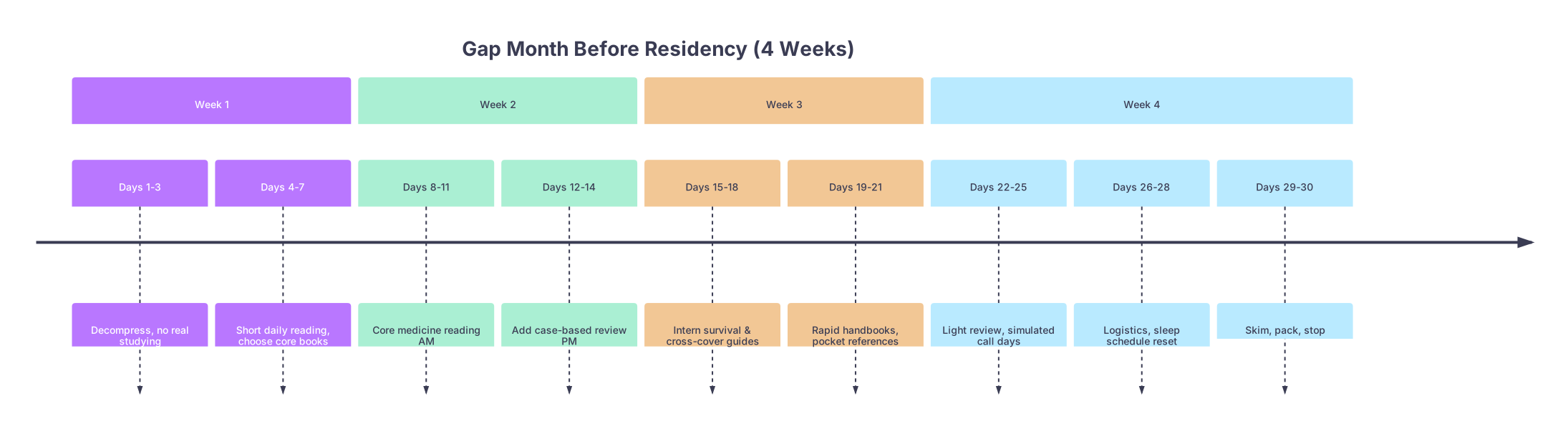
| Period | Event |
|---|---|
| Week 1 - Days 1-3 | Decompress, no real studying |
| Week 1 - Days 4-7 | Short daily reading, choose core books |
| Week 2 - Days 8-11 | Core medicine reading AM |
| Week 2 - Days 12-14 | Add case-based review PM |
| Week 3 - Days 15-18 | Intern survival & cross-cover guides |
| Week 3 - Days 19-21 | Rapid handbooks, pocket references |
| Week 4 - Days 22-25 | Light review, simulated call days |
| Week 4 - Days 26-28 | Logistics, sleep schedule reset |
| Week 4 - Days 29-30 | Skim, pack, stop |
Week 1: Decompress, Then Choose Your Tools
Days 1–3: Full Stop, On Purpose
At this point you should not be opening question banks.
The first 3 days after graduation or your last exam should look like this:
- Sleep without alarms
- Move your body (walks, gym, yoga—whatever you actually do)
- See 1–2 key people in your life
- No serious reading. If you must touch medicine, it should be narrative, not didactic.
Good options:
- Narrative / big-picture books (non-mandatory):
- “Being Mortal” – Atul Gawande
- “Complications” – Atul Gawande
- “Intern” – Sandeep Jauhar
These remind you why you are doing this, without drilling you on obscure vasculitides.
Days 4–7: Light Structure + Book Selection
Now you start building the library you will actually use next year.
At this point you should:
- Pick 1–2 core clinical books for your specialty (or transitional year).
- Pick 1 intern-survival style book.
- Pick 1 pocket/handbook you will carry at work.
You are not going to read them all cover-to-cover this month. You are curating tools.
Strong examples by category:
| Category | Example Title |
|---|---|
| Core Medicine Text | Step-Up to Medicine |
| Specialty Core | The Washington Manual of Surgery |
| Intern Survival | The Tools of the Trade / The Internship Survival Guide |
| Pocket Handbook | Pocket Medicine (Mass General) |
| On-Call Guide | On Call: Principles and Protocols |
A few concrete picks that work for many new interns:
If you are going into Internal Medicine, FM, or a prelim year:
- Step-Up to Medicine
- Pocket Medicine (MGH)
- On Call: Principles and Protocols
If you are going into Surgery:
- Surgical Recall
- The Washington Manual of Surgery
- The Mont Reid Surgical Handbook
If Pediatrics, OB/GYN, EM, or another field:
Pick the equivalent of a concise core text + a pocket handbook used by residents at your institution. Ask current interns which books they actually open at 2 a.m.
During Days 4–7:
- Spend 30–45 minutes per day skimming 1–2 chapters from your core book.
- Do zero questions yet.
- Flag or tab:
- Common admission diagnoses
- Common cross-cover issues
- Antibiotic tables
- Fluid/electrolyte sections
Your only goal this week: know where the answers live, not memorize them yet.
Week 2: Core Knowledge Refresh (Without Burning Out)
Now your brain is rested. This week you sharpen the fundamentals you will see daily: chest pain, shortness of breath, fever, abdominal pain, common chronic conditions.
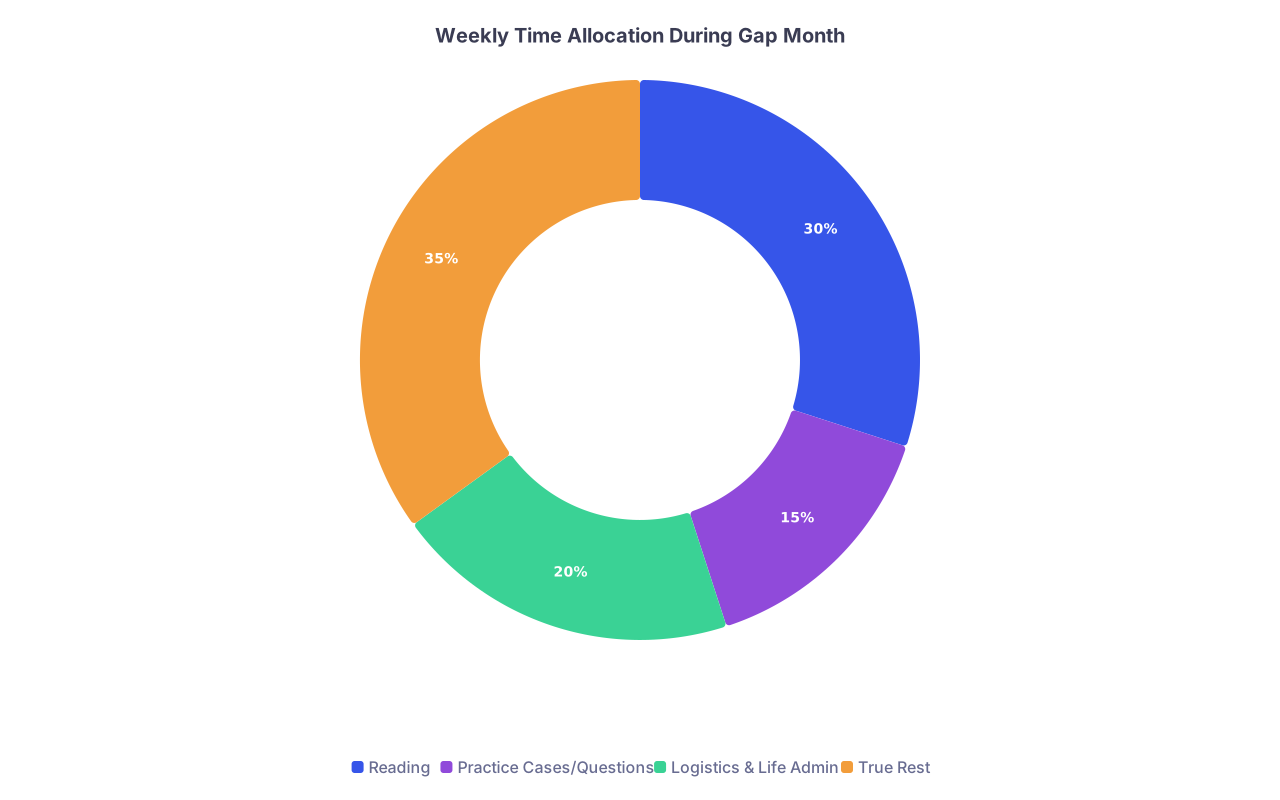
| Category | Value |
|---|---|
| Reading | 30 |
| Practice Cases/Questions | 15 |
| Logistics & Life Admin | 20 |
| True Rest | 35 |
Week 2 Structure (Days 8–14)
At this point you should aim for 2–3 hours of focused work per day, max:
- 60–90 minutes: core reading in the morning
- 30–60 minutes: case-based or question-based review in the afternoon
- Rest of the day: exercise, social time, hobbies, basic life admin
Morning: Core Reading
Use one main text. For IM/FM/prelim, for example:
- Step-Up to Medicine – target sections:
- Cardiology (chest pain, heart failure, arrhythmias)
- Pulmonology (COPD, asthma, pneumonia, PE basics)
- Infectious Disease (sepsis, common antibiotic regimens)
- Endocrine (DKA, HHS, thyroid storm fundamentals)
For Surgery:
- General principles (pre-op, post-op, fluids/electrolytes, wound care)
- Common acute abdomen causes
- Post-op complications
Break this into 4–5 days:
- Day 8–9: Cardio / Pulm (or equivalent “big” systems for your field)
- Day 10: ID / Antibiotics
- Day 11: Endocrine / Renal (DKA, AKI, fluids)
- Day 12–13: Specialty-specific high yield (e.g., trauma for surgery, pedi ID for peds)
- Day 14: Catch-up / light skim of weaker areas
You are reading for patterns, not Step-style trivia. Focus on:
- What admits vs what can go home
- Initial workup and first 24 hours of management
- “Red flag” features that should scare you
Afternoon: Cases or Light Questions
Now you introduce problems, but you keep the volume low and the focus clinical.
Good options:
- Case Files series (e.g., Case Files Internal Medicine, Case Files Surgery)
- Boards and Wards if you like condensed, bullet-style
- A small number (10–15) of clinical vignettes from any Qbank you still have, but:
- Untimed
- Focus on “What would I do first for this inpatient?” rather than test-taking strategy
Rough daily recipe (Days 8–14):
- Read 1–2 cases from Case Files (or equivalent)
- For each case, explicitly articulate:
- What labs and imaging am I ordering?
- What are my admission orders?
- What do I tell the nurse to watch for overnight?
This is how you pivot from “test” thinking to “intern” thinking.
Week 3: Practical Intern Skills and On-Call Thinking
By Week 3 you should feel that the basics are resurfacing. This is the week you fill the gap between “I know the disease” and “I am the one holding the pager.”
Days 15–18: Intern Survival + Cross-Cover Reading
At this point you should switch heavy reading time to:
- Intern survival guides and on-call manuals.
Examples that actually help:
- On Call: Principles and Protocols – core chapters on:
- Fever in the hospitalized patient
- Chest pain on the floor
- Shortness of breath
- Hypotension, tachycardia
- Electrolyte disturbances
- Pocket Medicine:
- Admission orders templates
- Common inpatient algorithms
- Any program-specific intern handbook your residency provides (often a PDF).
Daily structure:
- Pick 2–3 common overnight issues per day:
- Day 15: Chest pain, shortness of breath, low O2 sat
- Day 16: Fever, hypotension, tachycardia
- Day 17: Electrolytes (Na, K, Ca, Mg), glucose emergencies
- Day 18: Pain control, agitation/delirium, nausea/vomiting
For each topic, do this:
- Read the relevant section in your on-call guide.
- On paper, write:
- What questions do I ask the nurse on the phone?
- What do I check in the chart before seeing the patient?
- What immediate orders might be reasonable?
- When do I call my senior or attending?
This is tedious. It is also exactly how you avoid freezing at 3 a.m.
Days 19–21: Pocket Handbooks + “Dry Run” Orders
Now you practice using the actual pocket references you will carry.
You should:
Spend 30–45 minutes per day:
- Skimming tables (antibiotics, fluids, common dosing)
- Putting tabs or small sticky flags in your pocket book for:
- ICU vs floor admission criteria
- Insulin regimens basics
- Anticoagulation and DVT prophylaxis
- Code status and goals-of-care frameworks (even short ones)
Use 30–45 minutes per day on:
- “Dry run” admission orders:
- Take a common scenario: e.g., “65-year-old with pneumonia being admitted to medicine floor.”
- Write out: admitting diagnosis, vitals frequency, labs, imaging, diet, fluids, DVT prophylaxis, code status, PRNs.
- “Dry run” admission orders:
You do not need a full EHR to practice the mental checklist.
Week 4: Taper, Simulate Call, Then Stop
This is the week most people sabotage themselves. They panic, over-study, and walk into orientation already exhausted.
Do not be that intern.
Days 22–25: Light Review + “Simulated Call Days”
At this point you should:
- Drop heavy reading. No more than 90 minutes of medical reading per day.
- Use that time primarily for:
- Skimming your own notes and flags in your books
- Briefly revisiting your top weak systems (maybe 2 systems, not 8)
Now add simulated call scenarios 2–3 days this week:
Pick a morning or afternoon and do a 60–90 minute “mental call block”:
- Set a timer.
- Run through 5–6 common nurse pages you are likely to get:
- “Your patient in 402 is more short of breath.”
- “Temp is 38.9 on your neutropenic patient.”
- “Potassium is 2.9 on the morning labs.”
- “Post-op patient is more confused and trying to climb out of bed.”
- For each:
- Jot down what you would ask, check, and order
- Open your pocket reference if you get stuck
- Write when you would call your senior
This is exactly the kind of mental work that makes the first real call night feel like a repeat, not a first.

Days 26–28: Logistics, Sleep, Life Setup
At this point you should intentionally shift focus away from content and toward being a functional human being on day one.
Daily priorities:
Move your wake-up time toward what you will need for intern year
Do a realistic grocery run and plan 3–4 simple meals you can cook half-asleep
Organize:
- Scrubs, white coat, badge if you have it
- A small work bag with:
- Pocket notebook
- Your key handbook (e.g., Pocket Medicine)
- Pens, highlighter, small sticky notes
- Portable phone charger
Skim, do not deep read:
- Orientation materials
- Hospital maps or unit layouts if provided
- Any EMR training modules (these are mind-numbing; do them now, not after a 14-hour shift)
Reading this week:
- 30–45 minutes max per day
- Only from:
- Your on-call guide
- Your own written notes
- Your pocket handbook tables
No question banks. No new resources. You are consolidating.
Days 29–30: Taper to Zero
The last 2 days before orientation:
At this point you should:
- Stop structured study
- If you must read, limit it to:
- Skimming the table of contents of your go-to pocket book
- Glancing through your admission orders checklists
Better use of time:
- One long walk per day
- One enjoyable, non-medical activity (movie, dinner, hobby)
- Get your sleep consistent—bedtime and wake time close to what you will use on wards
You want to start residency slightly under-read and well-rested, not “crammed” and fried. The former catches up quickly. The latter does not.
Quick Comparison: What to Emphasize When
| Week | Primary Focus | Book Types Emphasized |
|---|---|---|
| Week 1 | Decompress + Orientation | Narrative medicine, core text skim |
| Week 2 | Core Knowledge Refresh | Core medicine/specialty text, case books |
| Week 3 | Practical Intern Skills | On-call guides, intern survival, pocket handbooks |
| Week 4 | Taper + Logistics | Pocket references, personal notes |
Final Thoughts: What Actually Matters
If you remember nothing else from this, keep three points:
- Front-load rest, not panic. The first 3–5 days set the tone. Sleep, move, then start light.
- Read what you will use at 2 a.m., not what gets you a 270. Core texts, on-call manuals, pocket handbooks. That is your stack.
- Taper before you start. The last week is about logistics, mental rehearsal, and normal sleep—not frantic last-minute cramming.
Do this, and you will walk into residency with your head clear, your tools chosen, and your instincts warmed up. That is all you need.