The biggest mistake MS1s make is thinking Step studying starts “after second year.” It doesn’t. It starts now—quietly, in the background, with how you use Q-banks and review books from day one.
You do not need to “study for Step 1” full time in MS1. That’s insane. But you do need a deliberate, structured way to layer in Q-banks and books so that when dedicated starts, you’re reviewing, not learning from scratch.
I’ll walk you month-by-month through M1 and M2 with concrete “at this point you should…” instructions. Think of this as a scaffold. Adjust details to fit your curriculum, but don’t drift from the structure.
Big Picture: Your 2-Year Step 1 Resource Timeline
Before we go month-by-month, you need your anchors. These are the only “core” Step 1 resources I’d commit to:
- Question banks
- UWorld Step 1 (non‑negotiable)
- Amboss or Kaplan (as your “early” bank)
- Books / content
- First Aid for the USMLE Step 1 (FA)
- Pathoma (video + book)
- Sketchy (micro and pharm at minimum)
At this stage, your goal isn’t volume; it’s sequence. Use the right thing at the right time.
| Phase | Q-Banks | Books / Videos |
|---|---|---|
| Early MS1 | Amboss/Kaplan | Pathoma (as needed) |
| Late MS1 | Amboss/Kaplan | First Aid – light |
| Early MS2 | Start UWorld | Pathoma + FA heavy |
| Late MS2/Dedicated | UWorld only | FA + incorrects |
MS1, Months 1–2: Don’t Touch Step 1 Yet (Almost)
At this point you should be: learning how to learn medical school content.
You’re not behind. You’re not “late” to Step 1. If you crack open UWorld your first month, you’ll mostly just scare yourself and waste questions.
Primary focus (Months 1–2):
- Figure out:
- How you take notes (typed, handwritten, or none with Anki)
- How many hours you realistically have outside class
- How long it takes you to master 20–30 new concepts
- Build your basic systems:
- A calendar (Google Calendar, Notion, paper—pick one and stick to it)
- A daily block for review (even 45–60 minutes)
Step 1 overlap (very light):
- If your school starts with basic science blocks (biochem, genetics, anatomy):
- Find the matching sections in First Aid and skim headings once per week.
- Watch Pathoma chapter 1–3 slowly if you feel like it. If not, fine. You’ll survive.
What you should not be doing yet:
- No daily Step 1 Q-bank questions
- No “I’m doing 40 UWorld/day” nonsense
- No obsessing over NBME scores
Your step prep in these first 1–2 months is indirect: you’re building the habits that will support Q-bank work later.
MS1, Months 3–4: Introduce Your First Q-Bank (Gently)
At this point you should be: layering in 5–10 questions a few times per week from a secondary Q-bank.
Use Amboss or Kaplan, not UWorld. You’re just learning the question style and forcing yourself to apply.
How to start:
- Pick 2–3 days per week. For example:
- Tuesday, Thursday, Saturday
- On those days:
- Do 5–10 timed, random-tutor questions tied loosely to your course topic
(e.g., if you’re in cardio block, filter to cardio physiology/path) - Review every explanation, not just the ones you missed.
- Do 5–10 timed, random-tutor questions tied loosely to your course topic
- Time box it:
- Max 45–60 minutes total on Q-bank + review those days.
Weekly checklist (Months 3–4):
- 15–25 Q-bank questions/week (Amboss/Kaplan)
- One 30–60 minute session skimming related First Aid/Pathoma for current block
- Zero guilt about not touching UWorld yet
This is about building the muscle of: see question → think → commit → read explanation → self-correct.
MS1, Months 5–8: System-Based Integration & Light First Aid
Now you’re settled. Exams have passed. You’ve seen what your school tests like. At this point you should be: syncing your Q-bank and books tightly with your organ blocks.
Let’s say you’re on renal. Your Step 1 integration that month should look like this:
Q-bank (Amboss/Kaplan)
- 10–15 questions, 3 days per week (so ~30–45/week)
- Filter to “renal” + maybe “electrolytes/acid-base”
- Always timed mode, never tutor mode during questions themselves
Pathoma
- Watch the renal chapters in the same week your school lectures renal pathology
- Same for cardio, pulm, heme, etc. through the year
- Lightly annotate Pathoma into First Aid if that helps you; don’t overdo it
First Aid
- Use it as a reference, not a textbook
- When you learn any big pathology (e.g., nephritic vs nephrotic syndromes), check how FA phrases it
That’s your “Step language.”
Weekly pattern example (Months 5–8):
- Mon–Fri
- Daytime: class + your own lecture studying
- 30–45 minutes on 2–3 evenings: Amboss/Kaplan question blocks
- Weekend
- 1–2 hours Pathoma relevant chapters
- 30 minutes flipping through FA pages that map to your week’s content
Do not chase volume. For MS1, 30–50 questions/week is plenty as long as you’re reading explanations carefully.
MS1, Months 9–10: End of MS1 – Close the Gaps
At this point you should be: using Q-banks and books to clean up weak systems from earlier in the year.
You’ve probably gone through several organ systems. Some felt fine; some felt like mud. This is when you deliberately go back.
Step-by-step for these months:
- List your blocks from MS1:
- Example: Foundations, Neuro, Cardio, Pulm, Renal, GI
- Rank them: 1 = weakest, 5 = strongest
- For your bottom 2 systems:
- Do mixed blocks in Amboss/Kaplan focusing on those systems:
- 10–20 questions twice a week for 4–6 weeks
- Re-watch the corresponding Pathoma chapters
- Spend one lazy afternoon skimming those sections in FA
- Do mixed blocks in Amboss/Kaplan focusing on those systems:
You’re not trying to master everything. You’re just making sure:
- Neuro basic anatomy isn’t completely gone
- You vaguely know your murmurs
- Renal physiology doesn’t look like hieroglyphics
If your school runs on an integrated systems curriculum that extends into MS2, that’s fine. Same principle: end of MS1 = patch the holes.
Summer after MS1: Optional, Not Mandatory
This part is controversial. I’ve seen people waste entire summers “studying for Step” badly. Don’t be that person.
At this point you should be: resting, doing something that looks good on a CV (research/volunteering), and optionally touching very light Step content.
What “light” looks like:
- Max 3–4 hours/week Step‑adjacent:
- Finish unruly Amboss/Kaplan questions from MS1 material
- Watch a few remaining early Pathoma chapters (1–3, general principles)
- Maybe start Sketchy micro if you’re bored
What you should not do:
- No UWorld purchase yet. It’ll just expire and stress you out.
- No 100 questions/day marathon.
- No trying to read FAll of FA.
Rest matters. Burnout in MS2 hurts Step 1 scores more than not cramming in the summer.
MS2, Months 1–2: Transition Phase – Still Secondary Q-Bank
Now things start to accelerate.
At this point you should be: using Amboss/Kaplan more seriously and starting to treat First Aid as your official “spine.”
If your school is starting more serious pathology/pharm systems (ID, heme/onc, rheum, etc.), align tightly.
Concrete weekly targets (Months 1–2 of MS2):
Amboss/Kaplan
- 60–80 questions/week
- Still organ-system focused, synced to your current block
- 2–3 blocks of 10–15 on weekdays, maybe one on the weekend
Pathoma
- Fully in play now. Watch entire system chapters as your course runs.
- Re-watch tough chapters (like heme) as needed.
First Aid
- For each new disease you learn in lectures:
- Find it in FA
- Read the bullet list once
- Maybe star or underline things your professors emphasize
- For each new disease you learn in lectures:
This is the time to stop treating Step resources as “extra.” They’re your main structure, with school filling in depth.
MS2, Month 3: Turn on UWorld (But Don’t Go All-In Yet)
At this point you should be: activating UWorld and using it in a controlled, organ-based way while you still finish out Amboss/Kaplan.
Turn on UWorld too early and you either burn it out or waste it when you aren’t ready. Month 3 of MS2 is a good compromise for most schools.
How to introduce UWorld:
- Week 1–2 with UWorld:
- 10–15 UWorld questions once or twice per week
- Filter to your current system
- Timed, random, 1 block at a time
- Keep Amboss/Kaplan as your volume workhorse for another 1–2 months:
- 50–70 questions/week from secondary bank
- 20–30/week from UWorld
Think of it like this:
- Amboss/Kaplan = extra reps, concept refinement
- UWorld = Step-style reality check and primary learning for Step framing
Track your performance loosely, but do not obsess over UWorld percentages yet. Early on, 40–60% correct is completely normal.
MS2, Months 4–6: UWorld Becomes the Main Event
Here we go. This is where most people either build a sustainable routine or spiral.
At this point you should be: phase-shifting from secondary Q-bank → UWorld as your primary, and integrating First Aid heavily.
Your goal by end of Month 6 of MS2:
- Finish ~60–70% of UWorld (system-based, not random yet)
- Have touched every major Pathoma system once
- Have at least seen every page of FA tied to your coursework
Weekly structure (Months 4–6):
Question volume
- 80–100 questions/week total
- 60–80 UWorld
- 20–40 Amboss/Kaplan (or drop secondary bank if time is tight)
Block design
- 2–3 blocks of 20 questions (UWorld) per week
- 1–2 blocks of 10–15 (Amboss/Kaplan) for weak systems
- All blocks timed, non-tutor; detailed review after
Review process (crucial):
- For each block:
- Mark every question with tags: “Know cold”, “Review”, “Weak”
- For “Weak” questions:
- Read UWorld explanation thoroughly
- Open FA to that topic; read the matching section
- If Pathoma covers it, re-watch that subsection
- For each block:
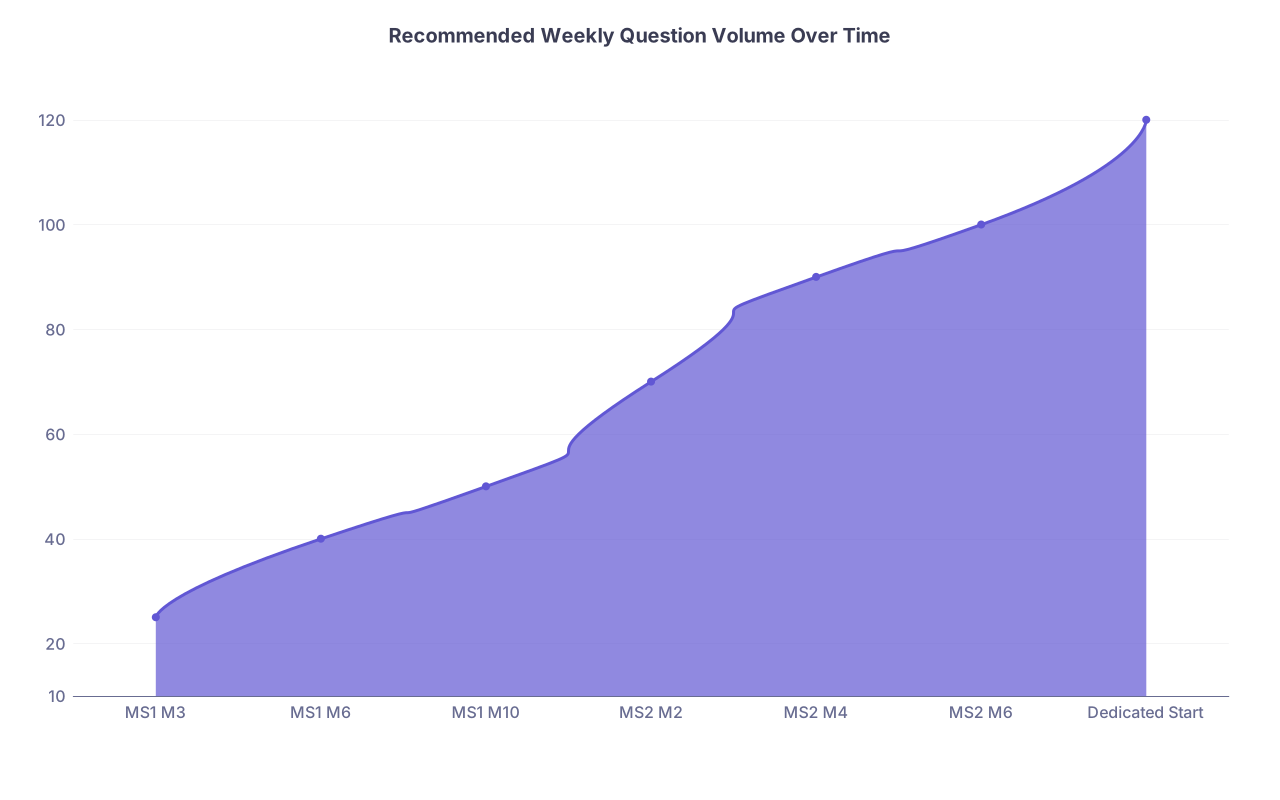
| Category | Value |
|---|---|
| MS1 M3 | 25 |
| MS1 M6 | 40 |
| MS1 M10 | 50 |
| MS2 M2 | 70 |
| MS2 M4 | 90 |
| MS2 M6 | 100 |
| Dedicated Start | 120 |
What about notes?
Don’t rewrite UWorld into a second First Aid. That’s how you burn weeks making pretty but useless documents.
Better options:
- Brief, targeted notes in the margins of FA
- A single running “high-yield corrections” document, kept under 10–15 pages
- Or tagging cards in Anki if you’re using a premade deck
MS2, Months 7–8: Finish UWorld Round 1 & Shift to Mixed Mode
You’re now approaching exam scheduling and dedicated. At this point you should be: finishing your first pass of UWorld and transitioning from system-based → mixed blocks.
Targets by end of Month 8:
- UWorld:
- 100% of questions completed
- Average performance is less important than trend (flat or improving = fine)
- First Aid:
- You’ve read every relevant section at least once
- Pathoma:
- All major systems watched, with re-watches for your weak areas
Weekly structure now:
- 100–120 UWorld questions/week
- 2–3 blocks (20 questions) of mixed subjects
- 1–2 blocks still organ-based for your worst system
- Review > questions:
- Expect 2–3 hours to seriously review a 40-question day
This is where you train your brain to switch contexts. No more “I’m in renal mode.” Mixed blocks mimic the exam.

Dedicated Period (4–8 Weeks Before Step 1): Tight Integration
Your school’s schedule will dictate exactly when this starts, but by the start of dedicated, your Q-bank/book plan should already be established.
At this point you should be: living inside UWorld, First Aid, and your incorrects list. Nothing new. No extra shiny resources.
Daily structure (example for 6-week dedicated):
Morning
- 40–60 UWorld mixed questions (2–3 blocks of 20)
- All timed, random, “exam conditions” (no phone, no mid-block breaks if you can handle it)
Midday
- 2–3 hours reviewing those questions:
- For every incorrect or guessed:
- UWorld explanation
- Corresponding FA page
- Add to “high-yield misses” doc or review tagged Anki
- For every incorrect or guessed:
- 2–3 hours reviewing those questions:
Afternoon
- 1–2 hours of FA + Pathoma:
- FA: read through one system or one chapter/day
- Pathoma: re-watch your worst systems, not everything
- 1–2 hours of FA + Pathoma:
Evening (light)
- Flashcards (if you use them)
- Light Sketchy review for micro/pharm as needed
- Quick scan of your “high-yield misses” doc
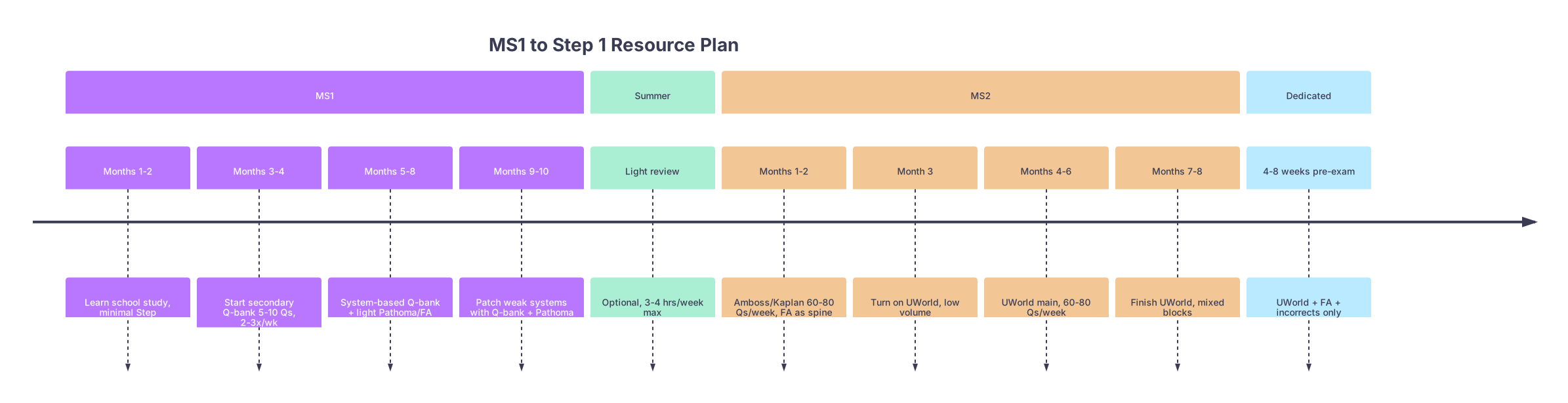
| Period | Event |
|---|---|
| MS1 - Months 1-2 | Learn school study, minimal Step |
| MS1 - Months 3-4 | Start secondary Q-bank 5-10 Qs, 2-3x/wk |
| MS1 - Months 5-8 | System-based Q-bank + light Pathoma/FA |
| MS1 - Months 9-10 | Patch weak systems with Q-bank + Pathoma |
| Summer - Light review | Optional, 3-4 hrs/week max |
| MS2 - Months 1-2 | Amboss/Kaplan 60-80 Qs/week, FA as spine |
| MS2 - Month 3 | Turn on UWorld, low volume |
| MS2 - Months 4-6 | UWorld main, 60-80 Qs/week |
| MS2 - Months 7-8 | Finish UWorld, mixed blocks |
| Dedicated - 4-8 weeks pre-exam | UWorld + FA + incorrects only |
NBMEs and self-assessments:
They’re not books or Q-banks, but they drive how you use them.
- First NBME:
- 8–10 weeks before test
- Then every 1–2 weeks:
- Use score to target which FA chapters and UWorld topics you hit next
On days you take a full NBME:
- Fewer or no UWorld blocks
- Heavy review of:
- Every question you missed
- Related FA sections
How to Adjust When Things Go Sideways
It won’t go perfectly. You’ll fall behind. That’s guaranteed.
Here’s what to do at each stage when life hits:
During MS1
- If exams crush you, drop Q-bank volume that month. Protect your grades.
- Minimum: 10–15 questions/week is fine during hell weeks.
Early MS2
- If 80–100 questions/week is overwhelming:
- Cut to 60 questions/week
- Prioritize UWorld over secondary banks the moment you feel pinched
- If 80–100 questions/week is overwhelming:
Late MS2 / Dedicated
- If you’re not on track to finish UWorld:
- Stop all secondary banks yesterday
- Use UWorld’s “unseen questions” and “incorrects” filters strategically
- If FA feels overwhelming:
- Follow UWorld → FA only for what you miss
- Don’t read FA front-to-back repeatedly. That’s performative, not effective.
- If you’re not on track to finish UWorld:
Final Thoughts: What Actually Matters
If you remember nothing else from this, take these:
- Timing > volume. Doing the right type of questions and books at the right stage always beats cramming everything late with no structure.
- UWorld is king, but not on day one. Use Amboss/Kaplan early, then move UWorld to the center of your universe by mid-MS2.
- Questions + explanations + FA/Pathoma link-up is the core loop. Every month, your only job is to run that loop a little more often and a little more efficiently.
You don’t need 20 resources. You need a calendar, a sane progression, and the discipline to keep showing up week after week. From MS1 to Step 1, that’s how you win.