
How to Build a Surgery Shelf Q-Bank Stack That Mirrors the Exam Blueprint
You are three weeks into your surgery rotation. It is 9:45 p.m. You just finished evening rounds that somehow morphed into a 45-minute teaching session on small bowel obstruction. You open your laptop, click into UWorld, and stare at the “Next” button. You have 50 half‑finished cards in Anki, 300 “recommended” AMBOSS surgery questions, and a friend telling you “Bro, just do all of UWorld, it covers everything.”
That is how people end up studying for an internal medicine exam and walking into the Surgery Shelf.
Let me break this down specifically: the Surgery Shelf is not a “surgery” exam in the way you think. It is a surgery‑anchored clinical management exam that lives on the NBME blueprint. If you want your Q‑bank work to actually move your score, your stack has to be built to mirror that blueprint—not vibes, not Reddit, not what the loudest person in your class insists “worked for them.”
We will build a Surgery Shelf Q‑bank stack like you’d build an OR case list: intentionally, with the right mix, and with clear roles for each tool.
Step 1: Understand What the Surgery Shelf Really Tests
Before you choose a single question, you need to understand the target. This exam is not 80% operative techniques and obscure eponyms. It is much closer to: “There is an acute surgical problem. Do you recognize it quickly, resuscitate appropriately, order the right imaging, and know whether the patient goes to the OR, the ICU, or the floor?”
Content-wise, most schools base their surgery shelf off the NBME Surgery Subject Exam content outline. Roughly, you can think of it like this distribution:
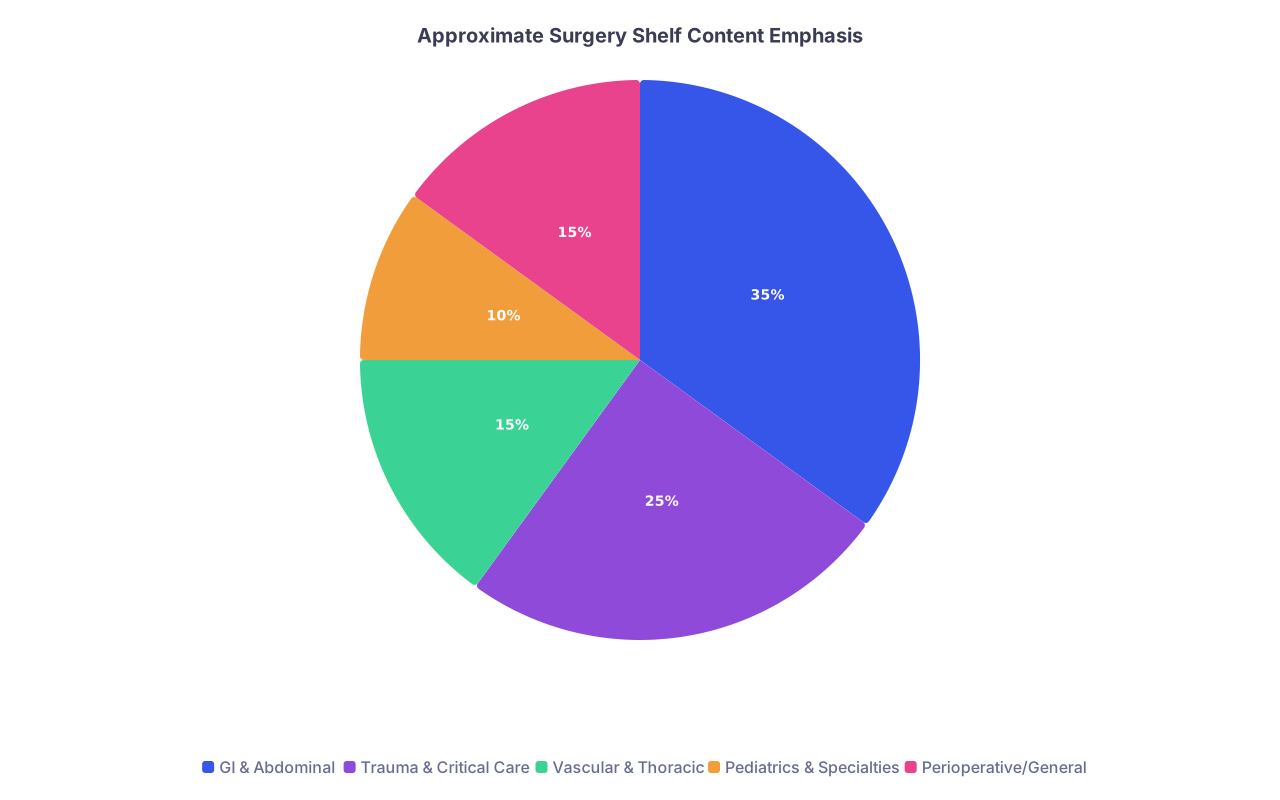
| Category | Value |
|---|---|
| GI & Abdominal | 35 |
| Trauma & Critical Care | 25 |
| Vascular & Thoracic | 15 |
| Pediatrics & Specialties | 10 |
| Perioperative/General | 15 |
The key point: a huge chunk of those questions are “medicine in a surgical patient.” Think:
- Post-op chest pain: MI vs PE vs atelectasis
- Post-op fever: POD #1 vs #3 vs #7 patterns
- Shock: hypovolemic vs septic vs obstructive vs cardiogenic
You need a Q-bank setup that reflects that. Pure “surgery only” banks will leave you exposed on perioperative medicine, fluids, electrolytes, and ICU-level decision making.
Step 2: Know What the Major Q‑Banks Actually Offer
Here is the mistake: students treat Q‑banks as interchangeable. They are not. They have different “personalities.” For surgery, some are great for pattern recognition; others teach algorithms; some are frankly a waste of time for this specific exam.
Let’s compare the main players in terms of how they fit the Surgery Shelf use-case, not just general Step 2 prep.
| Resource | Best Use for Surgery Shelf | Question Style | Explanations Depth | Alignment to NBME Feel |
|---|---|---|---|---|
| UWorld Step 2 | Core surgery + periop medicine | Long, detailed vignettes | Very high | High-moderate |
| AMBOSS | Algorithmic management, breadth | Concise, high-yield | High + library | High |
| NBME CMS forms | Style calibration, self-assess | True NBME | Minimal | Exact |
| TrueLearn | Pattern drilling, stats-style | Exam-focused, shorter | Moderate | Moderate |
| OnlineMedEd Qs | Concept reinforcement | Simpler, didactic | Low-moderate | Low-moderate |
Bluntly: if you only have time (or money) for two, you choose UWorld and AMBOSS, then add NBME forms as non‑negotiable. TrueLearn and others are supplemental.
Step 3: Build the Stack – Roles, Not Redundancy
You are not trying to do “all the questions in the universe.” You are trying to cover the blueprint with appropriate roles for each tool, so you are not doing the same type of question five different ways.
Think of your Q‑bank stack like a team:
- UWorld = Attending: deep, over‑explanatory, sets the standard
- AMBOSS = Senior resident: algorithmic, fast, wide coverage
- NBME forms = The actual exam: harsh, stingy, shows what really counts
- Extra bank (TrueLearn / OME) = Intern: fills gaps, drills patterns
Core Architecture
If you are in a typical 8-week surgery block, here is a clean structure:
- UWorld Step 2: 250–350 core “surgery-labeled” + high‑yield surgery-adjacent questions
- AMBOSS: 200–300 surgery/EM/ICU/trauma/periop questions
- NBME surgery CMS forms: 3–4 forms (mixed blocks + review)
- Optional: 150–200 TrueLearn (if you have access) or your school’s Q-bank
Your goal is not a particular number; your goal is complete coverage of the blueprint via different lenses.
Step 4: Map the Blueprint to Specific Q‑Bank Categories
Here is where most people are sloppy. They just click “Surgery” and assume the bank did the thinking for them. That gives you blind spots.
You want to explicitly map NBME content areas to Q‑bank tags. For example:
A. Gastrointestinal & Abdominal Surgery (about 30–35%)
Core topics: SBO vs ileus, appendicitis, cholecystitis vs cholangitis, pancreatitis, GI bleeding, perforated ulcer, hernias, bowel ischemia, IBD complications, diverticulitis.
Your stack should pull:
- UWorld:
- Surgery: Abdomen, GI, Biliary, Pancreas
- Internal Med: GI bleed, pancreatitis, IBD flares, liver disease with surgical implications
- AMBOSS:
- “Acute abdomen,” “Upper GI bleed,” “Lower GI bleed,” “Gallstone disease,” “Acute pancreatitis”
- Hernias, colorectal cancer, bowel obstruction
You deliberately over-sample GI/abdomen because that is where the volume—and the points—live.
B. Trauma & Critical Care (about 20–25%)
Core topics: ATLS sequence, primary/secondary survey, airway management, chest trauma, abdominal trauma, pelvic fractures, spinal injuries, shock types, ICU complications.
Pull:
- UWorld:
- Surgery: Trauma, Shock, Burns, ICU
- EM: trauma resuscitation, airway, shock management
- AMBOSS:
- “Trauma management,” “Blunt abdominal trauma,” “Penetrating trauma,” “Burns,” “Shock”
I have seen too many students “kind of know ATLS” and miss 3–4 questions per block because they do not know exactly when to intubate, where to cut for a tension pneumothorax, or which imaging is appropriate in unstable vs stable trauma.
C. Vascular & Thoracic (about 10–15%)
Core: AAA, PAD, acute limb ischemia, DVT/PE (yes, medicine but shows up here), carotid disease, aortic dissection basics, lung cancer staging, pneumothorax, hemothorax.
Stack pulls:
- UWorld:
- Surgery: Vascular, Thoracic
- Internal Med: DVT/PE, aortic dissection, PAD, carotid stenosis
- AMBOSS:
- “Peripheral arterial disease,” “Aortic aneurysm,” “Pulmonary embolism,” “Lung cancer”
You are not being tested on how to do a carotid endarterectomy; you are being tested on who needs one versus medical management.
D. Pediatric Surgery & Specialties (about 10%)
Core: pyloric stenosis, malrotation/volvulus, NEC, TE fistula, Hirschsprung, intussusception, undescended testis, Wilms vs neuroblastoma, testicular torsion, some basic ortho emergencies.
Pull:
- UWorld:
- Pediatrics: surgical pediatrics tags (GI obstruction, GU, oncology)
- Surgery: any pediatric‑labeled content
- AMBOSS:
- “Pediatric acute abdomen,” “Intussusception,” “Necrotizing enterocolitis,” “Hypertrophic pyloric stenosis”
Most students under‑dose this section, then are shocked there are 6–10 questions involving kids.
E. Perioperative Medicine & General Principles (about 15%)
Core: pre‑op risk stratification, cardiac clearance, anticoagulation management, DVT prophylaxis, wound healing, post‑op complications (fever, ileus, atelectasis, PNA, MI, DVT/PE), fluids and electrolytes, nutrition, ethics/end‑of‑life in surgical patients.
Pull:
- UWorld:
- Internal Med: perioperative, fluids, electrolytes, acid–base, anticoagulation
- Surgery: perioperative, post‑op complications
- AMBOSS:
- “Perioperative care,” “Postoperative fever,” “Fluid management,” “Electrolyte disturbances”
This is the part that destroys people who only click “Surgery” and ignore medicine tags.
Step 5: How to Sequence Questions Week by Week
Your rotation length matters. I will assume an 8‑week core surgery block. Adjust proportionally for shorter blocks.
Week 1–2: Foundation + Pattern Exposure
Goal: Build basic frameworks while you are still drowning in the OR learning what a Bovie is.
Q‑bank plan:
- Daily: 10–15 UWorld “Surgery” questions in tutor mode, organ‑system targeted
- 5–10 AMBOSS questions if you have time, matched to what you saw that day (e.g., cholecystitis, appendicitis)
Do not start with random-timed blocks. You will waste learning opportunities. Example: You scrubbed an appy today? Do 10–15 questions tagged appendicitis / acute abdomen that evening, in tutor, reading explanations thoroughly.
Week 3–4: Ramp Volume, Start Mixed Timing
Goal: Transition from pure learning to exam‑style thinking under mild time pressure.
- Every other day: 20‑question UWorld mixed surgery block, timed, then full review
- Alternate days: 20–30 AMBOSS questions on focused themes (e.g., trauma-focused one day, GI the next)
- End of Week 4: Take one NBME surgery CMS form under exam conditions (timed, no notes)
Here is where you learn what NBME actually cares about vs what UWorld obsesses over. Expect your first NBME to feel brutal. That is the point.
Week 5–6: Blueprint Completion + NBME Feedback Loops
Goal: Close content gaps identified by your first NBME, push toward full blueprint coverage.
- 20–40 questions/day total (combined UWorld + AMBOSS)
- Focus categories: the systems you bombed on NBME (NBME score report will show breakdown)
- Week 6: Second NBME form; adjust again
Now you switch a bit: UWorld mostly mixed, timed blocks. AMBOSS more gap‑targeted: if you routinely miss trauma airway questions, you hammer those chapters.
Week 7–8: Exam Simulation + Surgical Medicine Finishing
Goal: Make the real exam feel like “just another block.”
- 3rd NBME form at start of Week 7
- 4th NBME form ~5–7 days before exam, or use a second run‑through of an earlier form for reinforcement if you are out of new ones
- 1–2 full 40‑question UWorld mixed blocks (timed) on at least 3 separate days
On non‑NBME days, you focus Q‑bank work on your chronic weak spots plus high-yield periop medicine.
Step 6: Use NBME Forms Correctly (Most People Don’t)
NBME CMS forms are not for your ego. They are for calibration and triage.
When you review:
Categorize each miss by:
- Content area (GI, trauma, vascular, peds, periop)
- Error type (content gap, misread question, time pressure, overthinking)
For content gaps:
- Read a short targeted reference (AMBOSS article, or dedicated section in a core text like Dr. Pestana’s Surgery Notes)
- Immediately do 5–10 Q‑bank questions on that exact topic from UWorld or AMBOSS
For pattern misses (e.g., repeatedly mismanagement of DVT/PE post-op):
- Write a 3–5 line “if X, then Y” management algorithm in your own words
- Stick it into Anki or a notes doc and hit it again via questions within 24 hours
NBME’s value is not just the score; it is the blueprint of your blind spots. Use it that way.
Step 7: Balance UWorld and AMBOSS Without Burning Out
You do not have unlimited cognitive bandwidth. So you need division of labor.
UWorld: Depth and Integration
Use UWorld for:
- Complex vignettes that weave surgery with medicine (e.g., cirrhotic with GI bleed who now may need surgery)
- High‑stakes decisions: OR now vs CT first vs observe
- Detailed explanation reads (yes, sometimes too long, but you mine them for frameworks)
Mode: Mostly timed blocks by Week 3–4. Early weeks you can use tutor mode while you are calibrating.
AMBOSS: Algorithms and Breadth
Use AMBOSS for:
- Rapid‑fire pattern drilling: “Trauma? Here is ATLS. Again and again.”
- Niche topics that UWorld under‑represents (certain peds surgery, pre-op risk scoring, specific imaging decisions)
- On‑call consult reinforcement: you see a patient with acute mesenteric ischemia, you go home and do every AMBOSS question and read the article that night.
Mode: Primarily tutor. Use the explanation’s “summary” and the AMBOSS library sections as your quick reference.
Step 8: Build Subject-Specific Micro‑Stacks
You should have mini‑stacks for certain high‑yield clusters. Not everything deserves equal weight. Some areas get their own “micro Q‑bank projects.”
Micro‑Stack 1: Post‑operative Complications
The exam loves:
- Post-op fever by day (wind, water, wound, walking, wonder drugs—but updated and nuanced)
- Post-op chest pain (MI vs PE vs atelectasis vs PNA vs pericarditis)
- Post-op ileus vs early SBO vs anastomotic leak
Your micro‑stack:
- 30–40 UWorld questions explicitly tagged post-op or complications
- 30–40 AMBOSS questions from “postoperative complications,” “perioperative care,” “fluid/electrolyte disorders”
And you keep a one‑page summary of common post-op scenarios. You will see these patterns again and again.
Micro‑Stack 2: Trauma & ATLS
You need automaticity on:
- Primary survey sequence and must‑not‑miss airway indications
- When to chest tube vs needle decompress vs observe
- When to go straight to the OR vs FAST vs CT vs DPL
Build:
- 40–60 trauma and critical care questions (mix from UWorld surgery + EM sections, plus AMBOSS trauma chapters)
- Revisit them twice: once mid‑rotation, once in the final 5 days
This is where getting 1–2 more questions right per block is very realistic.
Micro‑Stack 3: Acute Abdomen & Imaging
Core: know when you order US vs CT vs HIDA vs no imaging (straight to surgery).
Focus Q‑bank pulls on:
- Appendicitis across age groups
- RUQ pain (biliary colic vs cholecystitis vs cholangitis vs pancreatitis)
- LLQ pain (diverticulitis vs ovarian vs others)
- Free air perforation and emergent OR scenarios
Tie every question back to “what is the diagnostic test of choice” and “what gets you to the OR immediately.”
Step 9: Track Coverage Against the Blueprint, Not Just Question Counts
A lot of students brag: “I did 800 questions for surgery.” That sounds impressive and tells me almost nothing.
What I care about is coverage. A simple way:
Create a one‑page tracking table in Notion, Excel, or on paper:
| Domain | Target Qs | Completed | NBME Weak? (Y/N) | Notes/Plan |
|---|---|---|---|---|
| GI & Abdomen | 150 | 120 | Y | Focus SBO & GI bleed |
| Trauma & Critical Care | 120 | 80 | N | Keep steady |
| Vascular & Thoracic | 80 | 40 | Y | Add AMBOSS set |
| Pedi Surgical | 60 | 30 | Y | UWorld Peds + AMBOSS |
| Periop & Complications | 120 | 70 | Y | Post-op fever stack |
You do not need perfect numbers. But if you are two weeks out and pediatric surgery says “Completed: 12,” you know what your evenings look like.
Step 10: Integrate Questions With Clinical Days Without Destroying Yourself
You will not have a normal schedule. Some days you will do 40–60 questions. Others you will be lucky to do 10.
The trick is to align topic with what you saw:
- Appendectomy day? Do acute abdomen and appendicitis that night.
- Trauma call? Hit AMBOSS trauma algorithms and a UWorld trauma block the next day.
- Vascular clinic? Run a quick set on PAD, AAA, carotid disease.
Also, use dead time. I have seen people do 5 AMBOSS questions on their phone while waiting for cases to start. Those stack up faster than you think.
Step 11: Last 5 Days – Tighten, Do Not Fling More Resources
The final mistake: adding new Q‑banks in the last week “just to see more questions.” Terrible idea.
In the last 5 days, your Q‑bank usage should:
- Focus on weak domains exposed by NBME forms
- Be mostly mixed, timed 40‑question blocks (UWorld) to keep endurance and timing
- Include targeted AMBOSS sessions on trauma, post‑op, and perioperative care
You also re‑review:
- Every NBME question you got wrong, again
- Key micro‑stack algorithms: post-op fever, trauma airway/ATLS, imaging choice by scenario
If you want a mental model for the last week, here it is:

| Step | Description |
|---|---|
| Step 1 | Start of Final 5 Days |
| Step 2 | Targeted AMBOSS Sessions |
| Step 3 | Mixed UWorld Blocks |
| Step 4 | Re-test with 20-30 Qs |
| Step 5 | 40-Question Timed Blocks |
| Step 6 | Review Algorithms |
| Step 7 | Day Before Exam: Light Review Only |
| Step 8 | NBME Weak Areas? |
On the day before the exam, you are not grinding 120 fresh questions. You do a light 20–30 high‑yield review questions if you must, but mostly you are flipping through your summary notes and getting sleep.
Step 12: Common Q‑Bank Stack Mistakes (And What To Do Instead)
A few patterns I see over and over.
Only doing “Surgery”‑labeled questions
- Fix: Intentionally rope in medicine: GI bleed, PE, CHF, COPD exacerbation, sepsis, kidney injury, etc., when they intersect perioperative care.
Treating UWorld explanations like a novel
- Fix: For each missed question, force yourself to write a 1–2 line rule: “If unstable blunt abdominal trauma with positive FAST → straight to OR.” That rule is what you carry forward, not the paragraph.
Ignoring pediatrics because “I had a peds shelf already”
- Fix: Do a small, high‑yield pediatric surgery stack. The patterns are not the same as outpatient peds.
Saving NBME forms for the very end
- Fix: Space them. At least two forms before the final week so you can adjust your Q‑bank usage based on real data.
Using 4–5 Q‑banks halfway
- Fix: Pick 2 main (UWorld + AMBOSS), 1 real exam (NBME), optionally 1 supplemental. Finish or nearly finish categories that map to the blueprint instead of half‑doing everything.
A Quick Visual: How Your Question Volume Might Look
So you can see the relative emphasis rather than guess:
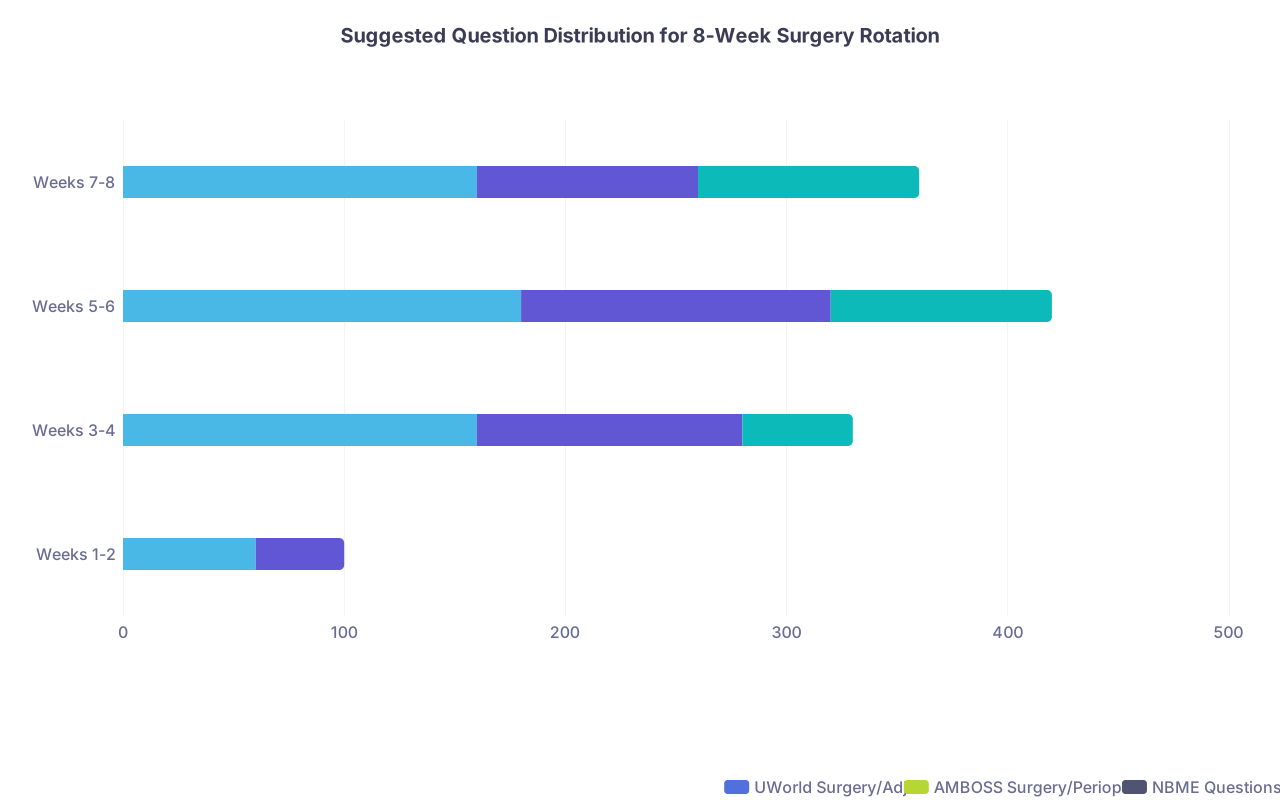
| Category | UWorld Surgery/Adj | AMBOSS Surgery/Periop | NBME Questions |
|---|---|---|---|
| Weeks 1-2 | 60 | 40 | 0 |
| Weeks 3-4 | 160 | 120 | 50 |
| Weeks 5-6 | 180 | 140 | 100 |
| Weeks 7-8 | 160 | 100 | 100 |
Numbers are approximate, but the pattern stands: ramp, calibrate with NBME, refine, simulate.
Final Thoughts: What Actually Moves Your Score
If you want a Surgery Shelf Q‑bank stack that works, not just looks impressive on paper, anchor yourself to three ideas:
The exam blueprint is king. Your stack must explicitly cover GI/abdomen, trauma/critical care, vascular/thoracic, pediatric surgery, and perioperative medicine—with extra weight on GI, trauma, and post-op problems.
Resources need defined roles. UWorld for depth and integration, AMBOSS for algorithms and breadth, NBME for calibration and humility. Anything else is optional.
Questions are only half the work. The other half is extracting rules and patterns from your misses, then immediately reinforcing them with more questions in that exact domain.
Do that consistently for 6–8 weeks, and the Surgery Shelf stops being this mysterious “surgical black box” and starts feeling like what it is: a structured, predictable exam testing clinical management around surgical disease.