
If English Is Not Your First Language: Choosing Clear, Concise Resources
What do you actually do when everyone says “UWorld and First Aid” and you’re thinking, “I can barely get through the explanations without rereading every sentence twice”?
If English is not your first language, most “advice” about exam prep quietly assumes that reading dense English all day is no big deal. For you, it is a big deal. Not because you’re less intelligent, but because your brain is doing extra work every second—translating, interpreting nuance, fighting unclear wording.
So you have two jobs:
- Learn the medicine.
- Survive the English.
You cannot afford bloated, wordy, “high-yield” resources that are really just “high-words.”
Here’s how to choose resources that are actually clear and concise when English is your second (or third) language—and how to build a setup that works in real life, not just in Reddit fantasyland.
Step 1: Admit What’s Actually Slowing You Down
You need to be honest about what’s holding you back. Is it the medical content, or the English packaging around it?
Typical signs that English is your main bottleneck:
- You understand lectures in your native language easily, but English videos feel twice as tiring.
- You miss questions because of wording, not because you did not know the fact.
- You can answer questions when someone explains them simply out loud, but you struggle with long text explanations.
- You reread question stems multiple times just to figure out what is being asked.
That profile is brutally common for international students, IMGs, and even US students who grew up speaking something else at home.
Here’s the rule: if English is your bottleneck, your resources must:
- Use simple, direct language.
- Avoid unnecessary adjectives and fluff.
- Use clear diagrams and tables.
- Repeat core concepts in consistent wording.
- Let you “see” the idea, not just read about it.
You are not looking for the fanciest resource. You are looking for the clearest one.
Step 2: How to Test if a Resource Is “Second-Language Friendly”
Do not trust marketing pages or random Reddit comments. Test each resource yourself with a small, controlled experiment.
Use this quick 20–30 minute test for any book, Qbank, or video series:
- Time yourself reading 1–2 pages of textbook or watching 5–10 minutes of video.
- After that:
- Can you explain the main idea in your native language?
- Can you explain it in simple English to a friend?
- Now look at the same topic from another resource:
- Which one needed fewer re-reads?
- Which one used fewer unknown words?
- Which one made the picture in your head clearer?
If a resource is “good” but you constantly feel like you’re decoding a puzzle, it is not good for you.
To make this more concrete:
| Feature | Good for You | Bad for You |
|---|---|---|
| Sentence length | Short, direct | Long, academic, many commas |
| Visual aids | Frequent, labeled clearly | Rare, small, or too complex |
| Vocabulary | Everyday medical terms | Fancy synonyms, literary style |
| Explanations | Step-by-step | Big paragraphs, no structure |
| Examples | Many, simple | Few examples, very abstract |
If you’re unsure, here’s a blunt filter:
If you can’t read one page without getting mentally exhausted, don’t build your entire study plan around that resource.
Step 3: Picking Qbanks When English Is Hard
You’re going to spend hundreds of hours in question banks. If the language is bad for you, you’re losing time and burning energy.
UWorld vs Others (Kaplan, AMBOSS, etc.)
You’ll hear “UWorld is king” a thousand times. UWorld is excellent—but not automatically best for every non-native speaker.
Think of Qbanks in three dimensions:
- Question language complexity
- Explanation style
- Visual support (tables, charts, diagrams)
Rough, generalized comparison:
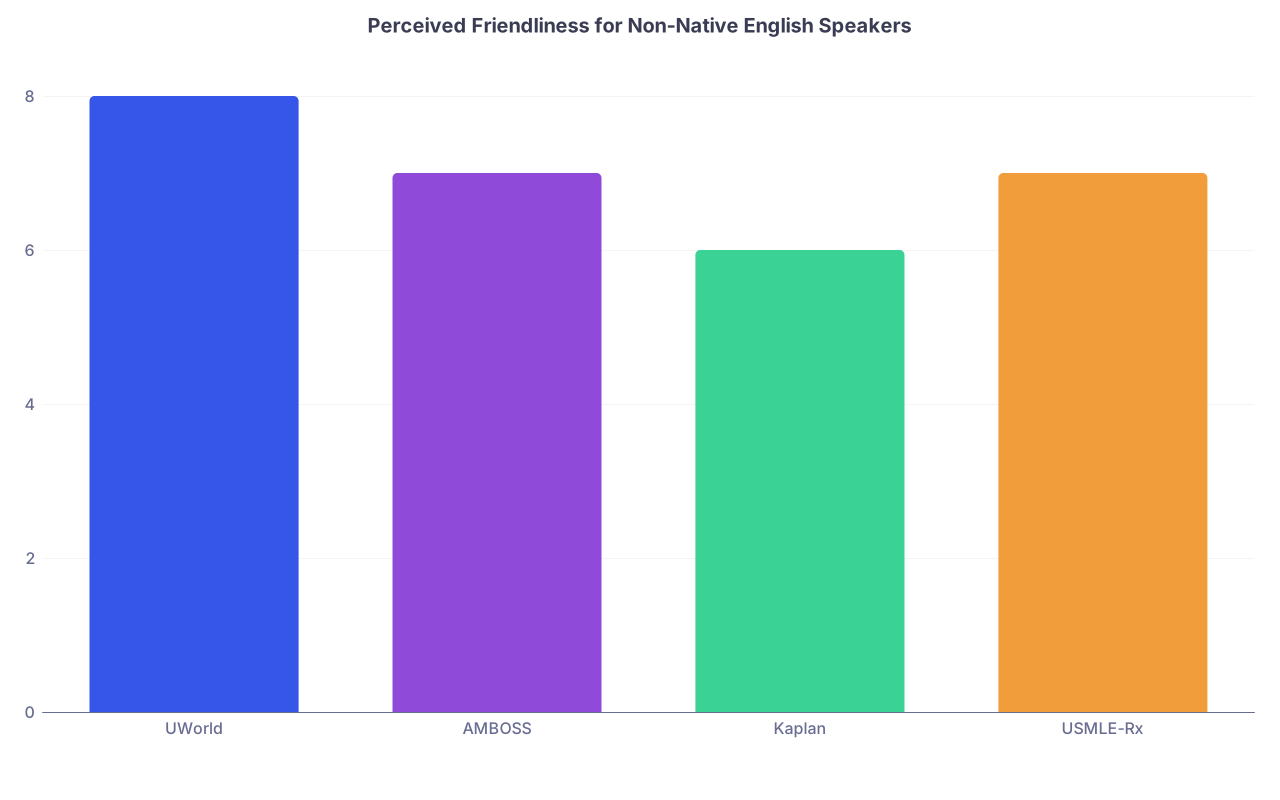
| Category | Value |
|---|---|
| UWorld | 8 |
| AMBOSS | 7 |
| Kaplan | 6 |
| USMLE-Rx | 7 |
(10 = very friendly, 1 = impossible; this is based on how students often describe them.)
Here’s how to handle them:
Start with a Qbank that feels slightly easier in language than the exam itself.
For many students: USMLE-Rx or Kaplan feel a bit more straightforward linguistically than UWorld.Use that “easier” bank to:
- Train your brain to read English question stems faster.
- Build pattern recognition with simpler language.
- Reduce your anxiety with unfamiliar phrasing.
Then move into UWorld when:
- You’re not getting stuck on wording as much.
- You’ve built up your medical vocabulary in English.
If you’re already in UWorld and drowning in the explanations:
- Shorten the explanations yourself.
- After each question, you write a 1–2 line “essence” of the explanation in your own words (in English or your language). That rewrites complex English into your mental language.
Step 4: Choosing Videos and Lectures That Won’t Drain You
Videos are a lifesaver if reading English is slow. But some lecturers talk like they’re auditioning for an academic podcast—too many words, too few pictures.
You want:
- Clear diagrams shown as they talk.
- Slower, articulate speech.
- Limited slang or jokes that interrupt flow.
- Structured progression: definition → mechanism → example.
Good candidates (depending on exam and region):
- Boards & Beyond (USMLE-type prep): clear structure, reasonably paced, not overloaded with slang.
- Osmosis: visual, extremely helpful for concept building if your reading is weaker.
- Some local-language YouTube channels for basic concepts, then switch to English resources later for exam-style details.
Mix languages strategically:
Use your native language for:
- First exposure to a tough topic (e.g., renal physiology).
- Initial conceptual understanding.
Then use English resources for:
- Clinical correlations.
- Exam-style phrasing.
- Key buzzwords and terms (the exam will be in English, not translated in your head).
If you understand the topic well in your language but always miss it on questions, that’s a sign: you’ve undertrained English phrasing for that content.
Step 5: Textbooks, Notes, and “High-Yield” Books
Most medical textbooks are written like the authors are paid per syllable. As a non-native speaker, that’s a trap.
You need slim, structured, visually clear resources.
For exam-prep style, prefer:
- Outline-style books with:
- headings,
- subheadings,
- bullet lists,
- tables,
- simple schemas.
Avoid:
- Wall-of-text paragraphs with no structure.
- Books that try to be cute with language.
Here’s a test: open a random page and check:
- Can you find a definition within 2–3 seconds?
- Are there more than 3 long, unbroken paragraphs on the page?
- Are key terms bolded or highlighted clearly?
If the layout fights you, you’ll lose hours to scrolling and searching.
Step 6: Build a Hybrid Language System (Instead of Forcing Full English)
You don’t have to be a hero and do 100% of your prep in English from day one. That’s how people burn out and fail.
Here’s a system that works better:
Learn the concept in your strongest language first
Use:- Local-language lectures
- Your med school notes
- Tutors or peers who speak your language
Goal: You can explain “what’s happening” in the disease without thinking about English at all.
Layer English terms on top
For each topic, build a small table in your notes:- Column 1: Native-language phrase
- Column 2: English term
- Column 3: Short explanation in simple English or your language
Use English-only for questions and recall
When doing Qbanks:- Read the question in English.
- Pause. Can you explain the disease in your head in your own language?
- Then map back to the English key words.
This “two-language bridge” makes your brain faster. It also prevents that awful feeling of “I know this in my language, but I freeze on test day.”
Step 7: Handling Long, Confusing Question Stems
A lot of non-native speakers are strong in science and weak in decoding long stems. That’s fixable with technique, not just more vocabulary.
Basic approach for any long stem:
Read the last 1–2 lines first.
Ask: What’s the question actually asking? Diagnosis? Mechanism? Next step?Then skim for:
- Age, sex
- Setting (ER, clinic, ICU)
- Key symptoms
- Important labs/imaging
Ignore decorative details on first pass.
Many stems add “story flavor” that you don’t need. As a non-native speaker, that extra text is your enemy.
Practice rewriting stems:
- Take a missed question.
- Rewrite the stem in 2–3 short simple sentences in your own notes.
- Keep the logic, ditch the fluff.
Do this for 5–10 questions a day for a month. You’ll feel your reading speed change.
Step 8: Using Translation and AI Tools Without Letting Them Ruin You
You’re tempted to translate everything. That’s understandable—and dangerous if you never move beyond it.
Here’s a realistic way to use tools:
Reasonable uses:
- Translate individual words or short phrases you keep seeing.
- Occasionally translate a full explanation to confirm you understood the English correctly.
- Ask an AI (like me) to:
- Rephrase a complicated explanation in simpler English.
- Give 2–3 extra examples with the same concept.
- Turn a long explanation into a short, stepwise summary.
Bad uses:
- Auto-translating every question stem before answering.
- Studying only in your native language until 2 months before the exam.
- Letting translation apps rewrite entire chapters while you passively read.
Rule: tools should support your active thinking, not replace it.
Step 9: A Sample Resource Setup That Actually Works
Let me give you a concrete, realistic combo for a non-native English speaker in med school studying for board-style exams (adjust branding for your exam/region).
Morning (concept building):
- Topic: e.g., Heart failure
- 20–30 min: Watch a short English video (e.g., Boards & Beyond / Osmosis).
- 15–20 min: Quickly read your local-language notes or a short summary to solidify mechanisms.
- 10–15 min: Build a small bilingual table:
- “Reduced ejection fraction” ↔ phrase in your language.
- “Increased end-diastolic volume” ↔ translation.
Afternoon (question training):
- 20–40 Qs mixed from an easier Qbank or subject-specific bank.
- For each missed question:
- Identify: Did I fail the medicine, or did I fail the English?
- Rewrite the key idea in 1–2 simple sentences.
- If English blocked you, create a micro-vocab list from that question.
Evening (language + recall):
- 10–15 minutes:
- Take your small vocab lists and try to explain each term out loud in simple English, then in your language.
- Or teach a friend/yourself in the mirror.
Repeat this over weeks. It’s boring. It works.
Step 10: Watch for These Common Traps
There are a few predictable mistakes I’ve seen again and again:
Copying native speakers’ study plans
They can brute-force 80-page chapters in dense English. You’ll drown. Their bottleneck is content volume; yours is often language + volume combined. You need more efficient resources and more time for repetition.Using too many resources at once
Two Qbanks, three video series, four textbooks—this is suicide, especially when your reading speed is slower. Pick one main resource per function:- one primary Qbank,
- one main video series or notes,
- one reference book if absolutely needed.
Shaming yourself for using your native language
Using your first language strategically is smart, not weak. The exam is in English, yes—but your brain does not magically become monolingual just because you’re taking USMLE or some national exam.Ignoring reading speed until 1–2 months before the exam
If English slows you down, you must train reading daily. Not just medicine—read short, well-written English (NYTimes health section, UpToDate patient summaries, etc.) for 10–15 minutes a day. You’re building reading muscles.
Quick Process Map: How to Choose and Use Resources

| Step | Description |
|---|---|
| Step 1 | Identify bottleneck: content vs English |
| Step 2 | Test resources for clarity 20-30 min each |
| Step 3 | Use standard high-yield mix |
| Step 4 | Select clear Qbank + video series |
| Step 5 | Learn concepts in native language first |
| Step 6 | Layer English terms and question practice |
| Step 7 | Regularly adjust based on reading difficulty |
| Step 8 | English is major issue? |
FAQ (Exactly 3 Questions)
1. Should I ever fully translate questions into my native language while practicing?
Occasionally, for learning—yes. For routine practice—no. It’s fine to take a very hard question, translate parts of it, and make sure you truly understand what’s being asked. That can expose gaps in both language and content. But if you make it a habit to translate every stem, you’re training the wrong skill for test day. The right compromise: translate a few of your worst missed questions per week, learn from them, then do the rest in English only.
2. Is UWorld still necessary if the English feels too hard at first?
Necessary? For many major exams, yes—eventually. But it doesn’t have to be your starting point. You can begin with a slightly easier Qbank to build confidence and language familiarity, then gradually transition to UWorld for the final stretch. When you do use UWorld, don’t passively suffer through the explanations. Rewrite them in simple language, focus on patterns, and mark questions where wording tricked you so you can revisit them.
3. How do I know if a resource is “too hard” vs “I just need to push through”?
Give it a fair 3–5 day trial. If after that:
- Your accuracy stays extremely low mainly due to misreading,
- You feel mentally destroyed after a small number of pages/questions,
- And you’re spending more time decoding English than learning medicine,
then the resource is probably mismatched for your current level. That doesn’t mean you’re weak; it means you need an intermediate step. Scale down to something clearer, build your English-medical foundation, and come back later if needed.
Key points to walk away with:
- Your main enemy is not just “hard exams,” it’s unclear, bloated English—so choose resources with simple language, strong visuals, and structure.
- Use a hybrid approach: understand concepts in your strongest language, then deliberately train English for questions and key terms.
- Keep your setup lean: one main Qbank, one main teaching resource, and consistent practice rewriting complex English into simple, clear explanations you truly own.