
The board prep industry wants you to think a premium course is mandatory. It isn’t.
If you already have strong Q‑banks, a premium board prep course is optional for most students, not required. For a small subset of test‑takers it’s genuinely high‑yield; for many others it’s an expensive security blanket.
Let me walk through how to decide which side you’re on.
The Real Answer in One Sentence
If you:
- consistently score at/above your target on NBME/UWorld self‑assessments,
- use Q‑banks actively with spaced review, and
- have at least one decent concise content resource (e.g., First Aid, Boards & Beyond, Pathoma notes),
then you do not “need” a premium board prep course. You might want one for structure or confidence—but that’s different.
On the other hand, if you’re lost, failing practice tests, or chronically under‑disciplined, a good course can salvage your prep.
Let’s get specific.
What Premium Board Prep Courses Actually Do (vs. Q‑Banks)
Strip away the marketing and premium courses do about five things:
Content delivery
Long video libraries, organized by system/topic. Examples: Boards & Beyond, Sketchy, Kaplan, Lecturio, Rx videos.Study structure
Schedules, curated “watch this then do that,” topic checklists, “high‑yield” tags.Explanations in another format
Concept breakdowns that some students find clearer than reading Q‑bank explanations or First Aid.Extra practice questions
Usually lower quality than UWorld/Amboss, but more reps.“Hand‑holding”
Some programs add tutoring, coaching calls, or progress dashboards.
What Q‑banks actually do better than almost anything else:
- Test recognition of board‑style patterns
- Reveal weaknesses in real time
- Teach reasoning via explanations and answer choices
- Train test‑taking stamina and timing
Here’s the key:
You pass (and score high) based on how well you answer questions—not how many hours of video you watch.
If you already have:
- UWorld or Amboss (ideally both across your prep timeline)
- A disciplined way to review missed questions and notes
- Some form of spaced repetition (Anki or similar)
you already own the highest‑yield piece of the puzzle.
A Simple 4‑Question Decision Framework
Use this as a blunt filter. If you answer “yes” to most of these, you might benefit from a premium course. If not, save your money.

| Step | Description |
|---|---|
| Step 1 | Have strong Q-banks? |
| Step 2 | Buy Q-bank first |
| Step 3 | Course optional but helpful |
| Step 4 | Skip course |
| Step 5 | Course likely helpful |
| Step 6 | Focus on Q-bank strategy |
| Step 7 | NBME/UWorld at goal? |
| Step 8 | Need structure/accountability? |
| Step 9 | Weak content knowledge? |
1. How are your NBME / self‑assessment scores?
If you’re already within ~5–10 points of your goal:
You don’t need a course. You need polishing: targeted review of weak subjects, more timed blocks, maybe a light content refresher.If you’re 15–25+ points below passing or your target:
Now we ask why. Massive content gaps? Or poor question strategy? Courses help more with the former than the latter.
2. Are your content gaps huge or specific?
Content gap patterns:
- Huge: “I consistently miss basic physio, biochem pathways, pharmacology mechanisms.”
- Specific: “I’m fine overall but always miss renal physiology and biostatistics.”
Premium courses are better at massive, foundational content building.
For narrow gaps, targeted resources (Pathoma for path, one stats chapter, a couple of videos) are cheaper and faster.
3. Do you struggle with structure and self‑discipline?
Be honest.
If you chronically drift, redo your favorite easy blocks, or “study” by endlessly tweaking your Anki deck:
The structure of a course schedule can keep you from sabotaging yourself.If you already have a working system—daily Q‑bank, timed blocks, scheduled review—you’re paying for structure you built yourself.
4. What’s your budget vs. your real risk?
| Option | Typical Cost | Who Should Prioritize It |
|---|---|---|
| UWorld 6-12 months | $400-500 | Everyone serious about boards |
| Amboss (or 2nd Q-bank) | $200-350 | High scorers / repeat practice |
| Premium video course | $300-1000+ | Big content gaps / low scores |
| 1:1 tutoring block | $400-800 | Very low scores / repeat takers |
If money is tight, I’d always buy:
UWorld → one strong concise text or video set → assess → then maybe a course.
Not the other way around.
When a Premium Course Is Worth It
Here are the cases where I’ve seen a course pay off, repeatedly.
1. Non‑traditional or weaker basic science background
If you:
- changed careers and rushed through prereqs
- attended a school with chaotic or weak preclinical teaching
- had major life disruptions and missed big chunks of M1/M2
then yes, a structured board course can shortcut years of disorganized content into a coherent map. You’re not just “reviewing”—you’re learning from scratch.
In that case, think of the course as:
- “M1–M2 in fast‑forward, but organized properly”
Boards & Beyond + Pathoma + Sketchy (for micro/pharm) often beats the giant “all‑in‑one” advertised packages, and usually for less money.
2. You failed or barely passed a prior big exam
If you:
- failed an NBME shelf or a prior Step/Level attempt
- consistently underperform standardized tests compared to class exams
you need more than “do more questions.”
You likely need:
- structured re‑teaching of core content
- specific help identifying cognitive traps and test‑taking issues
- accountability so you cannot just keep doing what feels easy
In this scenario, a course plus some tutoring or faculty guidance makes sense. You’re trying to fix a system that clearly did not work.
3. You panic and freeze without external structure
I’ve seen this more with very conscientious students. They’re not lazy. They’re paralyzed by options.
Signs:
- You spend hours building the “perfect” schedule, then don’t follow it
- You constantly switch resources because “everyone says X is better”
- You chase new YouTube channels instead of finishing anything
For you, a decent course schedule is a feature, not fluff. You’re paying to offload decision‑making so you can actually execute.
But you must commit: if you buy a course and still hop around, it’s wasted.
When Q‑Banks + Targeted Resources Are Enough (for Most People)
If all of this sounds extreme and you’re more “average anxious med student,” here’s the default efficient path.
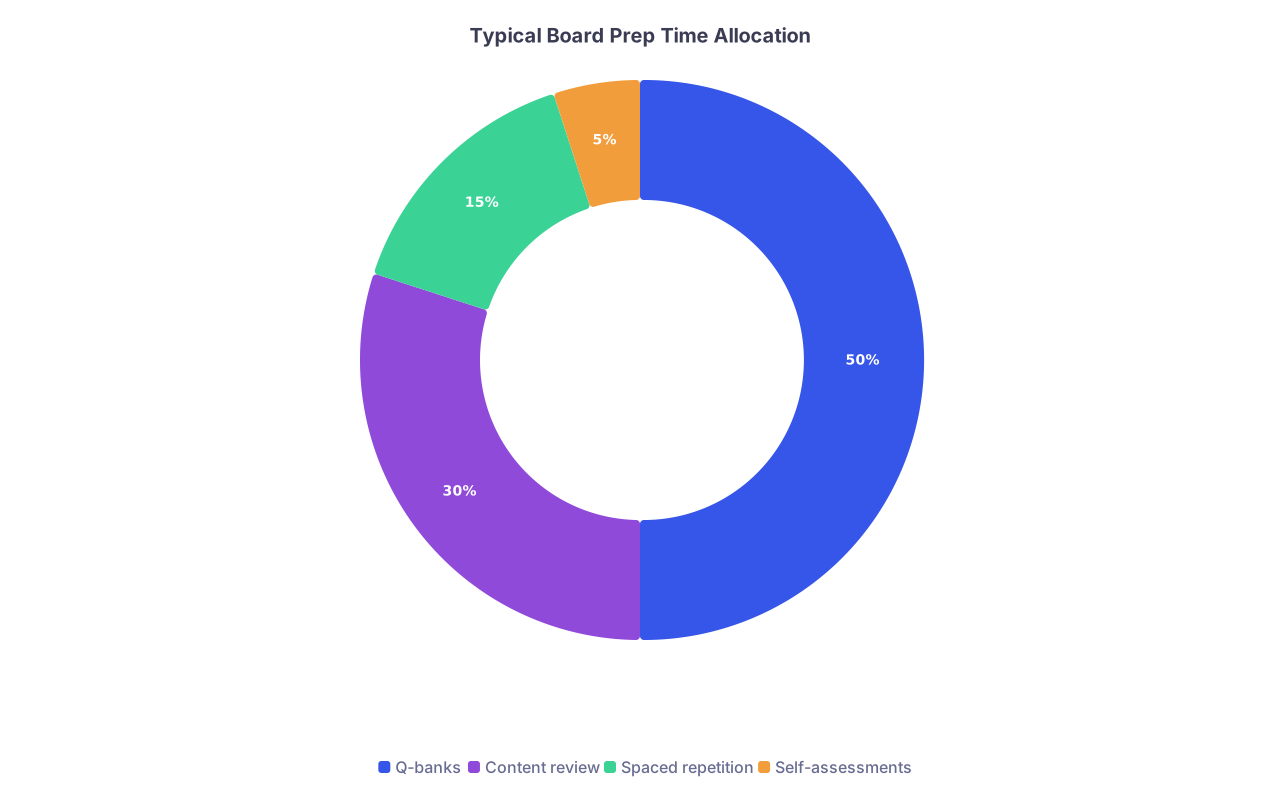
Core setup
One primary Q‑bank
Usually UWorld for USMLE; for COMLEX, either UWorld + COMLEX‑specific bank (COMBANK/TrueLearn) or Amboss + COMLEX bank.One main content outline
Could be:- Boards & Beyond videos + notes
- First Aid (or equivalent) as your “table of contents”
- Pathoma for path, Sketchy for micro/pharm, and your own integrated notes
Spaced repetition
Anki decks (Anking, lightyear, or your custom deck). Or a simple “incorrects” review system if you hate Anki.Regular self‑assessments
NBME forms, UWSAs, COMSAEs at defined intervals.
| Category | Value |
|---|---|
| Q-banks | 50 |
| Content review | 30 |
| Spaced repetition | 15 |
| Self-assessments | 5 |
This core setup is what actually moves scores. A course may plug into “content review,” but it can’t replace the rest.
How to use Q‑banks so you don’t need a course
This is where many students mess up and then blame the resources.
Do timed, random or mixed blocks early
Not endless tutor‑mode, system‑only blocks. You need to train your brain for the real exam’s chaos.Review every question with intent
Not just “why is A right,” but:- Why are B, C, D wrong?
- What keywords in the stem should have pushed me away from my choice?
- What concept is this really testing?
Make focused notes or cards only on recurring issues
If you miss something once, fine. If you miss it three times, it gets a flashcard or a bold note.Track patterns
If your last 80 incorrects cluster in, say, renal physio and endocrine pharm, you don’t need a 300‑hour course. You need a short, targeted deep dive into those.
If you’re doing all of this and your practice scores are moving up, a premium course is just a polished extra.
How to Evaluate a Course If You’re Still Tempted
If you’re leaning “yes,” don’t just buy the shiniest one. Use a few harsh filters.
1. Does it match your weak points?
Examples:
- Bad at path + interpretation of images? Pathoma + a proper image bank helps.
- Weak in systems‑based physio? Boards & Beyond or similar is logical.
- Need integrated clinical thinking? Consider Amboss’ library or high‑quality case‑based review, not just slides.
“Everyone at my school uses X” is not a valid reason by itself.
2. Is the schedule realistic for your life?
Look at the advertised schedule honestly:
- How many hours per day?
- How many days per week?
- Does it assume you’re off rotations, or on an easy elective?
- Will you still be doing clinical work, call, or research?
If the “standard” plan needs 8 hours/day and you can give 3–4, you’ll just feel behind and guilty. That sabotages you more than helps.
3. What’s the actual value add over what you already have?
Ask:
- Does this give me better explanations than my Q‑bank?
- Does it organize content more clearly than my current notes/First Aid?
- Will I actually watch and actively learn, or just let videos run at 1.5x while I scroll my phone?
If the answer is “I’ll probably zone out,” skip it. You’re not buying knowledge; you’re buying videos. Very different.
Practical Recommendation by Student Type
To make this more concrete, here’s how I’d advise different profiles.
| Student Profile | Course Needed? |
|---|---|
| Solid student, Q-bank + NBMEs good | Usually no |
| Non-trad, shaky basic sciences | Often yes |
| Prior fail / very low practice | Strongly consider |
| High scorer aiming 250+ | Maybe, but optional |
| Disorganized, anxious, average | Course for structure, optional |
If you’re an “average but hardworking” student
- Get UWorld
- Pick 1–2 focused content resources (e.g., Boards & Beyond + Pathoma, or FA + Sketchy for weak areas)
- Use Anki or a similar system consistently
- Take NBMEs on schedule
You will be fine without a giant, branded “premium” package.
If you’re truly lost and floundering
- Strongly consider a structured course that includes progress tracking
- Add occasional 1:1 review with a tutor, chief resident, or faculty mentor
- Have someone outside you look at your NBME performance reports
Your problem is likely a mix of content gaps and test‑taking habits, not absence of resources.
FAQ: Premium Board Prep Courses vs. Q‑Banks
1. If I can only buy one thing: UWorld or a premium course?
UWorld. Every time. A high‑quality Q‑bank is non‑negotiable. Courses are negotiable.
2. Are free/cheap resources (YouTube, school lectures) enough with Q‑banks?
For many students, yes. If your fundamentals are solid and you use Q‑banks + self‑assessments well, you can patch almost all gaps with targeted free videos and your class notes.
3. Do high scorers typically use premium courses?
Some do, some don’t. The consistent pattern among 250+ scorers is not “everyone had a course.” The pattern is: they did Q‑banks deeply, ruthlessly attacked weaknesses, and used at least one organized content resource (which might be a paid course or just very well‑used FA/Anki).
4. Is it a mistake to buy a premium course late in dedicated?
If you’re within 4–6 weeks of your exam and far below target, a huge course is usually too slow. At that stage, you need:
- intensive Q‑bank work
- focused review of your NBME‑identified weak systems
- maybe some short, targeted videos (not a 200‑hour curriculum)
Buying a full premium course late is mostly a way to spend money and feel busy without improving scores.
5. What’s a sane, high‑yield setup if I want some video help but not a massive course?
A very efficient combo is:
- UWorld (or Amboss)
- Pathoma (for pathology)
- Boards & Beyond only for your weakest systems, not end‑to‑end
- Anki (AnKing or your own deck) for spaced repetition
- NBMEs/UWSAs on a schedule
That covers content, questions, and memory far better than 95% of bloated “everything included” packages.
Key points to leave you with:
- A strong Q‑bank is essential; a premium course is optional and situational.
- Buy structure and targeted teaching only if your scores, background, or habits actually require it.
- Most score gains come from how you use Q‑banks and self‑assessments—not from how many hours of video you stream.