
The problem with most OB/GYN shelf advice is simple: people recommend “good resources,” not resources that actually match NBME question style.
Let me be very clear. For the OB/GYN shelf, content is not your bottleneck. Question style is. You can know the textbook answer and still miss the question because the stem construction, distractors, and “most appropriate next step” hierarchy do not feel familiar.
So I am not going to give you a generic “use X and Y” list. I am going to tell you, from how these resources behave on test day, which ones actually feel like NBMEs and which ones do not—and how to use each of them without wasting time.
The NBME OB/GYN Shelf: What The Questions Really Look Like
Before we judge books, you need a clear picture of the target.
OB/GYN shelf questions have a very specific flavor:
- Medium-length stems (not as bloated as UWorld).
- One or two key decision points, not five.
- Heavy emphasis on:
- Management algorithms (ACOG-style).
- Initial workup vs. definitive treatment.
- Timing (now vs. postpartum vs. expectant).
- Lots of “what’s the next step?” rather than pure diagnosis.
- Narrow answer choices that feel frustratingly similar.
Patterns that surprise students the first time:
OB emergencies and triage dominate more than you expect.
Shoulder dystocia maneuvers, category III tracings, severe preeclampsia, PPROM management, postpartum hemorrhage. If you are not fluent in those algorithms, the test will eat you alive.Gynecology is algorithmic, not pathologic.
They care less about describing weird ovarian masses and more about: Do you do an endometrial biopsy, TVUS, colposcopy, or reassurance? In which order. At what age. With which risk factors.Preventive care is baked into almost every block.
Contraception choices with specific contraindications. Cervical cancer screening timelines. Sometimes the “OB” question is really a Pap smear question in disguise.They love “most appropriate” over “any reasonable” answer.
You often have 2–3 technically defensible options. NBME wants the cleanest evidence-based, guideline-aligned one. If you have not practiced that style, it feels random.
So the benchmark for any book or resource is not “covers OB/GYN well.” The benchmark is: Does this feel like an NBME block?
The Core Question Banks: How Their Style Compares
Let me break down the big three that actually matter for question practice: UWorld, AMBOSS, and NBME forms.
UWorld Step 2 CK – OB/GYN Section
Short version: Best single resource for learning + close enough to shelf style, but not perfect.
What UWorld gets right:
Content coverage is very strong.
Labor management, fetal heart tracings, hypertensive disorders of pregnancy, early pregnancy bleeding, ectopic, gestational diabetes, gynecologic oncology, contraception, abnormal uterine bleeding—if it can be tested, it is in there.Explanations are gold.
The teaching is better than any book. You get algorithms, reasoning, and “why this answer is slightly better than that one,” which is exactly what you need for NBME logic.Difficulty is appropriate.
Typically a half-step harder than shelf questions in reasoning, not in obscure facts. Stems are slightly longer, but not insane.
Where UWorld diverges from NBME:
Stems can be more convoluted.
NBME does not usually bury the key in 10 tangential details. UWorld sometimes does. On test day, the NBME feels “cleaner.”Slightly higher density of multi-step reasoning.
NBME OB/GYN questions are fairly direct: identify stage of labor → pick appropriate intervention. UWorld occasionally makes you go three steps: interpret test, recall guideline nuance, apply to unusual scenario.
How to use it effectively:
- Do all OB/GYN questions once, ideally during or right before the rotation.
- If you are short on time, prioritize:
- Pregnancy complications (HTN, diabetes, preterm labor, bleeding).
- L&D management.
- Postpartum complications.
- AUB and gyn onc.
- Do not obsess about UWorld percentages. Use it to build a mental algorithm library.
Verdict on style: 70–80% match to NBME. Excellent learning tool. Slightly heavier, but safely transferable.
AMBOSS – OB/GYN Shelf Questions
AMBOSS is polarizing. Used correctly, it is extremely valuable. Used lazily, it wrecks your confidence.
What AMBOSS gets right:
Question density per topic is very high.
You can drill a topic like PPROM or abnormal Pap smears with multiple variants.Strong guideline alignment.
They lean heavily on ACOG-style management. The actual choice of “most appropriate next step” is often very NBME-like.Excellent for patching weak spots.
If you keep missing postpartum hemorrhage management, you can filter by topic and hammer that category.
Where it diverges from NBME:
Difficulty is deliberately turned up.
This is the big one. AMBOSS loves curveballs, uncommon complications, or edge-case contraindications. NBME shelf does this rarely.Stems sometimes feel a bit Step 2-ish rather than clerkship-level.
That is fine for CK prep, but for shelf it can overcomplicate your mental model.Interface encourages overreliance on library articles mid-quiz.
Helpful for learning, but if you keep reading full articles during questions, you are not training the time pressure and snap-decision style the shelf uses.
How to use it without destroying morale:
- Use AMBOSS as a second bank after UWorld, not your first exposure.
- Switch difficulty to “standard” if you are getting crushed. There is no prize for suffering.
- Use it selectively for:
- Topic targeting (e.g., “I keep missing FHR tracings → filter and drill”).
- “NBME-ish” questions: sets labeled for clerkship shelves are better mirrors than general CK sets.
Verdict on style: 60–70% match. Harder, more detailed, but very good for solidifying guidelines once basics are in place.
NBME Self-Assessments (Old School Forms)
These are the closest thing you will ever get to true shelf style. Because they are NBME questions.
Strengths:
- Perfect stem length and wording style.
- Identical answer choice structure.
- Direct read on your timing and mental fatigue.
Weaknesses:
- Limited volume.
- Explanations are poor to nonexistent unless you use third-party write-ups.
- Content is slightly older; some details are off from the latest ACOG, but the logic is stable.
How to use them:
- Do 1 form about 7–10 days before the exam, timed, no pausing.
- Do another form 2–4 days before if available.
- Spend serious time reviewing why each correct choice is superior to the others, not just “what is the diagnosis.”
Verdict on style: 100% match. Non-negotiable if you care about calibration.
Books and Written Resources: Which Actually Mimic Shelf Logic
Now to the main question you actually asked: Which OB/GYN books match the question style? And which are just content dumps with occasional questions stapled on?
We will go through the main ones you will see recommended.
| Resource | Style Match to NBME | Best Use Case |
|---|---|---|
| Case Files OB/GYN | Low–Moderate | Basic clinical framing |
| Blueprints OB/GYN | Low | Content overview |
| UWorld Explanations | High (via Qs) | Algorithm + concept |
| OnlineMedEd + Qs | Moderate | Fast structure + review |
| APGO/uexcel questions | Moderate–High | Clerkship-style nitpicks |
Case Files: OB/GYN
People love Case Files. Faculty push it, upperclassmen recommend it, it feels “clinical.” For the shelf? It is overrated.
What it gives you:
- 60-ish clinical cases with concise discussions.
- Decent framing of typical problems: prenatal care, antepartum complications, L&D, gyn issues.
- End-of-case questions that test basic understanding.
Why it does not match NBME style well:
The questions are simple. Too simple.
NBME will often give you two correct statements and force you to pick the better one. Case Files is more like: “What is the diagnosis?” or “What is the next step?” with obvious wrong answers.The distractors are weak.
On shelf questions, you will have to parse between “do ultrasound” vs “do CT” vs “do MRI” vs “observe.” Case Files gives you “reassurance,” “appendectomy,” “antibiotics,” where two are clearly absurd.It underemphasizes nuanced management.
For example, hypertensive disorders of pregnancy will be covered, but you will not see the range of variations the NBME likes to test: timing of delivery at 34 vs 37 weeks, magnesium indications, when to give steroids, etc.
How to use it (if you insist):
- Read the OB sections early in the rotation for clinical context.
- Do not treat the end-of-case questions as serious shelf prep. They are warmups at best.
- Stop reading it as soon as you are below ~60% on UWorld/AMBOSS OB/GYN blocks and need higher-yield practice.
Verdict: Good for getting your head in the game clinically; weak match for NBME question style.
Blueprints Obstetrics and Gynecology
Blueprints is a classic. It is also a trap if you are trying to crush the shelf.
Strengths:
- Broad content coverage in a relatively readable narrative.
- Some students like it as a “first pass” before starting questions.
Problems for shelf purposes:
- It is essentially a mini-textbook, not a question-style trainer.
- The associated questions (if you use the question book) feel old-school: short, fact-based, with limited emphasis on best-next-step reasoning.
- Many chapters are too descriptive and not sufficiently algorithmic. The NBME cares about what you do next, not how beautifully you can describe stages of labor.
In other words, you can know Blueprints cold and still feel lost when they ask:
“A 37-year-old G5P3 at 39 weeks in active labor has a category II tracing with recurrent variable decelerations despite intrauterine resuscitation. Cervix 9 cm, +1 station, occiput anterior. What is the best next step?”
Blueprints might have taught you what variables are. It probably did not train you to rank: amnioinfusion vs. operative vaginal delivery vs. emergent C-section vs. continue expectant.
Verdict: Decent content backbone if you like reading. Poor match to modern NBME question style. Not mandatory.
OnlineMedEd OB/GYN + Their Questions
OnlineMedEd is not a book, but it is often used like one: structured didactics, then questions.
What it does well:
Gives you a clean algorithmic overview.
OME’s pregnancy HTN, AUB, ectopic, and L&D lectures mirror how you should think on test day: flowchart-style.Their in-house questions (depending on the era/version you have) are closer to shelf style than textbook questions.
Stems are moderate length, and you get some decent “what is the next step” practice.
Where it falls short:
Breadth is limited.
Some niche but testable topics get lighter coverage: reproductive endocrinology, certain gyn cancers, detailed prenatal screening nuances.The questions are not as refined as NBME or UWorld.
Distractors are better than Case Files, worse than NBME.
How to use it:
- Early in the rotation: use OME videos to build your mental algorithms.
- Do their questions as immediate reinforcement, but do not stop there.
- Then switch your main engine to UWorld + NBME.
Verdict: Moderate style match. Great for structuring your brain, but not sufficient as primary question source.
APGO / uWISE, or School-Provided Question Sets
Now we are getting closer to the kind of questions that feel like the OB shelf.
APGO (Association of Professors of Gynecology and Obstetrics) and related uWISE or proprietary sets many schools use are written specifically for clerkship-level learners.
What they get right:
- Emphasis on guideline-driven management.
- Many questions written in the “what is the most appropriate…” format.
- Difficulty level calibrated to third-year students, not residents or Step 2.
What they get wrong or inconsistently:
- Quality is variable. Some questions feel beautifully NBME-like; others feel like they were written 15 years ago and never updated.
- Stems can be shorter and slightly more direct than NBME.
Still, if your school provides these, they usually sit much closer to the shelf than Case Files/Blueprints question sets.
Verdict: Moderate–high style match. If you have access, do them after UWorld/NBME, not instead of.
Putting It Together: A Practical Sequence That Mirrors Shelf Style
You do not need five books. You need the right mix of foundational content plus NBME-style decision training.
Here is a sequence I have seen work repeatedly for students who end up scoring 80s–90s on the OB shelf.
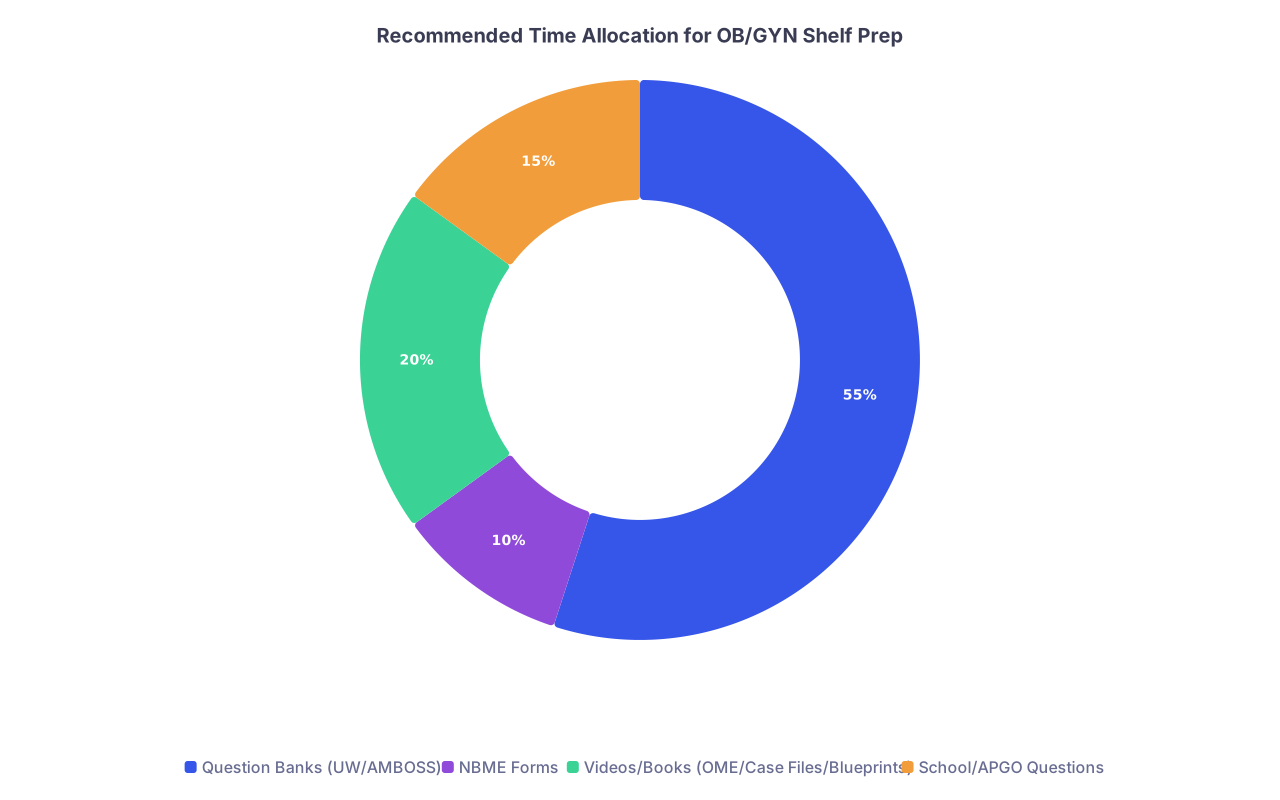
| Category | Value |
|---|---|
| Question Banks (UW/AMBOSS) | 55 |
| NBME Forms | 10 |
| Videos/Books (OME/Case Files/Blueprints) | 20 |
| School/APGO Questions | 15 |
Step 1: Build Algorithms, Not Trivia
Use ONE of:
- OnlineMedEd OB/GYN videos
- Or rapid pass through your favorite short text (if you absolutely must read, Case Files > Blueprints for sanity)
Goal: You should be able to answer, off the top of your head:
- How to manage:
- PPROM at 32 vs 36 weeks.
- Preeclampsia with severe features at 34 vs 38 weeks.
- Prolonged latent vs active-phase arrest.
- Category II vs III fetal heart rate tracings.
- What to do:
- After an ASC-US Pap in a 23-year-old vs 34-year-old.
- With a 52-year-old with postmenopausal bleeding.
- With a hemodynamically stable vs unstable ectopic pregnancy.
If your “book” is not leaving you with clear, testable algorithms, it is failing you.
Step 2: Main Engine – UWorld OB/GYN Section
Turn UWorld into your real textbook.
- Do every OB/GYN question in untimed tutor mode initially.
- Do not rush. For each question, ask:
- What algorithm did this question test?
- Could I write that algorithm out in 4–6 boxes?
- What made the correct answer better than the 2nd best option?
Use the explanation text, not any physical book, as your primary content reference. UWorld explanations are written closer to how NBME frames the world than most shelf books.
If you want something “physical,” screenshot key tables/algorithms into your notes.
Step 3: Calibration – NBME Forms
7–10 days before the shelf, you switch gears.
- Take an NBME self-assessment (whichever your school or NBME offers for OB/GYN).
- Do it under strict test conditions. No pausing. No checking.
- Review every single question. Even the ones you got right but guessed on.
You will notice a few things immediately:
- Stems are shorter than you are used to from UWorld.
- They expect slightly less esoteric detail, but more precise ranking of good vs better vs best options.
- Time pressure feels different. Less about reading speed, more about decisiveness.
Two or three days before the shelf, repeat with another NBME if you have one available.
Step 4: Targeted AMBOSS / APGO Drilling
After you see your NBME weak spots, you patch them surgically.
Let us say your NBME review shows misses in:
- Postpartum complications
- Contraception contraindications
- Gyn oncology staging/management
You go to:
- AMBOSS, filter by topic, and do those questions.
- Or APGO/uWISE sets if your school provides them for the same subtopics.
Do not wander. You are not “doing more questions” generically. You are treating NBME-identified deficits.
Concrete Matching: Topic-by-Topic Resource Alignment
Let me be very specific about which resources have NBME-like questions for the high-yield domains.
| Topic | Best NBME-Style Match |
|---|---|
| Hypertensive disorders | UWorld + NBME forms |
| PPROM / Preterm labor | UWorld + AMBOSS |
| L&D (stages, arrest, FHR) | UWorld + APGO/uWISE |
| Postpartum hemorrhage | UWorld + AMBOSS targeted |
| Contraception | UWorld + NBME + AMBOSS |
| AUB / Endometrial pathology | UWorld + AMBOSS |
| Cervical dysplasia screening | UWorld + APGO/uWISE |
Where books like Case Files/Blueprints consistently fall short:
- Hypertension and preeclampsia nuance (timing, meds, delivery).
- Modern cervical cancer screening algorithms (age-based, HPV testing).
- Specifics of fetal heart rate interpretation and response hierarchy.
- Detailed contraceptive contraindications and matching.
How This Feels on Test Day If You Trained Style Correctly
Let me paint you two different exam days I have seen play out.
Student A – “Book Heavy, Question Light”
This is the person who read all of Blueprints, did most of Case Files, and sprinkled in 100–150 UWorld questions late in the game.
On test day, they:
- Recognize every diagnosis.
- Struggle with “what is the best next step?” when there are several decent options.
- Frequently think, “I know this is postpartum hemorrhage, but do I give uterotonics next or go to suction curettage?”
- Run out of time reviewing marked questions because many feel 50/50.
They walk out saying, “I knew everything, but it felt tricky.” Score: often mid 60s–low 70s.
Student B – “Question First, Book as Support”
This student:
- Started with a short high-yield framework (OME or brief notes).
- Did all of UWorld OB/GYN, carefully.
- Took at least one NBME form and corrected based on that style.
- Used AMBOSS/APGO in a targeted way.
On test day, they:
- Find stems shorter and more straightforward than UWorld.
- See familiar algorithm patterns (“this is literally that UWorld ectopic question but with different numbers”).
- Feel clear about next-step decisions because they have practiced ranking options, not just recognizing them.
They walk out saying, “There were a few weird ones, but overall it felt fair.” Score often high 70s–90s.
The difference is not intelligence. It is training on the right style.
A Few Tactical Corrections to Common Bad Advice
I will be blunt about some popular recommendations that do not actually help with question style.
“Just do Case Files and you’ll be fine.”
No. That might pass you. It will not optimize your performance. The question style is too simplistic.“Blueprints is enough if you read it twice.”
You are training recall, not decision-making. Shelf is not a recall exam.“AMBOSS is too hard; skip it.”
Misguided. AMBOSS is hard, yes, but selective use for weak topics after UWorld is extremely effective.“NBME forms are just to see your score.”
Wrong. They are your best template for style, pacing, and how NBME phrases nuance.
A Quick Visual: Priority of Resources by Style Match
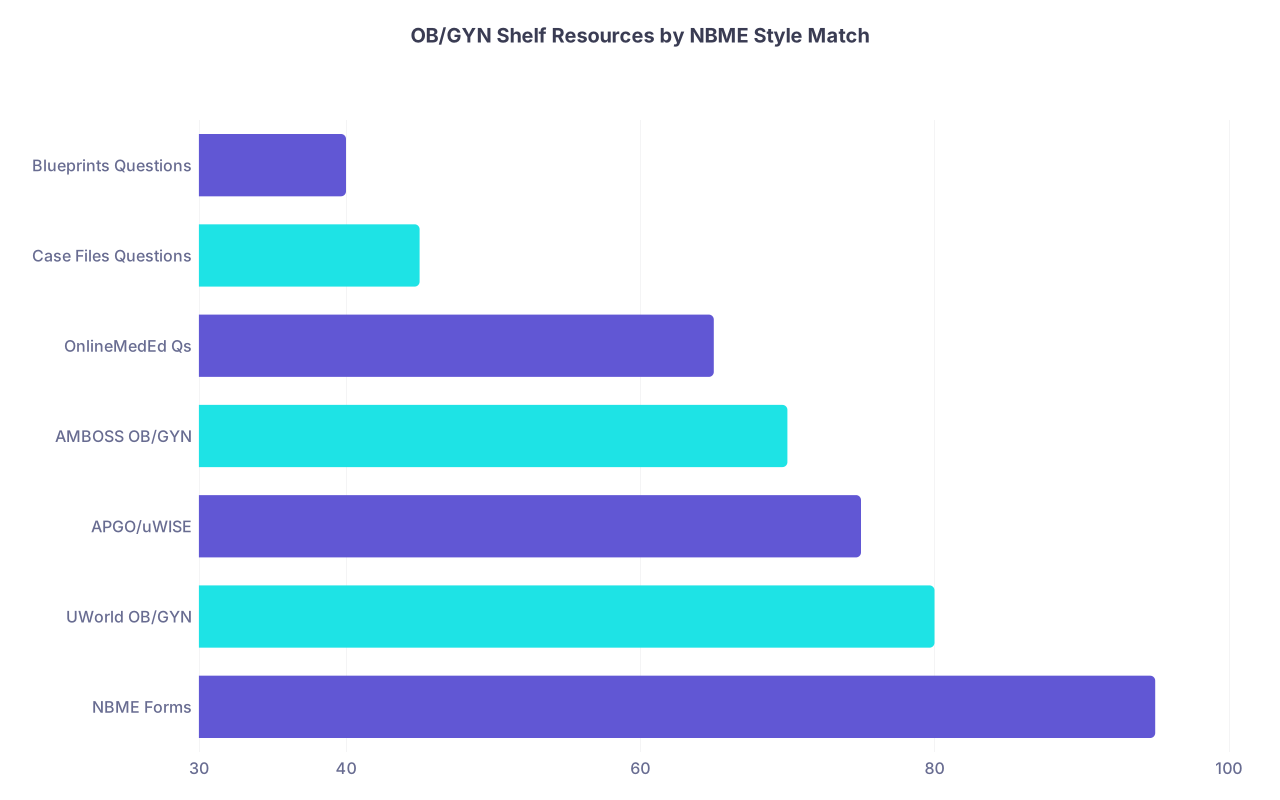
| Category | Value |
|---|---|
| NBME Forms | 95 |
| UWorld OB/GYN | 80 |
| APGO/uWISE | 75 |
| AMBOSS OB/GYN | 70 |
| OnlineMedEd Qs | 65 |
| Case Files Questions | 45 |
| Blueprints Questions | 40 |
Percentages are not scientific; they reflect how closely the question experience feels like the real shelf.
Key Takeaways
If your goal is to match NBME OB/GYN shelf style, UWorld + NBME forms are non-negotiable; everything else is support, not the main event.
Case Files and Blueprints are acceptable for early content framing, but their questions do not mimic modern NBME complexity or distractor quality. Do not mistake them for serious shelf prep.
Use AMBOSS/APGO/uWISE selectively for targeted drilling after you have a solid base from UWorld, and always let NBME forms guide your final-week adjustments.