Introduction: How AI Is Rewriting the Rules of Early Disease Detection
AI in Healthcare is moving from buzzword to bedside. Over the last decade, rapid advances in computing power, cloud infrastructure, and algorithm design have pushed artificial intelligence (AI) from research labs into everyday clinical workflows. One of the most transformative areas is AI-powered diagnostics, where machine learning models analyze complex clinical data to support Early Disease Detection, refine Medical Diagnostics, and ultimately improve Patient Care.
For medical students, residents, and early-career clinicians, understanding how these tools work—and where they are headed—is now part of core clinical literacy. AI is becoming a critical layer of Healthcare Technology, reshaping radiology, pathology, cardiology, dermatology, ophthalmology, genomics, and primary care.
This article explores:
- Why early detection remains one of the highest-yield interventions in medicine
- How AI-powered diagnostics work across different data types
- Real-world examples of AI in screening and early diagnosis
- Advantages, risks, and ethical considerations
- What the future might look like, and how trainees can prepare
Why Early Disease Detection Still Saves the Most Lives
The Clinical Impact of Catching Disease Early
From a public health and individual patient standpoint, time is one of the most powerful determinants of outcome. Across specialties, early recognition changes everything: treatment options, prognosis, cost, and quality of life.
Oncology
- Stage migration is often the difference between cure and palliation.
- Early-stage breast cancer can have 5-year survival rates exceeding 90–99%, while metastatic disease drops that dramatically.
- Similar patterns hold for colorectal, lung, cervical, and many other cancers: earlier detection means smaller tumor burden, less invasive therapy, and better survival.
Cardiovascular Disease
- Coronary artery disease and heart failure often have subclinical phases measurable by imaging, biomarkers, ECG trends, or wearable data long before a major event.
- Detecting risk early allows:
- Aggressive risk factor modification (lipids, blood pressure, smoking)
- Initiation of guideline-directed medical therapy
- Timely intervention before irreversible myocardial damage or stroke occurs
Metabolic Disease
- Type 2 diabetes and pre-diabetes usually evolve over years.
- Earlier detection can:
- Prevent progression by lifestyle and pharmacologic interventions
- Reduce incidence of neuropathy, retinopathy, nephropathy, and cardiovascular complications
In all of these conditions, the core public health question is: How can we reliably identify at-risk patients earlier, at scale, and with acceptable cost and accuracy? This is where AI in Healthcare offers something fundamentally new.
The Limits of Traditional Diagnostic Approaches
Even with established screening guidelines, conventional diagnostics face intrinsic challenges:
Human limitations:
- Fatigue, cognitive overload, and variable experience can affect diagnostic accuracy.
- Subtle imaging findings or pattern-based risk signatures may escape human perception.
Data overload:
- Clinicians now contend with massive volumes of imaging, lab, genomic, and physiologic data.
- Electronic health records (EHRs) generate more unstructured text than any single clinician can systematically mine.
One-size-fits-all thresholds:
- Traditional risk calculators use a limited number of variables and often assume linear relationships.
- They may not capture the complex, nonlinear, and interactive features that characterize real-world disease risk.
AI-powered diagnostics are being developed to address exactly these gaps—augmenting, not replacing, human clinical judgment.
How AI-Powered Diagnostics Work in Real Clinical Contexts
Core Concepts: AI, Machine Learning, and Deep Learning
AI in Healthcare typically refers to a set of computational approaches that can learn from data and make predictions or classifications. The main families include:
- Machine Learning (ML): Algorithms that learn patterns from labeled or unlabeled data (e.g., random forests, gradient boosting, support vector machines).
- Deep Learning (DL): Neural networks with multiple layers that excel at pattern recognition in complex data such as images, audio, and sequential signals.
- Natural Language Processing (NLP): Methods for extracting meaning from unstructured text (e.g., clinical notes, radiology reports, literature).
In Medical Diagnostics, these approaches enable systems to:
- Classify imaging studies (e.g., suspicious vs. benign lesions)
- Predict disease risk scores (e.g., near-term risk of MI or stroke)
- Flag abnormal patterns in vital signs or continuous wearable data
- Summarize and structure clinical narratives from EHR notes
Key Data Sources Feeding AI-Powered Diagnostics
AI models are only as powerful as the data they learn from. In modern Healthcare Technology, several streams are especially important:
1. Imaging Data
- Radiology: X-rays, CT, MRI, PET, ultrasound
- AI can detect microcalcifications, early pulmonary nodules, intracranial hemorrhage, fractures, and more.
- Ophthalmology: Fundus photographs, OCT
- Algorithms already screen for diabetic retinopathy, macular edema, and glaucoma.
2. Pathology and Cytology
- High-resolution whole-slide images are ideal for deep learning.
- AI assists with:
- Tumor grading and subtyping
- Mitotic count quantification
- Detecting micrometastases in lymph nodes
3. Genomic, Proteomic, and Molecular Data
- Genomics: Variant interpretation for hereditary cancer syndromes, cardiomyopathies, arrhythmias, and rare diseases.
- Multi-omics: Integration of genomics, transcriptomics, proteomics, and metabolomics to create advanced risk predictors and identify preclinical disease signatures.
4. Physiologic and Wearable Data
- Smartphone sensors and wearables (smartwatches, patches, home BP monitors) continuously capture:
- Heart rate and rhythm
- Activity, sleep, respiration, sometimes SpO₂
- AI models can detect:
- Atrial fibrillation and other arrhythmias
- Sleep apnea risk
- Deterioration in chronic disease (e.g., heart failure decompensation) before overt symptoms arise
5. Electronic Health Records (EHRs) and Clinical Notes
- NLP and ML can sift through:
- Problem lists, medication histories, and labs
- Narrative notes and prior consult documentation
- These models can flag:
- Missed follow-ups, unsafe medication combinations
- High-risk phenotypes for sepsis, AKI, or clinical deterioration on the ward
Real-World Applications of AI in Early Disease Detection
Radiology: From “Second Reader” to Continuous Triage
Radiology has been one of the earliest and most visible success stories in AI-powered diagnostics:
Cancer screening:
- AI algorithms for mammography can detect subtle patterns of breast cancer that may be overlooked on first read.
- Some systems operate as a “second reader”, highlighting suspicious areas for radiologists.
Emergent findings:
- Real-time triage tools analyze incoming head CT scans to detect stroke or hemorrhage and reprioritize the radiologist’s worklist.
- This can shave critical minutes off time-to-diagnosis in emergencies.
Chest imaging:
- AI tools can detect pulmonary nodules, early interstitial lung disease, or even predict cardiovascular risk from a standard chest CT.
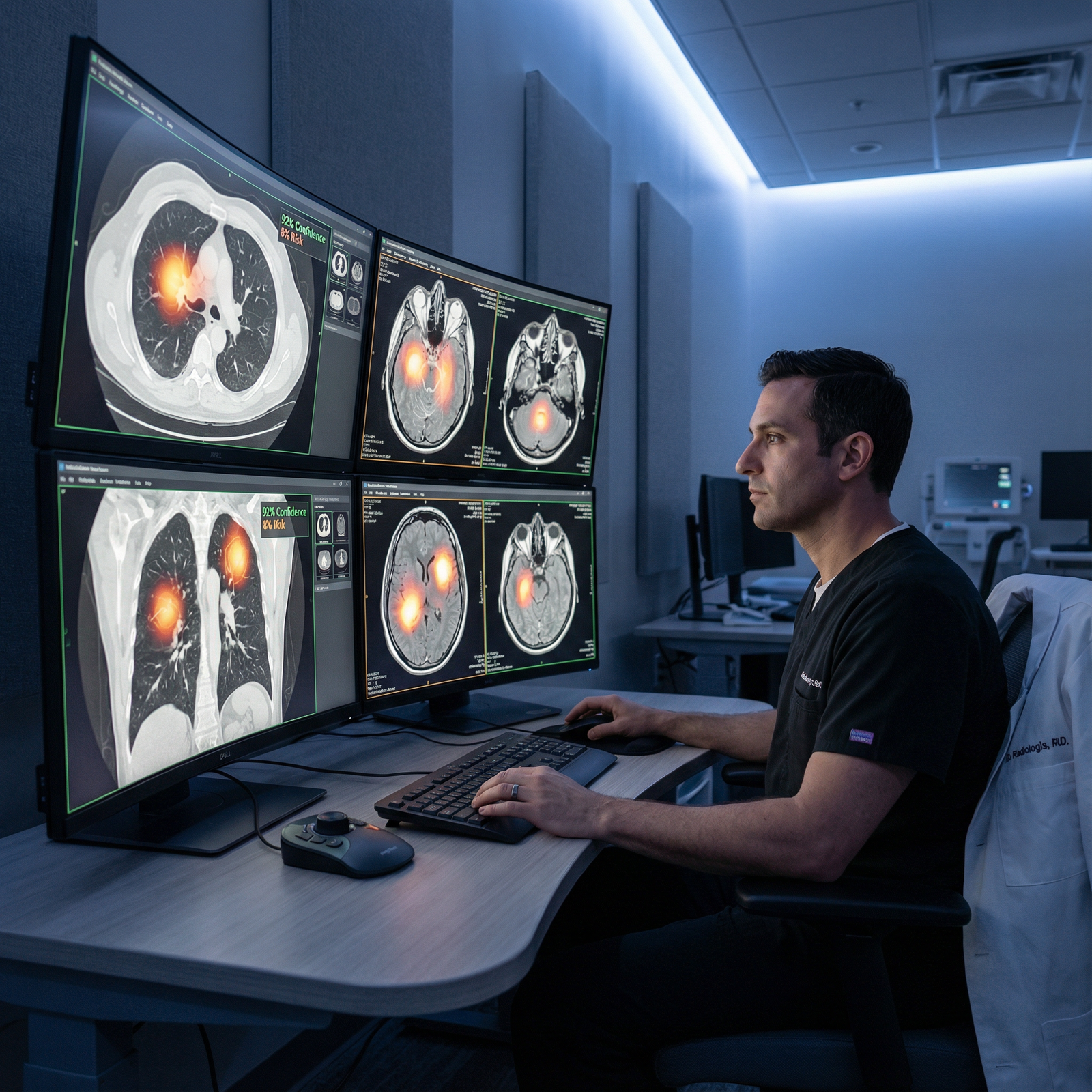
For trainees, it’s increasingly common to see AI overlays, heatmaps, and auto-generated measurements integrated into PACS viewers.
Pathology: Scaling Precision Diagnostics
In pathology, AI is accelerating and standardizing labor-intensive tasks:
- Automated quantification of tumor-infiltrating lymphocytes or mitotic figures
- Detection of micrometastases in sentinel lymph nodes
- Assessment of receptor status in breast cancer (ER/PR/HER2) from digital slides
Early detection here often means earlier, more accurate classification, enabling targeted therapies and more precise prognostication.
Cardiology and Continuous Monitoring
In cardiology, AI merges imaging, ECG, wearables, and EHR data:
ECG interpretation:
- Deep learning models can detect not only arrhythmias but also subtle markers of LV dysfunction or hypertrophic cardiomyopathy from a standard 12-lead ECG.
Wearable-based AF detection:
- Smartwatches using AI classify photoplethysmography (PPG) signals and alert patients to possible atrial fibrillation, prompting formal evaluation long before stroke.
Risk prediction:
- Multifactorial models predict near-term risk of heart failure hospitalization or MI, allowing proactive medication optimization and close follow-up.
Ophthalmology, Dermatology, and Primary Care
Ophthalmology:
- Autonomous AI systems for diabetic retinopathy detection from retinal photographs are already FDA-cleared.
- These systems enable screening in primary care offices without an on-site ophthalmologist.
Dermatology:
- AI skin lesion classifiers can support triage of lesions suspicious for melanoma or other skin cancers from dermoscopic or clinical photos.
Primary care:
- Risk scores integrated into the EHR can highlight patients who meet criteria for early screening (e.g., lung cancer CT, HCC imaging, colonoscopy) but have not yet been referred.
Advantages of AI-Powered Diagnostics for Clinicians and Patients
1. Improved Diagnostic Accuracy and Consistency
AI models, trained on large, diverse datasets, can:
- Detect patterns below the threshold of human perception (e.g., pixel-level changes in imaging).
- Reduce inter-observer variability in grading, staging, or risk assessment.
- Scan massive amounts of prior data to provide a more comprehensive, longitudinal perspective.
In many settings, models reach or surpass human-level performance on narrow tasks (e.g., detecting specific lesions or abnormalities), especially when used as an adjunct.
2. Enhanced Efficiency and Reduced Cognitive Load
AI in Healthcare can automate high-volume, repetitive tasks:
- Pre-screening normal studies (e.g., “no acute findings”), allowing radiologists to focus on complex or urgent cases.
- Auto-segmenting structures and quantifying volumes in radiology or cardiology.
- Generating preliminary structured reports or differential lists.
For residents and clinicians, this can free cognitive bandwidth for nuanced reasoning, communication, and shared decision-making with patients.
3. Enabling Personalized and Preventive Medicine
AI-powered diagnostics are central to the transition from reactive care to precision prevention:
- Integrating clinical, imaging, genomic, and wearable data to produce individualized risk profiles.
- Supporting tailored screening intervals, lifestyle interventions, and pharmacologic strategies.
- Identifying high-risk patients before they meet classical disease criteria, allowing earlier intervention.
In oncology, cardiology, and endocrine disease, this granular personalization is an emerging standard of care rather than a distant goal.
4. Continuous Learning Systems
AI models can be updated as new data are generated:
- Performance can improve over time with ongoing validation and retraining.
- Feedback loops allow “learning” from misclassifications, refining future predictions.
When deployed with proper governance, this learning health system model can keep diagnostic tools aligned with the latest evidence and real-world outcomes.
Challenges, Risks, and Ethical Considerations
Data Privacy, Security, and Governance
High-performing AI in Healthcare requires large volumes of often sensitive patient data:
Privacy:
- Compliance with regulations like HIPAA, GDPR, and regional privacy laws is non-negotiable.
- De-identification, data minimization, and robust access controls are critical.
Security:
- Health systems become high-value targets for cyberattacks.
- Strong encryption, network security, and incident response plans are indispensable.
Emerging approaches like federated learning and privacy-preserving analytics aim to train powerful models without centralized pooling of raw patient data.
Bias, Fairness, and Health Equity
AI models can exacerbate health disparities if not carefully designed and evaluated:
- Under-representation of certain populations (by race, gender, geography, socioeconomic status) in training data can lead to:
- Lower accuracy for those groups
- Systematic under- or over-diagnosis
- Surrogate variables (e.g., zip code, insurance status) can encode structural bias.
Mitigating this requires:
- Diverse, representative training datasets
- Subgroup performance reporting (e.g., sensitivity/specificity by demographic)
- Ongoing post-deployment monitoring for inequitable impacts
Regulatory Oversight and Clinical Responsibility
AI-powered diagnostics are increasingly regulated as Software as a Medical Device (SaMD):
- Pre-market evaluation focuses on safety, efficacy, and generalizability.
- Post-market surveillance is needed to ensure performance over time and across contexts.
Clinically, responsibility remains with the human clinician:
- AI tools are decision support—not autonomous decision-makers in most current settings.
- Clear documentation of how AI outputs influence decisions is wise for both quality and medicolegal reasons.
Dependence on Technology and the Risk of Deskilling
There is a legitimate concern that over-reliance on AI could erode core diagnostic skills:
- Residents may be tempted to accept algorithmic outputs uncritically.
- Subtle pattern recognition skills might degrade over time if rarely exercised.
Mitigation strategies:
- Education that emphasizes AI literacy and critical appraisal
- Training programs that require residents to interpret data independently before reviewing AI output
- Regular calibration exercises and human-AI disagreement analyses
The Future Landscape of AI-Powered Early Disease Detection
Deeper Integration with Telehealth and Remote Care
AI will increasingly underpin telemedicine and virtual care models:
- Real-time triage of symptoms reported via chatbots or telehealth portals
- Integration of home monitoring (BP, glucose, weight, wearables) with AI alerts for early deterioration
- Remote image capture (e.g., smartphone otoscopy or dermoscopy) analyzed by AI, with escalation to specialists when needed
For underserved regions, this combination can deliver specialist-level Medical Diagnostics where none previously existed.
Interoperability and the Learning Health System
For AI to reach its full potential, health data must flow safely and efficiently:
- Standardized data formats (e.g., FHIR) and terminology (e.g., SNOMED CT, LOINC) facilitate sharing.
- National and regional data infrastructures will allow:
- Larger training cohorts
- Faster validation and deployment
- More responsive model updating
The long-term vision: a learning health system where findings from one institution can rapidly inform care everywhere, while respecting privacy and local context.
Multimodal and Foundation Models
Next-generation AI models will integrate multiple data modalities:
- Imaging + EHR text + labs + genomics + wearables
- “Foundation models” trained on massive diverse clinical corpora may offer:
- More robust generalization across sites and specialties
- Flexible fine-tuning for specific disease areas or populations
These multimodal systems could provide richer Patient Care insights than any single-modality model.
Preparing as a Medical Trainee or Early-Career Clinician
To work effectively with AI in Healthcare, trainees can:
- Build basic AI literacy: Understand key concepts (sensitivity, specificity, AUC, calibration, bias, external validation).
- Learn to interpret risk scores and AI outputs: Know thresholds, limitations, and appropriate use-cases.
- Participate in quality improvement or research projects involving AI tools at your institution.
- Stay current with emerging guidelines from professional societies (e.g., radiology, cardiology, oncology) regarding AI use.

FAQ: AI-Powered Diagnostics and Early Disease Detection
1. How does AI actually improve diagnostic accuracy in practice?
AI improves diagnostic accuracy by learning from large, labeled datasets to recognize complex patterns that may be subtle or invisible to the human eye. For example, deep learning models can detect early microcalcifications on mammograms or tiny pulmonary nodules on CT scans. When used as decision support—rather than stand-alone decision-makers—these systems can reduce missed findings, provide consistent grading, and highlight areas for closer review by clinicians.
2. Will AI replace radiologists, pathologists, or other diagnosticians?
AI is far more likely to reshape diagnostic roles than replace them. Current and foreseeable systems perform best on narrow tasks—e.g., detecting a specific lesion type or flagging abnormal trends—while humans remain essential for:
- Integrating findings across systems and specialties
- Weighing patient preferences and contextual factors
- Handling ambiguous, atypical, or conflicting data
- Communicating diagnoses and action plans to patients
The most effective future model is collaboration, not substitution, with AI extending clinician capacity and precision.
3. What should patients and clinicians know about the safety and reliability of AI tools?
Clinicians should verify that diagnostic AI tools:
- Are cleared or approved by relevant regulators (e.g., FDA, EMA) when required
- Have been validated on diverse, external datasets
- Report performance metrics (sensitivity, specificity, PPV, NPV) and subgroup analyses
Patients can ask their clinicians:
- How the AI tool is used in their care
- Whether a human clinician reviews the AI’s interpretation
- What safeguards exist for data privacy and security
Ultimately, AI outputs should always be interpreted within the context of a comprehensive clinical assessment.
4. How can health systems reduce bias and inequities when implementing AI in Healthcare?
Key strategies include:
- Using diverse, representative training and validation datasets
- Conducting fairness audits with subgroup performance reporting (by race, gender, age, socioeconomic status, etc.)
- Engaging clinicians, patients, and ethicists from multiple communities in the design and deployment process
- Building feedback mechanisms to identify and correct systematic misclassifications or inequities post-deployment
Bias mitigation is not a one-time task but an ongoing component of responsible AI governance.
5. What practical steps can residents and early-career physicians take to get involved with AI in Medical Diagnostics?
You can:
- Seek electives or research projects in clinical informatics, data science, or digital health.
- Learn basic data analysis and statistics (e.g., R, Python, or at least spreadsheet-based analytics).
- Attend hospital or departmental meetings where AI tools are being evaluated or implemented.
- Join specialty society working groups or interest sections focused on AI and Healthcare Technology.
Even if you never write a line of code, being able to critically appraise AI tools and thoughtfully integrate them into your workflow will increasingly be a core clinical competency.
AI-powered diagnostics are not a distant promise; they are already embedded in many aspects of early disease detection and Patient Care. The challenge—and opportunity—for the next generation of clinicians is to understand these tools deeply, use them responsibly, and help shape a future of healthcare that is more accurate, equitable, and preventive than ever before.