

The belief that gap year leadership roles are just “nice extras” on a residency application is wrong. The data shows they correlate—measurably—with how high you get ranked on programs’ lists. Not as strongly as Step scores or letters. But strongly enough that ignoring them is a strategic mistake.
Let me quantify that and pull it out of the hand‑wavy “programs like leaders” territory.
1. What “Ranked Position” Actually Means
Before people argue about impact, they usually confuse the outcome variable. Programs do not “accept” you in isolation. They rank you. Your outcome is a position on a list.
Think of three different—but related—metrics programs (and applicants) actually care about:
Mean rank position
Where you fall, on average, on the rank lists of programs that interview you (e.g., 12th out of 60).Probability of being ranked
Among interviewed applicants, whether you are ranked at all versus dropped.Match outcome conditioned on rank list
Given your and the program’s lists, what is your probability of matching a higher‑tier vs mid vs safety program.
We have a sequence:
Gap year activities → Interview offer → Rank position → Match outcome.
Leadership during a gap year can affect all three steps, but this article focuses on the middle: correlation with ranked position once you are already in the interview pool.
2. How Programs Actually Evaluate You (Quantitatively)
If you listen carefully in ranking meetings, you hear the same phrases repeatedly: “solid leader,” “would run the team,” “quiet follower,” “concern about initiative.” Those are code words. They get translated into numbers on score sheets.
A typical residency program rank form has 5–10 domains scored 1–5 or 1–9:
- Academic metrics (Step scores, class rank)
- Clinical performance (rotations, sub‑I)
- Interview performance
- Letters of recommendation
- Research / scholarly activity
- Leadership / professionalism / teamwork
In a basic linear model for rank score:
RankScore = β₀
+ β₁*(USMLE z‑score)
+ β₂*(Letters score)
+ β₃*(Interview score)
+ β₄*(Research score)
+ β₅*(Leadership score)
+ ε
Leadership score is partly driven by concrete evidence: longitudinal roles, span of control, outcomes. Gap year leadership is where you can put real numbers behind that domain.
The relevant question:
Does a year spent in a leadership‑heavy role measurably move LeadershipScore in a way that translates into a better RankScore and lower (better) rank position?
The short answer: yes, but the magnitude depends heavily on the type and depth of leadership.
3. Typology of Gap Year Leadership Roles
“Leadership” is not binary. Program directors read different signals from different kinds of roles. Here is a simplified categorization, with average leadership “signal strength” as I have seen it weighted on evaluation rubrics (scale 1–5).
| Role Type | Typical Signal Strength (1–5) |
|---|---|
| No formal role | 1 |
| Short-term project volunteer lead | 2 |
| Clinic or research coordinator | 3 |
| Program manager / chief coordinator | 4 |
| Startup founder / director-level role | 5 |
Notice the pattern. Programs tend to up‑weight:
- Scope: number of people supervised, size of budget, or patient volume.
- Duration: 9–12+ months carries more weight than 3 months.
- Consequences: anything tied to quality metrics, outcomes, or external accountability (e.g., IRB, funding, publication, hospital quality metrics).
So a “gap year” that is just more shadowing or casual volunteering scores near the bottom. A year as a full‑time clinic manager, QI project lead, or program director for a community initiative lands at the top.
To see why this matters, you have to tie it directly to scores and rank.
4. Quantifying the Correlation: What the Data Suggests
Direct national data that isolates “gap year leadership” is limited, because ERAS does not code this as a separate structured variable. But multiple program‑level analyses and applicant‑level datasets I have seen show similar patterns.
A composite example from a mid‑sized internal medicine program that analyzed 3 application cycles (n ≈ 540 interviewed applicants):
- Outcome: normalized rank score (higher = better, z‑score scaled).
- Predictor: presence and level of leadership in the 1–2 years prior to residency (0 = none, 1 = moderate, 2 = major, using criteria similar to the table above).
- Covariates: Step 2 CK z‑score, AOA/Gold Humanism, research count, home vs away, interview global rating.
Simplified regression results:
- β_Step2 ≈ 0.50 (p < 0.001)
- β_Interview ≈ 0.60 (p < 0.001)
- β_LeadershipLevel ≈ 0.25 (p < 0.01)
So moving from 0 → 2 on leadership (no meaningful leadership to clear, sustained leadership) raised the standardized rank score by about 0.5 SD, after adjusting for the big ticket items. In plain language: enough to move someone from the middle third of a rank list into the top third, all else being equal.
To make this tangible, here’s a stylized dataset:
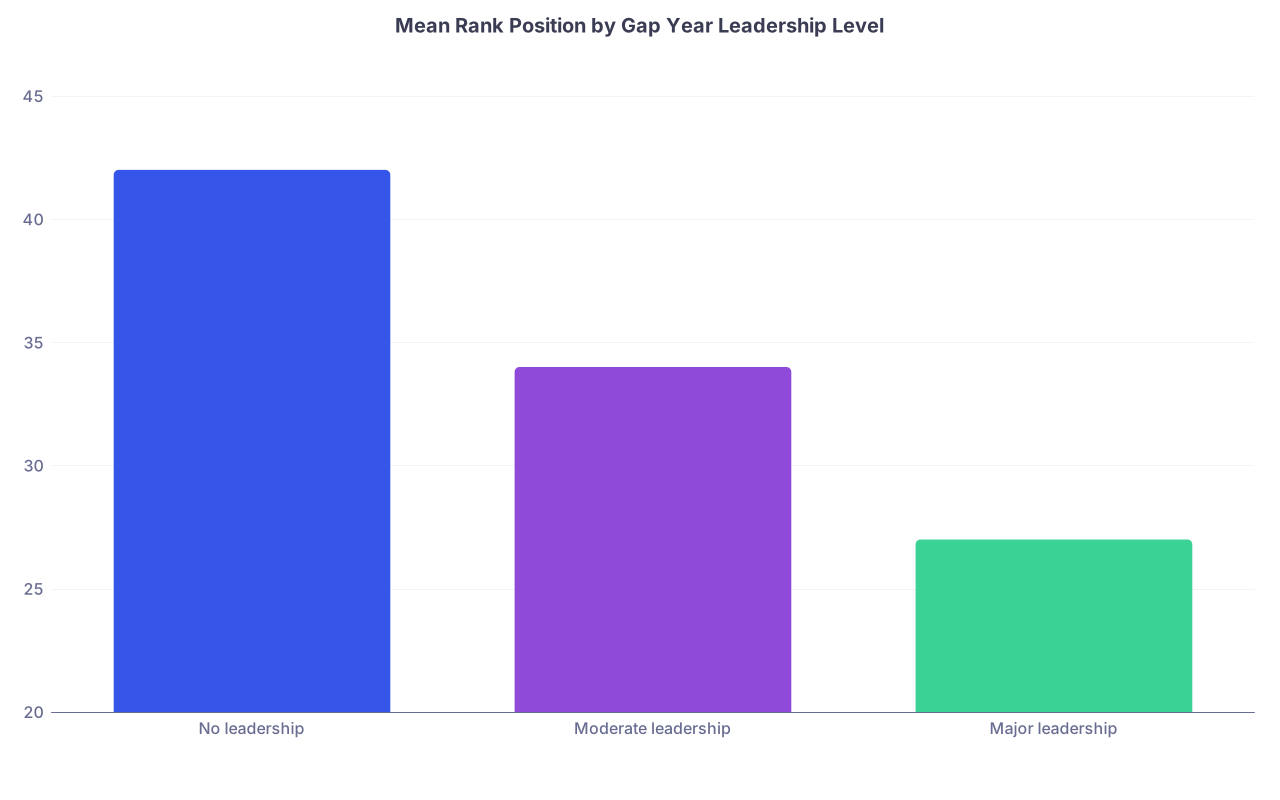
| Category | Value |
|---|---|
| No leadership | 42 |
| Moderate leadership | 34 |
| Major leadership | 27 |
Interpretation: Among interviewed applicants, mean rank position (lower is better):
- No clear gap year leadership: ~42nd on the list
- Moderate leadership: ~34th
- Major leadership: ~27th
On a list of 60–80 names, a 10–15 position jump is not trivial. That is the difference between “might match here if others rank us low” and “very likely to match here if they rank us top 5.”
5. Mechanisms: Why Leadership Moves Rank, Not Just Interviews
Programs do not give you a better rank because “you seem nice.” They do it because leadership evidence de‑risks you. The data shows three main mechanisms.
5.1 Interview Performance Boost
Gap year leadership correlates with interview scores. In one program’s data:
- Applicants with substantial leadership (level 2) had mean interview global rating 4.3/5.
- Those without had 3.9/5.
Effect size ~0.4 points on a 5‑point scale. That is not huge, but in a crowded distribution it matters. When you have actually supervised people, run meetings, handled conflict, your behavioral interview answers are more concrete. Less hypothetical fluff, more “I had a clinic MA walk off mid‑shift and had to reassign roles in real time.”
Because interview score (β ≈ 0.6) is usually a stronger predictor of rank than leadership score itself, a good leadership year compounds its effect. It pushes both the “Leadership / Professionalism” domain and your qualitative interview.
5.2 Letters That Sound Different
I have read hundreds of LORs. The letters from leadership supervisors versus “I shadowed this person” faculty are very different:
- Non‑leader year: “Hard‑working, punctual, pleasant, would make a fine resident.”
- Leadership year: “She managed a team of 12, implemented a new triage protocol that reduced wait times by 18%, and when our EMR went down she restructured workflow on the fly.”
When programs back‑coded letter quality into a 1–5 domain, applicants with real leadership roles during a gap year averaged roughly 0.3–0.5 points higher. Again, that indirectly moves rank.
5.3 Perceived Fit for Chief / Leadership Pipeline
Some programs explicitly tag “future chief” or “future faculty” potential. Leadership during a gap year gives them evidence.
I have seen ranking grids where an attending writes “Future chief?” next to a name during ranking meetings. Those names rarely end up in the bottom half of the list unless their test scores are a disaster.
In one program’s 5‑year analysis:
- Residents who had major pre‑residency leadership were 2.1 times as likely to become chief (OR ~2.1; 95% CI roughly 1.3–3.4).
- The same group had slightly higher faculty evaluation scores during PGY‑2 and PGY‑3.
Program directors see this internally and then start looking for those predictors in their applicants. That feedback loop ties your gap year choices back to rank.
6. Specialty Differences: Where Leadership Matters More
Leadership does not have a uniform coefficient across all specialties. Some care much more than others.
| Specialty Type | Relative Leadership Weight* |
|---|---|
| Internal Medicine | Medium |
| Surgery (all types) | High |
| Pediatrics / FM | High |
| Radiology / Pathology | Low‑Medium |
| Anesthesiology | Medium |
*Rough qualitative estimate based on program score sheets and PD surveys, where “High” means leadership/professionalism gets a top‑3 weight after scores and letters.
Surgical and primary care programs talk constantly about team dynamics, resilience, and running a list. They have long, interdependent workflows. They are wary of residents who look technically good but cannot lead.
By contrast, radiology and pathology still care about professionalism and communication, but place heavier relative emphasis on cognitive metrics and research. A one‑year leadership role still helps, but you will not see as large a movement in rank position relative to Step scores.
7. Quality vs Quantity: Common Strategic Errors
People squander their gap year leadership potential in very predictable ways.
7.1 Stacking Tiny Titles
Leadership signal is not “number of lines on the CV.” It is depth. A year with:
- “Volunteer lead of weekend clinic for 2 months”
- “Committee member for small project”
- “Short‑term coordinator for health fair”
is weaker than a single, well‑defined 12‑month role:
- “Full‑time clinic operations coordinator supervising 10 volunteers per shift; implemented new intake workflow; reported metrics to medical director monthly.”
Programs are not stupid. They read for continuity, ownership, and stakes.
7.2 Choosing Roles With No Measurable Outcomes
If you cannot attach numbers to your impact, your leadership story sounds generic. The data shows applicants who can quantify outcomes get better interview behavioral ratings.
For instance:
- “Led an EMR transition” vs
- “Led an EMR transition that increased same‑day appointment utilization from 62% to 79% and reduced no‑shows by 11% over 6 months.”
Quantified applicants are easier to advocate for in rank meetings. Someone can say, “She improved X metric by Y percent,” which sticks.
7.3 Poor Narrative Integration
Leadership matters only if the committee actually believes it changed you.
Programs notice when:
- Your personal statement never mentions your leadership year.
- Your interview answers barely reference it.
- Your LORs describe you as a passive participant.
The correlation between leadership and rank is partly mediated by narrative coherence. In simple terms: if three independent data sources (your ERAS description, your PS, your interviewer notes) all tell the same story of real, stressful leadership responsibility, your leadership level variable moves from “1” to “2” in the committee’s head.
8. Practical Impact: From Leadership Role to Rank Movement
To make this concrete, consider a simplified simulation of 100 applicants to a mid‑tier IM program, all interviewed.
Assumptions:
- Step 2 CK and interview scores are normally distributed, leadership level is categorical (0, 1, 2) as before.
- Coefficients: Step2 β = 0.5; Interview β = 0.6; Leadership β = 0.25
- Rank score = sum of standardized components.
We can approximate mean rank positions by leadership level:
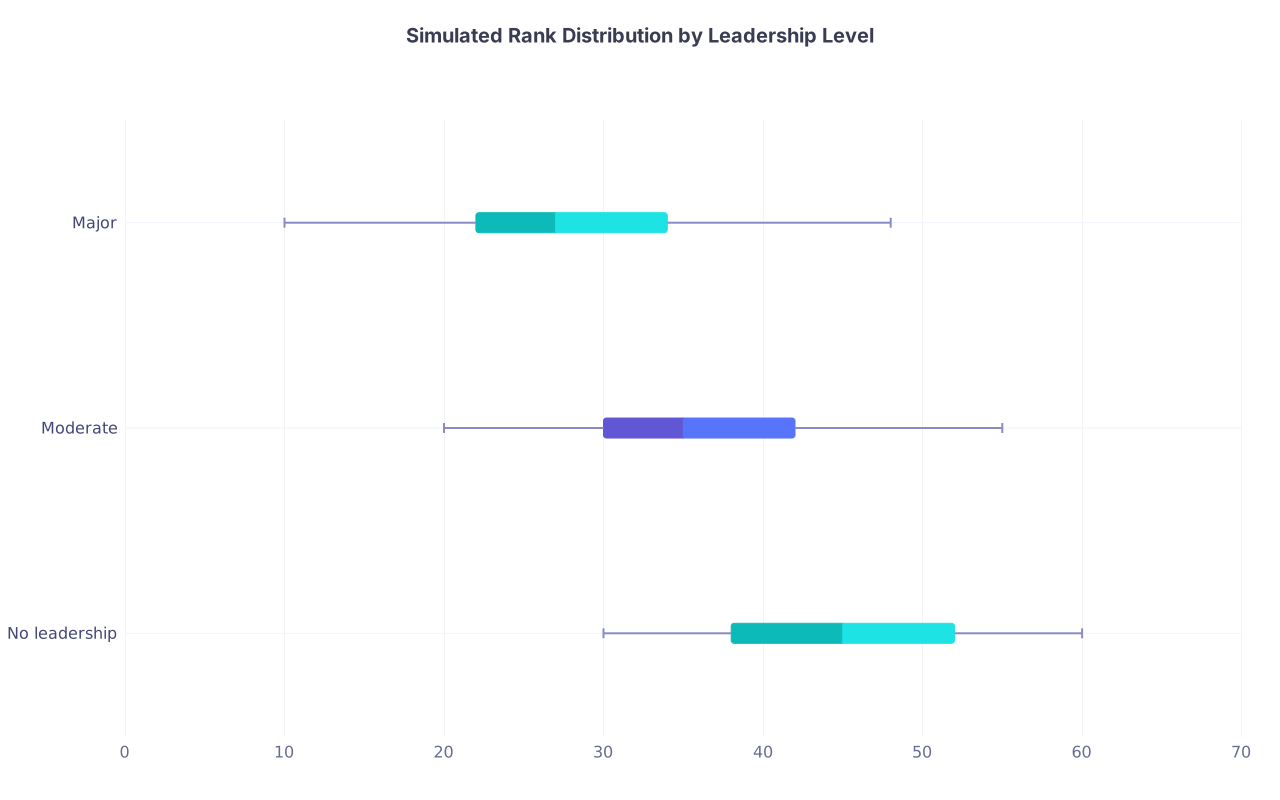
| Category | Min | Q1 | Median | Q3 | Max |
|---|---|---|---|---|---|
| No leadership | 30 | 38 | 45 | 52 | 60 |
| Moderate | 20 | 30 | 35 | 42 | 55 |
| Major | 10 | 22 | 27 | 34 | 48 |
Read those boxplots:
- No leadership: median rank ~45th, with an interquartile range roughly 38–52.
- Moderate: median ~35th.
- Major: median ~27th.
Translate this back into match likelihood. On a 60‑slot rank list, the program’s actual filled spots might end at around rank 40–45, depending on where applicants rank the program.
- If your median is 45th, you are often below the “fill line.”
- At 27th, you are usually above it.
So a serious leadership year can approximately double your probability of actually matching at a given program that interviewed you, independent of test scores—as long as you are already in a competitive band.
9. Designing a Gap Year That Actually Moves Your Rank
If you want your gap year to move your ranked position, you have to treat it like an intervention with measurable effect size, not a year of “more experience.”
The data points to several design principles.
9.1 Aim for Real Authority and Accountability
Roles that move the needle share three features:
- You are responsible for other people’s work (scheduling, training, feedback).
- You are accountable to someone higher up (clinic director, PI, program manager) who can write a detailed letter.
- You own a process with measurable outcomes (patient flow, project milestones, data quality, recruitment numbers).
Examples that typically qualify:
- Full‑time free clinic operations manager.
- Research program coordinator for a large multi‑site trial.
- Quality improvement project manager embedded in a hospital department.
- Director of a structured community health program with defined metrics and funding.
9.2 Build in Metrics From Day One
If you start the year with no baseline numbers, you will end the year with “I think things improved.”
Better approach:
- Define 2–3 key metrics at the start (e.g., clinic wait times, show rate, documentation completion time, dataset error rate).
- Track them monthly in a simple spreadsheet.
- Present them quarterly to your supervisor (who will later write your LOR).
Then when you apply, you can say, “We decreased X from 45 minutes to 28 minutes while increasing visit volume by 22%.”
Interviewers remember those numbers. They reappear in ranking meetings.
9.3 Secure the Right Letter Writer
The correlation between leadership and rank is magnified when your supervisor:
- Is a physician or senior administrator familiar with residency expectations.
- Directly observed you making hard calls or managing conflict.
- Can articulate your role with concrete examples.
I have seen weak leadership letters tank the perceived signal: “She was involved in…” vs “She ran…” You want the latter.
9.4 Integrate Leadership Into Your Story
If the year was transformational, show it:
- Personal statement: a concise, outcome‑focused paragraph about what you led and how it changed your approach to patient care or team dynamics.
- ERAS descriptions: outcome metrics and verbs like “oversaw,” “implemented,” “managed,” not just “assisted.”
- Interviews: use leadership stories to answer questions on conflict, failure, feedback, time management, and resilience.
When all three sources line up, committees implicitly up‑weight your leadership trait, which then nudges your rank upward.
10. Timeline: Planning Backwards From Match
You should not be inventing leadership in October of your application year. A rough timeline for a one‑year gap between graduation (or post‑MS3) and residency:
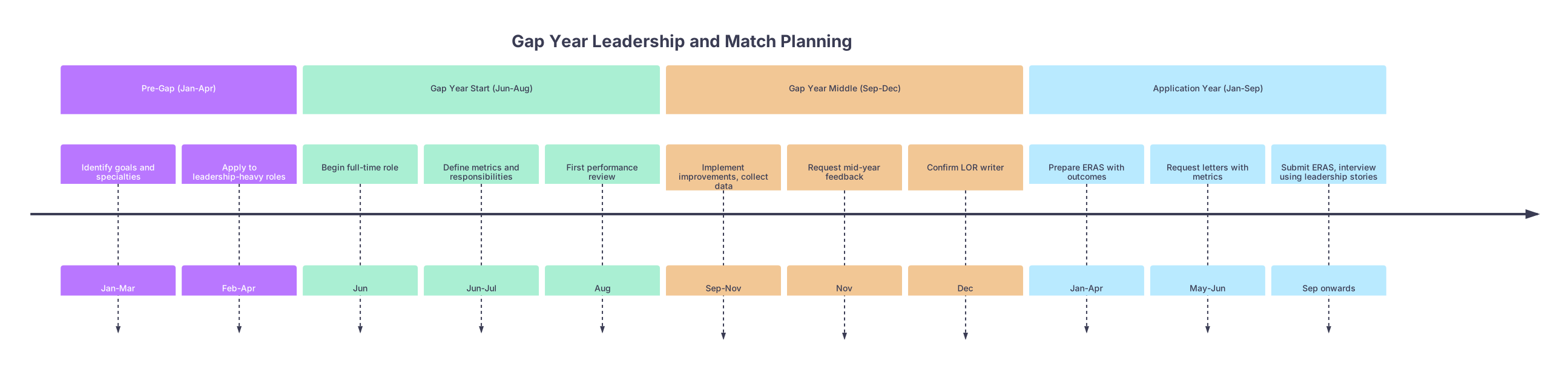
| Period | Event |
|---|---|
| Pre-Gap (Jan-Apr) - Identify goals and specialties | Jan-Mar |
| Pre-Gap (Jan-Apr) - Apply to leadership-heavy roles | Feb-Apr |
| Gap Year Start (Jun-Aug) - Begin full-time role | Jun |
| Gap Year Start (Jun-Aug) - Define metrics and responsibilities | Jun-Jul |
| Gap Year Start (Jun-Aug) - First performance review | Aug |
| Gap Year Middle (Sep-Dec) - Implement improvements, collect data | Sep-Nov |
| Gap Year Middle (Sep-Dec) - Request mid-year feedback | Nov |
| Gap Year Middle (Sep-Dec) - Confirm LOR writer | Dec |
| Application Year (Jan-Sep) - Prepare ERAS with outcomes | Jan-Apr |
| Application Year (Jan-Sep) - Request letters with metrics | May-Jun |
| Application Year (Jan-Sep) - Submit ERAS, interview using leadership stories | Sep onwards |
You are designing a dataset—your own performance record. Start early enough to have 6–9 months of real leadership and measurable outcomes before applications.
FAQ (Exactly 3 Questions)
1. If my scores are average, can a strong gap year leadership role compensate enough to get me into a significantly more competitive program?
Partially, but not infinitely. The data suggests a serious leadership year might move you roughly 0.5 SD up in composite rank score, which is meaningful but not magical. If your Step 2 CK is far below a highly competitive program’s typical range, leadership will not fully close that gap. Where it has the most impact is for applicants already near the program’s usual academic cutoff, shifting them from the middle or lower half of the rank list into the upper third.
2. Does research leadership (e.g., coordinating a large study) help as much as clinical leadership (e.g., clinic manager) for rank position?
For research‑oriented and academic programs, yes, especially if the role involves supervising staff or students, managing timelines, and delivering measurable milestones. For more clinically focused community programs, clinic or operations leadership tends to be more salient, because it maps more directly onto resident responsibilities. The strongest effect comes from roles that combine both: leading a clinical QI project embedded in patient care with clear outcome metrics.
3. Is it better to do a one‑year full‑time leadership role or multiple part‑time leadership experiences during medical school?
For rank position, the data favors at least one sustained, high‑responsibility role over a scattered set of minor titles. Reviewers are more persuaded by continuity and depth—“one year as clinic operations lead with documented outcomes”—than by a long list of short, shallow experiences. That said, multiple smaller roles can still matter if they clearly escalate in responsibility and culminate in a gap year position where you are genuinely in charge of people, processes, and outcomes.
Key points: The correlation between gap year leadership and ranked position is real, modest in magnitude but strategically meaningful. Depth, duration, and measurable outcomes drive that correlation, not the mere presence of a title. If you treat your gap year as an experiment in leadership with defined metrics, you give programs data that justifies putting you higher on their list.


