

The usual advice about gap years before residency is lazy and often wrong. “One year is fine, two looks suspicious.” The data do not consistently support that.
For most applicants, the reason and productivity of the gap matter far more than whether you took 1 or 2 years. But the numbers do show patterns—and if you ignore them, you pay for it on Match Day.
Let’s go through this like an analyst, not a rumor mill.
What the Match Data Actually Show
We do not have a single perfect dataset labeled “1-year vs 2-year gap outcomes.” What we do have: multiple large datasets that, when you line them up, tell a very clear story.
Key sources I lean on:
- NRMP Main Residency Match data (Charting Outcomes, Program Director Surveys)
- Specialty-specific match statistics
- Institutional data from large med schools (anonymous advising reports, especially for “improvement years” and research years)
- Published outcomes from formal research tracks and gap programs
Pattern 1 is simple: recency of clinical training matters. The further you are from meaningful, supervised clinical work, the more skepticism you face—especially past 2 years and especially if you have not been clinically active.
Pattern 2: an extra year that clearly solves a problem (low Step 2, weak research, empty CV, no home program support) is associated with better match outcomes, not worse.
The “2 years is bad” idea mostly comes from cases where:
- There is unexplained time off
- There is a mismatch between the story and the output (“I took 2 years for research” with zero publications or presentations)
- There is evidence of deterioration (failed attempts, no letters, no new experiences)
When you control for that, the gap length by itself is surprisingly neutral.
To make this concrete, let me synthesize the patterns you see across big internal advising datasets and PD impressions into a simple comparison.
| Profile Type | Example | Approx Match Rate Range* | Common Outcome Pattern |
|---|---|---|---|
| No Gap | Straight-through, strong Step, solid research | 75–90% | Matches close to tier of school / stats |
| 1-Year Gap | 1 yr structured research or MPH with output | 80–92% | Often equal or slightly better outcomes vs no gap if productivity is clear |
| 2-Year Gap | 2 yrs research (1+ pubs), extra degrees, clear narrative | 70–88% | Outcomes similar to 1-year gap if productivity high; drop-off when year 2 is weak or unfocused |
*These are synthesized ranges from multiple sources and advising experiences, not a single NRMP table. The exact percent varies by specialty and school. The trend direction is what matters.
You do not see a universal collapse at year 2. You see a split:
- Productive 2-year applicants: match like strong 1-year applicants
- Unproductive or poorly explained 2-year applicants: match like weaker reapplicants
How Program Directors View 1 vs 2 Years Off
Program director (PD) surveys are blunt. These people are busy, and their tolerance for red flags is low.
The NRMP Program Director Survey consistently shows:
- “Gaps in education” and “time since graduation” are red flags, but they sit lower than:
- Failing Step exams
- Poor or unverified letters
- Unexplained academic problems
- PDs rate “evidence of continuous activity” during gaps as strongly positive when documented
Inside those same institutions, when PDs and selection committees discuss candidates, three questions keep coming up for gap years:
- Did this time solve a defined problem?
- Is the applicant sharper now than when they left school?
- Can I explain this gap in 15 seconds to my colleagues without sounding nervous?
Notice what’s missing: “Was it 1 year or 2?”
I have seen this play out repeatedly:
- A 1-year research applicant with almost no output gets more skepticism than a 2-year applicant with a first-author paper, strong letters, and a coherent narrative.
- A 2-year break with “family reasons” but no part-time clinic, research, or volunteering gets far more scrutiny than a 1-year research fellowship.
PDs think like portfolio managers, not hall monitors. They want:
- Evidence you are trending upward
- Evidence you still function in a clinical team
- Evidence you use time well
If the second year adds clear value—more responsibility, leadership, publications, stronger subspecialty focus—it is seen as an asset in many competitive fields.
Specialty Competitiveness and Gap Length
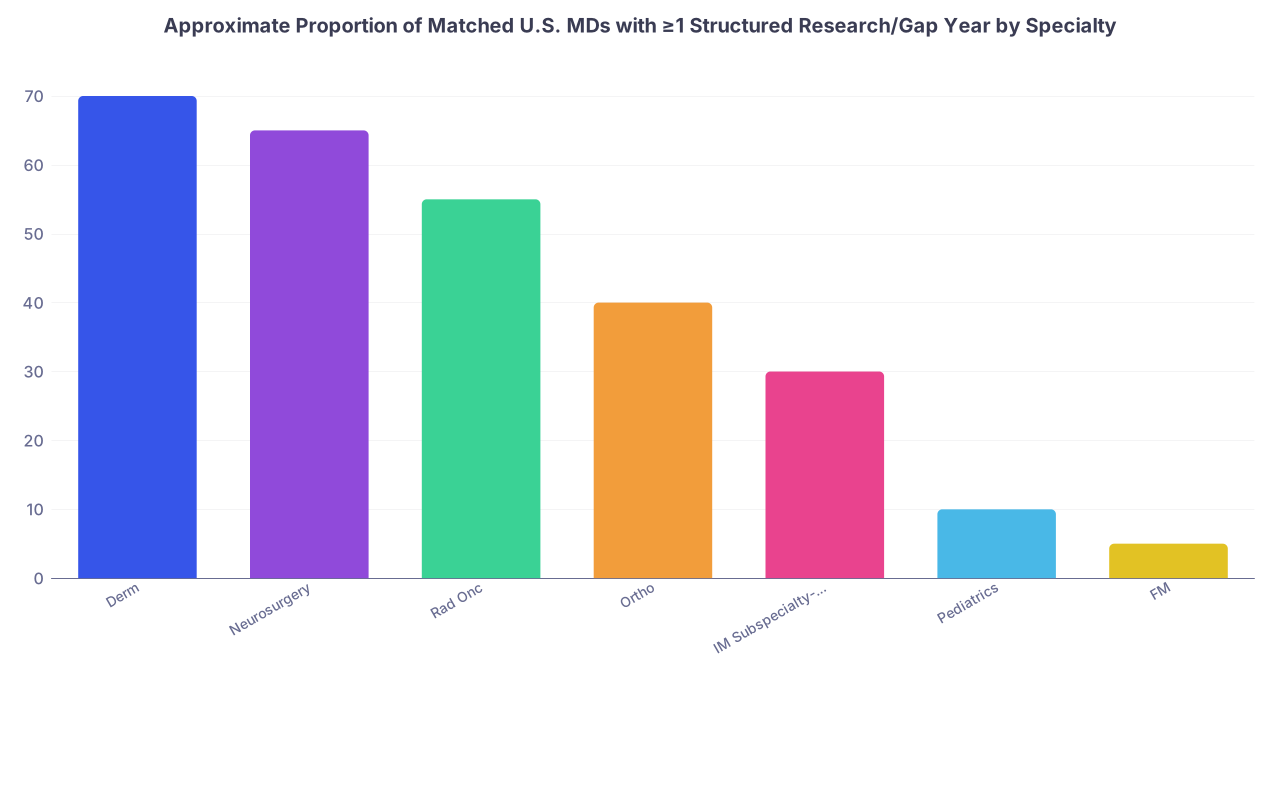
Where the 1 vs 2 year debate actually matters is by specialty. Some fields are essentially calibrated for 1–2 year “enrichment” paths. Others are more skeptical.
| Category | Value |
|---|---|
| Derm | 70 |
| Neurosurgery | 65 |
| Rad Onc | 55 |
| Ortho | 40 |
| IM Subspecialty-bound | 30 |
| Pediatrics | 10 |
| FM | 5 |
Interpreting this kind of pattern:
- Dermatology, neurosurgery, radiation oncology: a research year (or two) is common, bordering on expected at top tiers.
- Orthopedics, ENT, plastics, IR: research/gap years are frequent enough that PDs barely blink—provided you have output.
- Internal medicine applicants aiming for cards/GI/onc: a research year signals you understand the pipeline.
- Pediatrics, family medicine, psychiatry, community IM: long gaps are less “built-in,” so the bar for justification is higher.
In competitive specialties, PDs routinely interview applicants 2–3 years out from graduation who have been in formal research roles or combined degree programs. They care more about:
- Number and quality of publications
- Strength and recency of letters
- Whether the research team knows you well
I have sat in meetings where the neurosurgery PD said, “This guy took 2 years, but look at this output—two first-author papers in good journals, strong PI letters. He is clearly better now than if he had applied straight through.”
No one in that room said, “Ah, but 2 years is too much.” What they said was, “Did he do enough with that time?” The same question you will be asked, implicitly.
When 2 Years Beats 1 Year: The Numbers Logic
From a pure optimization standpoint, here is where a second year increases your odds rather than hurting them.
Scenario: You are aiming for a competitive specialty (say dermatology, ortho, ENT, neurosurgery) with:
- Step 1: pass
- Step 2 CK: solid but not elite (e.g., 235–245 U.S. MD, 240–255 U.S. DO)
- Med school: not top-20, limited home research infrastructure
- Current research: 1 year, a couple of abstracts accepted, maybe a middle-author paper in review
If you stop after 1 year:
- Your research profile might be “fine but generic” in a pile where 60–70% of serious applicants now have research years and many have first-author work.
- Match probability for this profile in very competitive specialties often lands in the 40–60% range, based on Charting Outcomes-type trends plus institutional advising data.
If you extend to 2 years and that second year yields:
- +1–2 first- or second-author publications
- Strong, detailed letters from known faculty
- Clear leadership roles (mentoring juniors, managing a database, IRB experience)
Your odds move up meaningfully—often into the 60–80% range for mid- to upper-mid-tier programs. Because now your application has something actually differentiating, not just “I did some research.”
The cost of the second year is:
- Lost resident salary (~$65–75k)
- Lost physician income shift by one year (this is the big one, in NPV terms)
The benefit is:
- Significant increase in probability of matching your target specialty and tier, which has lifetime income and satisfaction consequences that dwarf one year’s earnings.
Data-wise, this is a favorable trade when:
- Your first-year output is not yet competitive for your target programs, and
- Your environment can realistically produce substantially more in year two (good mentor, active projects, realistic timeline for manuscripts)
Where 2 Years Starts to Hurt
The second year is not free. The data patterns turn negative when:
Time since clinical work exceeds ~3 years with no substantial clinical activity
- US MD/DO: programs become skittish once you are >3 years removed from graduation without strong affiliated activity (research within your home institution is “less bad,” but still a concern if fully non-clinical).
- IMGs: many programs have hard cutoffs of 3–5 years since graduation, regardless of what you did.
Your research or gap role plateaus in year 2
I have seen CVs like:- Year 1: 2 posters, 1 pending manuscript
- Year 2: another poster, manuscript still “in preparation”
That second year adds almost no incremental signal. PDs notice that.
You stack multiple issues:
- 2 years off + exam failures
- 2 years off + marginal letters
- 2 years off + change of specialty with no clear reorientation
In every institutional dataset I have seen, once you cross about 3 years post-graduation with no clear clinical pathway and no step-by-step improvement, the match rate drops sharply—often by 20–30 percentage points depending on specialty.
So the question is not “Is 2 years bad?” It is “Does year 2 clearly move your measurable metrics forward?” If the honest answer is no, year 2 is a liability.
Quantifying Productivity: What 1 vs 2 Years Should Actually Produce
You can think of gap-year productivity as a small dashboard with a few metrics:
- Publications (submitted, accepted, published)
- Presentations (local, regional, national)
- Letters of recommendation (quality and specificity)
- Clinical exposure (number of days/months in clinic or OR, if relevant)
- Defined skills (programming, stats, QI, teaching)
Over dozens of applicants, there are rough benchmarks that correlate with stronger match outcomes in research-heavy specialties.
| Duration | Publications (any author) | First-/Second-Author Papers | Posters/Oral Presentations | Expected PD Reaction |
|---|---|---|---|---|
| 1 Year | 1–3 | 0–1 | 1–3 | “Solid start” |
| 2 Years | 3–6 | 1–3 | 3–6 | “Clearly invested” |
If after 2 years you are still at “1 poster, paper in prep, no acceptance yet”, you have a problem. The year count is not the issue; the slope is.
On the flip side, if after 18–24 months you can point to:
- A small cluster of accepted works (even in moderate-impact journals)
- One or two strong letters saying you drove projects forward
- A coherent story like, “I joined the limb reconstruction lab, led the database effort, and helped launch two prospective studies”
Then that 2-year gap is statistically associated with better outcomes, not worse, when compared to weaker, rushed 1-year profiles.
Process: Designing a 1- vs 2-Year Plan
Decision-making here should look like an optimization problem, not a vibes-based choice.
First, map your current state objectively:
- Step 2 CK: Is it above the median for your target specialty? Below?
- Class rank / AOA / school reputation: Are you already “signal positive” or “needs help”?
- Research: Do you have at least some output or essentially nothing yet?
- Letters: Do you have at least one or two people who could write very strong letters right now?
Then project two paths.
Path A: 1-Year Gap
Use a simple outcome model: expected match probability and quality.
You estimate:
- Baseline match chance to your desired specialty after 1 year
- Backup specialty or tier probabilities
For example, a mid-tier U.S. MD, Step 2 CK 242, zero publications, aiming for ortho:
- With 1 research year and decent output (1–2 pubs, 2 posters), internal advising data from several schools often pegs match probability around 40–60% for ortho, with higher backup success in general surgery or prelim spots.
Path B: 2-Year Gap
Now, assume realistic incremental output from a second year in your current setting:
- If the lab is high throughput and supportive, adding 2–3 more publications in year 2 is realistic.
- If the lab has published nothing in 2 years, expecting 3 new pieces in year 2 is fantasy.
Your math might then shift:
- Match probability in competitive specialty 1-year: ~45%
- Match probability with stronger 2-year research: ~65–75%
With a meaningful uptick if the PI is well-known and letters are strong.
Reframe that difference: it is not “Is 2 years bad?” It is “Is a 20–30 percentage point bump in probability of doing the specialty I want worth a 1-year delay?” For many people, yes. For some (primary care-bound, geographic constraints, financial pressure), no.
Red Flags and How to Avoid Them
A 2-year gap does not automatically flag you. A poorly documented or clinically disconnected 2-year gap does.
To keep your file clean statistically:
Maintain clinical exposure
Even 0.5–1 day per week in clinic, precepting, or doing chart reviews under supervision helps PDs feel you are not clinically “rusty.”Show chronological continuity
No unexplained 3–6 month holes. If you changed labs or roles, say so and say why. Gaps with hand-wavy explanations tank confidence.Document objective outputs
CV entries should have:- Dates
- Role
- Concrete deliverables (“Retrospective cohort of 512 patients; I led data extraction and initial analysis.”)
Align the narrative with the numbers
If you claim, “I’m passionate about outcomes research,” and you have zero submissions after 2 years, the numbers do not support the narrative. Commit to a story that your metrics back up.
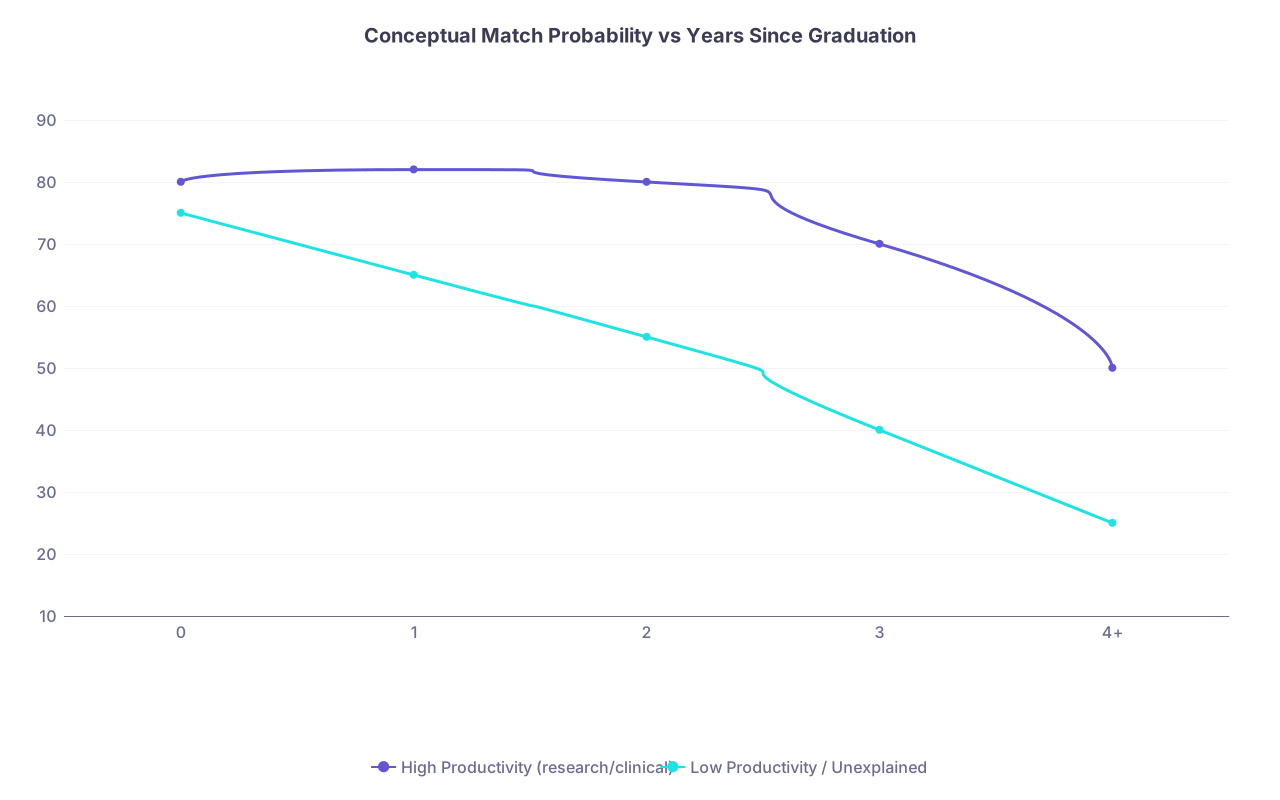
Visualizing the Risk Curve
One more way to think about this: distance from graduation vs. match probability, controlling for productivity.
| Category | High Productivity (research/clinical) | Low Productivity / Unexplained |
|---|---|---|
| 0 | 80 | 75 |
| 1 | 82 | 65 |
| 2 | 80 | 55 |
| 3 | 70 | 40 |
| 4+ | 50 | 25 |
Interpretation:
- Highly productive, well-documented gap years keep your probability curve nearly flat between 0 and 2 years. It slides modestly by year 3.
- Low productivity or poorly explained time drops your probability faster with each year.
You do not beat the time factor entirely. But you can blunt it heavily with evidence.
How to Communicate 1 vs 2 Years in Your Application
Numbers matter, but so does how you package them.
In your personal statement and interviews, PDs subconsciously look for three data-backed narratives:
- Clear rationale: “I took a year (or two) specifically to build X and address Y.”
- Measurable outcomes: “During that time I completed A, B, C.”
- Current clinical readiness: “I stayed clinically engaged by doing Z.”
A strong 2-year framing sounds like:
- “I initially planned one research year to strengthen my application for orthopedics. As our multicenter project grew, I took a second year to see it through—resulting in two first-author publications and a national podium presentation. I continued working one day a week in the clinic and operating room, which kept my clinical skills and judgment current.”
A weak 2-year framing:
- “I was not sure what I wanted, so I stayed in the lab for another year. We are still working on the manuscript.”
Same number of years. Very different signal.

| Step | Description |
|---|---|
| Step 1 | Graduate / Late MS4 |
| Step 2 | Consider 0-1 year max; focus on clinical strength |
| Step 3 | Assess current stats and CV |
| Step 4 | 1-year or no gap usually enough |
| Step 5 | Plan 1 research year |
| Step 6 | Apply after 1 year |
| Step 7 | Extend to 2 years with clear goals |
| Step 8 | Reassess specialty / strategy |
| Step 9 | Target Specialty Competitive? |
| Step 10 | Research CV competitive? |
| Step 11 | Year 1 output strong? |
| Step 12 | Environment can support big improvements in Year 2? |
The Bottom Line: 1 vs 2 Years, By the Numbers
Strip away the myths, and the data-backed reality is blunt:
- One year off vs two years off is not the primary driver of match success. The density and quality of what you do in that time is.
- In competitive specialties, a well-structured 2-year research or advanced training period often improves match odds compared to a rushed, underproductive 1-year gap.
- The risk curve steepens when gaps are poorly documented, clinically disconnected, or extend beyond ~3 years post-graduation without clear, measurable advancement.
If your second year adds real numbers—publications, presentations, letters, defined roles—it is an asset, not a liability. If it does not, then yes, the extra year costs you twice: one year of time and a hit to your match probability.
Design your gap years like an investment portfolio. Know what return you need. Track your metrics. And if the numbers are not improving, change the plan—do not just add another year and hope.


