

It’s January. You didn’t match, or you matched prelim-only, or your application just isn’t where you want it. Friends are signing contracts and buying scrubs with their future hospital logo, and you’re staring at a spreadsheet titled: “Second Gap Year – Am I Seriously Doing This?”
You’re not just asking “Should I take time off?” anymore. You’re asking something sharper:
Is a second gap year worth the risk, the money, and the hit to momentum?
Let me be blunt: a second gap year can either save your career or slowly kill your chances, depending on how and why you do it. The question isn’t “Is a second gap year bad?” The question is: Will another year meaningfully change my odds, or am I just delaying the inevitable?
Let’s sort that out.
Step 1: Get Real About Your Current Competitiveness
You can’t decide about another year until you’re brutally honest about where you stand right now.
Here’s the core question:
If you applied again this cycle with almost the same app, what would actually be different?
You need to look at your profile across four axes:
- Academics / Exams
- Clinical strength and letters
- Specialty choice realism
- Application execution (strategy, timing, number of programs, geography)
Let’s structure that a bit.
| Area | Strong Enough? | Evidence You’re Weak Here |
|---|---|---|
| Exams (Step/COMLEX) | Yes / No | Failed scores, very low pass, no improvement plan |
| Clinical / Letters | Yes / No | No strong advocates, generic letters, no recent US clinical evals |
| Specialty fit | Yes / No | Applying way above stats, ignoring backup plan |
| App strategy | Yes / No | Applied late, too few programs, bad personal statement, no advising |
If you’re clearly weak in none of these? Another gap year is likely a waste. You don’t have a leverage point.
If you’re clearly weak in one or more, a second gap year can help—but only if you can convert that year into measurable improvements (not vibes, not “I worked hard,” but actual metrics and experiences).
Step 2: Know the Actual Payoff You Need From a Second Year
A second gap year is only worth it if you can answer this cleanly:
“If I take another year, I will accomplish X, Y, and Z that will increase my chances of matching by A–B%.”
Obviously you won’t know exact percentages, but you should be able to name concrete deliverables, like:
- A strong US clinical experience (U.S. grads: a sub-I or acting internship; IMGs: hands-on observership/externship with real LOR potential)
- A new board score or improved Step 2 CK/COMLEX Level 2 result
- 1–3 first- or second-author publications, ideally in your chosen specialty
- 2–3 new, strong letters from people who actually know you well
- A compelling narrative shift (for example: “I pivoted from plastics to general surgery with real experience to back it up”)
If your plan is vague—“more research,” “more time to think,” “maybe improve my CV”—that’s not a plan; that’s avoidance.
Here’s the litmus test:
If you can’t list 3 specific, high-impact outcomes you’ll realistically achieve in 12 months, a second gap year is probably not worth it.
Step 3: Understand the Real Risks of a Second Gap Year
Programs don’t automatically hate multiple gap years. What they hate is unexplained or unproductive time.
A second gap year carries a few real risks:
Distance from clinical medicine
Another year away from the wards = more questions:- Are your skills rusty?
- Did other programs already pass on you twice?
- Why should they pick you over a fresh grad?
Narrative erosion
“I took a year to strengthen my application” is a fine story once.
“I took another year to strengthen my application” without a major new achievement starts to sound like spinning your wheels.Financial and personal cost
Lost attending income later. Another year of low or no pay. Relationship strain. Visa issues (if you’re an IMG).Perception of risk to the program
PDs think in risk-reward.
A candidate with multiple years off and no visible progress feels like a risk:- Will they pass boards?
- Will they complete the program?
- Are they hiding something?
None of these are automatic deal-breakers. I’ve seen people with two gap years still match. But they had one thing you need: a clear, provable story of growth and momentum.
Step 4: Figure Out Which Bucket You’re In (This Matters a Lot)
Let’s be specific. Most people thinking about a second gap year fall into one of these buckets. Be honest about which one is you.
](https://cdn.residencyadvisor.com/images/articles_svg/chart-common-reasons-for-considering-a-second-gap-year-5594.svg "Common Reasons for Considering a Second Gap Year")
| Category | Value |
|---|---|
| Did not match twice | 30 |
| Switching specialties | 20 |
| Low scores/failed exam | 20 |
| IMG needing US experience | 20 |
| [Personal/health reasons](https://residencyadvisor.com/resources/gap-year-residency/how-do-i-explain-a-personal-reason-gap-year-without-oversharing) | 10 |
Bucket 1: Didn’t Match Twice, Same Specialty
Reality:
Programs have already seen a version of you two cycles in a row. To justify a third attempt, your profile needs to look meaningfully different.
Second gap year might be worth it if:
- You failed or barely passed an exam and you can now show a clear academic turnaround (strong Step 2, shelf scores, or equivalent)
- You can add a high-impact year (dedicated research with real output, a clinical year with strong US LORs, etc.)
- You’re also adjusting strategy: more programs, broader geography, community-heavy mix, DO programs if appropriate
Second gap year is usually not worth it if:
- You’re applying to the same ultra-competitive specialty with the same scores and same research level
- You’re unwilling to apply more broadly or to backup specialties
- Your planned year is just “more of the same thing that didn’t work last time”
Bucket 2: Switching to a More Realistic Specialty
Example: tried Derm or Ortho with mid-tier stats, now considering IM, Peds, FM, Psych, Path, etc.
In that case:
- A second gap year can absolutely be worth it if you use it to:
- Get specialty-specific US clinical experience
- Earn letters in the new specialty
- Build a coherent narrative around the switch
Often, you don’t actually need a full extra year here. You might be able to:
- Do focused rotations and letters early in the year
- Apply in the same upcoming cycle with a revised strategy
If you’re considering a switch to a less competitive specialty and already have decent scores and no professionalism issues, a second full gap year is often overkill. What you need is targeted repositioning, not 12 more months.
Bucket 3: IMG With Limited US Experience
For IMGs, this is trickier. Lack of US clinical experience or LORs is a real barrier.
Second gap year may be justified if:
- Year 1 was poorly structured (random observerships, no strong letters, no research, late application)
- You now have access to:
- A structured research position at a US academic center
- Reputable US clinical experiences with real supervision and letters
But you must be very clear:
- What exact positions you’ll hold
- What letters you’ll realistically get
- How this will address program concerns: “Can this person function safely in a US hospital?”
If your “USCE plan” for the second year is still vague or low-yield, the gap year might just extend your unemployment without moving your odds.
Step 5: Design the Year Like It’s a One-Shot Contract
If you choose a second gap year, you don’t “see how it goes.” You treat it like a one-year proving ground.
You should be able to map your year almost like a project:

| Step | Description |
|---|---|
| Step 1 | Decide on Second Gap Year |
| Step 2 | Secure Position: Research or Clinical |
| Step 3 | Define 3-5 Measurable Goals |
| Step 4 | Quarterly Checkpoint with Mentor |
| Step 5 | Adjust Plan if Output Low |
| Step 6 | Prepare Application Materials Early |
| Step 7 | Submit Early and Broad |
What goes in this plan?
At least three of these, ideally four:
- A clear role: clinical fellow, research fellow, sub-I, teaching fellow, etc.
- Specific output targets: “2 posters, 1 manuscript submission,” not “more research”
- Named mentors who know they’re writing you a letter if you deliver
- A timeline: when you’ll have enough to update ERAS, when you’ll ask for letters
- A parallel plan to fix non-CV issues: interview skills, personal statement, program list
If you can’t secure a structured role (you’re just hoping something appears), that’s a red flag. Programs can smell “aimless year” from a mile away.
Step 6: Put the Financial and Life Costs On Paper
Don’t hand-wave this. Write it down.
- Expected income during gap year (research job, scribe, etc.)
- Loan payments or deferment status
- Living costs (rent, food, insurance, exams, ERAS fees)
- Compare:
- One more year at gap-year income
vs. - One more year as a resident, moving toward attending salary
- One more year at gap-year income
Then add the non-financial:
- Impact on relationships (partner waiting on moving, kids, family support)
- Visa status if you’re on a limited timeline
- Mental health – are you actually capable of grinding through another uncertain year?
If you’re already mentally maxed out and your plan for the year is highly uncertain, piling on another gap year can do real damage.
Step 7: Get Outside Eyes (But Choose Them Carefully)
You’re too close to this. Everyone is.
You want feedback from:
- A program director or APD who’s willing to be blunt
- A faculty mentor who sees many applicants, not just you
- Ideally someone not emotionally invested in telling you what you want to hear
Ask specific questions, not “What do you think?”
Try these:
- “If I reapply to [specialty] this year with no major changes, would you expect me to match?”
- “If I spend a year doing [specific role], how much do you think that changes my odds?”
- “Would you personally interview someone with my profile and two gap years? Why or why not?”
You’re looking for patterns. If three honest people say, “You need a different specialty” and you’re planning a second gap year to force the same one to work, that’s not brave. That’s denial.
When a Second Gap Year Is Usually Worth It
Here’s when I generally say “Yes, consider it”:
- You failed or did poorly on a major exam but now have a realistic, supported plan to significantly improve or show academic strength
- You can step into a structured, reputable research or clinical fellowship with strong letter-writers and clear output
- You’re switching to a more realistic specialty and need time to build specialty-specific letters and experiences
- You’ve fixed your strategy mistakes from prior cycles (late apps, too few programs, narrow geography) and now you’re adding real substance on top
And even then, the default assumption should be:
“This is my last gap year. I’m going all in. No half-measures.”
When a Second Gap Year Is Usually a Bad Bet
I’d be very skeptical in these situations:
- You’re applying to the same hyper-competitive specialty, with the same stats, and your “plan” is just “do more of what I already did”
- You don’t have a confirmed position or role for the year—just vague ideas
- You’re unwilling to broaden your program list or consider backup specialties
- Your primary barrier is professionalism, repeated failures, or red flags that another year won’t erase
- You’re already burned out to the point that another year of uncertainty is likely to crush you
Sometimes, the “brave” choice isn’t another gap year. It’s changing specialties. Or accepting prelim/TY and back-dooring into a categorical later. Or stepping away entirely.
Quick Side-by-Side: Gap Year vs. Reapply Now
| Option | Good If… | Bad If… |
|---|---|---|
| Second gap year | You have a concrete, structured plan | Plan is vague or low-yield |
| You can clearly upgrade scores/letters | You refuse to adjust specialty/strategy | |
| You can afford 12 more months financially | You’re already unstable or burned out | |
| Reapply now | App is close and only strategy was weak | Core metrics are well below target |
| You’re willing to broaden programs/specialty | You’ll re-run the same failed playbook |
Visual: How a Strong Second Gap Year Should Change Your Profile
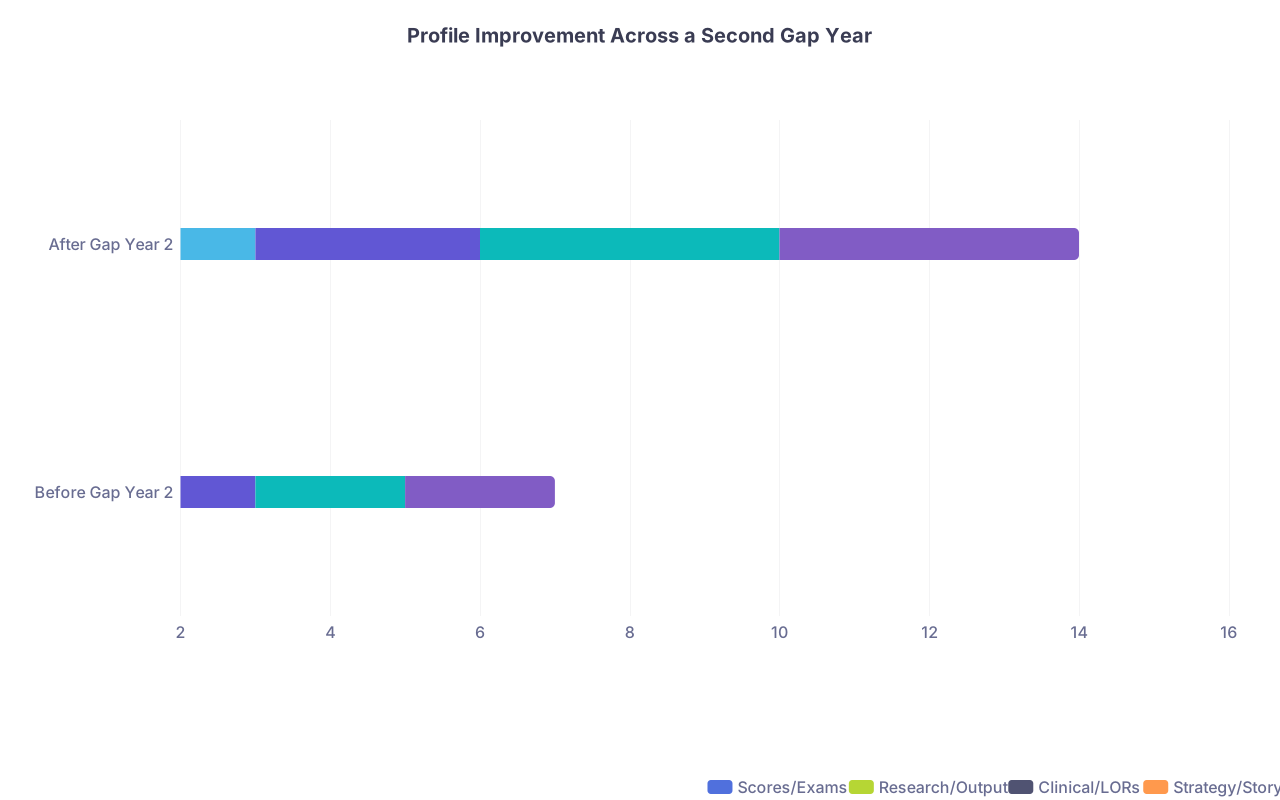
| Category | Scores/Exams | Research/Output | Clinical/LORs | Strategy/Story |
|---|---|---|---|---|
| Before Gap Year 2 | 2 | 1 | 2 | 2 |
| After Gap Year 2 | 3 | 3 | 4 | 4 |
(Scale is conceptual: 1 = weak, 5 = strong. Point is: after a good second gap year, multiple dimensions should move up meaningfully.)
FAQ: Second Gap Year Before Residency

1. Will two gap years automatically hurt my chances of matching?
No, not automatically. Programs care more about what you did in those years than the raw number. Two gap years with strong research, clinical work, and great letters can absolutely be acceptable. Two “empty” years with nothing but vague experience descriptions? That’s a big problem. The red flag isn’t the time; it’s the lack of progress.
2. Is it better to take a prelim/TY spot instead of another gap year?
Often, yes—if:
- You can handle the workload
- You don’t have serious exam risk (you still need to pass Step 3 / Level 3)
- You’re switching into a field that values prior clinical training (IM, anesthesia, radiology, etc.)
A prelim year gives you:
- Fresh clinical evaluations
- New letters
- Proof you can function as a resident
But if your main issue is academics (multiple failed exams), a prelim year can backfire if you struggle again. In that case, a structured, lower-pressure academic or research year focused on fixing the test problem may be safer.
3. How do I explain a second gap year in my personal statement and interviews?
You keep it tight and concrete:
- Briefly state the reason: “After my initial unsuccessful application, I chose to take an additional year to strengthen my candidacy.”
- Highlight what you did, with specifics: “I completed a research fellowship in cardiology, resulting in two abstracts and a manuscript submission, and I worked closely with Dr. X and Dr. Y, who observed my clinical reasoning and work ethic firsthand.”
- Connect it to your readiness now: “This year confirmed my commitment to internal medicine and made me a more prepared and resilient applicant.”
Avoid:
- Long emotional narratives about disappointment
- Blaming prior programs or the system
- Vague claims like “I grew a lot” without proof
4. How much research is “enough” to justify a second gap year?
There’s no magic number, but here’s the honest bar:
Your total output after the second gap year should look clearly different from when you started it.
Reasonable targets:
- 1–2 first- or second-author papers submitted (or accepted)
- Several abstracts/posters at recognized conferences
- Ongoing projects with clear continued involvement
What doesn’t justify a whole extra year:
- Your name buried in the middle of one paper you barely worked on
- A couple of case reports with minimal involvement
- “I helped with data collection” and nothing to show for it
If your mentor can’t commit to helping you reach meaningful output, that’s not a good reason to take another year.
5. What if my gut says “I can’t take another year of this,” but logically it seems I should?
Listen to that. Burnout isn’t a side note; it’s a real constraint. Residents who drag themselves in already exhausted from years of limbo don’t do well.
If your logical analysis says:
- “I probably need more to be competitive in this specialty”
And your emotional reality says:
- “I can’t stomach another year of uncertainty and low pay”
You have three honest options:
- Switch to a more realistic specialty and apply this cycle with targeted changes.
- Take a shorter, partial gap (e.g., 6–8 months in a high-yield role) if that’s available.
- Decide that protecting your long-term wellbeing matters more than forcing this specific path, and consider alternative careers or related fields.
“Push through no matter what” sounds inspiring on Instagram. In real life, it breaks people.
Bottom line:
- A second gap year is only worth it if you can turn it into visible, measurable progress—not just more time.
- If your plan doesn’t change your profile in a way a PD would actually care about, you’re likely just delaying pain, not avoiding it.
- Be ruthless in your assessment, aggressive in your planning, and honest about your limits. That combination—more than the extra year itself—is what actually moves the needle.


