

The worst timing to fall in love with a new specialty is exactly when it usually happens: during your gap year, right before residency applications go in.
You’re not broken. The system is.
You were told to pick a specialty early, build a narrative, commit. And now in your research year, chief year, prelim year, or “work and re-evaluate” year…you discover something else lights you up. Maybe you were set on internal medicine and suddenly EM or anesthesia or dermatology feels right. Or you were going into general surgery and now ENT or radiology is all you can think about.
Here’s what you do next—step by step—so you do not blow up your future just because your timing is inconvenient.
Step 1: Get brutally clear on whether this is a crush or the real thing
Before you change course mid–gap year, you need to answer one question honestly:
Is this a temporary infatuation, or is your previous plan actually wrong for you?
People get “specialty crushes” all the time after one great rotation or a nice attending. That’s not enough to upend your whole trajectory.
Run this quick diagnostic:
Duration: How long have you been interested?
- Less than 2–3 weeks after a single exposure? That’s a flag for “rotation high.”
- More than a month, with repeated exposure and still excited? More credible.
Exposure depth:
You need more than a highlight reel. Ask to see:- The worst cases / least glamorous parts
- The call schedule and weekend burden
- Clinic days with no-shows, documentation hell, insurance fights If you still want it after watching someone chart for 2 hours straight at 6 pm, that matters.
Compare real days, not fantasy versions.
Write down:- “A typical day in the specialty I was planning”
- “A typical day in the new specialty” Include:
- Start/finish times
- Procedures vs talking vs documentation
- Inpatient vs outpatient
- Longitudinal relationships vs one-off encounters
Which day do you actually want to live 5 days a week for decades?
Gut test: Imagine match email day.
- You open your email and you matched your old specialty.
- Real reaction: relief? disappointment? dread?
- Do the same imagining you matched the new specialty.
If your stomach drops at your old plan, don’t ignore that.
If, after that, the new specialty still feels right, then yes—you take it seriously.
Step 2: Map your calendar against the match timeline—today, not “later”
This is where most people screw up. They “think about it” for months and then discover they’ve blown through critical deadlines.
Lay out your actual year:
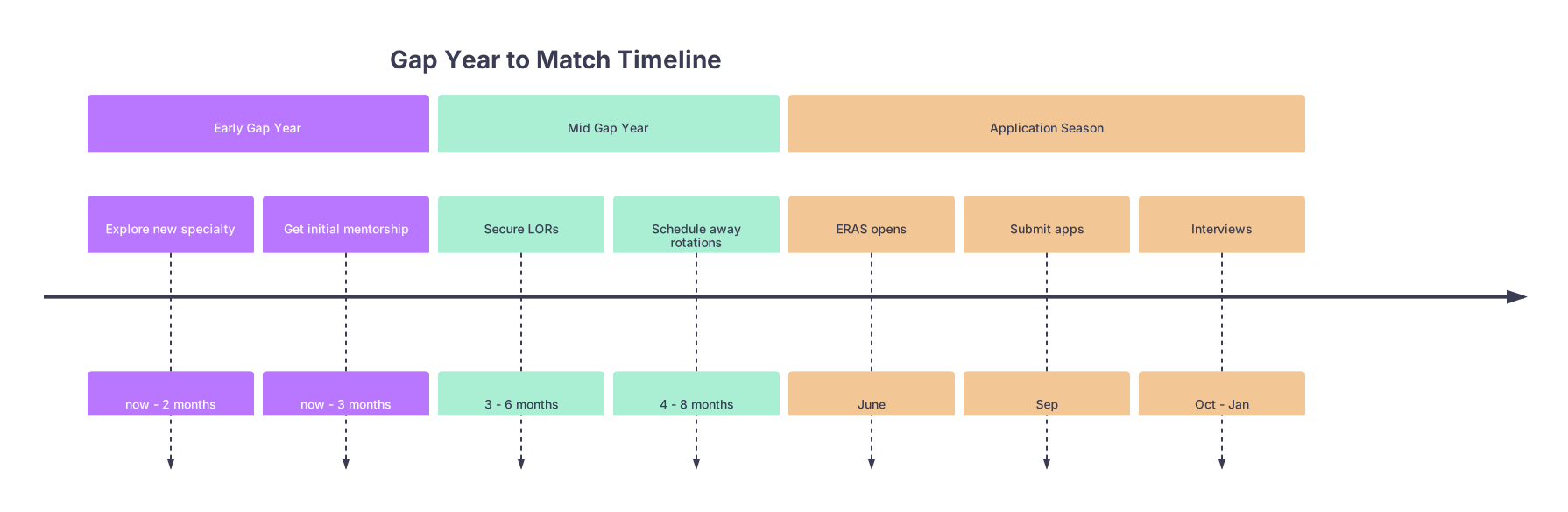
| Period | Event |
|---|---|
| Early Gap Year - Explore new specialty | now - 2 months |
| Early Gap Year - Get initial mentorship | now - 3 months |
| Mid Gap Year - Secure LORs | 3 - 6 months |
| Mid Gap Year - Schedule away rotations | 4 - 8 months |
| Application Season - ERAS opens | June |
| Application Season - Submit apps | Sep |
| Application Season - Interviews | Oct - Jan |
Now place yourself honestly on that timeline.
- If you’re 9–12 months before applications: You’ve got room to pivot cleanly.
- If you’re 6 months out: Possible, but you need to be aggressive and focused.
- If you’re 3 months out or less: You may need a 1–2 year strategy, not a frantic last-minute flip.
Do not guess. Look at actual dates:
- ERAS open date
- Application submission date
- When programs in that specialty typically send first interview invites
You need to decide if you’re applying this cycle to the new specialty, delaying a year, or hedging.
Step 3: Pressure-test feasibility by specialty
Some specialties tolerate late conversions better than others. Some do not.
| Specialty Type | Switch Difficulty | Key Limiting Factor |
|---|---|---|
| Primary Care (IM/FM) | Easier | Timing + LORs |
| Psych/Neuro/Peds | Moderate | Exposure + fit |
| EM/Anesthesia | Moderate-Hard | SLOEs / letters |
| Surgical Subspecialty | Hard | Research + connections |
| Derm/Ortho/Plastics | Very Hard | Research + scores |
Now be honest about:
- Your Step/COMLEX scores
- Your class rank
- Any red flags (failed exams, leaves, professionalism write-ups)
- Existing research and letters in the new area (probably little to none)
You can absolutely move from, say:
- IM → Psych
- Psych → Neuro
- EM → Anesthesia
- IM → EM (with hustle)
- Surgery → Anesthesia
Derm, ortho, plastics, ENT, neurosurgery, urology? Mid–gap-year conversion is possible but usually means:
- Extra year(s) of targeted research
- Strategic mentorship at a big-name department
- Realistic acceptance of applying more than once
If what you’ve discovered is one of the hyper-competitive fields and you’re late in the game with average scores and no aligned research? You probably cannot “just apply this year and see.” That’s how people waste cycles and get stuck.
You might still get there. But your plan becomes two-step:
- Secure some residency that keeps doors open (prelim, TY, IM, etc.).
- Build a real competitive file for the targeted switch.
Step 4: Decide between three actual paths (not fantasies)
You have three real options. Everything else is just denial in different clothes.
Path A: Full pivot to the new specialty this cycle
Use this if:
- You are ≥ 9 months before application season
- Or you’re 6–9 months out and the new specialty is moderately competitive
- You’re willing to risk not matching this year (or SOAP into something else)
Concrete moves:
- Drop prior specialty research that does not convert or translate
- Aggressively pursue shadowing, observerships, and at least 1 concrete project (case report, QI, retrospective chart review) in the new field
- Get at least 2 strong letters from that specialty
- Rewrite your personal statement and activities to reflect a coherent story
This is “burn the ships and commit.” Good if your previous plan feels wrong enough that matching into it would feel like a trap.
Path B: Hedge: apply to both specialties strategically
Use this if:
- Your previous specialty is reasonable and you’d be okay doing it
- You’re not competitive enough yet for a full switch
- You don’t want to risk an unmatched year and have financial or visa pressures
How this actually looks:
- You apply primarily to the new specialty but keep a solid number of apps to the old specialty (or vice versa)
- Your personal statement and letters need to be specialty-specific; don’t send a generic “I love medicine and people” essay to both
- You accept that some programs will view dual-interest as lack of commitment—but many know the game and don’t care as long as your file is strong
If you do this, be surgical:
- Do not spray 80 applications in each specialty blindly.
- Segment: where are you truly competitive in the new specialty vs the old?
- Many people match this way. It’s not ideal. But it’s better than unemployable.
Path C: Delay and rebuild a convincing application
Use this if:
- You are fewer than 6 months from application and have almost zero exposure in the new field
- The specialty is highly competitive and your stats are average
- You’d rather take a year to do it right than be stuck reapplying repeatedly
What that year looks like:
- Dedicated research year in your new specialty at a strong program
- Deliberate networking with PDs, chairs, and influential faculty
- Building 2–3 heavy-hitting letters
- Possibly doing an away rotation or sub-I if you still have student status or PGY-1 flexibility
This feels like “falling behind.” It isn’t. You’re trading one year for 30+ years of the right career.
Step 5: Build credibility in the new specialty fast
Whatever path you pick, you need one thing quickly: receipts.
Program directors do not believe narratives; they believe evidence. You show seriousness with actions, not vibes.
Here’s how you stack that evidence during your gap year:
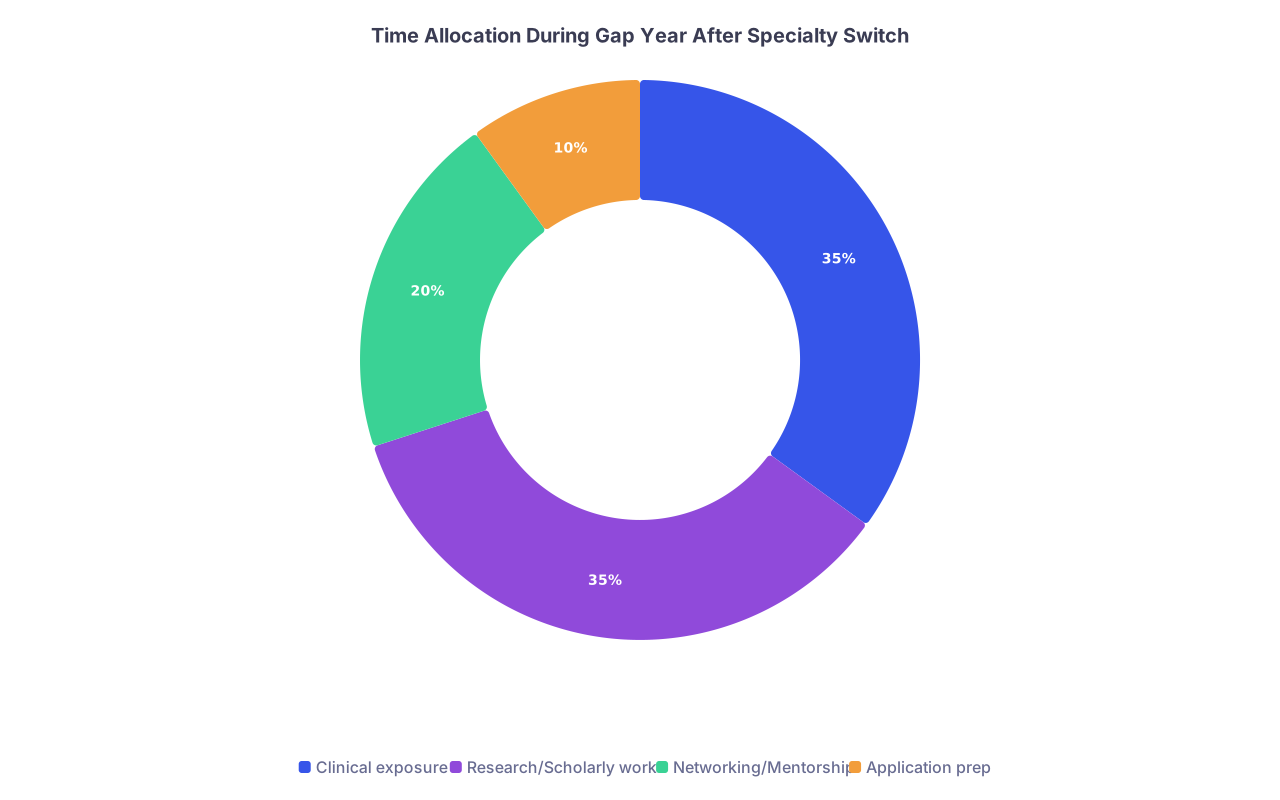
| Category | Value |
|---|---|
| Clinical exposure | 35 |
| Research/Scholarly work | 35 |
| Networking/Mentorship | 20 |
| Application prep | 10 |
Clinical exposure
- Shadow consistently, not just one afternoon. One half-day a week for 2–3 months is much better than a random 8-hour day.
- If you’re in a research or prelim year, ask to be explicitly involved in that specialty’s clinics or consults.
- Keep a simple log of dates, settings, and what you observed. Helps with essays and interviews.
Concrete scholarly activity
You do not need a first-author NEJM paper. You need something with your name on it that lives in that field:- Case reports
- Retrospective reviews
- QI projects
- Educational materials (curriculum, patient handouts, etc.) with faculty backing
Aim for at least:
- 1–2 accepted abstracts/posters
- 1–2 papers submitted (even if not yet accepted)
Letters of recommendation that actually say something
You need:- At least one letter stating clearly: “I would be happy to have this applicant in our program.”
- A writer who has seen you on real clinical work, not just research Zoom calls.
During your time with them:
- Show up early.
- Do unglamorous tasks well.
- Ask for feedback, implement it, and let them see you improve.
Mentorship with teeth
Find one attending in the new specialty who:- Knows your story
- Believes in your capacity to do this specialty
- Is willing to email or call PDs on your behalf when applications go out
This last piece is what often separates the “late converts who match” from the “late converts who don’t.”
Step 6: Clean up your story so it doesn’t sound like chaos
You can absolutely explain a mid–gap-year pivot in a way that makes sense. But you have to be deliberate.
You’re answering:
- Why this new specialty?
- Why not your original choice?
- Are you just chasing lifestyle or prestige?
A strong narrative hits three beats:
Prior plan was thoughtful, not impulsive
Example:
“Throughout medical school I thought I’d pursue internal medicine. I liked longitudinal care and complex problem solving, and I spent my third-year electives and early gap year research building in that direction.”The new specialty connection is grounded in experiences
“During my research year, I joined our hospital’s stroke response team as part of a QI project. Working closely with neurology attendings in the ED and on the wards, I realized I was drawn to the acute decision-making and focused diagnostic process they owned. Over several months, as I took more responsibility on that team, I found myself staying late for admissions and follow-ups out of genuine interest.”The switch is deliberate, not flaky
“I did not change course after one exciting case. Over 5–6 months, I sought additional neurology clinic time, took call with the residents when possible, and worked on two neurology-focused QI projects. After these experiences, I realized neurology fit the aspects of medicine I value most: detailed clinical reasoning, longitudinal care, and evolving therapeutics. That’s when I sought mentorship and decided to commit fully to applying in neurology.”
Notice what you do not say:
- “I just fell in love with it.”
- “I hated my old specialty.”
- “I always liked both and couldn’t decide” (makes you sound indecisive).
You can acknowledge misalignment with the old path without trashing it:
- “I enjoyed internal medicine, but I realized I wanted more procedural work and acute care than typical IM practice offers.”
- “Surgery gave me discipline and technical skills, but I found I missed longitudinal patient relationships, which I’ve now found in ENT.”
Step 7: Handle your existing mentors and letters without burning bridges
You probably have:
- Research mentors in your old specialty
- Letter writers lined up
- Advisors who think you’re headed one direction
You’re about to tell them you’re changing. Do it like a grown-up.
How to have that conversation:
Do it in person or via video if at all possible.
Lead with appreciation, not apology: “You’ve invested a lot in my development in [old specialty], and I’m very grateful. Over the past X months, I’ve had increasing exposure to [new specialty] through [specific experiences], and I’ve realized it’s a better long-term fit for me.”
Own responsibility: “I didn’t come to this lightly. I gave it several months, sought feedback, and thought through the risks. I decided I’d rather realign now than train in a field that isn’t the best fit.”
Be explicit about what you’re asking for:
- Sometimes: “I’m hoping you’ll still support me with a letter that speaks to my clinical and research skills, even though I’m applying in [new specialty].”
- Sometimes: “I completely understand if you’d rather not write a letter now that I’m changing paths.”
Most decent humans respect this. Some will be annoyed for a week then get over it. A few will be petty. You cannot let the petty ones dictate 30 years of your life.
Step 8: Know what happens if you don’t match—and have a plan now
If you pivot late, your risk of not matching may go up. That does not mean you’ve ruined your career. It means you need a Plan B that isn’t “panic.”
Common realistic Plan B options:
- SOAP into a prelim year (medicine, surgery, transitional) and plan a reapplication with stronger backing
- Non-categorical PGY-1 in a related field while building more evidence for your new specialty
- Another year of research with a transparent re-application plan (works best if your mentor is influential)
Avoid:
- Taking random, unrelated jobs with no clinical or academic connection, then trying to reappear in the match with a story that makes no sense
- Hiding an unmatched year without explanation
Instead, make the time work for you:
- Increase research output
- Maintain clinical skills
- Stay connected to mentors and programs
Programs care less that you “took an extra year” and more about whether that year has a coherent logic and visible productivity.
Visual snapshot: which path fits you?
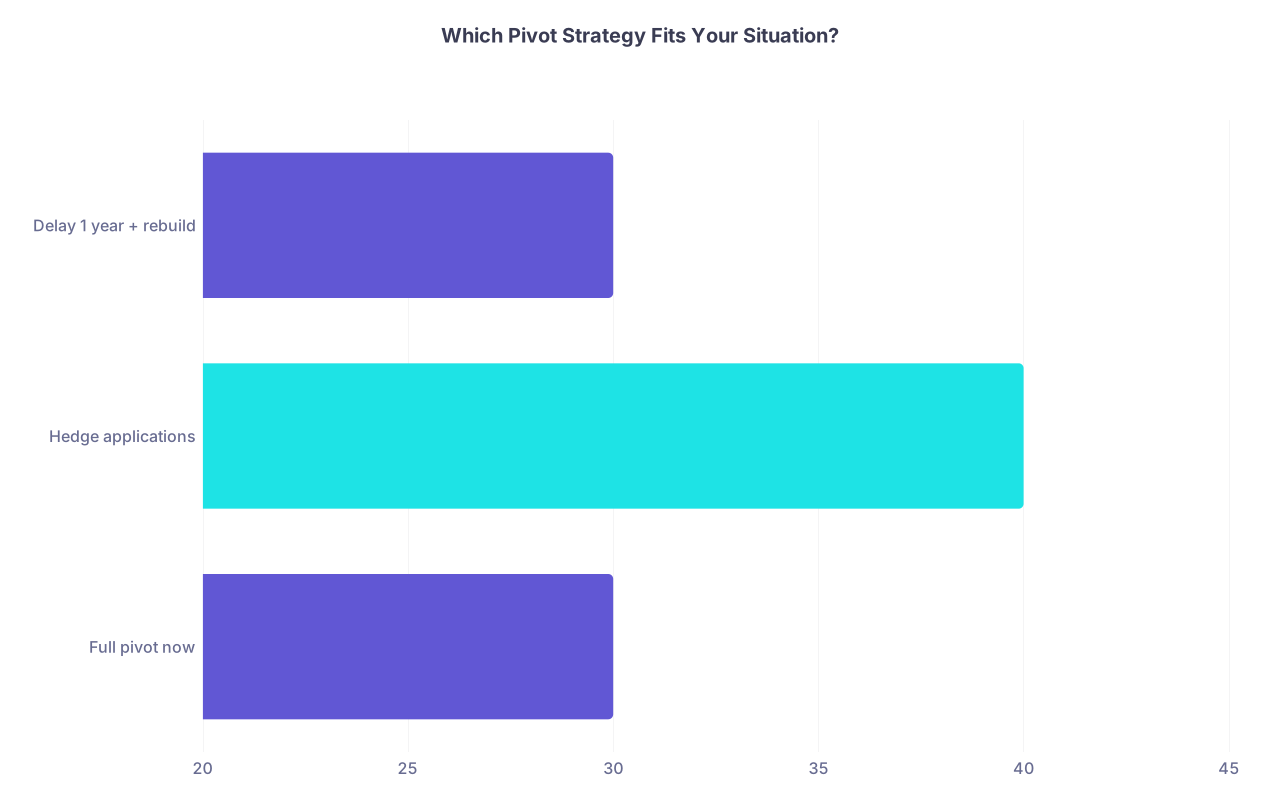
| Category | Value |
|---|---|
| Full pivot now | 30 |
| Hedge applications | 40 |
| Delay 1 year + rebuild | 30 |
This isn’t exact data; it’s how I see real applicants split when they discover a new specialty mid–gap year:
- A minority are in good shape to pivot now.
- Many are best served by a structured hedge.
- A solid chunk are smarter to delay and come back strong.
Common scenario walkthroughs
Scenario 1: Research year planning on IM, suddenly loves neurology
You:
- Are 10 months from ERAS open
- Have IM mentors and a couple of IM projects
- Just joined a stroke QI project and love it
Best move:
- Commit now to neurology
- Convert one IM project into neuro-adjacent if possible (e.g., outcomes in patients with neurologic comorbidities)
- Get 2 neurology letters (one clinical, one research)
- Keep 1 general IM letter emphasizing your clinical reasoning and reliability
- Apply mostly neurology, with a small hedge to IM only if you truly would accept it
Scenario 2: Working as a prelim surgery resident, falls in love with anesthesia
You:
- Are in PGY-1 surgery
- Keep loving your time in the OR, but prefer the anesthesia side
- Are 6 months from application season
Best move:
- Ask your PD how supportive they are of you switching. Their attitude matters.
- Build relationships with anesthesia attendings this year; ask to help with simple pre-ops, follow cases, join QI projects
- Get at least 2 anesthesia letters and 1 from surgery talking about your work ethic and OR performance
- Apply anesthesia broadly while keeping in mind your PGY-1 makes you attractive as a CA-1
Scenario 3: Gap year for derm research, realizes they actually want psych
You:
- Have built a derm CV but hate clinic days
- Loved psych clerkship but never took it seriously
- Are 3–4 months from application
Best move:
- Psych is more forgiving but 3–4 months is tight
- You need immediate psych clinic exposure, at least one psych mentor, and 1–2 concrete psych projects
- You can apply psych this cycle, but hedge with IM or FM if you’re worried about risk
- Your derm research doesn’t hurt you; spin it as strong foundation in detailed outpatient care and long-term follow-up—but be clear on why psych fits better
FAQ (exactly 5 questions)
1. Will programs think I’m flaky if I change specialties during my gap year?
Some will, most will not—if your explanation is coherent and your actions match your story. Flakiness looks like shallow exposure, no real commitment, and vague explanations. Seriousness looks like months of clinical exposure, targeted research, strong specialty-specific letters, and a clear rationale that connects your prior path to your new choice.
2. Do I have to erase my old specialty from my application?
No. In fact, trying to erase it usually backfires. Use your past seriously: show what you learned, how those skills transfer, and why you’re making a considered course correction instead of chasing novelty. It’s fine to have IM research while applying to EM, or surgery experience while moving to anesthesia. Just make sure there’s enough new specialty content to prove you’re not just putting a new label on the same file.
3. Is it ever smart to match into my original specialty first, then switch later?
Sometimes—but it’s risky. If your new specialty is more competitive than your original one, it’s usually harder to switch after matching. You’ll be competing with people who built their entire application around that field. This strategy can work going from very competitive → less competitive, or between closely related specialties where PGY-1 training is valued across both (e.g., surgery → anesthesia). But don’t rely on an easy switch if the new field is more competitive.
4. How many months of exposure do I need in the new specialty before I’m credible?
There’s no magic number, but a realistic floor is 3–6 consistent months of involvement: regular clinic/OR/ED time, plus at least one concrete project and real relationships with faculty. One stellar month plus a single letter can work in less competitive fields, but for anything moderately competitive and above, you want a track record, not just a rotation.
5. What if my school or current program actively discourages my switch?
That happens, especially if they’ve invested in you as “their” future X specialist. You’re not obligated to let their preference dictate your life. Get external mentorship: faculty at another institution, a former resident who switched, or professional advising. You can still be respectful locally while quietly building your new specialty application with outside mentors and opportunities. Their disappointment should not weigh more than decades of your own satisfaction and fit.
Key points, so you do not drown in this:
- Don’t trust a one-rotation crush; get sustained exposure and then decide.
- Pick a real path—pivot now, hedge, or delay—and then execute ruthlessly in that direction.
- Build evidence: clinical exposure, projects, letters, and a story that sounds like thoughtful growth, not random chaos.


