

A “startup gap year” will either be the best thing on your ERAS or the most suspicious. There is almost no middle ground.
Let me be blunt: program directors are tired of vague “innovation fellowships,” stealth test-prep companies, and one-line descriptions of “healthcare startup founder” that sound like you mostly sat in coffee shops. If you are going to take a year for a medical startup, you must convert that time into hard, residency-relevant outcomes. Otherwise, it hurts you.
I am going to walk through how to do this deliberately, how to talk about it on ERAS, and exactly which metrics and narratives actually move the needle in interviews and rank lists.
1. The Fundamental Problem: Startup Time Looks Risky to PDs
From the residency side, a startup gap year raises three immediate questions:
- Are you still clinically sharp?
- Are you actually reliable, or are you going to quit for your company mid-residency?
- Did you do real work with outcomes, or is this resume theater?
If you do not answer all three questions clearly and aggressively, many committees will quietly downgrade you. Not because they hate entrepreneurship, but because they have been burned.
They have seen:
- The “digital health cofounder” who did zero clinical work for 24 months and struggles with basic patient care on day one.
- The “AI in radiology founder” who demands part-time residency and threatens to leave whenever their startup gets a grant.
- The “innovation year” that produced no data, no product, no publications—just a generic paragraph on the CV.
Your job is to flip that script: make your startup year scream discipline, execution, and outcomes. Not vague “passion for innovation.”
2. Define Your Startup Year Like a Research Fellowship
The easiest way for residency leadership to understand your gap year is to see it as analogous to a structured research year. That means you need:
- Clear scope
- Defined timeline
- Specific deliverables
- Measurable outputs
If you are in the middle of the gap year, you still have time to fix this. If you already finished, you can still reframe and extract measurable outcomes retrospectively.
Let me break this into two buckets:
- What you actually do during the year
- How you package it for selection committees
3. What You Should Actually Be Doing During the Startup Year
3.1 Non-negotiables: Clinical and Academic Anchors
If you disappear entirely into “business land,” you will pay for it later. You need anchors that keep you recognizable as a future resident, not a defector.
Concrete anchors you should build in:
-
- Clinical volunteering in a hospital/clinic aligned with your target specialty.
- Scribing or telemedicine work (if appropriate and permitted for your training level and location).
- Shadowing with documented involvement (letters, logs).
Academic output:
- At least 1–2 projects with real data that can become abstracts, posters, or manuscripts.
- IRB-approved pilot study if you are building a clinical tool.
- Implementation science style projects: “We deployed this workflow/app/intervention and here is the pre/post data.”
Mentorship:
- A faculty mentor in your specialty of interest who knows what you are doing and will vouch for you.
- Regular check-ins (monthly) and a clear, documented project you are tackling together (even if it sits on top of your startup’s tech).
If your startup work cannot be converted into a trial, quality improvement project, or measurable implementation study, you are wasting a huge opportunity.
3.2 Startup Work That Translates Well to Residency
Residency programs do not care that you learned to “pivot” or “fail fast.” They care about things they can map to real responsibilities: QI, leadership, systems thinking, data literacy.
Your startup activities should produce things like:
Operational metrics:
- “We reduced no-show rates in a resident clinic from 23% to 14% over 6 months using a text-based reminder system we designed.”
- “We improved medication reconciliation completion from 65% to 88% on admission with a new workflow integrated into the EHR.”
Clinical relevance:
- “We piloted a triage decision-support tool in an ED observation unit and showed a 0.4-day reduction in length of stay.”
- “We built a resident-facing dashboard for lab results that reduced missed critical values from 4/month to 0 over 3 months.”
Team and leadership evidence:
- Led a 5–8 person, cross-functional team (clinical + tech).
- Managed weekly stand-ups, defined deliverables, set and tracked KPIs.
- Coordinated with hospital IT, risk management, or clinical department leadership for deployment.
If your startup is pure B2C wellness or non-clinical, you can still salvage it, but you will have to work harder to draw the line to clinical practice. Example: proving that your insomnia app decreased PHQ-9 by X points in young adults, then linking it to mental health rotations.
4. Translate Startup Hustle into Hard Numbers
“Worked on a digital health startup” is useless.
You need quantified, specific outcomes. Residency application readers are used to research metrics: n=, p-values, effect sizes, grant dollars. Borrow that mindset.
Here is what you should be tracking and later presenting:
| Metric Type | Example Metric |
|---|---|
| Clinical impact | Reduction in readmissions, ED LOS, no-shows |
| User engagement | Active users, adherence %, completion rates |
| Operational outcomes | Time saved per task, error reduction |
| Scale & adoption | Number of clinics/sites/users |
| Academic output | Abstracts, posters, manuscripts |
Think in the format PDs like to see:
“Led design and deployment of a text-based reminder system for a resident continuity clinic (n=650 patients), reducing no-show rates from 22.9% to 13.4% over 4 months (p<0.01) and increasing continuity visit completion by 18%.”
That sounds like a serious QI project. They do not care that it is a “startup product” nearly as much as they care that it produced measurable, clinically relevant change.
If you do not have p-values, fine. You can still say:
- “Pre–post analysis showed a 38% relative reduction in medication list discrepancies at discharge.”
- “Implementation across 3 clinics resulted in a 15–20% increase in completion of depression screens.”
You are speaking their language now.
5. Building the Measurable Outcome Portfolio
Think of your gap year as needing 4–6 “anchor outcomes.” These are specific, defensible bullets that you can repeat in:
- ERAS “Experience” entries
- Personal statement
- Letters of recommendation
- Interviews
5.1 Categories of Anchor Outcomes
Aim for at least one tangible result in each of these:
Clinical / QI Outcome
- Example: Reduced 30-day readmissions in a HF clinic using a telemonitoring prototype.
- Example: Increased vaccination completion rates through a reminder module.
Scholarly Output
- Abstract at a relevant conference (e.g., SGIM, SHM, AMIA, ACEP, RSNA depending on specialty).
- Poster or oral presentation at a regional academic meeting.
- At minimum: pre-print or manuscript in submission.
Technical / Process Outcome
- Deployed MVP in a clinical setting, completed X iterations.
- Built and validated a clinical prediction model with AUROC, calibration metrics, etc.
- Documented workflow map or SOP adopted by a clinical unit.
Leadership / Team Outcome
- Led a cross-disciplinary team and hit structured milestones.
- Secured institutional partnership or pilot funding.
- Ran a stakeholder group with residents, nurses, and attendings to co-design a solution.
If you do not hit all four, hit at least three. But you need more than a single “we built a prototype” story.
6. How to Present the Startup Year in ERAS
ERAS is structured. You need to fit a nontraditional year into a rigid template in a way that feels natural to PDs used to research fellowships, chief years, and MPH programs.
6.1 Experience Entries: Get Ruthlessly Specific
Do not lump everything into one “Founder, X Health” entry if it covers 18 different projects. Split strategically.
Better approach:
“Co-Founder, X Health (Digital Health Startup)”
- Institution: If affiliated with a university incubator, list that. Otherwise, the company.
- Location: City, State / Country
- Position Type: Employment
- Bullet 1: One-line description of what the company does in clinical terms.
- Bullet 2–4: Hard metrics and your role.
Separate entry for a related QI or research project:
- “Research Fellow (Innovation and Quality Improvement), Department of Medicine, [Institution]”
- This lets PDs mentally file you as “research year” plus “startup,” not “random gap.”
Sample bullet construction:
- “Designed and led a QI project integrating a mobile follow-up system for ED discharges (n=420), improving 7-day follow-up completion from 41% to 67%.”
- “Coordinated multi-disciplinary team (2 residents, 1 attending, 2 engineers, 1 designer) with weekly sprints; delivered MVP in 4 months and iterated through 3 pilot cycles.”
- “Presented results at regional ACP meeting (first author poster). Manuscript in revision for submission to [Journal].”
6.2 Research and Publications Section
Anything that touches your startup but has data belongs here:
- Abstracts from pilot studies
- Posters on implementation science
- Co-authorship on analytics work (e.g., algorithm development, validation)
Do not hide these under “other experiences.” Treat them exactly like any other research output.
7. Personal Statement: Avoid the Startup Cliché Trap
The fastest way to sink your application is to turn your personal statement into a TED talk about “disruption” and “innovation.”
Residency PDs want why you are safe, committed, and useful as a trainee, not why you are the next health tech unicorn.
Use your startup year to:
- Show you understand front-line problems more deeply
- Demonstrate that you learned humility from implementation failure
- Illustrate you can execute and stick with a project
Structure that works well:
- Clinical anecdote pre-startup: the frustration or problem that planted the seed (missed follow-up, chaotic discharge, communication failure).
- Brief description of startup year work tied to that specific problem.
- A concrete, measured outcome and what it taught you about systems, teams, and patient care.
- Direct pivot to residency: how those skills will make you a better intern and resident, not a better founder.
Example pivot line:
“That year taught me that real change in healthcare lives or dies on the everyday decisions of residents, nurses, and attendings at 3 a.m., not in pitch decks. I am applying to internal medicine because I want to spend those 3 a.m. hours at the bedside, using both my clinical skills and systems mindset to make care safer and more reliable.”
Notice what it does not do: it does not imply you are “only here until my startup takes off.”
8. Letters of Recommendation: The Make-or-Break for Nontraditional Paths
For a startup gap year, generic letters will not save you. You need at least one letter that directly addresses:
- Your reliability and follow-through
- Your ability to function on a team
- Concrete outcomes from the year
- Your commitment to clinical training
The ideal letter writer:
- Is an academic clinician (or clinical department leader) who engaged with your project
- Has a title PDs respect: Program Director, Division Chief, QI Director, CMIO, etc.
- Can say something like:
- “I would rank this applicant in the top 5% of residents I have worked with in terms of project execution and follow-through.”
- “She has repeatedly emphasized her intention to complete residency and has made decisions (turning down certain opportunities) that support that.”
You want the letter to neutralize the unspoken PD fear: “Is this person going to leave us for a Series A raise?”
9. Anticipating and Answering Interview Questions
If you have a startup gap year, expect these questions. Over and over.
- “So tell me about this startup year—what exactly did you do?”
- “Why did you step away from the traditional path?”
- “Are you planning to continue this work during residency?”
- “What would you do if your startup suddenly took off during PGY2?”
- “How has this experience prepared you for being an intern?”
You need crisp, rehearsed, but not robotic answers that:
- Anchor everything back to patient care and training.
- Emphasize finishing residency as non-negotiable.
- Use specific metrics when describing what you accomplished.
Example answer construction:
Q: “What did you actually accomplish in your startup year?”
Bad: “We worked on an app that helps patients manage chronic disease, and I learned a lot about teamwork and innovation.”
Good:
“Three main things. First, I led a QI-style pilot of our heart failure follow-up tool at [Hospital], where we enrolled 110 patients and reduced 30-day readmissions from 21% to 15%. Second, I worked with our internal medicine clinic to redesign their visit reminder flow, which decreased no-shows by about 35% over four months. Third, we presented this work at [Conference], and I am first author on a manuscript currently in revision. Those projects forced me to think like a resident—balancing time, information overload, and competing demands—just from the systems side instead of the bedside.”
Q: “What if your startup gets funded during residency?”
You cannot waffle here.
Strong response:
“I took this year specifically to push the company to a point where it could either stand on its own with a non-physician CEO or be paused without harm. Residency is my primary commitment for the next several years. If there is growth, my role will be evenings/weekends and strategic, not operational. I am not interested in being the resident who is distracted and unreliable because of outside work.”
That is what PDs want to hear. Clearly and without hedging.
10. Specialty-Specific Angles: Tailor Your Outcomes
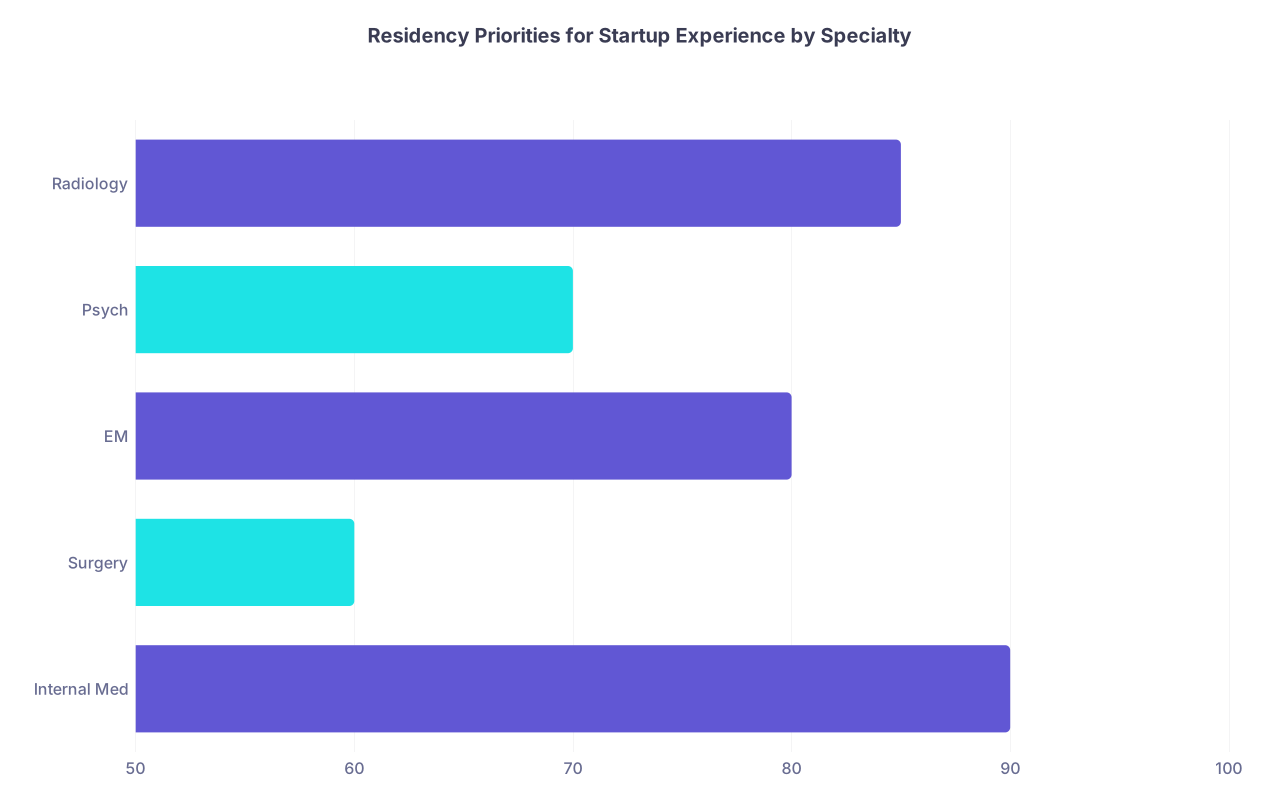
Different specialties value different aspects of a startup year. You should bias your framing accordingly.
| Category | Value |
|---|---|
| Internal Med | 90 |
| Surgery | 60 |
| EM | 80 |
| Psych | 70 |
| Radiology | 85 |
(Think of the numbers loosely as how much each specialty tends to value systems/QI/tech-aligned work, not precise data.)
10.1 Internal Medicine / Family Medicine / Pediatrics
High-yield focus:
- Chronic disease management tools
- Clinic flow optimization
- Readmission reduction
- Population health dashboards
- Telemedicine workflows
You want to sound like someone who will improve clinic efficiency and patient outcomes, not just build shiny apps.
10.2 Emergency Medicine
Focus on:
- Triage, throughput, and ED length of stay
- Risk stratification tools
- Communication handoffs (ED to floor)
- Safety metrics (missed sepsis, return visits)
They like people who understand operational chaos and how to bring order with data and systems.
10.3 Surgery and Surgical Subspecialties
Honestly, some surgical PDs are skeptical of “startup” anything unless it is deeply tied to:
- OR efficiency and block time optimization
- Surgical checklists and safety outcomes
- Device development with tangible improvements
You must show that you are not trying to be half-surgeon, half-CEO. They want full commitment.
10.4 Radiology / Pathology / Anesthesiology
Your startup experience might actually be a big plus if:
- You worked on imaging analytics, workflow triage, decision support.
- You can talk coherently about algorithm bias, validation, generalizability.
- You mesh with their increasing attention to AI and automation.
But again: emphasize that you intend to be the physician who understands and safely uses these tools, not someone who is going to leave for Silicon Valley mid-residency.
11. Common Failure Patterns—and How to Fix Them
Let me call out the patterns I have seen that tank otherwise strong applications:
11.1 The “Vague Founder”
ERAS entry: “Co-Founder, Stealth Health Startup”
Description: “Worked on innovative AI solutions to improve patient care, led a dynamic team, pitched to investors.”
No metrics. No clinical details. No physician mentor. This triggers every red flag.
Fix: Retroactively define clear projects. Dig up usage stats, pilot numbers, pre/post data. Rebuild the ERAS entry around outcomes, not buzzwords.
11.2 The “Abandoned Medicine” Vibe
You stopped all clinical exposure for 1–2 years. No clinical letters in that window. Your personal statement reads like an escape narrative from clinical work into “systems-level impact.”
Fix: Re-establish clinical links fast. Volunteer, shadow, join QI committees. Get at least one recent, clinically grounded letter. Rewrite your narrative so medicine is the core, not a stepping stone.
11.3 The “I Want to Do a Part-Time Residency” Signal
You mention wanting to keep “significant time” for your company in your personal statement or interviews. You ask about moonlighting for your startup in Q&A. You brag about turning down other training offers to keep working on your product.
Fix: Do not do this. You can absolutely keep the company alive, but your public stance to programs must be crystal clear: full-time residency is your priority. Any startup work is strictly secondary and flexible.
12. A Simple Framework to Audit Your Startup Year Before ERAS
Use this checklist and be ruthless. If you cannot check most of these boxes, you have work to do.

| Step | Description |
|---|---|
| Step 1 | Startup Gap Year |
| Step 2 | Add clinic/QI/volunteer role |
| Step 3 | Define pilot & track metrics |
| Step 4 | Turn results into abstract/poster |
| Step 5 | Engage faculty mentor now |
| Step 6 | Package for ERAS & Interviews |
| Step 7 | Clinical Anchor? |
| Step 8 | Measurable Project? |
| Step 9 | Academic Output? |
| Step 10 | Strong Mentor Letter? |
By the time you submit ERAS, you should be able to say:
- Yes, I maintained or re-established real clinical contact.
- Yes, I can name at least 2–3 projects with clear, numeric outcomes.
- Yes, I have at least one academic product from this work.
- Yes, a respected clinician can vouch for my commitment and performance.
If you cannot honestly say that, do not sugarcoat the gap year. Fix the gaps before applications go out.
13. A Sample “Before and After” ERAS Experience Entry
To make this painfully concrete:
Before (what I actually see too often):
Co-Founder, CareConnect Health
- Worked on AI tools to improve patient care
- Led a small team of developers and designers
- Pitched to investors and incubators
After (what you should aim for):
Co-Founder, CareConnect Health (Digital Health Startup)
- Co-led design and implementation of a text-message follow-up system for ED discharges at [Hospital], enrolling 186 adult patients with asthma and COPD.
- Reduced 30-day ED revisits from 19.4% to 12.1% over 6 months through structured follow-up prompts and symptom check-ins.
- Collaborated with the Department of Emergency Medicine’s QI team to integrate the workflow into resident discharge templates; results presented as first-author poster at [Conference].
- Managed a cross-disciplinary team (2 engineers, 1 designer, 2 residents) using weekly sprint cycles and defined success metrics (engagement rate, revisit rate, follow-up completion).
Completely different signal. One sounds like a pitch deck. The other sounds like a serious trainee who understands QI, systems, and data.
14. How to Keep the Startup Alive Without Hurting Your Match
You do not actually need to kill your company. You just need to orchestrate it so it does not compete with your identity as a future resident.
Practical strategies:
- Shift yourself out of day-to-day operations into advisory or clinical oversight role.
- Bring in a non-physician co-founder or manager as operational lead.
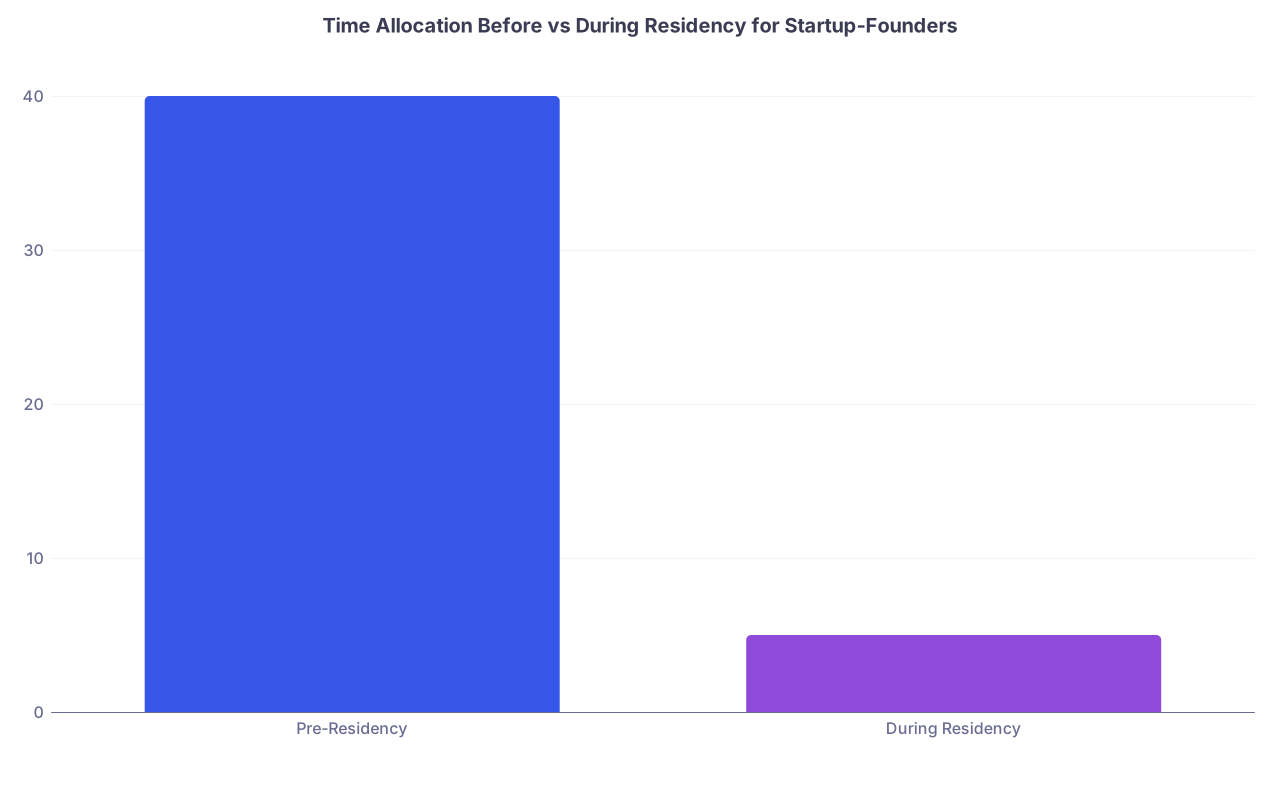
- Set a clear “residency mode” plan with your team: limited hours, defined tasks, flexible deadlines.
- Publicly (to programs and your mentors) commit to completing residency no matter what happens with the startup.
| Category | Value |
|---|---|
| Pre-Residency | 40 |
| During Residency | 5 |
The message is simple: full-time physician, very part-time founder.
15. If You Are Early and Still Deciding on a Startup Gap Year
If you have not taken the year yet, you have more leverage.
My advice if you are considering it:
Tie the startup to an existing academic structure:
- Innovation fellowship
- QI fellowship
- Health systems research lab
Secure a formal title at a hospital or university (Research Fellow, Innovation Scholar, QI Associate) even if you are mostly working on your startup. It gives you institutional legitimacy and easier access to data, IRB, and letters.
Design from day one for measurable outcomes:
- Pre/post design or controlled cohort for any clinical intervention.
- Defined KPIs you will track monthly.
- Planned abstract submission deadlines 6–9 months into the year.
This is how you ensure your gap year does not become a black box of “I was busy, trust me.”
Key Takeaways
- A startup gap year only helps your residency application if you convert it into measurable, clinically relevant outcomes: QI-style metrics, academic output, and clear leadership roles.
- You must aggressively address PD concerns about clinical readiness and commitment by maintaining clinical anchors, securing strong clinician letters, and clearly prioritizing residency over startup growth.
- In ERAS, your personal statement, and interviews, ditch the vague innovation narrative and instead present your year like a structured research/QI fellowship with specific numbers, projects, and lessons directly tied to how you will function as a resident.


