

The way most applicants handle gap year research output is strategically weak. They sit on data, wait for journals, and then complain when the publication status line on ERAS still says “submitted” in February.
You can do much better than that.
The real move in a research-heavy gap year is to weaponize preprints and institutional repositories so that, by the time programs read your application, you do not just promise productivity—you can show it, with time-stamped, citable work that looks like you actually finished something.
Let me break this down specifically.
Why Preprints Matter in a Gap Year (And When They Backfire)
Forget abstract enthusiasm for “open science.” You are using preprints and repositories for three concrete reasons:
- To create visible, verifiable research output before ERAS opens.
- To make your work easily accessible to program directors (PDs) and letter writers.
- To protect your contribution priority when your lab is slow or political.
However, you can also hurt yourself with sloppy, premature, or obviously low-quality preprints. The difference between strategic and desperate is in the timing, venue, and presentation.
How PDs actually look at research in a gap year
Here’s what happens on the other side of the screen.
On a busy PD or associate PD’s desk, your research output is mentally sorted into four rough tiers:
Published in solid, recognizable journals
Not necessarily NEJM. Think Journal of Hospital Medicine, Radiology, Annals of Emergency Medicine, JAMA Network Open. Real, peer‑reviewed, PubMed‑indexed.In press / accepted with documentation
The letter says “accepted,” the CV says “in press,” maybe a DOI is visible, maybe an early view is online.Preprints, institutional repository items, or fully written but under review
There is a real manuscript. There are figures. The work is coherent and findable.Vague “in preparation,” “submitted,” or “manuscript in progress” lines
This is background noise. Everyone knows 50% of these never see daylight.
Your job during a gap year is to move as many projects as possible from tier 4 to tier 3 or higher before ERAS submission. Preprints and repositories are exactly how you do that when journals move slowly—if you use them correctly.
Choosing the Right Preprint Server: Signal vs Noise
You do not throw your manuscript at the first server you see. Preprint platforms vary in how they are perceived and how often PDs or faculty actually use them.
Here is the rough landscape for clinical and translational work:
| Platform | Best For | Visibility in Medicine | Screening Rigor |
|---|---|---|---|
| medRxiv | Clinical / translational work | High | Moderate (screen) |
| bioRxiv | Basic/translational bioscience | High in academia | Moderate |
| arXiv (q-bio) | Quant/bioinformatics/ML in med | High in quant fields | Light |
| SSRN | Health policy, econ, education | Moderate | Light |
| Institutional repo | Theses, local projects | Variable | Variable |
medRxiv vs “random server your PI found once”
If your work is clinical, medRxiv is the default. It has:
- Name recognition among academic clinicians.
- Basic screening (ethics, trial registration, removal of overt nonsense).
- A standard citation format PDs understand.
bioRxiv is appropriate for bench or heavily mechanistic translational projects—even if they are “medical” but not really about patient-level data.
arXiv is reasonable for imaging AI, signal processing, or heavy statistics projects. If you are doing deep learning for chest CT triage, PDs in radiology, neurology, EM, and pulm/critical care will not find arXiv weird at all.
If your program or university has a formal institutional repository (many do—DASH at Harvard, Deep Blue at Michigan, etc.), it is absolutely acceptable for:
- Quality improvement (QI) projects that are deeply contextual and unlikely to be published.
- Capstone or thesis-style works.
- Detailed technical appendices, protocols, or data dictionaries attached to a main preprint or paper.
The “random server” category—obscure, not widely used, minimal screening—is where you lose credibility. If your work is strong enough to show, it is strong enough for a serious platform.
Timing: When in the Gap Year You Should Preprint
Your calendar is not their calendar. ERAS, fellowship match, and ranking deadlines are fixed. Journal timelines are not. You have to align your research pipeline with the match calendar, not with the abstract idea of “final publication.”
Let me lay out a simple, aggressive timeline for a one‑year research gap between graduation and application.
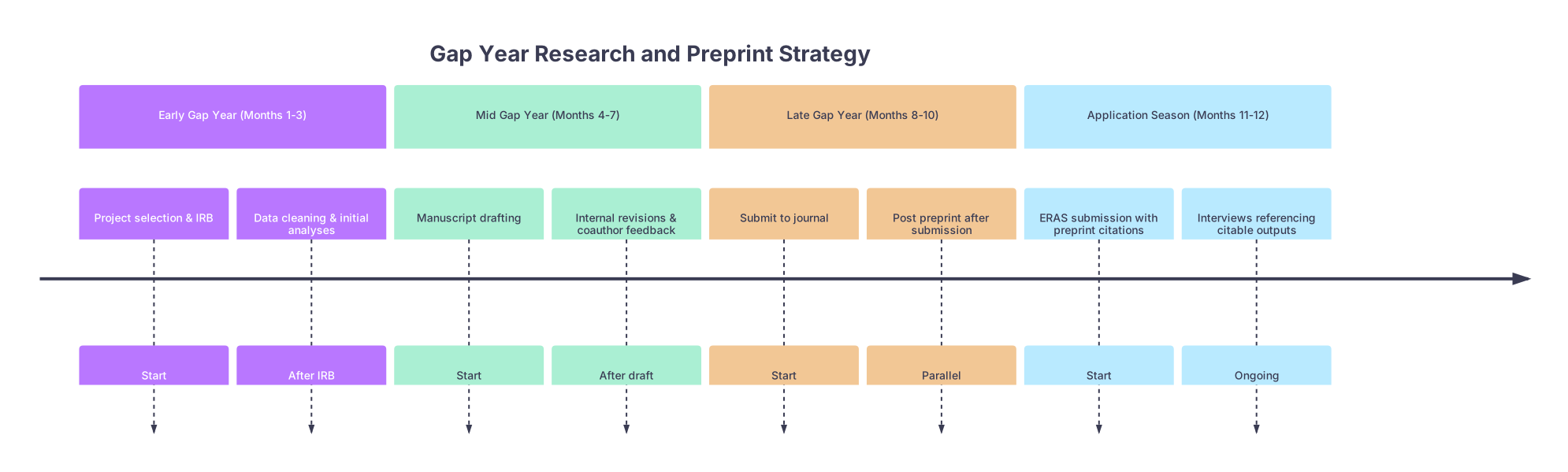
| Period | Event |
|---|---|
| Early Gap Year (Months 1-3) - Project selection & IRB | Start |
| Early Gap Year (Months 1-3) - Data cleaning & initial analyses | After IRB |
| Mid Gap Year (Months 4-7) - Manuscript drafting | Start |
| Mid Gap Year (Months 4-7) - Internal revisions & coauthor feedback | After draft |
| Late Gap Year (Months 8-10) - Submit to journal | Start |
| Late Gap Year (Months 8-10) - Post preprint after submission | Parallel |
| Application Season (Months 11-12) - ERAS submission with preprint citations | Start |
| Application Season (Months 11-12) - Interviews referencing citable outputs | Ongoing |
Key rules:
- Do not preprint garbage just to have more lines on your CV in July. A half-baked preprint reads worse than “manuscript in progress.”
- Do have at least one fully drafted manuscript by month 5–6 of your gap year. That gives you time for coauthor edits, journal submission, and then a preprint.
The minimally acceptable state for a preprint:
- Completed introduction, methods, results, and discussion.
- Clean figures and tables that do not scream “draft.”
- Coauthors have reviewed or at least are aware and consent to public posting.
- IRB and ethical considerations are fully cleared.
Strategic move: submit to a journal and then post the revised manuscript as a preprint with the journal “under review at [journal name]” clearly indicated. That signals seriousness and avoids most journal‑conflict drama.
How Journals and Programs Actually View Preprints
There is a lot of superstition here, usually from people who have never actually been senior author or served on an editorial board.
Journals: the real (not mythical) risks
For mainstream medical journals in 2024+:
- Most major publishers (NEJM Group, The Lancet, JAMA, BMJ, Nature, Elsevier) explicitly allow prior preprint posting.
- Many encourage or integrate with medRxiv/bioRxiv.
The exceptions:
- A minority of niche, legacy, or low‑tier journals may still frown on preprints.
- Some clinical trial journals require registered trials and specific disclosures; they may want the preprint to match the protocol very closely.
- Duplicate submission and data fragmentation (splitting one dataset into three weak papers) is what gets you into trouble, not the mere existence of a preprint.
Bottom line: in serious academic environments, well-executed preprints are not a red flag. They are increasingly part of the workflow.
PDs and selection committees
What PDs care about, especially for research-heavy specialties (derm, rad onc, ortho, neurosurgery, some IM subspecialties):
- Can you complete projects?
- Do you understand the research process?
- Did you produce something coherent, not just “assisted with data collection”?
A medRxiv preprint with:
- Clear first‑author status.
- A reasonable, clinically relevant question.
- Clean methods.
- A link that opens to a real paper, not a PDF draft with “TRACK CHANGES” on every page.
…does more for you than three “manuscripts in preparation” lines.
Some PDs will not know medRxiv from Dropbox. That is fine. You are still coming across as the person who got things done, with citable, time‑stamped work.
Using Institutional Repositories: The Underused Power Tool
Everyone talks about medRxiv. Far fewer gap-year applicants use their institutional repository strategically.
These repositories are typically run by the medical school or university library. They give you:
- Stable URLs and DOIs for:
- QI projects.
- Education curricula.
- Detailed protocols.
- Data dictionaries and appendices.
- A citable home for work that is important but not necessarily “journal article” material.
This matters because a lot of gap-year work never fits neatly into a standard “original research article” format. For example:
- You rebuild the hospital’s sepsis order set and implement a new pathway with dramatic process‑of‑care improvements.
- You create a full 8‑week ultrasound curriculum for interns with videos, cases, and assessments.
- You perform a multi-site chart review whose granular protocol is the true intellectual heavy lifting.
You can:
- Publish the main outcomes paper in a journal.
- Deposit:
- Full protocol.
- Educational materials.
- Extended tables and code. in your institutional repository, each with a separate DOI.
On your CV and ERAS:
- Journal article: listed under “Peer‑Reviewed Articles.”
- Repository items: listed under “Other Articles / Posters / Presentations,” with clear notation: “Institutional Repository Publication (peer reviewed internally by department education committee)” when accurate.
That creates layers of output from one project. PDs see both the polished front‑stage and the serious behind‑the‑scenes work.
How to Present Preprints and Repositories on ERAS and Your CV
This is where many applicants quietly torpedo themselves. They either hide preprints (wasted value) or present them so sloppily that they look unserious.
You are aiming for three things:
- Transparency.
- Standardized formatting.
- Immediate accessibility.
Formatting entries
For a first‑author medRxiv preprint:
Smith AB, Lee C, Nguyen D, et al. Early mobilization after ICU admission and hospital length of stay: a retrospective cohort study. medRxiv. Preprint posted June 2025. doi:10.1101/2025.06.15.123456.
On ERAS:
- Category: “Peer Reviewed Journal Article/Abstract (other than published).”
- Status: “Submitted” or “Preprint” depending on how your school instructs you, but be consistent.
- In the description/comments:
“Preprint available at: https://doi.org/10.1101/2025.06.15.123456. Under review at [Journal Name].”
For institutional repository items:
Smith AB, Patel R, Johnson L. Implementation protocol for a resident-led sepsis early-warning system. [Institution Name] Institutional Repository. Published August 2025. Available at: [stable URL].
Category can be “Other Articles” or “Other than Published”, depending on structure, but you should clearly label:
- “Institutional repository publication; internally reviewed.”
Do not, under any circumstance, pretend a preprint is a peer‑reviewed publication. That is the fastest way to trigger skepticism in any faculty who actually clicks the link.
Ordering and clustering
Where do preprints go on a CV?
- In the same section as journal publications, but:
- Group peer‑reviewed, PubMed‑indexed publications first.
- Then “Accepted / In Press.”
- Then “Preprints.”
- Never mix “published in JAMA” and “medRxiv preprint” randomly. The hierarchy should be obvious at a glance.
Quality Control: When Not to Preprint
You should not preprint:
- Half‑baked analyses that change dramatically with each re‑run.
- Questionable methods that your PI or mentor is not willing to stand behind in public.
- Anything with unresolved IRB/ethics issues.
- Sensitive topics (e.g., controversial health policy changes, politically explosive data) that your institution wants carefully handled.
If a senior author tells you, “I am not comfortable posting this as a preprint yet,” do not fight that. Ask instead:
- “What revisions or additional data would make this preprint‑ready?”
- “Can we at least post the protocol or a limited methods document in the institutional repository for now?”
The worst look: a preprint that is clearly wrong, then withdrawn, then still floating around your CV when you apply. You would be better off with “manuscript in preparation.”
Coordinating Preprints with Your PI, Coauthors, and IRB
Gap‑year applicants often forget a simple fact: you do not own the project. You are part of a team.
Preprinting without buy‑in is how you permanently damage relationships and lose mentors and letters.
The proper sequence:
- Draft the manuscript to a solid version.
- Circulate to all coauthors with a deadline for feedback.
- Incorporate reasonable edits, document disagreements.
- Have an explicit conversation with the senior/corresponding author:
- “I would like to submit this to [Journal X] and post it as a preprint on [medRxiv/bioRxiv]. Are you comfortable with that?”
- Confirm that:
- The IRB permits dissemination at this stage.
- Any sensitive elements are appropriately de‑identified.
Document the plan via email. That way, if a question arises later (“Who decided to post this?”), you are not alone.
Maximizing Visibility: Make Your Work Easy to Find and Use
A preprint or repository item that no one can find is marginally better than “manuscript in preparation,” but not by much. You want PDs and faculty to be able to click once and see exactly what you did.
Basic checklist:
- ORCID ID linked to medRxiv/bioRxiv where possible.
- Your name consistent across all outputs (no switching between “Alex B. Smith” and “Alexander Brandon Smith” randomly).
- A simple personal or lab webpage (or LinkedIn if done carefully) that:
- Lists your publications, preprints, and repository items.
- Includes live links.
- PDF copies saved cleanly: final preprint PDF, no tracked changes, with figures readable.
During interviews, if someone asks, “Can you tell me about your research?” you should be able to say:
- “Yes, I have a first‑author medRxiv preprint on early mobilization in the ICU; it is under review at Critical Care Medicine. The link is on my CV, but the short version is…”
No fumbling. No vague titles that you cannot explain.
Specialty‑Specific Nuances
Reality: the value of preprints and repositories is specialty‑dependent.
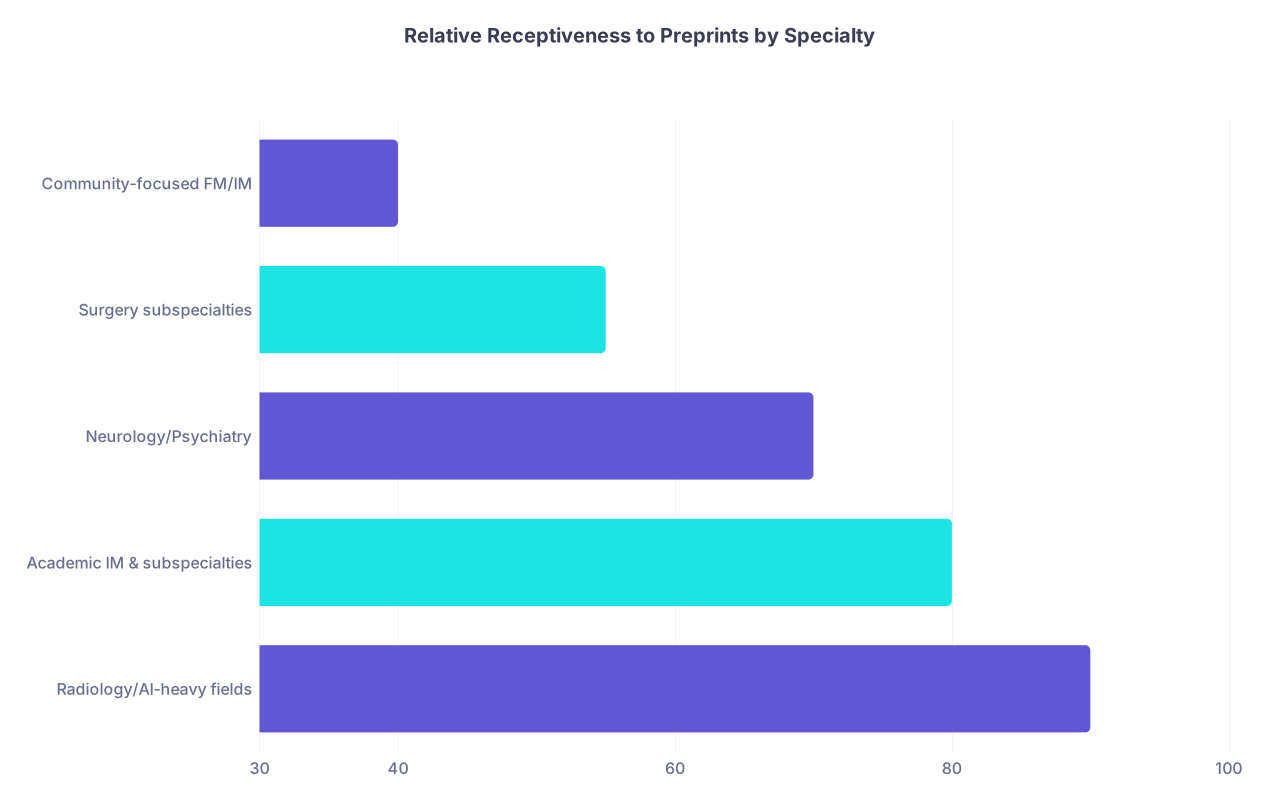
| Category | Value |
|---|---|
| Radiology/AI-heavy fields | 90 |
| Academic IM & subspecialties | 80 |
| Neurology/Psychiatry | 70 |
| Surgery subspecialties | 55 |
| Community-focused FM/IM | 40 |
This is not gospel, but a rough observation.
- Radiology, onc, AI‑heavy IM: Very comfortable with arXiv, medRxiv; preprints are normalized.
- Academic internal medicine, cards, pulm/crit, ID: Preprints welcome, particularly if the work is solid.
- Neurology/psychiatry: Mixed but improving; senior folks may be less familiar, younger faculty more open.
- Surgical subspecialties: Variable. Strong academic departments are fine with preprints; some more traditional programs barely read them.
- Community-focused programs (FM, community IM): Care more about clinical performance and fit; preprints are neutral but can help if they show clear productivity.
If you are applying to extremely competitive, academic‑heavy fields (derm, ortho, neurosurgery), preprints can be particularly valuable, because the applicant pool is saturated with “submitted” and “in preparation” claims. A tangible, readable preprint stands out.
Advanced Strategy: Linking Preprints, Repositories, and Conference Output
This is where you stretch one project intelligently without looking like you are padding.
Ideal flow for a strong project during a gap year:
- Data collection and initial analysis.
- Submit abstract to a major conference (e.g., AHA, ATS, RSNA, ASCO depending on field).
- Build a conference poster or oral presentation.
- Finish the full manuscript.
- Submit manuscript to journal.
- Post manuscript as preprint (after journal submission).
- Deposit extended materials (protocol, educational materials, code) in institutional repository.
You now have, from one carefully executed project:
- 1–2 abstracts/posters.
- 1 preprint.
- 1 journal submission (possibly accepted before or during residency).
- 1+ repository items.
This is how your ERAS suddenly shows “5–7 substantial scholarly items” without you juggling 12 weak projects.
Common Mistakes I Keep Seeing (And How to Fix Them)
Let me be blunt about the recurring errors gap‑year applicants make.
Listing everything as “in preparation” because the PI is slow
Fix: volunteer to drive the manuscript to preprint‑ready status; propose a concrete preprint timeline.Preprinting low‑quality capstone projects that read like student assignments
Fix: preprint only what would be plausibly publishable. For smaller works, use the institutional repository and frame them as QI or educational deliverables.Mixing preprints with peer‑reviewed papers without clear labeling
Fix: separate sections or clear annotations “Preprint (not peer‑reviewed).”No URLs or DOIs on the CV
Fix: every preprint and repository item gets a clickable link or DOI in its citation.Inability to explain the work succinctly in interviews
Fix: for each preprint/repository item, write a 2–3 sentence elevator pitch and a 1‑minute “methods and impact” summary. Practice them.
A Quick Reality Check: How Much of This Is Actually Necessary?
If you are applying to:
- A community internal medicine program with modest research emphasis?
You do not need to orchestrate a preprint empire. One or two solid projects, even just accepted or high‑quality submitted manuscripts, are enough.
If you are aiming for:
- Top‑tier academic IM with research tracks.
- Rad onc, derm, ortho, neurosurgery, IR, or physician‑scientist pathways.
Then yes, the difference between “I worked in a lab” and “Here are three first‑author preprints and two repository protocols you can read right now” is non‑trivial.
Preprints and repositories will not rescue you from a weak application. But they will absolutely tilt the field in your favor when you are already in the competitive range and you need concrete proof that your gap year was not just “time off.”
Final Thoughts: What Actually Moves the Needle
Condensed down to the essentials:
- Use preprints and institutional repositories to convert “in preparation” into real, readable, citable work before ERAS opens.
- Choose platforms and timing strategically—medRxiv/bioRxiv/arXiv for formal manuscripts, institutional repositories for QI, educational projects, and protocols—and present them transparently on ERAS with clean, consistent formatting and links.


