42% of physicians who move into cash-pay or concierge models actually earn less in the first 2–3 years than they did as employed doctors.
So much for the fantasy of quitting your RVU job on Friday and swimming in cash-pay revenue by Monday.
Let’s be blunt: “Go cash-pay and you’ll get rich fast” has become the new “start a blog and quit your job.” There are physicians doing extremely well with direct pay, concierge, and boutique models. But the idea that this is the fastest or easiest path to high income? That’s mostly marketing, not math.
You want income, quickly. Not vibes. Not “autonomy someday.” So let’s look at what actually happens on the ground when physicians chase high income via cash-pay practices.
What The Income Data Actually Shows
Most of the data we have compares:
- Employed physicians
- Traditional insurance-based private practice
- Concierge / direct primary care (DPC) / other cash-pay variants
Here’s a simplified snapshot:
| Practice Type | Typical Range (Attending, Full-Time) |
|---|---|
| Employed primary care | $230k–$290k |
| Employed high-paying specialty | $450k–$900k+ |
| Traditional private practice (PCP) | $250k–$350k |
| Concierge/DPC (mature panel) | $300k–$500k+ |
| Cash-pay niche subspecialty | $500k–$1M+ (highly variable) |
Now compare that to the time it takes to get there.
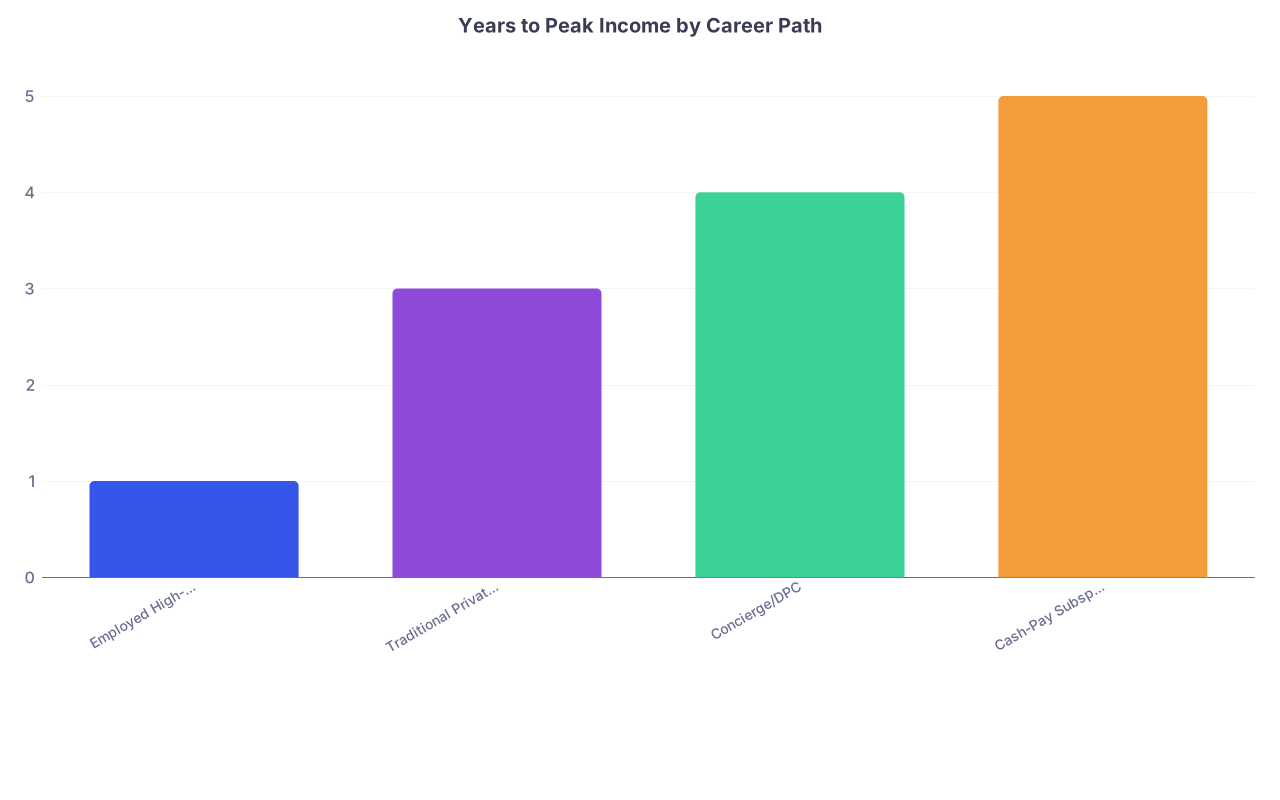
| Category | Value |
|---|---|
| Employed High-Pay Specialty | 1 |
| Traditional Private Practice | 3 |
| Concierge/DPC | 4 |
| Cash-Pay Subspecialty Startup | 5 |
The basic reality:
- If you match into a high-paying specialty (ortho, derm, radiology, GI, cards, etc.) and take an employed job, you can be at $500k+ within 1–2 years of finishing training.
- If you start a cash-pay practice from scratch, you typically spend 2–5 years just getting to a stable panel and predictable income.
So the very first myth: Cash-pay is not generally the fastest route to high income. High-paying specialty + employed job is.
Fastest != highest ceiling. Those are different questions.
The Seductive Myths Around Cash-Pay Practices
I hear the same lines from residents and young attendings:
- “If I go DPC, I’ll make $400k seeing 8–10 patients a day.”
- “Cash-pay aesthetics is easy money.”
- “Concierge means low stress, high pay, total control.”
A few of those can be true. But usually not all at the same time, and rarely fast.
Let’s pick apart the biggest myths.
Myth 1: “Cash-pay is automatically more profitable than insurance”
No. It can be. But the model is brutally sensitive to:
- Panel size
- Retention rate
- Overhead
- Local market wealth and competition
Take a simple DPC-style example:
- Monthly membership: $80
- Patient panel: 600 patients (solid panel for good access)
- Gross annual revenue: 600 × $80 × 12 = $576,000
Subtract:
- Staff (even lean: 1 MA/front desk): $45k–$60k
- Rent, utilities, malpractice, EHR, supplies: $80k–$120k
- Benefits for you (health, retirement, etc.): maybe $60k–$80k equivalent
You might land in the $300k–$380k pre-tax income range after a few years of growth. Very respectable. But that’s not wildly higher than a typical employed primary care job—and it likely took you 2–4 years to get there.
The trap? Many docs never reach 600 paying patients. I’ve seen multiple DPC clinics in mid-markets stuck at 250–350 patients after 3 years. Run the math on that same model with 300 patients and see what happens. You just built yourself a less stressful job that pays like a mid-career hospitalist. Nothing wrong with that—if it’s intentional. As a “fastest route to high income”? Not even close.
The Brutal Ramp-Up Curve Nobody Markets To You
What the success stories rarely mention: the ramp-up phase is financially ugly.
You go from:
- PGY-3 → employed: You’re cash-flow positive in your first real job. Stable salary, benefits, maybe a signing bonus.
Versus:
- PGY-3 → open cash-pay practice: You’re now a startup founder with medical license overhead.
Let’s visualize what actually happens.
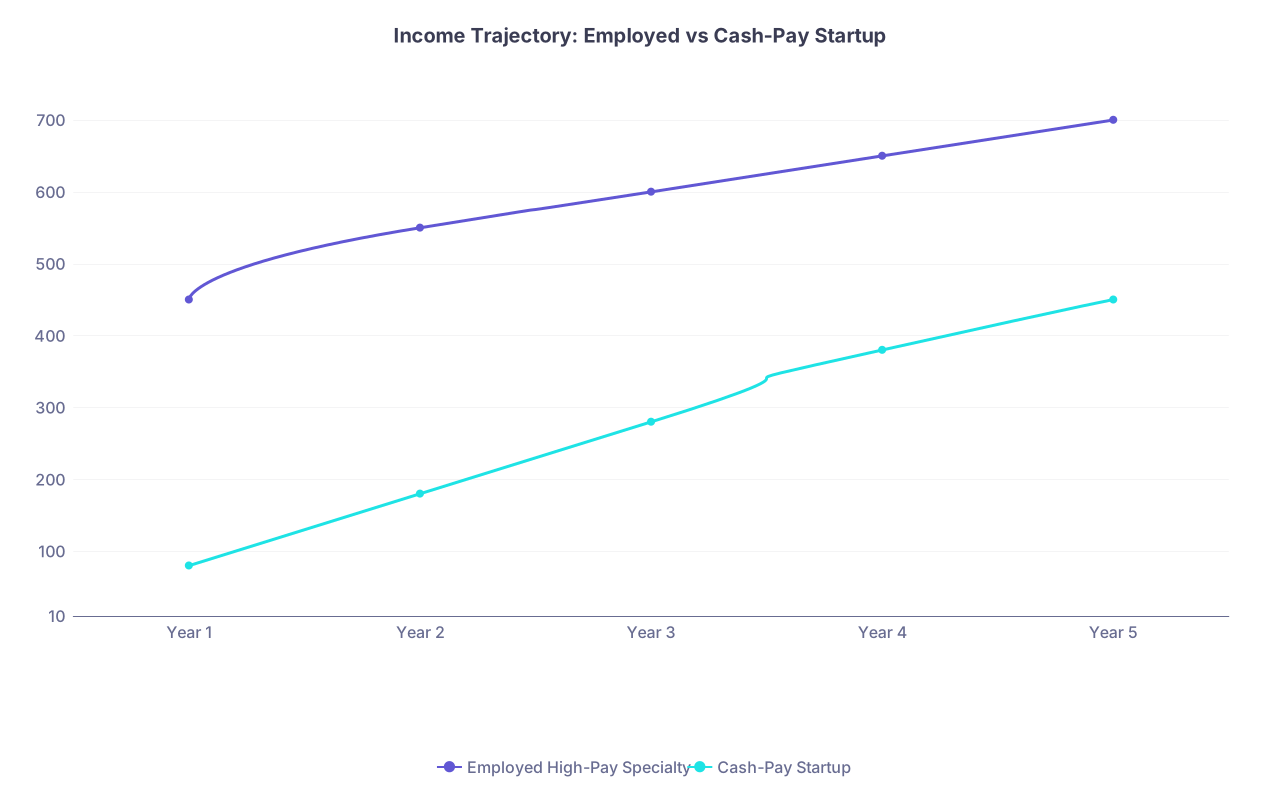
| Category | Employed High-Pay Specialty | Cash-Pay Startup |
|---|---|---|
| Year 1 | 450 | 80 |
| Year 2 | 550 | 180 |
| Year 3 | 600 | 280 |
| Year 4 | 650 | 380 |
| Year 5 | 700 | 450 |
Numbers are ballpark, obviously. But the shape is real:
- Employed high-paying specialty: big step-function jump right out of training, then modest growth.
- Cash-pay startup: slow, grinding climb from the red into something decent.
If you’re graduating with $300k+ in loans, maybe a spouse, maybe kids, maybe you like sleeping at night—this matters.
Specialty: The Elephant in the Room Everyone Ignores
The category here is “Highest Paid Specialties,” so let’s actually talk specialties, not Instagram fantasies.
Reality check by specialty
Here’s how cash-pay interacts with different fields.
| Specialty | Cash-Pay Leverage | Fastest Route to High Income? |
|---|---|---|
| Dermatology | Very high | Employed derm > then boutique |
| Plastic Surgery | Extremely high | Group/employed > then self-pay |
| PM&R/Pain | Moderate-high | Mix of interventional + cash |
| Psychiatry | Moderate | Private pay panels possible |
| Primary Care | Moderate | Employed now, DPC later |
| EM/Anesthesia | Low-moderate | Mostly facility/employed pay |
Blunt truth:
If your goal is high income fast, matching a top-paying specialty and taking a solid employed job is almost always a shorter path than building a cash-pay practice from zero in a lower-paying field.
You know what’s faster to $700k?
- PGY-5 ortho → hospital-employed or large group, RVU-based, busy service line
Not:
- PGY-3 FM → rent space → start DPC from scratch → learn marketing on YouTube.
Can a cash-pay derm or plastics clinic absolutely print money? Yes. But the doctors doing that typically:
- Matched into an already high-paying specialty
- Did fellowship and/or joined strong groups
- Built reputation and referral networks
- Then layered cash-pay (aesthetics, boutique surgery, concierge) on top
They didn’t shortcut the training or experience. They just captured more of the upside once they had leverage.
The Hidden Work: Business, Branding, and Bias
Another inconvenient truth: cash-pay income is not mostly about “clinical excellence.” It’s about demand.
You’re suddenly in a different game:
- Branding and positioning
- Patient acquisition cost
- Conversion and retention
- Online reviews and reputation
- Geography and demographics
And no, you are not exempt because “I’m a doctor.” Your patients now behave like customers. They compare, they price-shop, they google, they check Instagram.
For a resident who’s never:
- Run payroll
- Negotiated a commercial lease
- Tracked lead sources or customer acquisition cost
- Designed a website or handled Google Ads
…the leap into “I’ll just open a cash-pay clinic” is not a shortcut to income. It is a career change into physician-entrepreneur, with all the associated risk and delay in payoff.
I’ve watched:
- One FM doc open a beautiful DPC in a high-income suburb and sit at 150 patients three years in because they refused to market aggressively.
- A psych resident jump into private-pay telepsych and actually hit $350k+ in year one—but they worked 60 hours per week, evenings and weekends, no show protection, high burnout risk.
- A derm who joined an aesthetic-heavy group, learned the ropes, then spun out a boutique cosmetic practice and crossed $1M in collections within two years of going solo—after 7+ years of building a reputation under someone else’s umbrella.
Same label (cash-pay). Totally different risk, ramp, and context.
So What Is the Fastest Route to High Income?
If your priority is speed to a big paycheck, not entrepreneurship badges, here’s the unsexy answer:
Match a high-paying specialty.
Think ortho, neurosurg, plastics, GI, cardiology, radiology, anesthesia, EM, some subspecialty IM. Yes, lifestyle and personality fit matter. But from a pure income-speed lens, this is the big lever.Take a strong employed job straight out of training.
Group or hospital where you plug into existing volume. Typical pattern: sign-on bonus, RVU guarantee, relocation stipend, built-in referral base.Use that stable, high income to:
- Kill high-interest debt
- Build a real net worth cushion
- Learn about business with training wheels on (side hustles, moonlighting, equity opportunities)
Then decide whether to layer on cash-pay.
Once you’re not broke and terrified, you can rationally evaluate:- Cosmetic add-ons (aesthetics, boutique procedures)
- Concierge tiers for a subset of patients
- Hybrid models with membership + insurance
That sequence gets you “high income fast” and “optionality later” far more reliably than trying to have your first attending job also be your first startup.
The Role of Geography and Case Mix
You can’t talk about cash-pay without talking about zip codes.
High cash-pay success is strongly correlated with:
- High-income, high-density areas
- Patients with disposable income and out-of-network awareness
- A culture that tolerates (or prefers) private-pay for convenience and access
Contrast:
- DPC practice in an upper-middle-class suburb with tech workers and two-income households
- vs rural region with median income <$60k, high Medicaid penetration, and a hospital that controls most of the care patterns
The first can sustain $80–$120/month memberships without much friction. The second? You’re swimming upstream against math.
Same with cash-pay orthobiologics, concierge cardiology, direct-pay GI screening packages—your market matters more than your conviction.
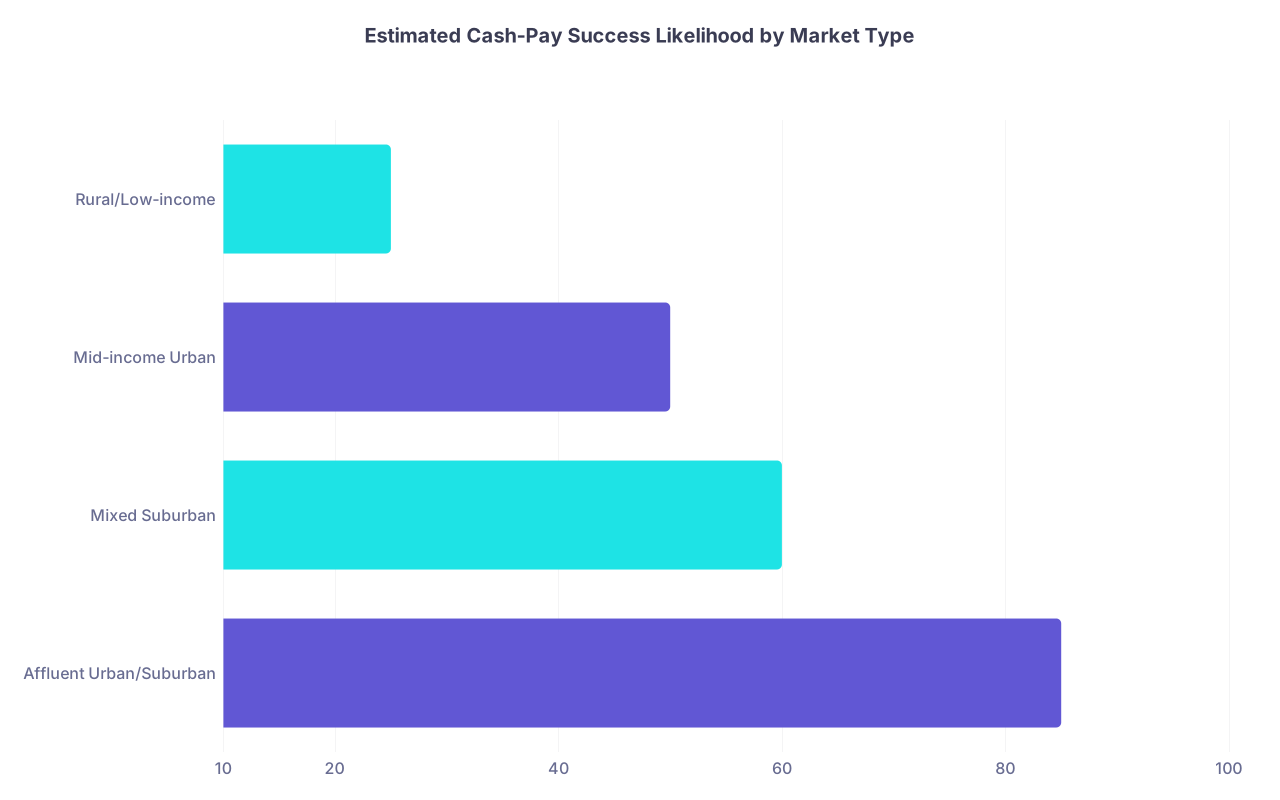
| Category | Value |
|---|---|
| Affluent Urban/Suburban | 85 |
| Mixed Suburban | 60 |
| Mid-income Urban | 50 |
| Rural/Low-income | 25 |
Those numbers are directional, but you get the point. If you ignore local economics, your “fastest route” becomes “most painful route.”
When Cash-Pay Does Make Sense (Even If It’s Not Fastest)
Let’s be fair. Cash-pay models are powerful when used intentionally.
They make sense when:
- You’re in a specialty where the insurance model is fundamentally broken for what you want to do (complex care, prevention, time-intensive visits).
- You care more about autonomy, longer visits, and meaningful relationships than about maximizing short-term income.
- You already have a panel or local reputation to convert from insurance-based care into membership/boutique care.
- Or you’re in a niche, high-demand cash-pay space (cosmetics, advanced imaging, boutique ortho, fertility) where the margins genuinely crush employed comp over time.
For a mid-career internist who’s done being chewed up by 15-minute visits, moving to DPC and “taking a pay cut” from $320k to $260k to reclaim sanity can be a huge win. Financially rational in a life sense.
But that’s a different question than: “How do I get to $600k as fast as possible?” Don’t mix up “best for your life” with “fastest for your bank account.”
The Real Myth: Confusing Control With Income
What a lot of cash-pay evangelists are actually selling is control:
- Control over schedule
- Control over patient volume
- Control over clinical decisions without prior auth hell
- Control over staff, culture, and clinic design
That’s valid. I’m all for doctors regaining control of their work environments.
But control and income are not the same axis. If you’re honest, your priority probably falls into one of these:
- “I want maximum income, quickly.”
- “I want a sane life, stable income, and some autonomy.”
- “I want to build something I own, even if it’s risky.”
Cash-pay practices fit the third bucket best. Sometimes the second. Rarely the first.
So if someone tells you, “Just start a cash-pay practice, it’s the fastest way to get rich,” they’re either:
- Trying to sell you something
- Or they’ve forgotten their own 3-year slog to break-even
Either way, you deserve better data.
Key Takeaways
- Cash-pay practices are not usually the fastest route to high physician income; matching a high-paying specialty and taking a strong employed job almost always beats it on speed.
- Cash-pay models can offer better control and sometimes higher eventual income, but they come with real startup risk, a slow ramp, and heavy dependence on market, specialty, and business skill.
- Use employed work in a high-paying or solid-paying specialty to stabilize your finances first—then, if you still want the autonomy and upside of cash-pay, build it from a position of strength, not desperation.