
The belief that you should “follow the money” to high cost-of-living (HCOL) cities is financially lazy thinking. For most physicians—even in the highest paid specialties—big-city headline salaries do not reliably beat out smaller or mid-market areas once you run the math honestly.
Let me be blunt: a $600k offer in Manhattan can be worse than a $450k offer in a mid-sized city you have never heard of. But recruiters, academic prestige, and social media flex culture have trained residents to look at the wrong number: gross salary instead of real, after-expenses life.
You are in the “specialty-specific residency insights” phase. This is exactly when people start making long-term financial mistakes they will feel for decades.
Let’s dismantle some myths.
Myth 1: “Big Cities Pay More, So You Come Out Ahead”
The core assumption is simple: HCOL = high pay = you win. Reality: the market does not care about your feelings on that.
Big HCOL metros—NYC, San Francisco, LA, Boston, Seattle, DC—often underpay relative to your specialty’s national earning potential, especially in the highest paid fields like:
- Orthopedic surgery
- Neurosurgery
- Cardiothoracic surgery
- Interventional cardiology
- GI with advanced endoscopy
- Dermatology with cosmetics
- Radiology (private practice, high-RVU setups)
- Anesthesia (independent groups, not academic)
Why? Because these markets are saturated with people willing to accept less: dual-physician couples, academic climbers, people with family ties, or those who will trade money for lifestyle or prestige.
At the same time, housing is punitive, taxes are higher, and everything from daycare to parking bleeds cash.
To make this less abstract, let’s look at a simplified comparison.
| Scenario | City Type | Base Salary | Effective State+Local Tax* | Typical Rent/Mortgage | Net After Tax & Housing |
|---|---|---|---|---|---|
| A | NYC Metro | $600,000 | ~11% extra vs no-tax state | $6,000/month | ~$300–320k |
| B | Mid-size No-Tax State (e.g., Tennessee, Texas) | $450,000 | No state income tax | $2,500/month | ~$290–310k |
| C | Smaller City High-Pay Market | $550,000 | Low tax | $2,000/month | ~$360–380k |
*Effective state+local tax here is ballpark and depends heavily on exact city, deductions, and filing status. The point is direction, not precision.
Look at C. Lower sticker salary than A, but way more spendable money. And even B is competitive with A despite a $150k lower nominal salary.
People obsess over the $600k and conveniently ignore that they are handing a huge chunk to their landlord and their state.
Myth 2: “After Residency, A Big Salary Will Crush My Loans”
This one is emotionally attractive but financially sloppy.
Residents in high-paying specialties often tell me some version of: “Yeah, the Bay Area is expensive, but once I’m making $700k, I’ll just pay off my $400k loans in a few years regardless.”
Reality check: high cost-of-living silently eats the exact dollars you think are going toward debt.
Let’s run a very stripped-down example for, say, an interventional cardiologist finishing fellowship.
Assume:
- Federal + state + payroll effective tax: ~40% in HCOL vs ~32% in low-tax, lower COL
- Aggressive but realistic loan payoff goal: $80k/year
- Same specialty, two markets:
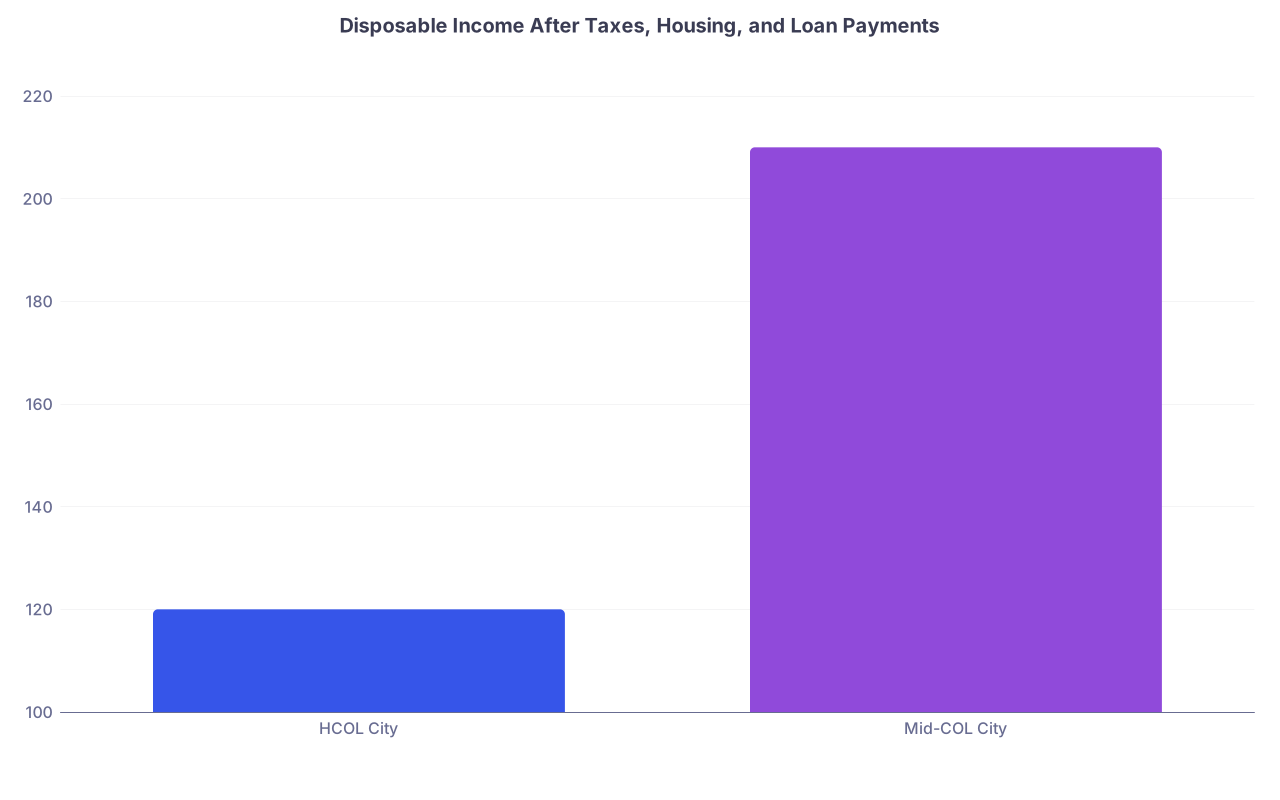
| Category | Value |
|---|---|
| HCOL City | 120 |
| Mid-COL City | 210 |
Interpretation (numbers approximated yearly, in thousands):
HCOL city:
- Salary: $650k
- Taxes (~40%): -$260k
- Housing: -$70k
- Loans: -$80k
- Left: ~$240k
- Now subtract child care, commuting, higher food and services, etc., and you are easily down near $120–150k real flexibility.
Mid-COL city:
- Salary: $500k
- Taxes (~32%): -$160k
- Housing: -$30k
- Loans: -$80k
- Left: ~$230k
- Much less erosion from daily costs, so maybe ~$200k+ true flexibility.
Same loan payment. Similar “headline” disposable income. But the mid-COL doc is not burning money on rent and overhead just to exist.
Myth 3: “Academic Hubs in HCOL Cities Are the Smart Long-Term Play”
This is where prestige poisons rational decision-making.
You hear: “But this is [insert big-name academic center] in Boston/NYC/SF. Long term, it’ll open doors, so I can accept lower pay.”
Sometimes that’s true—if you’re deeply committed to:
- NIH-funded research careers
- Very niche subspecialization
- Leadership tracks that require institutional branding
But many residents say that to justify a choice driven by city preference, social life, or sunk-cost ego around training. Then 7–10 years later, they are mid-career, underpaid, taxed hard, and locked into a lifestyle that requires two high incomes just to tread water.
You want honest long-term upside? In high-paid specialties, the leverage usually comes from:
- Partnership in a strong private group
- Ownership stake in surgery centers/imaging centers
- Control over schedule, call, and RVU generation
- The ability to move or negotiate if things change
Those are often easier to obtain—and more lucrative—in smaller markets where you are not the 89th orthopod or 120th anesthesiologist competing for OR time.
Myth 4: “I’ll Just Live Frugally in a Big City and Win Both Ways”
I’ve heard this in resident lounges more times than I can count. “We’ll just get a small place, no car, keep expenses low. Then the big salary in a big city is a no-brainer.”
Here’s what actually happens to most people:
- They finish training exhausted and feel like they “deserve” a better apartment.
- They have kids and suddenly need a second bedroom, then a third.
- Daycare costs $2,500–$3,500 per kid per month in urban cores.
- Friends and colleagues normalize expensive restaurants, private schools, nannies, travel.
Lifestyle creep in HCOL cities is not a bug. It’s the entire operating system.
Could you be the rare attending who stays in a 1-bedroom, bikes everywhere, and maintains a resident-level lifestyle for 5–7 years? Yes. I’ve met those people. Maybe 1 in 20 actually stick with it.
The majority eventually drift into:
“We have to live near good schools.”
“We have to have help with the kids.”
“We have to be within 25 minutes of the hospital.”
Each “have to” is a $10–30k/year decision compounded over decades.
Myth 5: Highest Paid Specialties Always Win in HCOL Markets
Even within the highest paid specialties, the spread between HCOL academic/mega-system jobs and non-HCOL, higher leverage jobs is brutal.
Typical pattern I’ve seen:
-
- Big-name coastal academic center in HCOL city: $450–600k, heavy call, big RVU thresholds, complex politics, minimal ownership upside.
- High-demand community group in mid-market or smaller city: $700k–$1M+ at partnership, equity in ASCs, control over schedule.
-
- HCOL coastal hospital system: $550–700k with RVU cliff and aggressive call.
- Southern/Midwestern regional system: $800–1.1M with better call distribution and earlier path to partnership.
Radiologist (private practice):
- Coastal HCOL: $450–550k as employee; partnership track uncertain or diluted.
- Non-HCOL strong group: $650–900k at partnership, sometimes more with telerad overnight and subspecialty work.
So yes, you’re in a “highest paid” specialty. That does not immunize you from geographic arbitrage. If anything, it magnifies it. The difference between $500k and $900k, compounded with lower cost of living and lower taxes, is the difference between “comfortably upper-middle-class attending” and “financial independence 10–15 years sooner.”
What the Data and Trends Actually Show
Hard numbers are messy because every market, system, and contract is different. But we can outline the structural forces that consistently shape outcomes.
Supply and demand is local, not national.
High prestige cities attract more trainees and early attendings. More supply = more bargaining power for employers = lower pay relative to your specialty’s earning potential.Taxes amplify HCOL pain.
High-income states with big cities (CA, NY, NJ, MA) often combine:- Higher state income tax
- Local city/county taxes
- High property taxes if you buy
Compare that to Texas, Florida, Tennessee, Nevada, etc. You do not just save on rent—you keep a higher fraction of every extra RVU you grind out.
Housing is not just rent vs mortgage—it’s leverage and risk.
A $1.5–2M starter home in a coastal city with high property taxes is a very different risk profile than a $600k house in a growing mid-sized city. Your PITI, your stress, and your margin for error are radically different.Spending patterns follow your peer group.
I’ve watched this play out in real time.
HCOL academic attendings: ski trips, private school pressures, expensive childcare, high-status neighborhoods.
Mid-COL high-earning private attendings: bigger homes, yes, but far lower recurring overhead and way more free cash flow to invest.
Reality Check: What Actually Matters When You Choose Where to Practice
Here’s where I’m going to sound annoyingly practical.
Stop fixating on the headline salary and the brand name. Start with:
- What fraction of your income will be taxed?
- What will decent housing actually cost per month, not on Zillow fantasy mode?
- What does childcare cost if you plan to have kids?
- Is there a path to partnership, equity, or real control—or are you just a replaceable RVU machine?
- How many other people in your specialty are lined up behind you for the same job in that city?
Let me map out a simple mental flow I wish more residents actually used:

| Step | Description |
|---|---|
| Step 1 | Identify Offers |
| Step 2 | Compare After Tax Income |
| Step 3 | Estimate Housing Cost |
| Step 4 | Estimate Childcare and Major Expenses |
| Step 5 | Calculate True Free Cash Flow |
| Step 6 | Favor Mid or Low COL with Upside |
| Step 7 | Consider Lifestyle and Family Ties |
| Step 8 | Accept HCOL Offer |
| Step 9 | Is High COL Offer Clearly Better? |
| Step 10 | Still Worth It After Tradeoffs? |
If you run this honestly, a surprising number of HCOL “dream jobs” turn into “oh, this is a lifestyle flex, not a financial win.”
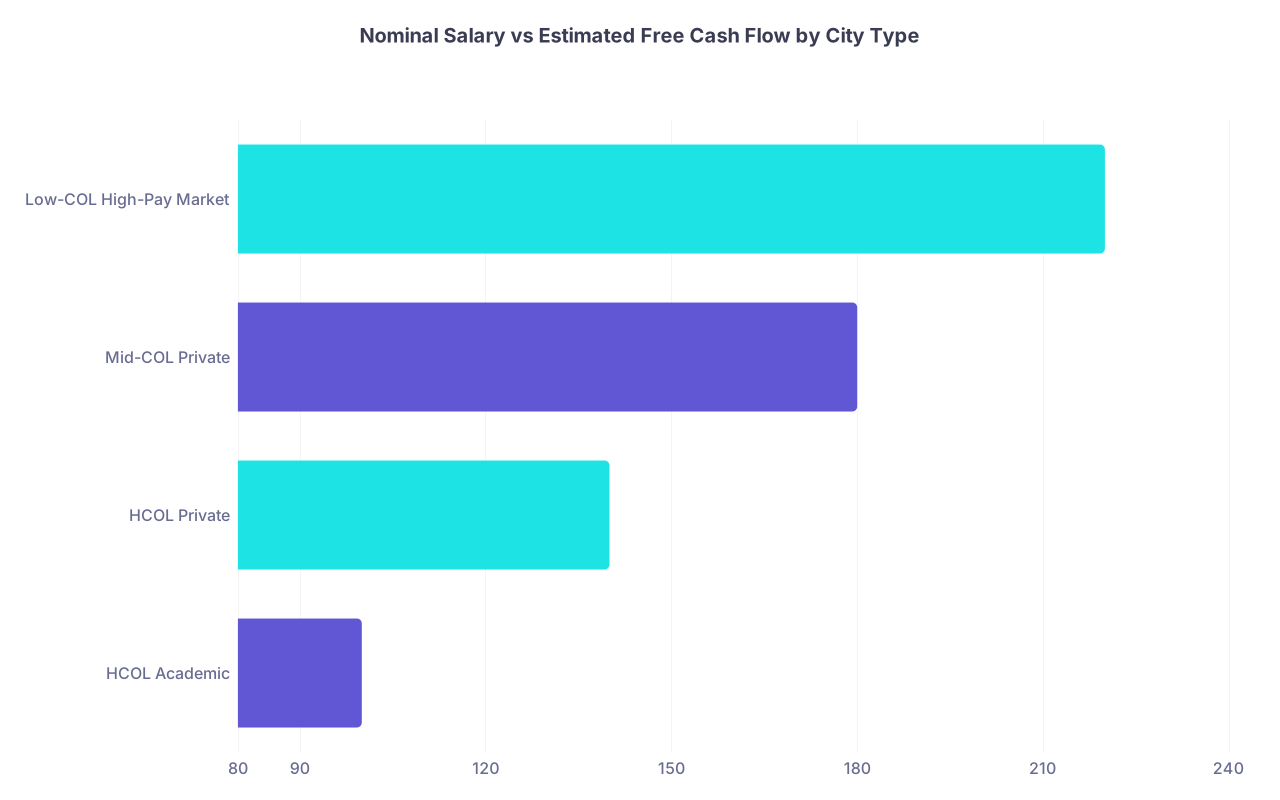
A Quick Visual: Salary vs Cost-of-Living Impact
Let’s compress the concept into one picture. This is stylized but directionally accurate for many high-paid specialties at attending level:
| Category | Value |
|---|---|
| HCOL Academic | 100 |
| HCOL Private | 140 |
| Mid-COL Private | 180 |
| Low-COL High-Pay Market | 220 |
Think of those numbers as “thousands of dollars of realistically investable or discretionary money per year” after taxes, typical housing, and baseline living expenses, not gross income. Notice who quietly wins.
So… Should You Ever Choose an HCOL City?
Sometimes, yes. I’m not telling you to exile yourself to a cornfield you hate just to chase an extra $50k.
It can make sense to choose HCOL if:
- You have strong family or support systems there that genuinely improve your quality of life.
- Your career path is uniquely tied to that institution or region (certain niche academic or research tracks).
- Your partner’s income is location-sensitive and substantially offsets the downside.
- You have the discipline and personality to live “below the city” financially—cheaper neighborhood, modest housing, no status games.
But be honest with yourself. If the real reason is, “I want cool restaurants, walkability, and my med school friends nearby,” then own that it is a lifestyle choice, not an optimal financial one. It is exactly like choosing a luxury car over a Honda. Not evil. Just expensive.
The trap is pretending it is a savvy money move when the math says the opposite.
The Bottom Line: What the Data Actually Supports
Strip away the hype and FOMO, and the evidence points to three hard truths:
Headline salaries in high cost-of-living cities rarely translate into superior long-term wealth, even in the highest paid specialties. After taxes and expenses, mid- and low-COL markets frequently win.
Your specialty’s earning power is multiplied or neutered by geography. The same orthopod, anesthesiologist, or interventional cardiologist can end up effectively “rich” in one city and perpetually constrained in another, purely based on cost-of-living and tax structure.
Choosing an HCOL city is usually a lifestyle decision, not a financial strategy. That can be a perfectly valid choice—but only if you stop lying to yourself about the tradeoffs and stop equating prestige and skyline views with financial success.
You are entering the part of your career where a few big decisions compound for decades. Do not let a shiny ZIP code and a big salary number on paper trick you into giving away most of your financial upside.