
The belief that owning ancillary services always maximizes physician earnings is false. And in some cases, it quietly destroys both income and career flexibility.
You’ve probably heard some version of this in the lounge: “The real money is in owning the MRI / lab / ASC / cath lab / infusion center.” The implication is simple-minded: if the CPT code is profitable to the hospital, then carving out a slice of it for yourself must be the golden ticket.
That’s not how the math — or the regulations, or the market — actually work.
Let’s pull this apart like adults. With numbers, real-world examples, and a hard look at risk and opportunity cost. Especially through the lens of the highest-paid specialties and what actually moves the needle in residency and early practice.
The Core Myth: Revenue vs. Profit vs. Risk
Most bad decisions in ancillary ownership come from confusing revenue with profit and ignoring risk.
That glossy PowerPoint from the vendor or local entrepreneur always shows one thing: top-line revenue per study/procedure multiplied by some volume number. It almost never shows:
- Collections after denials and contract adjustments
- Capital cost, debt service, and depreciation
- Staffing levels when a tech quits or you need coverage until 9 pm
- Payer mix deterioration over 3–5 years
- The “oh, this just became Stark/AKS enforcement bait” problem
Let me give you a simple comparison. This is closer to reality than the rosy pro forma you’ll be pitched.
| Scenario | Hospital-Based MRI | Physician-Owned MRI Share (per doc) |
|---|---|---|
| Annual scans | 4,000 | 4,000 (group-driven) |
| Technical revenue | $2,000,000 | $2,000,000 |
| Operating expenses | $1,500,000 | $1,500,000 |
| EBITDA (before debt/tax) | $500,000 | $500,000 |
| Debt service/lease | N/A (hospital) | $300,000 |
| Net distributable profit | N/A to doc | $200,000 total |
| Income per participating doc (3 owners) | $0 | ~$65,000 each |
So for three high-producing orthopods clearing $900k–$1.2M each, they added $65k with significant capital risk, reputational exposure, and more admin work.
Is that “maximizing earnings”? Or just financial busywork that feels sophisticated?
What The Highest Paid Specialties Actually Earn From Ancillaries
Let’s talk specialties people assume “must” win big from owning ancillaries: ortho, cardiology, radiology, GI, anesthesia, urology, neurosurgery.
The story you’re told: ancillaries are the income multiplier.
The story the data tell: it’s...mixed.
MGMA and various specialty societies (AAOS, ACG, ACC, ASA) show something pretty consistent over years:
- The biggest compensation driver is work RVUs and case mix, not ownership.
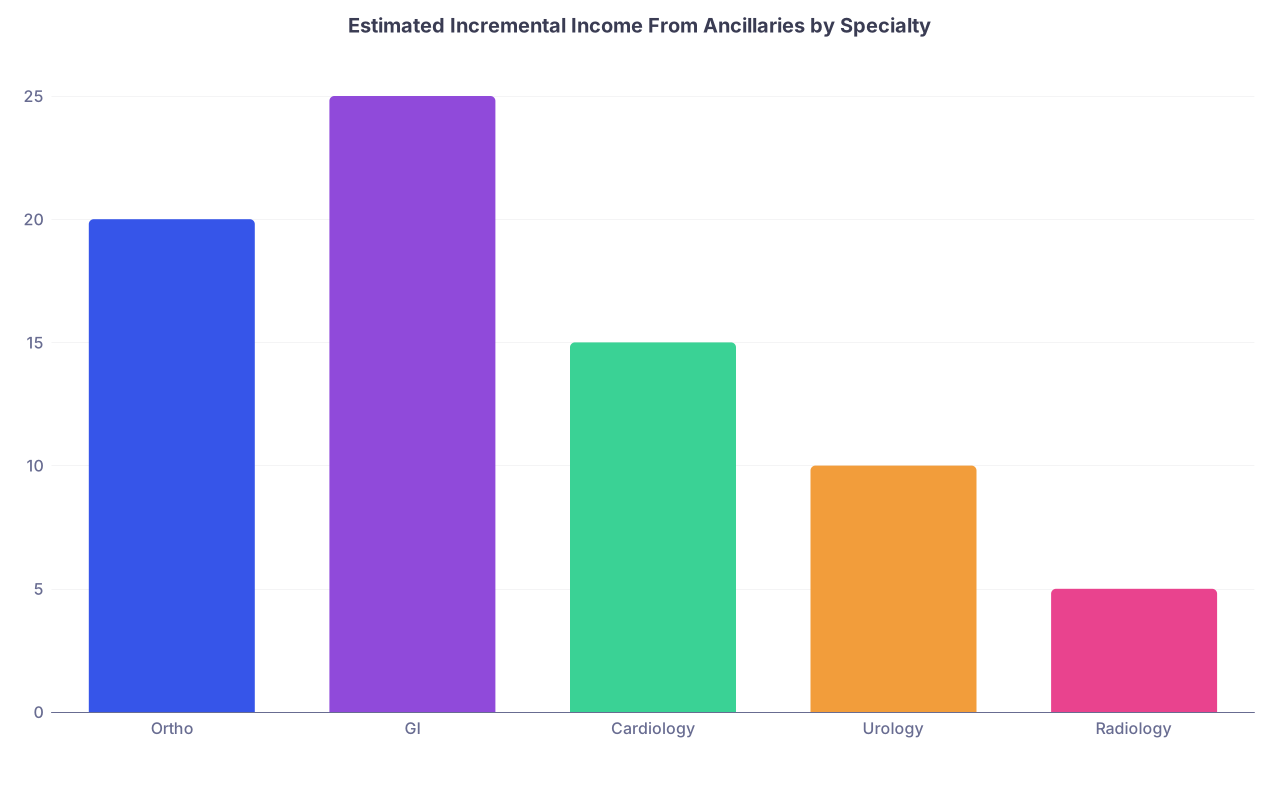
- Ownership can add 10–25% to an individual physician’s income if done correctly, with scale, and under stable payer contracts.
- For many small or mid-sized groups, ancillaries add 0–10% after debt, buy-ins, and overhead. Sometimes less.
| Category | Value |
|---|---|
| Ortho | 20 |
| GI | 25 |
| Cardiology | 15 |
| Urology | 10 |
| Radiology | 5 |
Those percentages above are rough, but directionally consistent with real-world conversations and practice surveys:
- Orthopedics and GI can do well with ASCs, PT, imaging, and infusion — with volume and scale.
- Cardiology varies a lot: office imaging and peripheral labs can be solid, but hospital-based cardiologists may see none of it.
- Urology and radiology often get less bang per doc unless they have large integrated enterprises.
So no, ownership is not a magic 2x multiplier for income. For many it’s a 10–20% bump, for some it’s noise, and for a minority it’s a home run. But that minority is who you hear giving the talks.
Residency Reality: What You’re Not Being Told
If you’re in residency (especially in a high-earning specialty), you’re probably hearing mentors toss around phrases like:
- “Get into a group where we own the ASC and MRI – that’s where the money is.”
- “Partnership track with imaging, lab, PT — you’ll crush it.”
- “Hospitals are ripping us off on technical fees. You’ve gotta own your ancillaries.”
Yes, the hospital’s technical margins on imaging, lab, or procedures can be huge. That doesn’t mean you can easily replace them.
Three big problems residents don’t see coming:
Buy-in math is often rigged against you
You’re not walking into a greenfield startup. You’re buying into someone else’s early risk, often at a valuation based on past high reimbursements that won’t hold. You may:- Pay $300–$800k to “buy” into an ASC or imaging center
- Take out personal debt to do it
- Need 7–10 years of distributions just to break even if margins compress
By the time you’re fully paid in, CMS has cut rates again, commercial contracts got renegotiated, or volume has plateaued.
The tail is often hidden
Malpractice tail, lease obligations, equipment refresh cycles, certificate of need (CON) risk, regulatory changes. The senior partners remember the early money; they tend to “forget” the upcoming headaches.You forfeit mobility
That partner in your department telling you “ownership is everything” has one thing in common with every sunk-cost investor: they need you to stay. Heavy ancillary buy-in ties you geographically and professionally. Leaving a group often means:- Walking away from your equity or selling at a discount
- Being locked out of the local ASC/imaging ecosystem by restrictive covenants
- Starting back at zero somewhere else
Stark, AKS, and the Compliance Trap
Here’s what almost nobody puts on the glossy brochure: your ancillary ownership lives under a microscope of federal and state law.
Stark Law and the Anti-Kickback Statute don’t ban ancillaries. They just make the line between “aligned incentives” and “illegal financial relationships” thin and shifting.
You know those “joint ventures” where a hospital invites physicians into ownership of an imaging center or ASC? Often the pitch is:
- “No capital required — we’ll finance your buy-in.”
- “Distributions based on your shares, which are tied to your expected referral volume.”
- “Win-win alignment.”
That’s exactly the kind of arrangement that has led to multi-million-dollar settlements and corporate integrity agreements when the feds decide the structure was effectively paying for referrals or not truly at fair market value.
I’ve seen young docs walk into these deals with zero real due diligence, trusting the hospital or ASC management company’s lawyers. Later they get named on documents or have to sit through compliance training realizing they signed onto something they barely understood.
You will not “maximize earnings” if you’re spending your peak earning years:
- Paying lawyers and compliance consultants
- Renegotiating operating agreements under government pressure
- Or worst-of-all, watching a distressed sale shred equity you thought you had
Ancillaries are not just a business decision. They’re a legal one. That’s not free.
The Scale Problem: Why Hospitals Seem To Print Money and You Don’t
The classic resident brain error: “My hospital makes a fortune on imaging; if I just owned the MRI myself, I’d make those margins.”
Wrong. Hospitals can eat terrible efficiencies and still make money because of scale and cross-subsidization:
- They negotiate multi-service contracts with payers (and get higher rates than you ever will)
- They amortize equipment and staff across multiple sites and long hours
- They cross-subsidize low-paying services with higher-margin ones
- They have in-house billing, collections, IT, compliance, and admin teams
You won’t. Not at that level. Your 2-physician cardiology practice or 5-physician ortho group doesn’t have the same leverage or infrastructure. Your per-unit cost of:
- Staffing
- Billing and denials management
- IT, PACS, cybersecurity
- Quality reporting and regulatory compliance
…will very likely be higher. Especially if your volumes are modest or variable.
So yes, on a spreadsheet, CPT 70553 might look like profit. On your P&L, after reality hits, that “profit” is often thin and fragile.
When Ancillary Ownership Does Make Sense
Despite all this, I’m not telling you ancillaries are bad. I’m telling you the default assumption — “owning them always maximizes income” — is lazy thinking.
They make sense when certain conditions line up:
You already have scale or a clear path to it
Large ortho groups with multiple locations and strong referral bases. GI groups doing high-volume endoscopy. Multi-specialty groups with thousands of covered lives. They have leverage with vendors and payers.You control or strongly influence the referral stream
If your group drives the majority of local MRI, CT, cath, endoscopy, or infusion volume, you can realistically underwrite an ancillary with predictable throughput.You have boring, disciplined management
The groups that actually make ancillaries work financially are not the flashy ones. They’re the ones obsessing over:- No-show rates
- Scanner/room utilization by hour
- Tech staffing efficiency
- Denial rates and billing clean claims
If your future partners don’t even know their denial rate or net collection percentage, but they’re hyped about “owning the building” and “taking back the technical component,” that’s a red flag.
Buy-in structure isn’t predatory
Fair buy-ins reflect current economics, not what the first generation of partners earned years ago. If the math assumes yesterday’s reimbursement in tomorrow’s world, you’re subsidizing someone else’s exit.
The Opportunity Cost Nobody Mentions
Every dollar and hour you sink into ancillaries is a dollar and hour you don’t put into other levers:
- Negotiating a better base and incentive structure
- Refining your case mix to higher-value procedures (especially in ortho, neurosurg, cardiology, GI)
- Building a regional or niche reputation that organically lifts your referrals and earnings
- Side ventures with asymmetric upside and less regulatory baggage (tech, consulting, equity in platforms, real estate not tied to referrals, etc.)
Let’s be blunt. For many high-paid specialists, an extra day a month doing high-complexity procedures at good payor mix is financially superior to wrestling with a marginally profitable MRI or PT enterprise.
Yet the culture keeps telling you that “real” grown-up doctors own buildings and machines. That’s vanity, not finance.
A Smarter Way to Think About Ancillaries in Your Career
Here’s the mental model that actually works:
First, maximize your core clinical earning power
For the highest-paid specialties, your main lever is still your own hands and brain. Case mix, efficiency, and negotiation matter more than your slice of a CT machine early in your career.Second, treat ancillaries as a portfolio component, not an identity
Maybe they’re 10–20% of your income eventually. Great. They should not be the only or even primary wealth-building strategy, especially if you’re buying in late at inflated valuations.Third, scrutinize any deal like an investor, not a doctor flattered by a “partner” label
If you wouldn’t buy this MRI/ASC/lab as a pure outside investor with no emotional attachment, you probably shouldn’t buy it as a physician either.Fourth, plan for exit and downside from day one
What if reimbursement drops 30%? A new competitor opens? A major payer excludes you from their network? You need to move states for family?
If the downside scenarios ruin you, you’re over-leveraged.
So, Does Owning Ancillaries Maximize Earnings?
Sometimes. For some physicians. In certain specialties. At certain scales. With well-structured deals.
But as a default assumption? It’s wrong.
For many doctors, especially those entering existing practices:
- Ancillary buy-ins transfer risk and legacy value from older partners to younger ones
- The real delta in income is modest relative to your base potential in a high-paying specialty
- The loss of flexibility and the regulatory overhead are underappreciated
- The opportunity cost — in time, capital, and attention — is huge
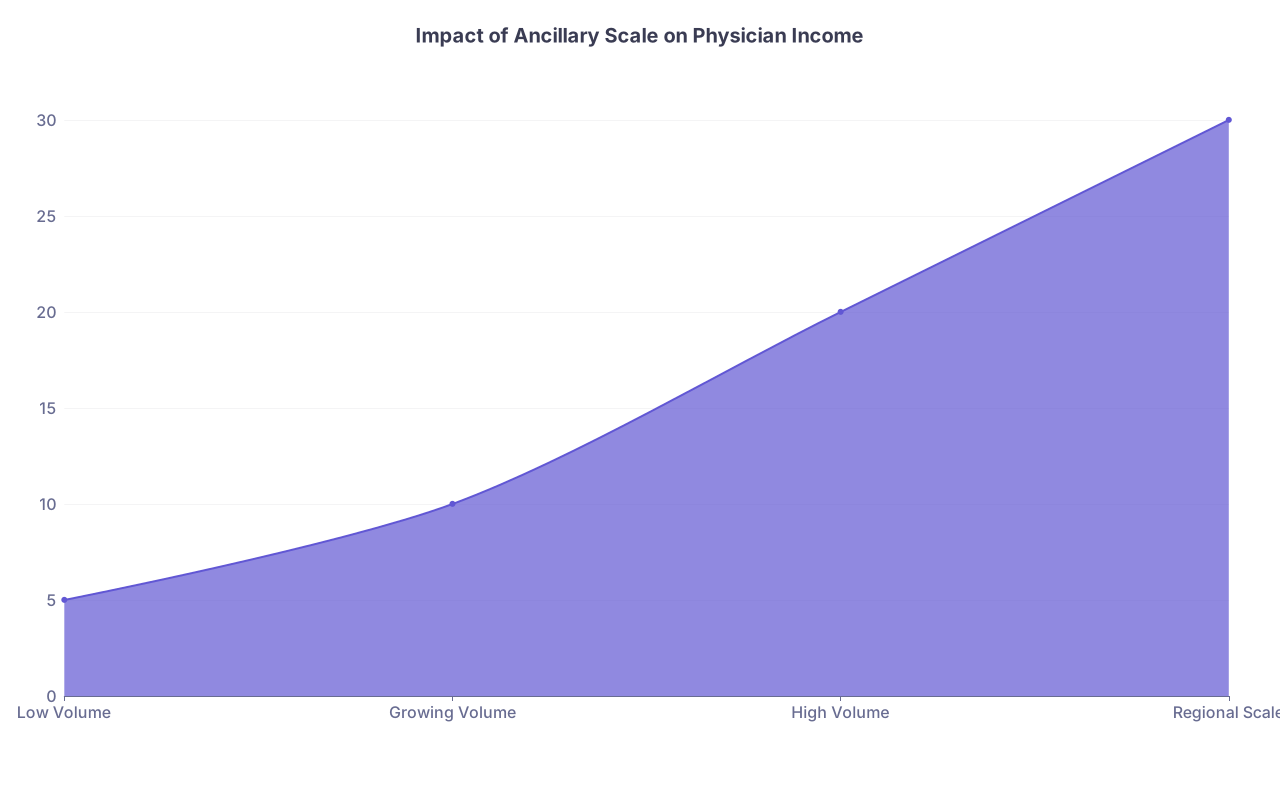
If you want to understand when it’s more likely to be worth it, think in terms of volume and leverage.
| Category | Value |
|---|---|
| Low Volume | 5 |
| Growing Volume | 10 |
| High Volume | 20 |
| Regional Scale | 30 |
That chart is the rough story:
- Low volume: 5% income bump, lots of hassle.
- Growing volume: 10% bump, still fragile.
- High volume: 20% bump, now interesting.
- Regional scale: up to 30% or more in rare high-performing groups — but these are the outliers, not the norm.
Most residents and early attendings are being sold the dream of “regional scale” by groups barely at “growing volume.”
What You Should Actually Do as a Resident or Young Attending
If you’re in a high-income specialty and trying to think clearly:
- Ask practices for actual, de-identified P&L statements for ancillaries over the last 3–5 years, not just “distributions history.”
- Ask: “What would my income be without ancillary distributions?” If it’s already excellent, view ancillaries as optional upside, not essential.
- Ask what happens to buy-in valuation if reimbursement drops. If nobody knows, that’s a problem.
- Talk to someone who left the group. Ask how their equity played out on exit.
Then be honest with yourself: are you trying to build wealth or cosplay as a mini-health-system CEO?
You chose a high-paid specialty because your time and skill have massive intrinsic value. Don’t dilute that by mindlessly chasing every ancillary dangling in front of you.
Years from now, you won’t brag about how many LLCs your name was on. You’ll remember whether you actually controlled your time, your risk, and your freedom — or whether you traded them for a few extra percentage points from a depreciating machine.