
41% of U.S. physician practices were owned by hospitals or corporate entities (including private equity) by 2022—yet physician satisfaction with autonomy dropped in almost every survey over the same period.
So yes, the money is flowing in. But a lot of the doctors in those systems quietly tell residents: “If you can avoid this, do it.”
Let’s strip out the marketing, the recruiter talking points, and the Twitter outrage. You want to know one thing: for the highest paid specialties, is private equity an income cheat code or a career landmine?
The real answer: it can give you a short-term income bump and faster equity-style payouts, but the long-term risk—to your earning power, bargaining position, and sanity—is very real. Especially if you’re early in your career.
You’re not choosing “private equity or not.” You’re choosing between different risk profiles and different timelines of who gets rich: you or the fund.
Where Private Equity Actually Lives in Medicine
First, let’s be specific. Private equity (PE) isn’t evenly spread across all specialties. It’s hunting where the margins are fat, procedures are billable, and ancillaries can be stacked.
The heaviest PE penetration is in:
- Emergency medicine
- Anesthesiology
- Radiology
- Dermatology
- Ophthalmology
- Gastroenterology
- Orthopedic surgery
- Urology
- Fertility and some pain practices
So yes, a lot of the “highest paid specialties” you’re eyeing are exactly the hunting grounds for PE groups.
Here’s a simplified snapshot:
| Specialty | PE Penetration Level |
|---|---|
| Emergency Med | Very High |
| Anesthesiology | High |
| Radiology | High |
| Dermatology | High |
| Ophthalmology | High |
| Orthopedics | Moderate-High |
No, this isn’t perfect down to the decimal. But if you match into one of these, odds are high you’ll be courted—directly or indirectly—by a PE-backed group.
The Myth of “Private Equity = More Money for Doctors”
The story you’ll hear as a resident sounds like this:
“We’ll pay you above market, sign-on bonus, productivity upside, maybe a path to equity. Our scale helps us negotiate better payer contracts, so you’ll make more.”
Sometimes that’s partially true. For a while.
Let me show you the usual pattern in a simplified way:
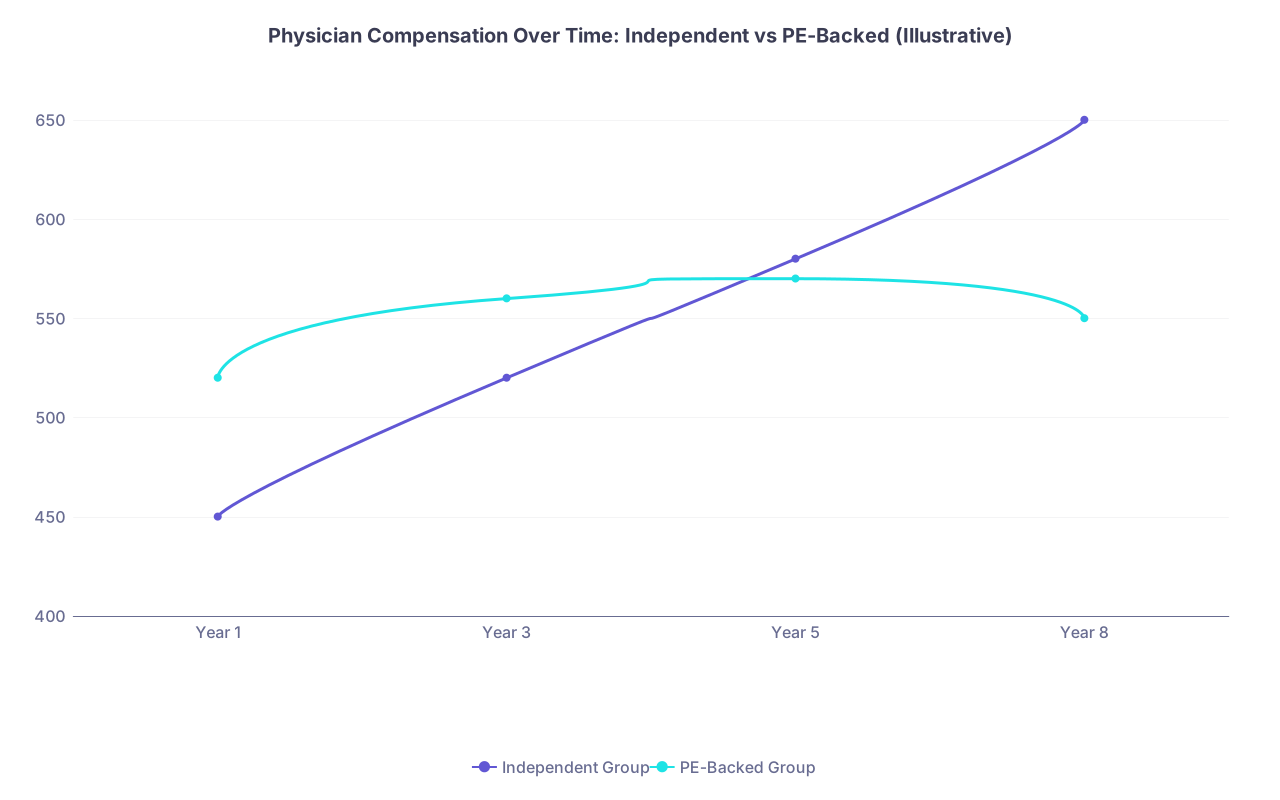
| Category | Independent Group | PE-Backed Group |
|---|---|---|
| Year 1 | 450 | 520 |
| Year 3 | 520 | 560 |
| Year 5 | 580 | 570 |
| Year 8 | 650 | 550 |
What tends to happen:
Year 1–3: PE-backed jobs often do pay more.
You get a big starting salary, maybe a nice sign-on, loan repayment, or a “guaranteed” high base while they ramp volume.
Year 4–8: The script changes.
Once you’re locked in, once referral patterns and hospital contracts are secured, the pressure pushes the other way—toward margin expansion. Meaning: more RVU, more shifts, slower techs, fewer scribes, tighter staffing, more midlevel substitution, and “contract adjustments” for doctor comp.
Meanwhile, the fund has:
- Bought your group at a multiple of EBITDA
- Stripped out “excess physician compensation” to improve margins
- Layered on debt (you didn’t benefit from the leverage, but you’re working under it)
- Prepped to flip the company to another fund or strategic buyer in 3–7 years
You get the initial sugar high. The fund gets the long-term equity event.
Residents almost never get the full picture. They’re shown one number: year-one comp. They’re not shown the spreadsheet with how your comp looks after the next recapitalization, nor how easy it is to push physicians’ share of the pie down by 10–20% once the platform is built and you’re replaceable.
How PE Changes the Game in High-Paid Specialties
Let’s pick a few specialties you might be actually considering and talk about what private equity really does to your career there.
Emergency Medicine
This is the classic case study. Big national staffing groups, heavy PE backing, aggressive contract bidding.
What I’ve seen repeatedly:
- New grads get quoted $250–$300/hour in some markets, big sign-on bonuses.
- Group wins exclusive contract with hospital by undercutting previous democratic group.
- Year or two later: schedules tighten, more boarded patients, more coverage holes, midlevels covering more acute areas, “efficiency metrics” start showing up in your inbox.
- Pay quietly stagnates while cost of living and workload go up.
And the big structural harm: the independent democratic EM group that used to pay partners $400k–600k with real voting rights? Gone from that market. Once PE-backed groups dominate contracting, your negotiating leverage as an individual EM doc tanks.
Slice it simply:
Short-term: decent paycheck, lots of locations, easy to find a job.
Long-term: fewer true partnership tracks, more churn, more burnout, less control.
Anesthesiology & Radiology
These used to be textbook examples of high pay + strong groups + real partnership. That still exists in some markets. But it’s shrinking.
What PE does here:
- Buys out senior partners at a huge multiple (they walk away rich)
- Converts future physicians to “employee” rather than real partner
- Centralizes scheduling, billing, and hiring
- Plays mix games: more CRNAs or NPs, fewer docs, more supervision ratios
I’ve seen groups where legacy partners were clearing >$800k before the deal. After the PE acquisition:
- Legacy partners: cash out multimillions plus still decent comp
- New hires: “competitive salary” of $500–600k with a vague “equity incentive” that’s effectively phantom equity, heavily controlled by the fund, and often tied to staying through the next sale event
One more quiet problem: once a PE roll-up buys multiple groups in your region, jumping to “another” radiology or anesthesia group doesn’t mean exiting that system. Different logo, same parent company, same economics.
Dermatology, Ophthalmology, Ortho, GI
These are gold mines for private equity because:
- High-margin procedures
- Lots of ancillaries: imaging, ASC ownership, pathology, cosmetics, optical shops
- Strong branding potential in local markets
What PE likes to pitch: “We’ll take all the business headaches off your plate. You focus on medicine, we grow the platform.”
What actually happens:
- They consolidate practices and move ancillaries into separate entities where owners (fund + top-level partners) capture the upside.
- Future recruits often get salaries + very limited access to real equity in the most profitable pieces (ASC, imaging, ancillaries).
- Visit times shrink. Volume expectations creep up. Cosmetic or cash-based lines get prioritized over lower-margin but clinically important work.
For residents in these fields, PE can feel like a trapdoor under what used to be the stairway to true practice ownership.
The “Income Booster” That Eats Your Future Leverage
The core lie is subtle: people treat income and autonomy as two separate dials. As if you could crank your income up now and pay some vague cost in “control” that won’t really hurt your wallet later.
Reality: income and autonomy are tightly linked. For physicians, autonomy is how you defend future earning power.
When you sign into a PE-backed structure early in your career, you do three things:
- You help solidify their market dominance, making it harder for independent groups to survive.
- You give up a seat at the real ownership table where long-term upside is distributed.
- You normalize an employment model where physician comp is just another cost line to squeeze.
That can be very expensive over a 30-year career, even if your first 3–5 years look “above average.”
Here’s a rough comparison to make it concrete:
| Path | Years 1–3 Avg | Years 4–10 Avg | 10-Year Total |
|---|---|---|---|
| PE-Backed Employment | $520k | $560k | ~$5.3M |
| True Partnership/Ownership | $450k | $700k | ~$5.9M |
The “more money now” story often masks “less money later, forever.”
How Private Equity Quietly Reshapes Your Daily Life
This isn’t just about check size. It’s about what your day looks like.
Patterns I see over and over once PE takes over:
- Productivity tracking gets more granular and more weaponized.
- Schedules get tighter; 15-minute visits become 10; 10 become 7.
- Non-RVU tasks (teaching, QI, mentoring) get devalued because they don’t show up on spreadsheets.
- Clinical decisions start getting nudged by metrics: downstream revenue, imaging rates, ASC utilization.
You will hear phrases like:
“Let’s standardize your templates.”
“We’re just aligning with new productivity benchmarks.”
“This is how we stay competitive in the market.”
And if you push back, there’s always a line of new grads or locums ready to slot in. That’s the real power shift: from physician labor being scarce and locally organized, to being commoditized on a national scale.
PE doesn’t need to yell. It just needs you to be replaceable.
When Private Equity Might Actually Make Sense
I’m not going to pretend PE is always evil and you should run for the hills in every scenario. That’s not honest either.
There are situations where a PE deal can be rational:
- You’re a late-career partner in a strong group getting a massive buyout. You’re near retirement, and you’re honest with yourself that you’re cashing out future physician leverage to de-risk your own finances.
- You’re moving to a niche or rural market where the only viable way to practice your specialty with modern infrastructure is through a large group that happens to be PE-backed.
- You have a brutally high debt load, zero family safety net, and a short time horizon where front-loading income for 3–5 years genuinely reduces existential risk for you.
Even there, you should go in with both eyes open and an exit plan, not a fantasy narrative about “we’re all equity partners here.”
To clarify the tradeoffs:
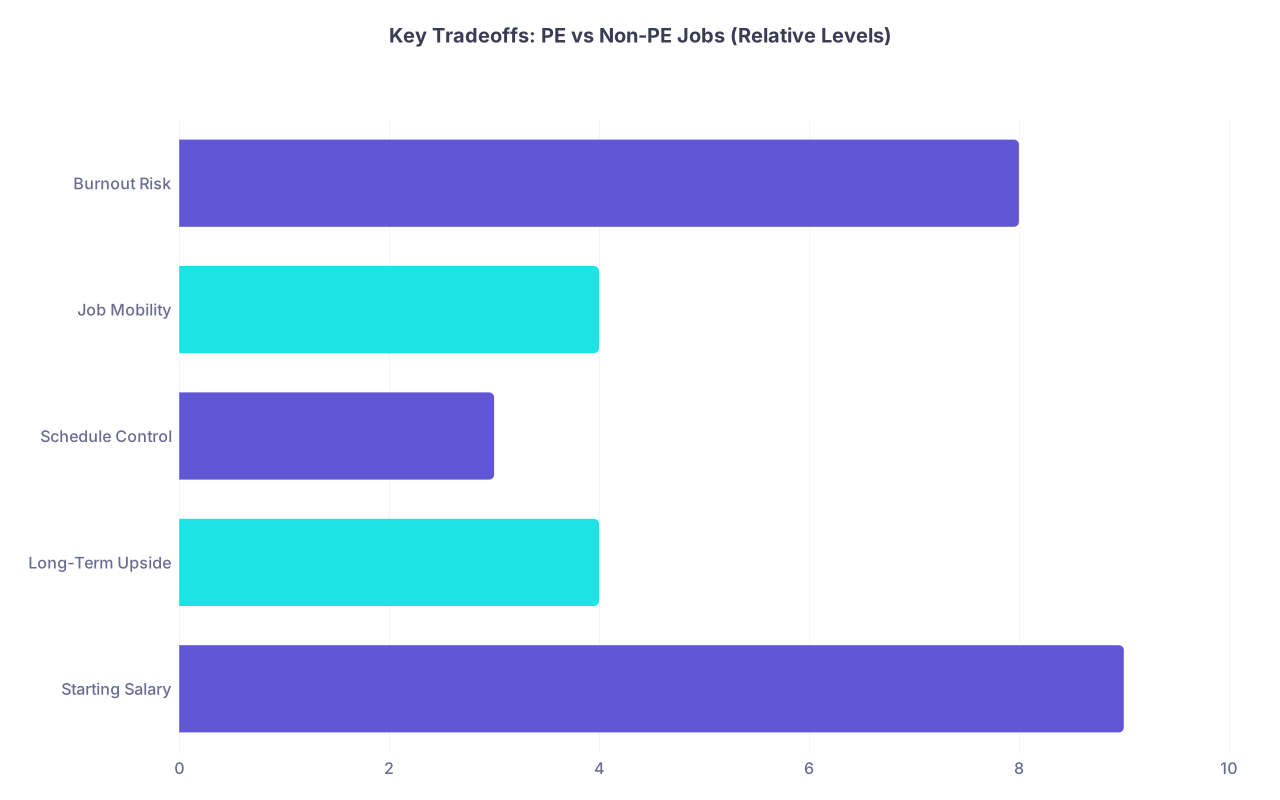
| Category | Value |
|---|---|
| Starting Salary | 9 |
| Long-Term Upside | 4 |
| Schedule Control | 3 |
| Job Mobility | 4 |
| Burnout Risk | 8 |
Interpretation (0–10 scale, rough and relative): PE usually scores high on starting salary, lower on autonomy and future upside, higher on burnout risk.
How to Actually Evaluate a PE-Backed Offer
If you’re a resident in one of the high-income specialties and you’re staring at a shiny PE contract, here’s what matters more than the base salary number:
- Ask: Who actually owns the ancillaries (ASC, imaging, pathology, cosmetics, optical)? Are physicians in my cohort allowed to buy in, and on what terms?
- Ask: What happened to compensation for physicians here before and after the PE acquisition? Specific numbers, not vibes.
- Ask: How many physicians have left in the last three years? Why?
- Ask: What’s the typical daily volume? How has that changed over time?
- Ask: Who controls scheduling and staffing ratios? Is that local or corporate?
- Ask: Is there a non-compete, and how tight is it geographically and temporally?
If the answers are vague, constantly redirected to “We’re very competitive,” or they refuse to show you historical comp trends—that’s your red flag. Not the equity logo. The opacity.
The Long-Term Risk You Don’t See in PGY-3
The biggest risk of private equity in medicine isn’t that you will get personally destroyed by one bad job. You can always leave one employer.
The bigger risk is systemic and slow:
- Fewer true partnership models exist in your specialty.
- Hospital contracts go to whoever promises the lowest labor cost—funded by debt and scale.
- Independent groups unable or unwilling to sell get boxed out of deals and eventually die.
- New grads never even see what real ownership looked like, so the new floor feels normal.
Once that happens, your “highly paid specialty” becomes a well-compensated but commoditized job in a corporate machine. Still better than many fields, sure. But far from the upside that originally attracted you.
The irony: PE loves targeting the highest paid specialties precisely because your potential future earnings are the raw material they can securitize and flip for a profit.
They’re not creating money. They’re redistributing who captures it and when.
So—Booster or Risk?
Short version, no sugar coating:
- If you’re early-career in a high-paying specialty, private equity is usually an income booster for a few years and a leverage killer for decades.
- If you’re late-career in a strong group, PE can be a personal windfall and a profession-level disaster.
- If you’re debt-crushed and desperate, PE may feel like the only rational move—but treat it like a time-limited trade, not a 30-year marriage.
You’re not just choosing a job. You’re choosing what kind of market you want to practice in ten years from now—and whether you’ll have any real say in it.
Years from now, you will not remember the exact number on your PGY-4 job offer. You will absolutely remember whether you still had the power to say “No, this isn’t safe for my patients” and have that actually matter.