
The hype about radiology income is broken. Both the “radiology is dead, AI will replace you” crowd and the “radiologists all make $800K from home in sweatpants” crowd are selling fantasies.
Let’s talk about what people actually earn, who gets squeezed, who wins, and where teleradiology and AI really fit. With numbers, not Reddit folklore.
What Radiologists Actually Make (Not the Recruiter Version)
You’ve seen the job ads: “$600–900K+ potential!” plastered over every job board. Then you look at MGMA or Medscape reports and see something totally different. Someone’s lying, right?
Not exactly lying. Just selectively telling the truth.
Here’s what the more credible data sources show:
- Medscape Radiology Compensation Report (recent years): average radiologist income lands roughly in the $500K ballpark (give or take depending on year and sample).
- Private practice partners in desirable markets: $550K–$800K+ is common, with some groups blowing past that when volumes are high and staffing is tight.
- Academics: typically $350K–$500K, sometimes higher in radiology because departments are desperate to keep people.
- Telerad: peri-hospital arrangements and overnight coverage can push $450K–$700K+, but it’s usually volume-based and fragile.
So no, the average radiologist is not quietly making $1 million a year. But also no, radiology is not some dying, mid-range specialty. It remains consistently among the top-earning non-procedural fields, especially when you factor in lifestyle.
To put radiology in context:
| Specialty Tier | Typical Range (USD) |
|---|---|
| Radiology (overall) | 400K–700K |
| Orthopedic Surgery | 600K–900K+ |
| Dermatology | 450K–700K |
| Internal Medicine (general) | 230K–320K |
| Pediatrics (general) | 200K–280K |
Radiology is firmly in the “high income” tier. But the spread is huge. The real story is how you practice, not just what you practice.
The Biggest Myth: “Radiologists Just Print Money”
This is the preclinical med student fantasy: sit in a dark room, scroll through studies, sign reports, bill 10 RVUs every 15 minutes, cash checks.
Here’s what actually drives radiology income:
- Practice model
- Geography
- Workload (RVUs, shifts, call)
- Modality mix (MRI-heavy vs plain films)
- Partnership track vs per-RVU employee
Let me be blunt: the “radiologist income” conversation is useless unless you specify these.
I’ve seen two attendings with the same board certification, same years out, same Step scores, with radically different lives:
- One: private practice partner in a medium city, 8–5 schedule plus q4 call, reads a ton of CT and MRI, makes $750K, has real equity in the group, decent control over schedule.
- Another: academic neurorad in a major coastal city, heavy teaching and conferences, lighter reading volume, $380K, lots of meetings and committees, but prestige, research, and residents.
Same specialty. Different universe.
And there’s a dark side: the sweatshop telerad employee on a per-RVU contract who “can make up to $700K” if they read like a machine at 1 a.m. every night, with no sick time, and whose contract rate gets cut the moment reimbursement dips.
So yes, radiology pays well. But the easy-money myth hides the tradeoffs in call burden, burnout, and contract power.
Teleradiology: Flexible Goldmine or Race to the Bottom?
Let’s tackle teleradiology, since this is where a lot of wild numbers — and bad advice — live.
Telerad started as a way to cover nights and underserved areas. Now it’s also a way for big companies to arbitrage radiologist labor: low overhead, high volume, centralized IT.
The fantasy you hear: “Just do telerad from home for $600K, live on a beach, flexible hours, no hospital politics.” Reality is more complicated.

How telerad actually pays
Most telerad gigs are some mix of:
- Per-RVU rate (e.g., $12–18 per RVU, sometimes more for nights/complex studies)
- Differential by modality (CT brain pays more than a plain chest X-ray)
- Sometimes a minimum guarantee or base salary
If you read a lot of high-RVU studies quickly, you can absolutely crack $500–700K. I’ve seen those W-2s and 1099s. But:
- You’re often working nights, evenings, or weekends.
- The volume can be relentless — hundreds of studies per shift.
- You may have no real control over case mix or workflow.
- Your contract can be “adjusted” when payer mix changes or big hospital clients renegotiate.
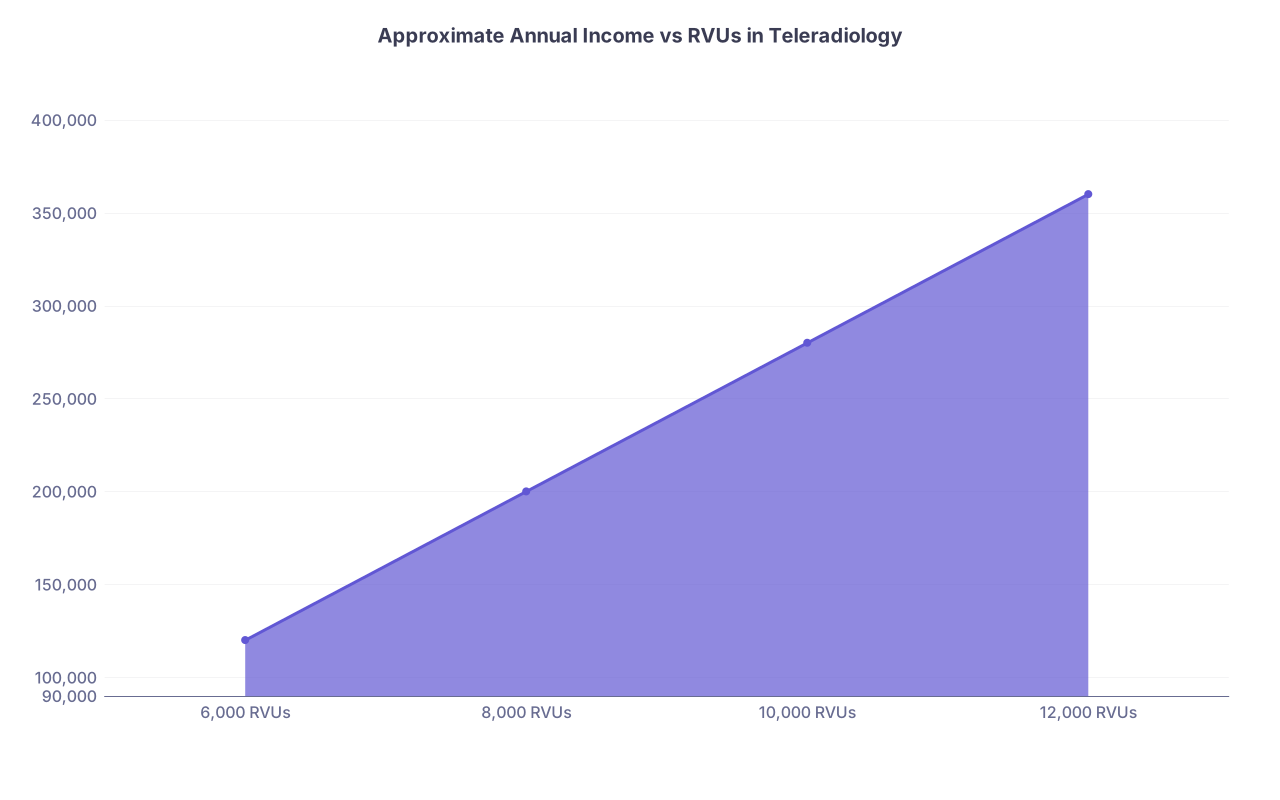
| Category | Value |
|---|---|
| 6,000 RVUs | 120000 |
| 8,000 RVUs | 200000 |
| 10,000 RVUs | 280000 |
| 12,000 RVUs | 360000 |
Those numbers assume something like $18/RVU. But the rates are not static. As more people crowd into telerad and reimbursements shrink, rates get pushed down. This is already happening.
The bigger issue: you’re commoditized. You’re not the local radiologist the surgeons know. You’re just “coverage” on a screen somewhere. That makes you easy to replace and easy to underpay over time.
Telerad can be fantastic if:
- You value geographic freedom more than local influence.
- You accept non-traditional hours.
- You negotiate wisely and stay ready to walk if the numbers change.
But as a stable, long-term, “set it and forget it” path to high income? It’s fragile.
AI in Radiology: Threat to Income or Free RVUs?
The AI panic is predictable. Every few months someone posts: “Why go into radiology when AI will be reading all the scans?” Usually from someone who has never opened PACS in their life.
Here’s the inconvenient truth: AI is already here, and income hasn’t collapsed. In some setups, it’s quietly boosting productivity and, yes, earnings.

| Step | Description |
|---|---|
| Step 1 | Image Acquisition |
| Step 2 | AI Preprocessing |
| Step 3 | Priority Triage |
| Step 4 | Radiologist Review |
| Step 5 | Report Generation |
| Step 6 | Quality Check |
Current AI tools are good at:
- Triage (flagging potential brain bleeds, PE, large pneumothorax)
- Detection assistance (lung nodules, fractures, mammography)
- Quantification (volumes, measurements, bone densities)
They are not good at:
- Integrating clinical context, prior imaging, and weird edge cases
- Handling medico-legal responsibility
- Dealing with colonoscopies ordered on the wrong patient at 2 a.m. (yes, this kind of chaos matters)
Economically, what does this mean?
Your reading speed may increase
If AI reliably flags likely negatives and prioritizes positives, you spend less time on normal studies. That can let you read more cases per hour.Your value shifts from pure detection to interpretation + integration
Pattern recognition alone is vulnerable. Radiology judgment is not. The attendings who add value in M&M, tumor boards, and surgical planning meetings will always be harder to replace.Group-level profits may grow before individual salaries do
This is the ugly, predictable part. If AI lets a group handle the same volume with fewer radiologists, the first instinct may be to hire less, not immediately pay more. Unless you’re a partner with equity, that efficiency gain may bypass you.
So no, AI is not going to nuke radiology income in the near term. The bigger risk is that naive radiologists allow corporate owners and venture-backed telerad firms to capture all the productivity gains while they remain interchangeable cogs.
If you want to future-proof your income, don’t fear AI. Learn enough to demand a share of the gains.
Resident and Fellow Reality: What You’re Actually Training For
Here’s another myth: “Just suffer through residency, and the big money starts on day 1 as an attending.”
Not quite.
Radiology residency and fellowship years line you up for very different economic futures depending on your choices.

Subspecialty and income
In general:
- Interventional radiology (IR) tends to command a premium because it’s procedure-heavy, call-heavy, and more difficult to replace.
- Neuroradiology, MSK, body imaging can all do very well in private practice since they’re bread-and-butter for advanced imaging.
- Mammo is tricky: high malpractice risk, but some markets pay well because nobody wants to deal with it.
- Peds rads, academic-focused subspecialties can be lower-paying, especially if tied tightly to university salaries.
But here’s the twist most residents miss: the market can swing rapidly. A hot subspecialty can become saturated in 5–7 years. What matters more is the structure of the job you land, not just the letters after your name.
Partnership vs employee
Two residents, both smart, both good readers:
- Resident A takes a job at a hospital-owned imaging department, W-2 employee, “fair” salary, 8 weeks vacation, no buy-in, no equity, no real partnership track. Ten years later they’re making maybe $450K, and it hasn’t gone up much.
- Resident B joins a well-run private group, eats some pain for a 2–3 year partnership track with moderate pay on the front end, buys in, and ten years later is making $650K+ with a large share of technical income and governance power.
Same years of training. Wildly different lifetime earnings and control.
The myth you’ll hear from burned-out attendings is: “All the good private practices are dead.” That’s exaggerated. Many have been bought out or squeezed, yes. But the ones that remain independent are often making more money than ever because competition locally is light and imaging demand hasn’t decreased.
You just have to be willing to look outside the three biggest coastal cities and not demand downtown San Francisco with partner pay and 9–3 hours.
Geography and Lifestyle: Where the Real Arbitrage Is
If you want to talk about “highest paid specialties,” you also have to talk about where they practice. Radiology is one of the specialties where geography can move your income by hundreds of thousands with zero change in skill.
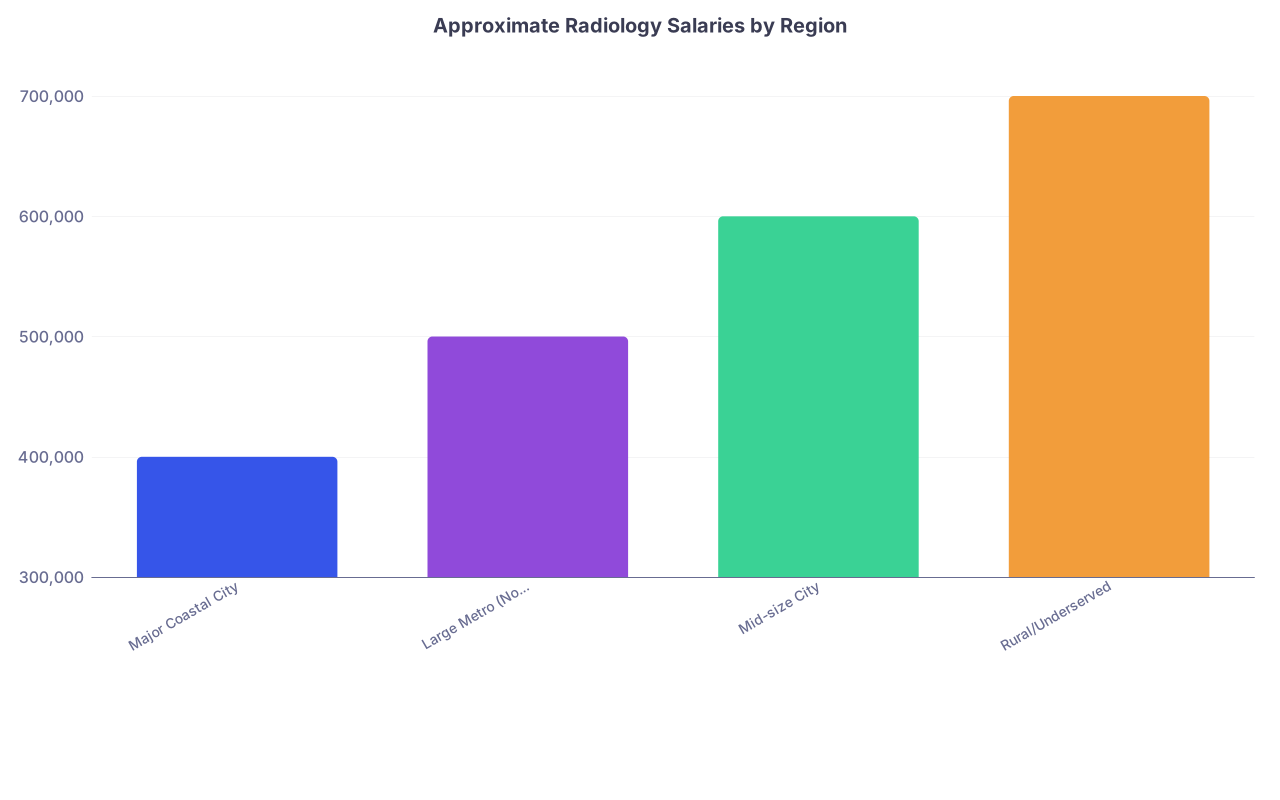
| Category | Value |
|---|---|
| Major Coastal City | 400000 |
| Large Metro (Non-coastal) | 500000 |
| Mid-size City | 600000 |
| Rural/Underserved | 700000 |
These are directional, not literal, but the pattern holds:
- Big coastal academic hubs: lower pay, more prestige, more competition.
- Flyover states, mid-size towns, rural systems: higher pay, more leverage, fewer applicants.
Radiology is one of the few specialties where you can live in a relatively low-cost area and still have a big-city-level intellectual practice, since the images and pathologies don’t care about zip codes. A PE is a PE whether you’re in Boston or Boise.
The people you see clearing $700K+ per year reading high-level studies from a comfortable home in a low-cost market did not stumble into that. They traded away something: glam location, 100% day shifts, hyper-narrow subspecialization, or the safety blanket of a mega-academic brand.
So, Should You Choose Radiology for the Money?
If you’re looking for “highest paid specialties,” radiology belongs on your list. But if you’re choosing it only for the money, you’re setting yourself up for disappointment.
Yes, a smart, motivated radiologist can still:
- Hit $500–700K+ in private/telerad setups.
- Maintain a better lifestyle than many surgical fields.
- Use AI as a force multiplier instead of a threat.
But radiology comes with its own taxes:
- Isolation risk. Sitting in a dark room for hours is not a joke.
- Burnout from volume pressure. High income is tied tightly to how much and how fast you read.
- Market pressure from corporatization and telerad consolidation.
- Vulnerability to reimbursement cuts, especially in imaging-heavy systems.

The people who thrive — and stay well-compensated — in radiology do a few things differently:
- They understand the business side: RVUs, payer mix, technical vs professional fees, contract structures.
- They avoid commoditization by being present in tumor boards, interdepartmental meetings, and decision-making.
- They pick their practice model and geography intentionally, instead of just chasing the biggest first-year salary.
The Bottom Line
Radiology income is neither a guaranteed gold rush nor a doomed casualty of AI. The truth is simpler and less sexy:
- Radiology remains a top-tier earning specialty, but actual salaries range widely from mid-300s in academia to 700K+ in high-volume or partner roles.
- Teleradiology is high-risk/high-reward: it can deliver big numbers with flexibility, but it turns you into a commodity and your pay will track the market — often down.
- AI is not eliminating radiology income; it’s shifting where the value is. Radiologists who act like replaceable image readers will be treated — and paid — that way. Those who integrate AI, own part of the workflow, and stay involved clinically will keep their leverage.
Strip away the myths, and radiology is still one of the best combinations of income and lifestyle in medicine — if you treat it like a profession and a business, not a shortcut to easy money.