
Academic vs private practice: the way most doctors talk about this money gap is wrong.
You’ve heard the script: “Academics pays less, but you do it for the love of teaching and research. If you want to make real money, go private.” That’s the folklore. It gets repeated on rounds, in resident lounges, and at every “career night” where the private practice guy jokes about his boat and the academic says, “I’m paid in educational satisfaction.”
Reality is messier. In some specialties, academic vs private is still a blowout. In others, especially at the high end, the gap is shrinking, or even flipping, once you account for call, wRVUs, and the fine print in those six-page contracts no one actually reads.
Let’s pull the curtain back.
The Myth: Private Practice Always Wins on Pay
The core myth goes like this: for any specialty—especially the highest paid ones—private practice physicians always out-earn their academic counterparts by a mile.
There was a time when that was essentially true. Twenty years ago, you could look at a cardiothoracic surgeon or orthopedic joint surgeon and assume: private = big money, academic = prestige and poverty (relatively speaking).
Now? Less clear.
Large health systems, “academic affiliates,” and hospital-employed models have dumped gasoline on the compensation landscape. RVU-based bonus structures, departmental incentives, and clinical productivity expectations in academics can look suspiciously similar to hospital-employed “private” jobs. And in some high-end niches, academic centers are paying market—or close enough that the lifestyle/call differences matter more than the base number.
To get specific, we have to talk actual data, not “my buddy in Texas.”
What the Numbers Actually Show (Not the Stories)
Let’s use high-paying specialties where this question really bites: ortho, neurosurgery, cardiology, GI, radiology, anesthesia, derm.
I am deliberately ignoring family med vs academics; that’s not where the myth lives. The myth lives in the “I do a procedure and money falls out” specialties.
Here’s a rough, realistic snapshot using aggregated numbers from MGMA-type benchmarks and Medscape-style surveys. These are ballpark, not gospel, but they’re close enough for decisions.
| Specialty | Academic Median ($) | Private Median ($) |
|---|---|---|
| Orthopedic Surgery | 550,000–650,000 | 750,000–1,000,000+ |
| Neurosurgery | 700,000–900,000 | 1,000,000–1,400,000 |
| Cardiology (Invasive) | 550,000–700,000 | 650,000–900,000 |
| GI (Advanced / ERCP) | 500,000–650,000 | 650,000–900,000 |
| Radiology | 450,000–600,000 | 600,000–800,000 |
This looks like it confirms the myth. But it hides three huge distortions:
- “Academic” pay data is polluted by low-paid early-career assistant professors with minimal negotiating leverage and heavy non-clinical time.
- “Private practice” data hides partners vs employees. A “private” job where you’re a hospital-employed W-2 with no ownership is not remotely the same as being a senior partner in a high-volume group.
- wRVU expectations differ. Many academic contracts essentially say: we will underpay on base, then demand private-level productivity to unlock money that brings you up to… what you’d make in a decent hospital-employed job anyway.
So does private usually pay more? Yes. But “how much more” and “for whom” are the actual questions. And the answers are not uniform.
The Hidden Levers: wRVUs, Call, and Ownership
If you only memorize one thing from this: title and setting matter less than three levers—wRVUs, call, and ownership.
1. wRVUs: Your Real Currency
That base salary line on the contract is bait. The real money is often in how they value your work RVUs (wRVUs).
Most high-paying specialties live and die by RVUs. An interventional cardiologist might generate 12,000–16,000 wRVUs a year. A procedural GI in a busy group can hit similar numbers. Ortho and neurosurgery can be wildly higher per hour because each case is dense with RVUs.
You’ll see contracts like:
- Academic: 350–450k base, then bonus above 7,000–8,000 wRVUs at $40–55 per RVU
- Hospital-employed “private”: 450–550k base, bonus above 8,000–9,000 wRVUs at $50–70 per RVU
- True private group (partner track): 400–500k as an associate, then 800k+ as partner depending on collections, surgery center ownership, ancillaries
So that neurosurgeon who says “I make 900k in academics” typically isn’t just paid for showing up to tumor board. They’re churning RVUs at a rate that would also make them a millionaire in the right private setup.
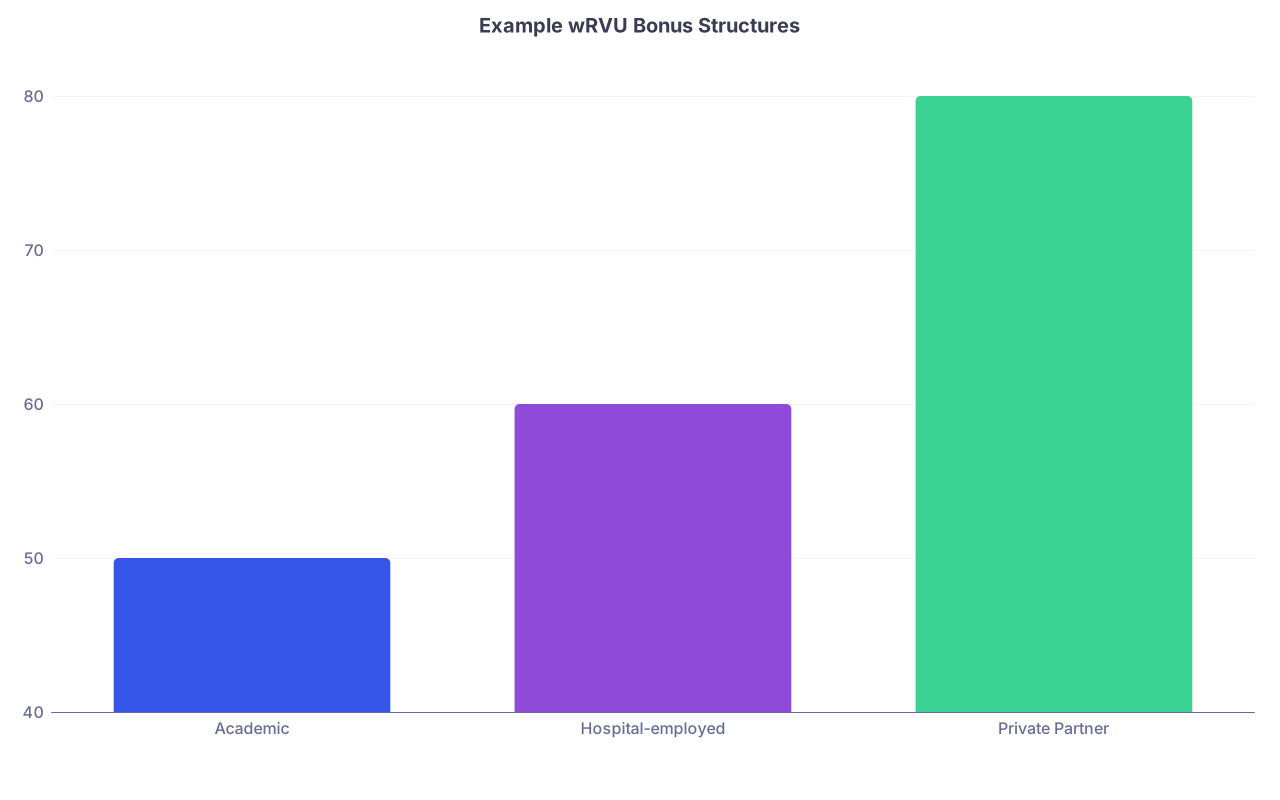
| Category | Value |
|---|---|
| Academic | 50 |
| Hospital-employed | 60 |
| Private Partner | 80 |
Those “values” might as well be $/wRVU equivalent when you factor in ancillaries and distributions. That’s why partners crush everyone else.
2. Call: Paid Differently, or Not At All
Here’s where “take-home” starts to diverge from “headline salary.”
Residents hear, “academics has lighter call” or “better backup.” Sometimes that’s true. But I’ve seen:
- Level 1 trauma center academic neurosurgery with brutal q2–3 call, mostly in-house, “compensated” via vague departmental RVU credit.
- Community hospital neurosurgeon with 1:4 call, paid a defined $2–3k per weekday call and more for weekends.
When you add call stipends, some “worse” private call situations are financially superior to academic setups that pretend call is a professional duty and not billable misery.
Private groups more often have explicit call pay and extra-comp policies. Academic departments more often bury call in culture and “teamwork.” That matters if you actually calculate hourly effective pay.
3. Ownership: The Real Private Practice Secret
This is the part students and residents consistently underestimate.
The private partner in a high-end group isn’t just being paid for clinic and OR time. They’re making money from:
- Surgery centers / cath labs
- Imaging
- In-office procedures
- Lab, PT, infusion, etc.
Academic physicians rarely touch that equity. In a true partnership model, once you’re in, your distribution can dwarf your “salary.”
So yes, a new attending in academic ortho at 550k vs a hospital-employed ortho at 650k makes the private track look higher—but that’s not the real gap. The real gap is between a mid-career academic at 650–750k and a private partner orthopod netting 1–1.5M with multiple revenue streams.
That’s the actual game.
Highest Paid Specialties: Where the Gap Is Real vs Overblown
Let’s walk through a few of the marquee money specialties and where the myth holds vs cracks.
Orthopedic Surgery
Here the stereotype mostly holds.
- Academic ortho: Competitive base (500–700k for subspecialty), heavy clinical load, teaching, admin. Maybe some bonus. Rarely real equity.
- Private ortho group: Lower base early, painful partnership buy-in, but once partner, total comp often crosses 1M, especially if you touch joints, spine, or sports with a busy ASC.
I’ve seen academic joint surgeons at big-name centers making 700–800k and staying purely for prestige and research. Down the road, anonymous community joint surgeons quietly clear 1.2M with less bureaucracy and no residents. Money difference? Substantial.
Neurosurgery
Same story, amplified.
- Academic neurosurgery: 700–900k is doable with solid RVUs, but paired with rough call and committee hell.
- Private neurosurgery: Partnership track groups, or high-volume hospital-employed setups, routinely clear seven figures with aggressive case mix.
This is one of the specialties where, if your sole goal is maximum income, purely academic long-term practice is hard to justify financially. You’re trading real, quantifiable dollars for academic brand and case variety.
Cardiology (Interventional / EP)
This one is closer than people think.
Academic cardiology used to be a financial black hole. Now:
- Academic interventional/EP: 550–700k with RVU bonus is common at big systems. Device trials and prestige attract volume.
- Private: Busy groups and hospital-employed setups absolutely still win—650–900k+, sometimes more with ownership in cath labs.
But there are academic-ish jobs at quasi-academic systems where the cardiologist basically functions like a private doc with a title. Those can be nearly private-level pay with a university badge.
Here the gap exists but is narrower, and some “academic” jobs are essentially private practice with conferences.
Gastroenterology
GI is quietly one of the most distorted fields by ownership economics.
- Academic GI: 450–650k. Heavy complex cases, IBD clinics, liver transplant work, less scoping volume per FTE. Prestige comes from pathology and complexity, not raw numbers.
- Private GI: Busy scoper in a group with endoscopy center ownership can crack 1M. Yes, really. The colonoscopy mill model churns RVUs and facility fees.
The myth holds strongly here. Academic GI is a major pay haircut relative to what’s possible in private practice, especially if you do bread-and-butter with procedural volume.
Radiology & Anesthesia
These two have changed a lot with corporate groups and hospital-employed models.
- Academic rads/anesthesia: 400–600k, depending on specialty and location. Telerads and CRNA supervision complicate the picture.
- Private: Healthy groups with equity and good negotiating power can exceed 700–800k. But many “private” jobs are just national corp W-2 roles paying not much more than strong academic packages.
So in these fields, the old rule “private >> academic” is eroding. True partnership still pays more, but a lot of what’s labeled “private” is just another flavor of employment.
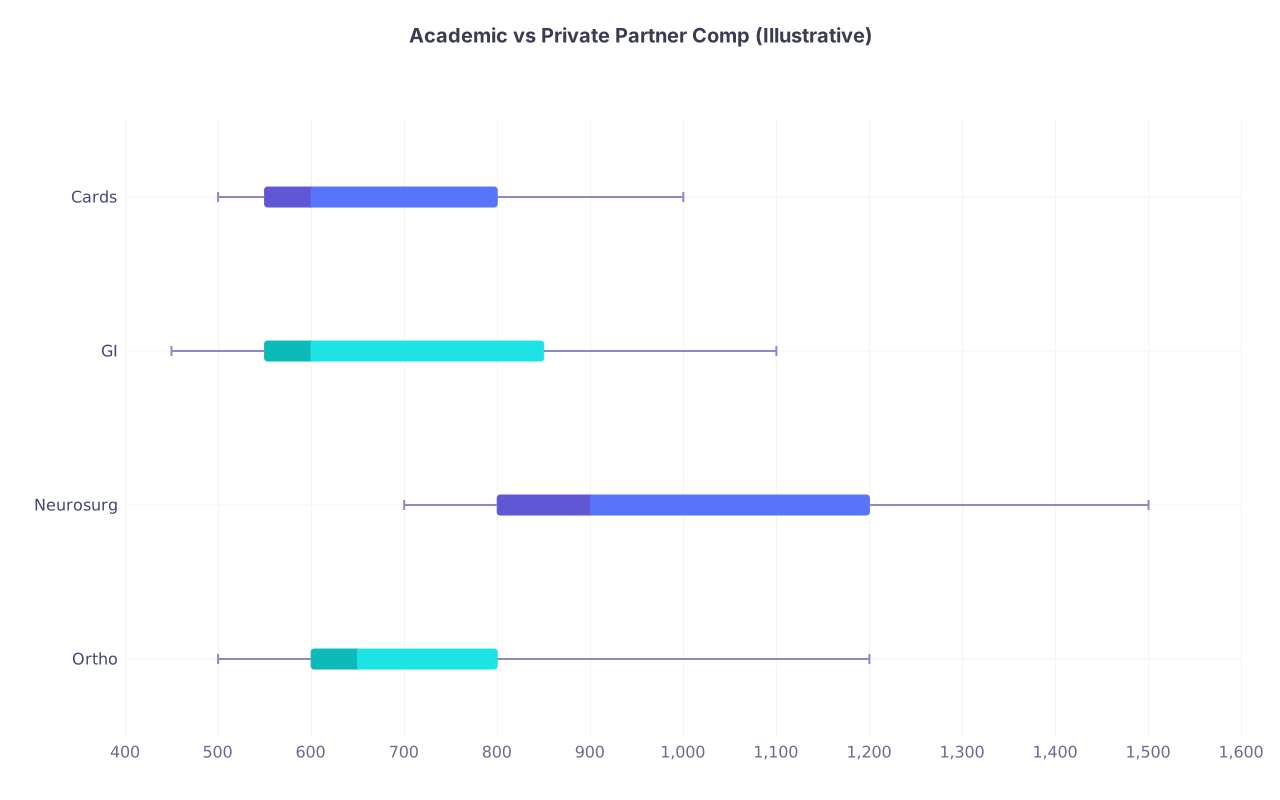
| Category | Min | Q1 | Median | Q3 | Max |
|---|---|---|---|---|---|
| Ortho | 500 | 600 | 650 | 800 | 1200 |
| Neurosurg | 700 | 800 | 900 | 1200 | 1500 |
| GI | 450 | 550 | 600 | 850 | 1100 |
| Cards | 500 | 550 | 600 | 800 | 1000 |
Boxplot hint: narrow gap at the median in some fields; enormous gaps at the upper end with private partners.
Academic vs Private: The Lifestyle Tax and the Prestige Premium
Money isn’t just numbers. You also pay or get paid in non-monetary currency: control, prestige, complexity, training, hours.
Academic jobs often “justify” lower pay with:
- Protected time (theoretically) for research/teaching
- Brand name (Harvard/Stanford/UCSF on your CV)
- Complex cases you won’t see in a community setting
- Teaching satisfaction if you actually like residents and fellows
But let’s be honest: that “protected time” evaporates in many departments when service lines are understaffed. You’re doing full private-level clinical work with academic-level pay and still expected to sit on committees and crank out papers.
Some academic jobs are truly cushy and controlled; many are not. The “prestige premium” is real early in your career. It opens doors. Long-term, though, it doesn’t pay your loans. Or your kids’ tuition.
Private practice, especially partnership-track, trades prestige for:
- More control over schedule (in good groups)
- Much higher income ceiling
- Real equity upside
- Often more transparent alignment between work and pay
But with risk. Bad ownership structures. Toxic partners. Buy-ins that never really pay off. Corporate acquisitions that kneecap distributions.
This is why the question “who takes home more money” is too blunt. The better question is: for a given specialty, are you trading income for academic prestige by a small amount or by a life-changing amount?
How Phase of Career Completely Changes the Math
Residents get trapped by one more illusion: that your first attending job defines your lifetime income pattern.
It doesn’t. The money differences compound across career stages.
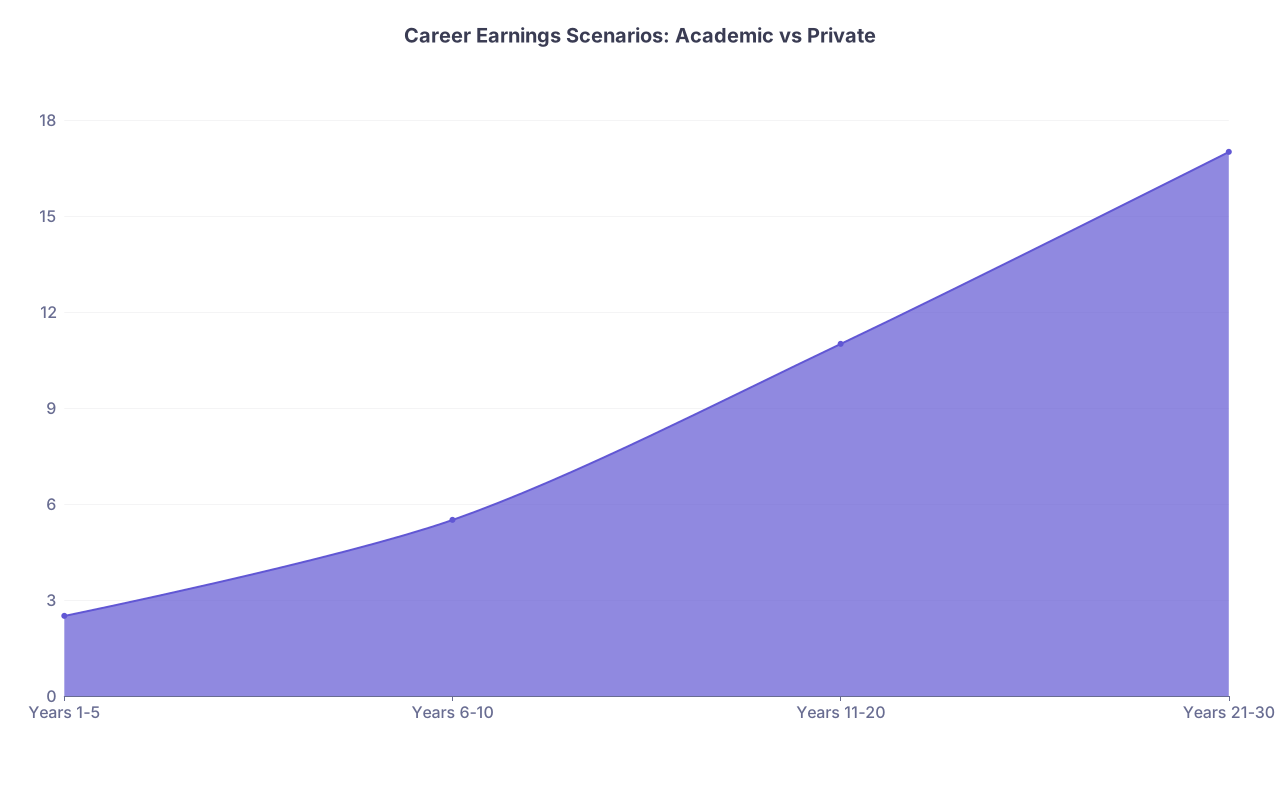
| Category | Value |
|---|---|
| Years 1-5 | 2.5 |
| Years 6-10 | 5.5 |
| Years 11-20 | 11 |
| Years 21-30 | 17 |
Imagine two interventional cardiologists:
- Doc A: Goes straight into a strong academic job. Starts at 550k, grows to 700k over 10–15 years. Never owns labs. Stays at 700–750k.
- Doc B: Takes hospital-employed job at 600k for 3–5 years, then buys into a group / lab. From year 10 onward, making 900k–1M+.
The first five years? Similar. Over 25–30 years? The compounding difference is millions.
Alternatively, some people do the reverse: academic early, then private later once kids and loans force the issue. You can absolutely pivot out. Your “academic penalty” then hits just part of your earning curve, not all of it.
The Ugly Truth No One Tells Residents
The biggest mismatch is this: residents talk about “academic vs private” like it’s a philosophical identity choice.
Hospitals and groups treat it like a financial arbitrage.
Academic centers lean hard on mission language to justify paying less for the same RVUs, same call, same risk. Private groups lean hard on partnership dreams to justify underpaying early and shifting risk onto new associates.
You’re the one who pays if you don’t run the math.
And here is the actual punchline to your original question:
Who actually takes home more money, academic or private?
- At the median, in high-paying specialties, private practice (especially partnership-track) almost always wins by a wide margin over a 20–30 year career.
- At the early-career level, academics vs hospital-employed private can be surprisingly close, especially in big hospital systems where “academic” is mostly a brand overlay.
- At the top end, the ceiling is not even comparable. Academic stars can do very well, but private partners in the right fields and markets absolutely out-earn them, sometimes by 2–3x.
Just be clear on what you’re buying and what you’re selling.


| Step | Description |
|---|---|
| Step 1 | Residency |
| Step 2 | Private practice track |
| Step 3 | Academic or Hybrid |
| Step 4 | Equity and higher ceiling |
| Step 5 | Hospital employed private |
| Step 6 | Academic with private-level workload |
| Step 7 | True academic with protected time |
| Step 8 | High income priority |
| Step 9 | Partnership option |
| Step 10 | RVU heavy? |


Bottom Line: What You Should Actually Do With This
Three clear takeaways:
Private practice—especially partnership with real ownership—almost always wins on lifetime income in the highest paid specialties. The gap between a long-term academic and a successful private partner can be measured in millions, not tens of thousands.
Titles lie; contracts and RVUs tell the truth. “Academic” vs “private” is less important than: What’s the base? What are the RVU thresholds and $/RVU? Is there call pay? Is there equity or a realistic path to it?
If you choose academics, do it with your eyes open. You’re probably trading real money for research, teaching, prestige, or complex cases. That can be a rational trade. Just do not pretend the incomes are equivalent at the top end. They are not.
You get one attending career. Believe the data, not the lounge mythology.