
Most of what residents believe about call pay in high-earning specialties is flat-out wrong.
I’ve watched people pick specialties, jobs, even cities based on fantasy numbers they saw in a Reddit thread or heard from “a guy who knows a partner in ortho.” Then they get their first attending offer and realize: the big money stories were either half-truths or tied to very specific, unpleasant situations.
Let’s tear this open.
Myth #1: “High-paying specialties always get huge call pay”
No. High-paying procedural specialties often get less call pay than lower-paid ones — as a percentage of income — and sometimes none at all.
Look at the typical pattern in many markets:
- Orthopedic surgery, neurosurgery, interventional cardiology, GI, IR: frequently high base or RVU comp, but call is baked into that package.
- Hospitalist, general surgery, anesthesia, OB/GYN in some markets: often more explicit per-shift or per-24-hour call pay, especially for extra or uncovered shifts.
The big trap: confusing total compensation with explicit call pay.
A lot of the “my buddy makes $1M and gets $5K per night of call” stories actually look more like this when you see the contract:
- Partnership track
- Heavy call that’s “part of being in the group”
- Explicit call pay only for additional unassigned shifts or for covering another hospital
- A huge total comp number, yes — but the call component is buried in:
- RVUs from emergencies
- Trauma add-on fees
- Stipends paid to the group that never show up as a separate “call pay” line item in your paycheck
Hospitals love this arrangement because it’s simple: pay the group a big block of money, let the group handle internal distribution. Residents then hear only the total and think it’s all straight salary + call.
Here’s what’s closer to reality in many busy centers:
| Specialty | Explicit Call Pay for Partners | Call Included in Base/Prod | Extra Call Pay Common? |
|---|---|---|---|
| Orthopedic Surgery | Rare | Very common | Sometimes |
| Neurosurgery | Rare | Very common | Sometimes |
| Interventional Cardio | Rare | Very common | Sometimes |
| GI (advanced) | Sometimes | Common | Yes |
| IR | Sometimes | Common | Yes |
The big-earning specialties absolutely get paid for call. But for many, it’s not “$X per night.” It’s higher partner draws, ownership distributions, professional fees from emergency cases, and hospital stipends — things that residents don’t see clearly.
Myth #2: “$3–5K per 24-hour call is normal if you’re in a top-paying field”
This is one of the most persistent myths, especially in ortho, neurosurgery, and interventional cardiology.
Yes, there are people getting $3–5K for 24-hour call. But when you drill down, the pattern is almost always:
- Low desirability market (rural, hard-to-recruit region)
- High burden call (solo coverage, level I/II trauma, stroke call, STEMI call)
- Frequent actual night work, not “sleeping at home most nights”
- True 1:2 or 1:3 call, with very limited backup
For most metro or desirable markets, numbers tend to look more like:
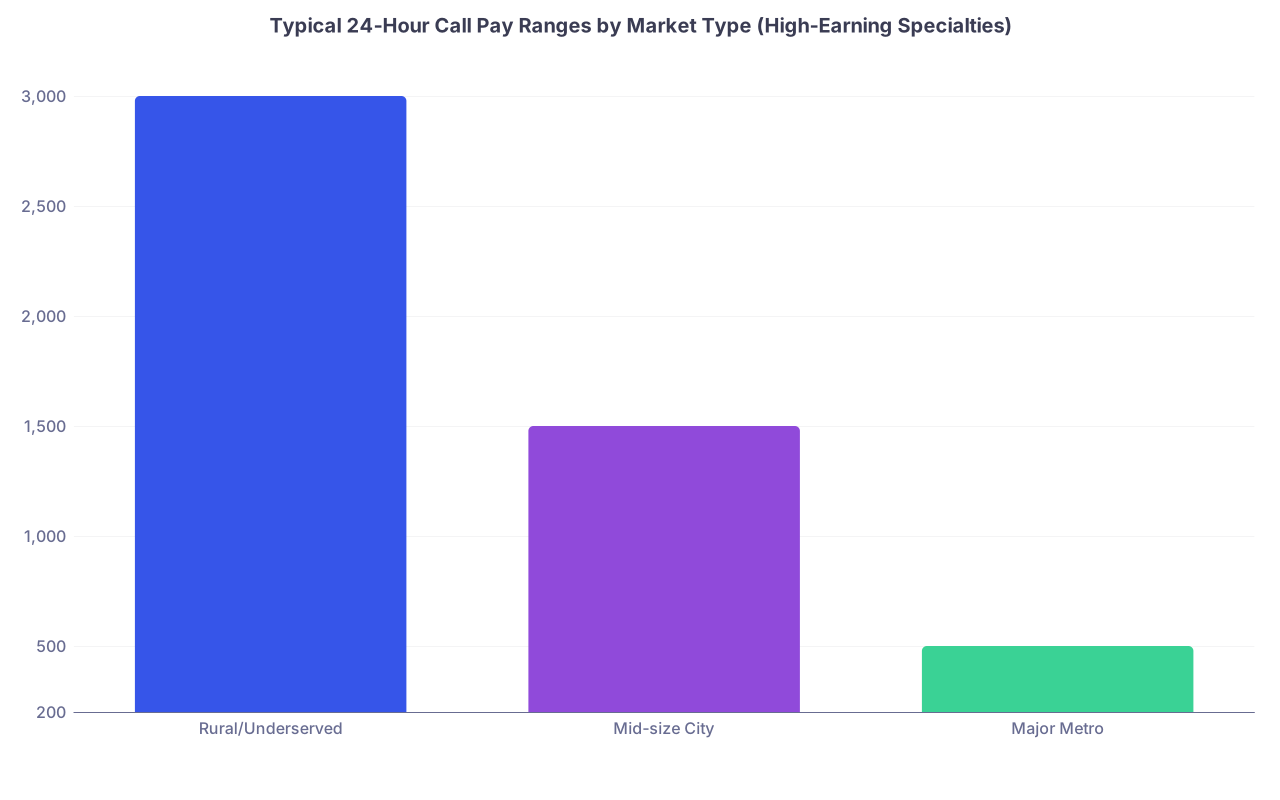
| Category | Value |
|---|---|
| Rural/Underserved | 3000 |
| Mid-size City | 1500 |
| Major Metro | 500 |
That “Major Metro $500” bar often isn’t even a separate call stipend; it’s the approximate value of a small stipend or internal group pool divided by shifts.
I’ve seen neurosurgery jobs at big academic centers with:
- $0 explicit call pay
- Mandatory q3 or q4 home call
- “In exchange” for academic title and prestige
And private ortho groups with:
- Robust total comp ($800K+)
- But call is “part of partnership”; only extra nights beyond your base call get any pay, maybe $1–2K/24h at most.
Residents fixate on the outlier numbers. Recruiters and senior attendings in cushy situations conveniently forget to mention that those 5K/call jobs often have impossible schedules or extreme lifestyle costs.
Myth #3: “Surgeons and interventionalists always get more call pay than ‘cognitive’ docs”
Sometimes. Not reliably.
Call pay is less about specialty prestige and more about:
- How hard you are to replace in that market
- Whether the hospital is legally/financially exposed if they cannot meet coverage requirements
- How directly your call coverage ties to hospital revenue
That’s why you can see weird situations like:
- A general surgeon in a mid-market community hospital getting $1K per weekday call + $2K per weekend day
- While a cardiothoracic surgeon in a saturated metro market gets nothing explicit — because there are 10 of them, and the hospital knows it
You also see cognitive specialists in some areas pull respectable call pay:
- Neurology stroke call
- Critical care in small ICUs
- Hem/Onc in certain cancer centers with severe shortages
The hierarchy residents imagine (ortho at the top, then neuro, then cards, then others) doesn’t consistently map to call pay.
Reality is uglier and more local.
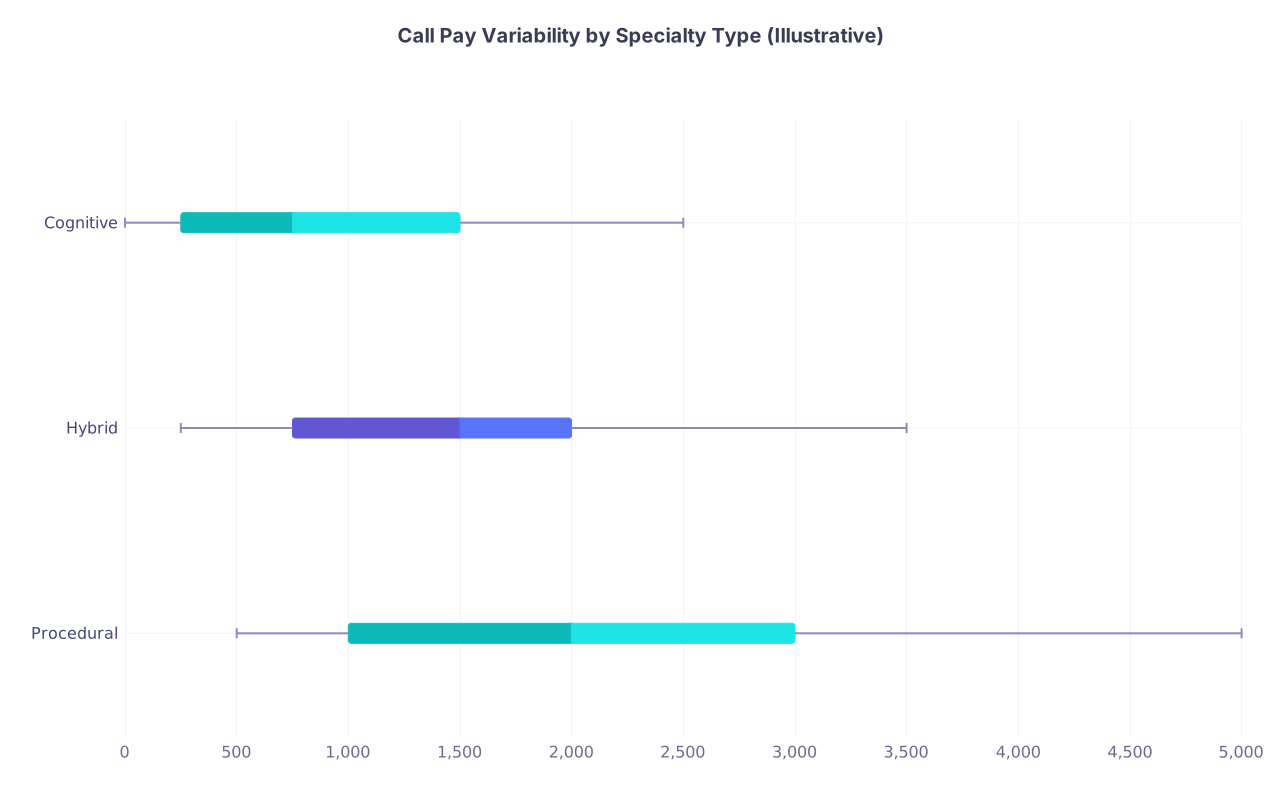
| Category | Min | Q1 | Median | Q3 | Max |
|---|---|---|---|---|---|
| Procedural | 500 | 1000 | 2000 | 3000 | 5000 |
| Hybrid | 250 | 750 | 1500 | 2000 | 3500 |
| Cognitive | 0 | 250 | 750 | 1500 | 2500 |
You’ll notice two things if you’re reading that right:
- The spread (min to max) is huge in all categories.
- There’s overlap. A cognitive field in a desperate market can out-earn a proceduralist on call pay alone in a saturated metro.
So no, being in a “highest paid” specialty doesn’t automatically protect you from mediocre call compensation.
Myth #4: “Partners get amazing call pay; associates just need to ‘wait their turn’”
Sometimes partners get amazing total comp. Different statement.
What I see over and over:
Associates:
- Small or no call stipend
- Heavy call share, often disproportionate (“you’re young, you can handle it”)
- Lower base + wRVU rate, minimal share of hospital stipends
Partners:
- Higher distributions from group profit
- Same or lighter call share
- Receive hospital or system call stipends paid to the group, not to individuals
The common bait-and-switch:
“Our group gets $X per month from the hospital for call. Once you’re partner, you’ll share in that.”
Translation: for the first 2–5 years, you’re doing a ton of call with zero of that stipend reaching you. When you become partner, yes, your “call pay” looks great on paper — but by then, it’s part of your overall distribution, not a discrete per-24h number.
If you’re a resident comparing offers, the key questions are painfully specific:
- “Is the hospital call stipend paid to the group or to individual physicians?”
- “How is that money divided between partners and associates?”
- “What is my call share as an associate vs partner?”
- “What explicit per-call or per-shift rate do I get, if any?”
Do not let someone hand-wave this with “it all evens out.” It never “just” evens out. Someone is subsidizing someone else. Often it’s the new person.
Myth #5: “Academic centers pay call badly; private practice and PP-hospital hybrids always win”
Academics often pay relatively poorly relative to workload, yes. That’s old news.
But the idea that private practice or “employed by private group with hospital stipend” always wins on call pay is too simplistic.
Patterns I’ve seen:
Academic, high-end neuro/ortho/cardiology:
- Weak or zero explicit call pay
- Tons of coverage expectations (trauma, ECMO, transplant, whatever flavor-of-the-month program leadership promised the C-suite)
- Prestige and niche experience as the “compensation” for brutal calls
Private group in same market:
- Modest or no explicit per-call rate
- Hospital pays a big annual stipend to the group to guarantee coverage
- Internal group politics determine who gets what, and it’s rarely transparent
- Can be a sleeper winner
- Smoother HR rules and compliance: hospitals more likely to put call stipends in writing
- Often more standardized per-shift/per-24h call pay, especially for extra shifts

| Step | Description |
|---|---|
| Step 1 | Hospital |
| Step 2 | Academic Dept |
| Step 3 | Private Group |
| Step 4 | Hospital Employed |
| Step 5 | Faculty |
| Step 6 | Partners |
| Step 7 | Associates |
| Step 8 | Employed Docs |
Notice who is in the weakest spot in this diagram: associates in private groups and junior academics. They often do the most work for the least direct call compensation.
So no, private does not automatically mean “great call pay.” It often means “less regulated, more opaque, and very dependent on local personalities.”
Myth #6: “Call pay is the main financial lever in high-earning specialties”
For the highest-paid fields, call pay is not the main lever. It’s a side dial.
Here’s where the real money tends to be:
- Partnership track vs permanent employed status
- Practice ownership (ASC, imaging centers, ancillaries)
- Payer mix and local contracts
- RVU rate or collections formula
- Volume and case mix: bread-and-butter vs complex but low-paying
Call pay is rarely the thing that takes you from $600K to $1M. More often, it’s the thing that adds or subtracts $30–100K at the margin.
That does not mean you ignore it. You absolutely should not. But if you’re obsessing over whether you’re getting $1,200 vs $1,800 per 24-hour call and ignoring:
- Whether the group owns the surgery center
- Whether partners get a cut of imaging or procedural facility fees
- Whether you’re locked into a low RVU contract with no upside
…then you’re focusing on the wrong axis.
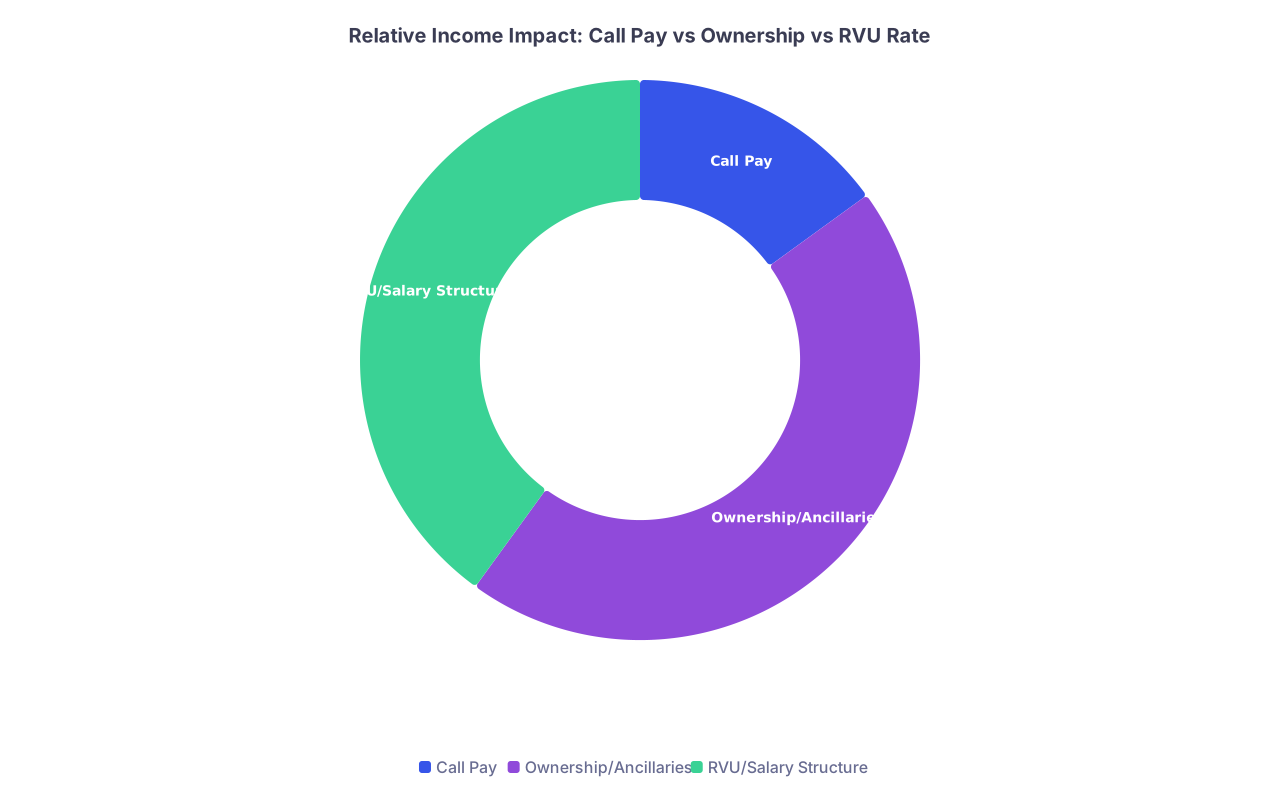
| Category | Value |
|---|---|
| Call Pay | 15 |
| Ownership/Ancillaries | 45 |
| RVU/Salary Structure | 40 |
This is why you’ll meet an ortho or GI doc with mediocre call pay but phenomenal total income. They optimized the big pieces.
Myth #7: “There’s a ‘typical’ call pay number for my specialty”
There isn’t. Not in any meaningful way.
What’s “typical” for GI in a Florida retirement community is laughable in a saturated West Coast metro. What’s common for IR in a big academic hospital means nothing in a 150-bed community facility that can barely keep call covered.
The variability drivers:
- Market desirability (coastal city vs Midwest town of 40K people)
- Call burden (q2 vs q7)
- In-house vs home call (and how often you actually get called in)
- Procedural volume from call (do you bill for middle-of-the-night cases or mostly phone calls?)
- Hospital dependence on your coverage to keep service lines alive (trauma designation, stroke center, cath lab status, etc.)
You can sometimes extract ballpark ranges from MGMA or local salary surveys, but they’re crude. The real benchmark is local comparables, not national averages.
If you want actual leverage, your homework is:
- Talk to fellows who just took jobs in your specialty.
- Ask them explicit questions:
- “What’s your 24-hour weekday call pay?”
- “Weekend 24h call pay?”
- “How often are you actually in-house overnight?”
- “Is call equal between partners and associates?”
- Compare 3–5 real offers, not a Reddit fantasy thread.
How to Actually Evaluate a Call Package (Without Lying to Yourself)
Instead of asking “What’s typical?” you should be asking, “Is this call setup rational for the work, location, and total package?”
Quick framework:
Call frequency
- q2? q4? q7?
- Any backup call? Is that paid?
Work intensity
- How often do people get called in?
- Is this mostly phone management, or are you in the OR/cath lab/IR suite at 2 a.m. twice a week?
Explicit pay
- Per 24h?
- Different rate for weekends vs weekdays?
- Any extra rate for holidays?
Implicit pay
- Do you bill for middle-of-the-night cases?
- Does call generate high RVUs that you actually see in your paycheck?
- Is there a hospital stipend quietly bumping up partner distributions?
Equity between ranks
- Are associates doing more call than partners for less effective compensation?
- What’s the timeline and certainty of reaching partner level?
Add those up and compare to other concrete offers, not to mythical “typical” numbers floating around online.
The Bottom Line: What’s Really Typical
Strip away all the posturing and selective storytelling, and here’s what usually holds true in the highest paid specialties:
- Call pay exists, but it’s messy and often hidden. It’s baked into partner distributions, hospital stipends, and night-time RVUs more than clean per-24h numbers.
- Huge per-call numbers are outliers, not norms. When you see $3–5K per 24-hour call, assume: less desirable location, brutal call burden, or both.
- Local market and practice structure matter more than specialty label. “I’m in ortho/neuro/cards/IR” tells you almost nothing about call pay. “I’m in a two-hospital call pool in a midwestern town with a hospital stipend to the group” tells you a lot.
If you remember that, you’ll make better decisions than the residents chasing ghost stories about mythical $10K weekends.