
The obsession with “highest paid specialties” is one of the worst decision tools you can use in medicine—and the long‑term data makes that painfully obvious.
The Salary List Trap
Every year the same charts make the rounds: orthopedics, plastics, cardiology, derm at the top; primary care, peds, psych near the bottom. Residents share them on Reddit, premeds screen‑shot them for “motivation,” and a few attendings smirk and say, “See, this is why you don’t do pediatrics.”
Here is the uncomfortable truth: those lists are mostly snapshots of current market distortions, before‑tax and before‑life‑happens numbers, entirely detached from:
- Time to peak earnings
- Realistic tax burden
- Career longevity and burnout
- Geographic variation
- Future reimbursement risk
In other words, they tell you almost nothing about your actual lifetime financial reality.
Let me show you what the numbers really say.
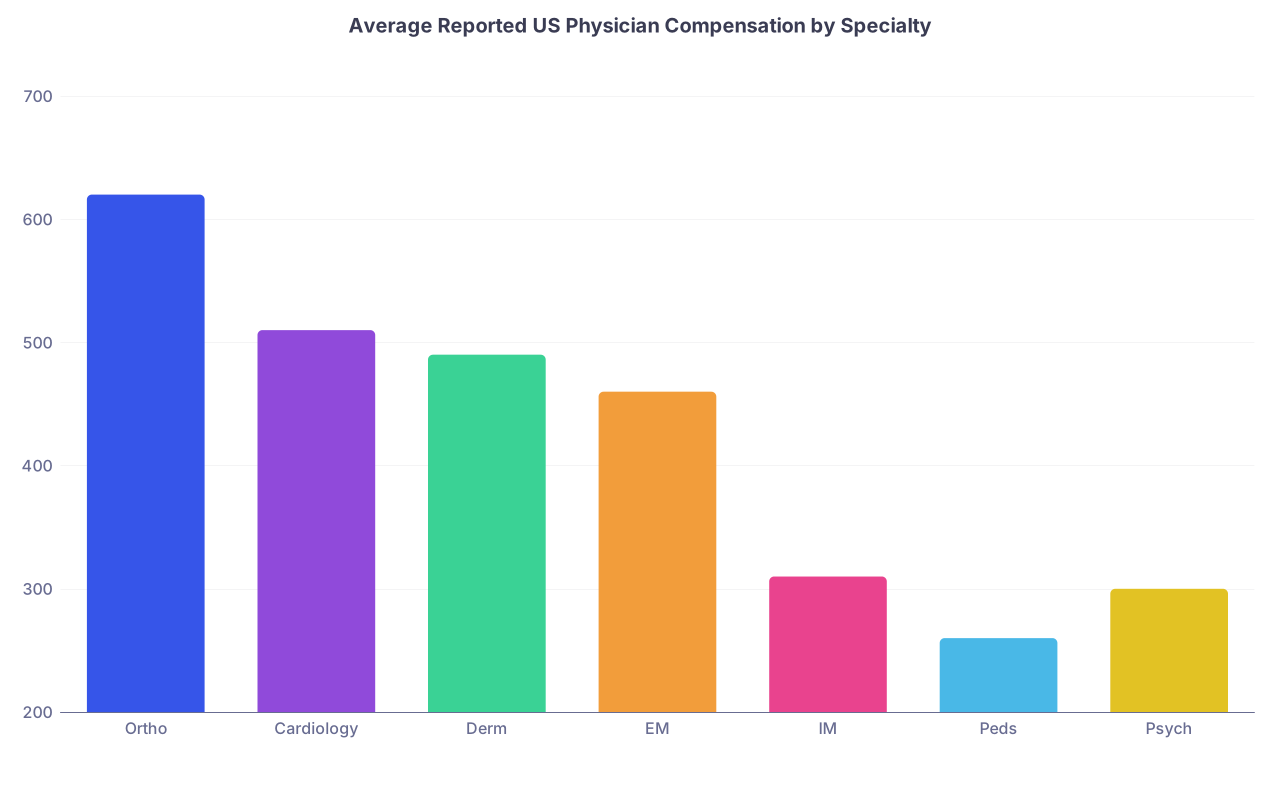
| Category | Value |
|---|---|
| Ortho | 620 |
| Cardiology | 510 |
| Derm | 490 |
| EM | 460 |
| IM | 310 |
| Peds | 260 |
| Psych | 300 |
Those numbers look dramatic. But as soon as you plug in training length, debt, taxes, and burnout risk, the clean hierarchy falls apart.
Training Length: The Silent Salary Killer
The “highest paid specialties” lists almost never adjust for when you actually start earning that money as an attending. That is not a small omission. That is the whole game.
Compare three simplified paths, all starting right after college:
| Path | Total Training (Med + Res/Fellow) | Age at Attending Income* |
|---|---|---|
| Pediatrics | 4 med + 3 res = 7 years | ~29–30 |
| Emergency Medicine | 4 med + 3–4 res = 7–8 years | ~30–31 |
| Interventional Cards | 4 med + 3 IM + 3 cards + 1–2 IC | ~33–35 |
*Assuming med school start around 22.
That cardiology/interventional cardiology pay bump? Often delayed 4–6 years compared with peds or EM. Those 4–6 years are not just delayed satisfaction; they are 4–6 years of attending‑level income you never get back.
If you keep everything cartoonishly simple:
- Pediatrician starts at 30 making $260k
- Interventional cardiologist starts at 35 making $600k
Let’s crude‑estimate the missed earnings: if the pediatrician earns on average $260k from 30–35 while the future IC makes ~$70k as a trainee, that’s roughly:
- Peds: 5 × $260k ≈ $1.3M
- IC trainee: 5 × $70k ≈ $350k
Difference: about $950k of lost early‑career earnings for the “higher paid” path.
Does the IC eventually catch up? Yes—often. But that lead time matters. Compound investing, home purchase, kids, geographic flexibility… all anchored to those early earning years.
And that’s before we talk about burnout and exit rates.
Burnout, Attrition, and the Mirage of “Average Income”
Salary lists assume a fantasy world where:
- Everyone works full time forever
- No one burns out or cuts back
- Nobody switches jobs, goes part‑time, or leaves clinical work
That is not the world you’re walking into.
Take emergency medicine and orthopedic surgery—both historically high‑paying and high‑demand. Over the last decade, EM has seen rising burnout, market saturation in some regions, and shifts in coverage models. I have watched multiple EM attendings voluntarily go 0.6–0.8 FTE by year 10 because nights, weekends, and the constant churn finally break them down.
When you go from full‑time $460k EM to 0.6 FTE to survive, your “highest paid” spot on a list suddenly looks different. While your med school classmate in outpatient psych, making a supposedly “low” $300k, is still working steadily at 1.0 FTE with no plans to throttle back.
The meaningful question is not, “What is the top‑end full‑time RVU‑maxed salary right now?” It is, “What is the realistic, sustainable income over 20–30 years for a human who wants a life and a spine that still works at 55?”
High‑earning, high‑burnout specialties quietly accumulate physicians who:
- Cut to part‑time
- Move to non‑clinical roles
- Switch to lower‑paying but livable jobs
- Retire early at a financial discount, out of sheer exhaustion
Salary lists do not count those people. Your bank account will.
The Real Math: Lifetime Earnings, Not First Contract
Most people never actually sit down and model lifetime earnings. They get hypnotized by first‑job offers and MGMA medians.
Let’s compare two very rough career arcs for illustration. Yes, this is simplified. No, it is not that far from reality.
Scenario A: General internist, hospitalist, 3‑year IM residency, starts attending at 30, earns steady money, mild burnout, works to 65.
Scenario B: Orthopedic surgeon, 5‑year residency + optional fellowship (ignore for simplicity), starts attending at 32, higher burnout, higher pay, goes hard early and then downshifts later.
Assume:
- Hospitalist: $310k/year for 35 years (age 30–65), stays full‑time
- Ortho: $620k/year for 15 years full‑time, then 0.6 FTE (~$372k) for 10 years, retires at 57 from clinical practice
Ignore investment returns and just multiply:
- Hospitalist: 35 × $310k = $10.85M career gross
- Ortho: (15 × $620k) + (10 × $372k) = $9.3M + $3.72M = $13.02M
Yes, ortho still wins in this crude model. But the margin is narrower than the “almost 2× salary” headlines suggest, especially when you remember:
- Ortho started 2 years later
- Ortho had higher opportunity cost during training
- Ortho often carries higher malpractice costs, overhead, and job volatility
- Slight changes in working years or FTE can swing this in either direction
If the orthopod retires even earlier (not uncommon) or goes 0.5 FTE earlier, that gap closes fast.
Now bring taxes into it.
Taxes: The Progressive Reality That Nobody Puts on Slides
High salary lists show pre‑tax numbers. And the US tax code is not linear. The more you earn, the more each additional dollar gets chewed up.
Translated: the jump from $300k to $600k is not a doubling of take‑home pay.
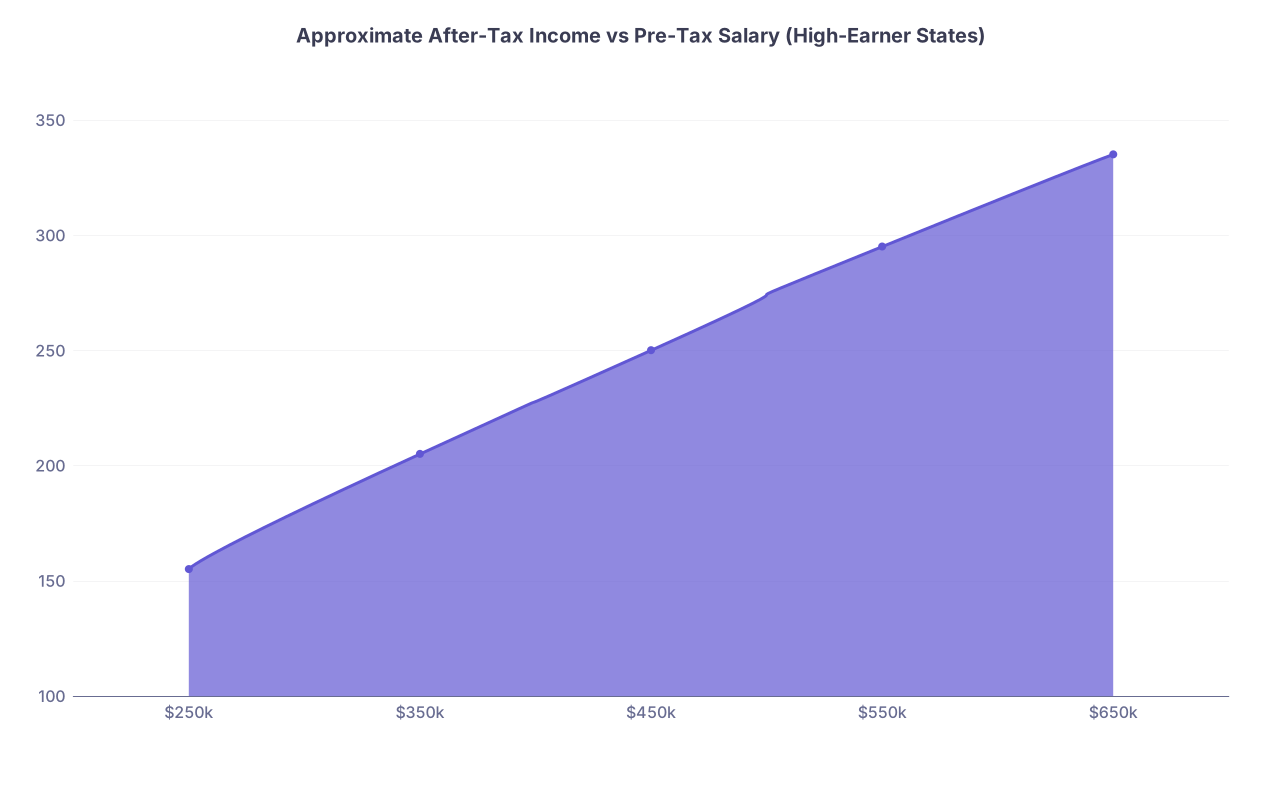
| Category | Value |
|---|---|
| $250k | 155 |
| $350k | 205 |
| $450k | 250 |
| $550k | 295 |
| $650k | 335 |
These are rough ballparks assuming combined federal + state + payroll taxes in a relatively high‑tax state, filing as a single high earner.
Look at that curve:
- $250k → ~$155k take‑home
- $350k → ~$205k (pre‑tax up 40%, take‑home up ~32%)
- $450k → ~$250k (pre‑tax up 80%, take‑home up ~61%)
- $650k → ~$335k (pre‑tax up 160%, take‑home up ~116%)
So going from a “lowly” $300k to a glamorous $600k might move net income by something like $90k–$120k per year, depending on state and deductions. Good money, yes. But not the massive chasm the gross salary chart suggests.
Now ask yourself the non‑romantic question:
Is that extra $100k/year, after taxes, worth:
- Extra years in training
- Higher risk of job volatility and reimbursement cuts
- More call, nights, weekends
- Higher burnout and earlier exit from the field
For some people the answer is absolutely yes. For many, once they do the math and subtract the Instagram flex, it is not.
Future Risk: Today’s “Top” Is Tomorrow’s Cautionary Tale
Salary lists are historical artifacts plus a tiny bit of last‑year’s survey data. They are not predictive. They do not tell you what your field will look like in 20 years.
We have already watched this movie:
- Emergency medicine was the darling of high‑pay, flexible‑schedule specialties. Then: more residency spots, corporate groups, oversupply in some regions, threat of mid‑level replacement, and algorithmic scheduling. The salary picture is already wobbling.
- Radiology and anesthesiology have both spent years as “future of AI/CRNAs” punching bags. Reimbursement has seesawed with regulatory changes, consolidation, and hospital negotiation power.
- Primary care reimbursement has been depressed for years, then suddenly everyone wakes up to chronic disease, aging populations, mental health crisis… and suddenly longitudinal outpatient care starts to look strategically crucial again.
You are not choosing a 2024 salary list. You are choosing a risk profile.
Your best defense against future volatility is not gaming which line is highest on this year’s bar graph. It is choosing a specialty where:
- You are good enough to be in the top tier of that field
- You actually like the work enough to pivot, survive, and adapt for decades
Because when reimbursement shifts (and it will), the people who stay employable and relatively well‑paid will be the ones who can’t easily imagine doing anything else.
Lifestyle, Autonomy, and “Effective Hourly Rate”
A sneaky myth in these rankings: that headline annual salary captures “how good the job is.” It doesn’t. At all.
If you are working 70–80 hours a week with q3 call, a $600k salary can quietly have a worse effective hourly rate and lower life satisfaction than a “lowly” $280k outpatient job with minimal call and true 40‑hour weeks.
Residents almost never calculate this. They see the MGMA mean, not the:
- Call burden
- Emotional load
- Documentation volume
- Night/weekend expectations
- Control over schedule
I have met multiple radiologists who make less than the flashy survey numbers but have near‑total control of their hours and work part‑time telerad from home in mid‑cost‑of‑living areas. Their after‑tax, after‑commute, after‑burnout lives crush many so‑called “top earners.”
On the flip side, I have seen surgical subspecialists earning huge numbers who are functionally trapped: golden handcuffs, massive fixed overhead, kids in private schools, big mortgage, no flexibility to cut back because their entire household budget assumes peak income forever.
High listed salary does not automatically mean high freedom.
Geography: Your Zip Code Beats Your Specialty
This one rarely gets said out loud: where you practice often matters more than what you practice.
A $300k psychiatrist in a state with no income tax and reasonable housing can easily outrun the after‑expenses life of a $500k subspecialist in San Francisco, New York, or Boston once you:
- Pay state + city tax
- Pay for childcare
- Pay for housing in a major metro
A family med doc in a medium‑COL city with a paid‑off house, sensible spending, and basic investing discipline can end up wealthier—and less stressed—than a high‑earning coastal proceduralist who spends everything they make to keep up with their own peer group.
So when a student says, “I’m thinking cardiology because the salaries are insane,” but then also tells me they want to live in downtown Boston or Manhattan… I know they have not run the actual numbers.
So How Should You Use Salary Data?
Here is what salary data is actually good for:
- Flagging truly underpaid or exploitative offers within a field
- Understanding rough pay bands across specialties, not precise rankings
- Planning loan repayment and basic financial strategy
- Negotiating your first contract with some sense of normal ranges
What it is terrible for:
- Choosing a specialty
- Predicting your individual lifetime wealth
- Deciding who in your class is “winning”
If you must use it, at least adjust for:
- Training length (years to attending)
- Realistic FTE (how many people actually sustain full‑tilt work)
- Taxes in the places you might live
- Your own tolerance for call, nights, procedures, and stress
And then ask the brutal question: “Would I still do this if it paid family‑medicine money?”
If the answer is no, walk away. Because payment structures change. Fast.

| Step | Description |
|---|---|
| Step 1 | Look at salary list |
| Step 2 | Do not choose this specialty |
| Step 3 | Consider long term risks and training |
| Step 4 | Make specialty choice |
| Step 5 | Would you like the work at 70 percent pay |
| Step 6 | Can you handle the lifestyle |
The Bottom Line: Smart, Not Shiny
Let me be blunt.
If you are chasing the “highest paid specialties” list as your main compass, you’re playing a short, shallow game in a long, brutal career.
Three things to actually remember:
Headline salary is a noisy, pre‑tax, short‑term metric. Training length, burnout, FTE, taxes, geography, and career longevity matter more to your lifetime financial reality than a single MGMA number.
Future risk and sustainability beat current rankings. You want a specialty you can still stand—and still be good at—20 years from now, across reimbursement cuts, policy shifts, and life changes.
Choose the work you can tolerate on your worst day, even at lower pay. If you would only do a specialty for its current spot on a salary chart, that is a terrible bet. The chart will change. Your job will not.
The smart move is not to ignore money. It is to stop being hypnotized by the top of the list and start thinking in decades, not surveys.