
Only surgeons get rich? Wrong. The data say something very different—and honestly, a lot more interesting—than the macho hallway mythology you hear on surgery rotations.
If you hang around hospitals long enough, you’ll hear the same tired lines:
“Derm and ortho are the only real money.” “Medicine folks just love being poor.” “Psych and peds are charity work.”
Most of that is garbage, or at least badly outdated. The real story is more nuanced and, in a few places, the exact opposite of what med students believe on rounds.
Let’s walk through what the income data actually shows, specialty by specialty, and kill a few myths along the way.
The Big Picture: Who Actually Sits at the Top?
Before slicing up the myths, let’s anchor in numbers. Recent large surveys (Medscape, MGMA, compensation reports from big systems) consistently show a familiar pattern: procedural and lifestyle-heavy specialties dominate the top of the pay scale.
Here’s a simplified snapshot using rounded national patterns, not a single survey year, to make the hierarchy clear:
| Specialty Group | Typical Range (USD) |
|---|---|
| Orthopedic Surgery | 600k–900k+ |
| Plastic / Neurosurgery / Cards | 550k–900k |
| Radiology / GI / Anesthesia | 450k–700k |
| EM / Urology / Derm | 400k–650k |
| General IM / Peds / Psych | 220k–350k |
Notice something?
Surgeons are high earners, yes. But:
- They do not uniquely “own” the top of the income spectrum.
- Several non-surgical fields sit right beside them.
- Some so‑called “lifestyle” specialties print money.
The question isn’t “Do surgeons get rich?” It’s “Is surgery the only path to high income?” And the answer is a straightforward no.
Myth 1: “If You Want to Make Money, You Have to Be a Surgeon”
This is the classic med school myth, fueled by cocky PGY‑2s bragging about future RVUs between cases.
Let me be blunt: it’s numerically false.
Across the last decade, the list of top-earning specialties has consistently included:
- Orthopedic surgery
- Plastic surgery
- Interventional cardiology
- Cardiac surgery
- Gastroenterology
- Radiology (especially interventional)
- Anesthesiology
- Some subspecialized urology
- Radiation oncology
Only some of that is “surgery” in the traditional “cutting in the OR” sense. Interventional radiologists, for instance, are not surgeons—but their income often rivals or beats many surgical subspecialties.
To visualize the breakdown, think of “high-income medicine” more by procedure intensity than by “surgical” versus “non-surgical.”
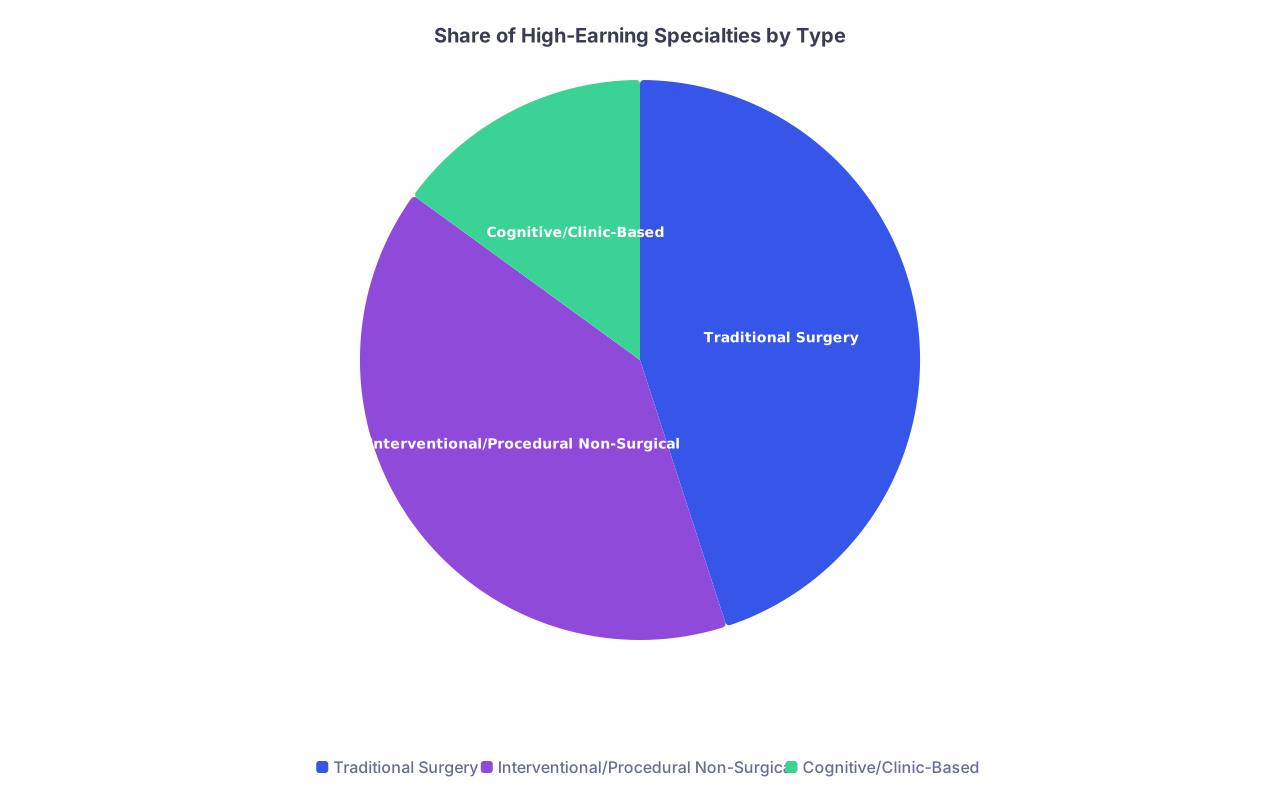
| Category | Value |
|---|---|
| Traditional Surgery | 45 |
| Interventional/Procedural Non-Surgical | 40 |
| Cognitive/Clinic-Based | 15 |
The majority of top-paying roles are either:
- Traditional OR-based surgery
- Non-surgical procedural work (caths, scopes, IR, EP, etc.)
But pure “cognitive” fields—fields built mostly on thinking rather than cutting or scoping—rarely crack the top tier unless you add something else: ownership, niche expertise, or volume-heavy models.
Key point: You absolutely do not have to be a surgeon to earn at the very top. You do usually need procedures, leverage, or scale.
Myth 2: “Lifestyle Specialties = Low Pay”
This one is especially popular among people who haven’t seen actual contracts.
There are lifestyle fields that pay badly, yes. But some of the best lifestyle–income combinations in medicine are not in the OR.
Let’s talk specifics.
Dermatology
- Frequently in the 400k–700k+ range, sometimes more with cosmetics or practice ownership.
- Clinic hours. Elective procedures. Many part-time options.
- “Poor but happy”? Not even close.
Radiology
- General rads often 450k–600k, IR higher.
- Flexible schedules, telerads, fewer in-person hassles.
- Not “lifestyle” in the nap-on-the-beach sense, but good control and high pay.
Anesthesiology
- Group-dependent, but 450k–700k is common in high-demand markets, plus locums can spike that further.
- Shift-based. When the case list is done, you’re done. No clinic days of 25 angry follow-ups.
Emergency Medicine
- Historically 350k–500k for full-time, though market pressures have been hitting EM hard lately with more corporate staffing and saturated markets.
- Still shift-based. No call. How sustainable that income is over 10+ years in a given region is another question, but “low pay” is not accurate.
Contrast that with something like general internal medicine or pediatrics outpatient:
- Many primary care internists: 220k–320k
- Outpatient pediatrics: 200k–280k
- Psych: 250k–350k (but with huge upside for high-efficiency private practice or telepsych)
So yes, primary care and traditional cognitive fields are clearly lower paid on average. But “lifestyle specialty means low pay” is lazy thinking.
Reality: A cluster of “lifestyle-ish” fields—derm, rads, anesthesia, EM—routinely out-earn many general surgeons and a lot of non-ortho surgical subspecialties, especially when you factor in call burden, night cases, or academic salaries.
Myth 3: “All Surgeons Are Loaded”
Even inside surgery, the story is not uniform.
Orthopedic surgery and plastic surgery are usually near the top. Neurosurgery and cardiothoracic surgery can go very high, with punishing hours but huge pay for certain private groups.
But then there’s:
- General surgery: decent, but often in the 350k–550k range depending on region, call, and trauma load. You can do better; you can also do worse, especially in academics.
- Vascular surgery: good but not always sky-high; reimbursement and call can be brutal.
- Trauma surgery: often underpaid relative to hours, lifestyle, and risk. Academic trauma surgeons can sit in the 350k–450k range while being in-house at 2 am managing chaos.
Even orthopedic surgeons can make very “normal” money if they’re hospital-employed in a low-RVU, low-volume setting with salary caps.
So no, “be a surgeon” is not a cheat code. You can land in a very comfortable upper-middle-class bracket. You can also work like a dog and watch non-surgeons out-earn you with fewer nights in the hospital.
Myth 4: “Income Is Decided by Specialty Alone”
This is one of the most dangerous simplifications students make.
Within almost every specialty, there’s a 2–3x spread based on:
- Geography (rural vs big coastal city)
- Employment model (academic vs private vs corporate)
- Ownership (partner vs employee)
- Procedure mix (e.g., derm with cosmetics vs pure medical derm)
- Call and hours (24/7 coverage vs no call vs tele-only)
I’ve seen:
- A community hospitalist making 350k+ on a 7-on/7-off model with some extra shifts, easily out-earning many fellow grads who went into low-end surgical gigs.
- A pediatric intensivist in the low 300s while a telepsych doc cleared 500k working from home with aggressive scheduling and group ownership.
- A private GI doc in a medium city breaking 900k while an academic orthopod in a famous coastal institution sat in the 350k range.
So yes, specialty has a huge effect. But it’s not the whole game; it’s more like your starting position.
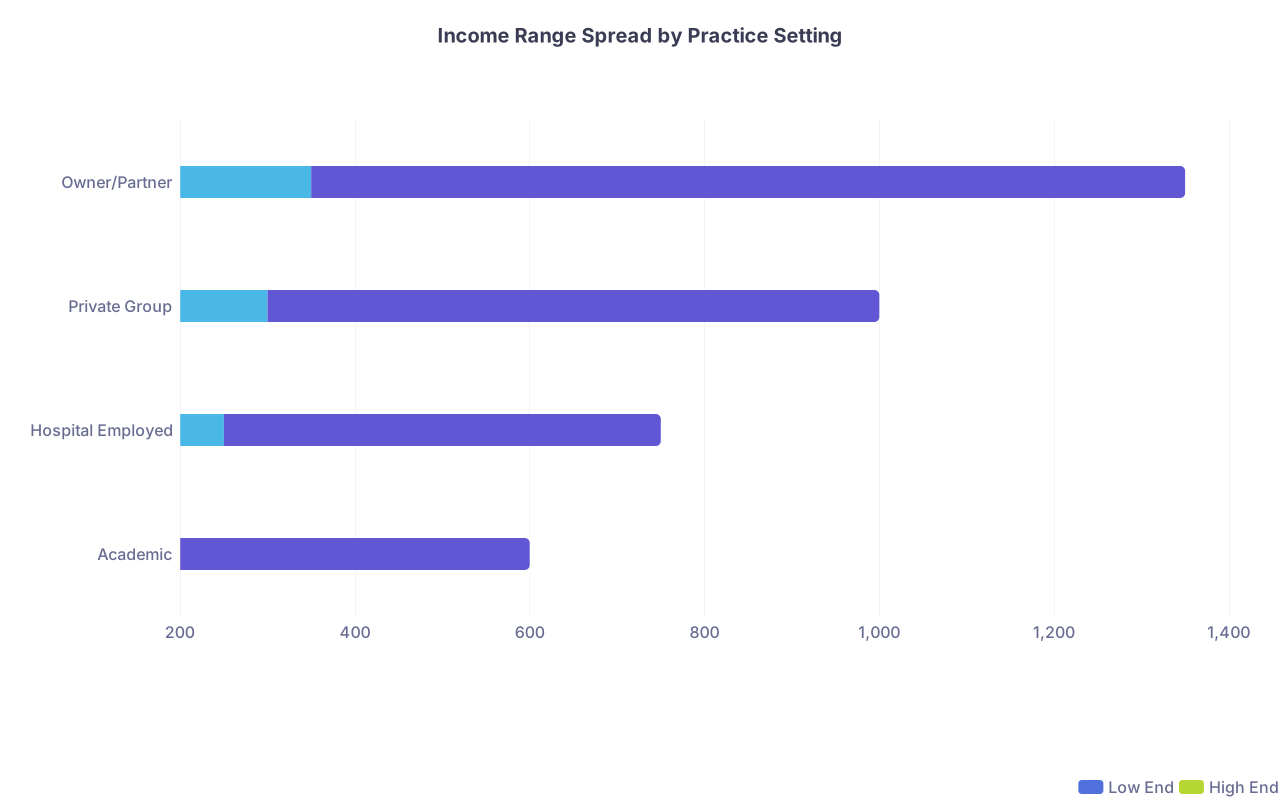
| Category | Low End | High End |
|---|---|---|
| Academic | 200 | 400 |
| Hospital Employed | 250 | 500 |
| Private Group | 300 | 700 |
| Owner/Partner | 350 | 1000 |
You’ll notice the same trend across specialties: ownership and procedure-heavy private practice consistently beat salaried academic roles by a wide margin.
So if you’re choosing, say, cardiology vs anesthesia vs surgery purely based on the “average salary number” you saw in one PDF, you’re missing the real levers that drive wealth.
Myth 5: “If You Don’t Match Derm/Ortho, You’re Financially Screwed”
This one’s mostly anxiety in disguise.
Look at where physician wealth actually comes from over a 30‑year career:
- Income (yes, but not just the final annual amount)
- How fast you start earning (debt, training length, time to attending pay)
- Cost of living
- Spending habits and lifestyle creep
- Ownership (practice, real estate, side ventures)
- Investing (401k, brokerage, etc.)
The ortho attending starting at 600k at age 35 after fellowship is not necessarily ahead of the EM doc who’s been at 350k since age 30 in a low-cost city, living reasonably, maxing retirement, and not buying a $2M house.
Extended surgical training and fellowships delay:
- High income start date
- Loan payoff
- Investing while young (when compounding is most powerful)
So you might “win” the salary number on paper at 40, but lose 10 years of compounding. Over decades, that matters a lot more than med students want to hear.
There are plenty of non-surgeons who end up “wealthier” in terms of net worth, freedom, and actual life flexibility because they:
- Started earning earlier
- Lived in cheaper areas
- Avoided extreme lifestyle inflation
- Took equity in a group or real estate early
If you miss derm or ortho, you didn’t just lose your one chance at financial sanity. You lost one particular high-income, high-competition path. There are others.
How to Actually Think About Money and Specialty Choice
You should not pick pediatrics if you’ll resent every paycheck. You also should not pick neurosurgery if you dread calls, blood, and 2 am disasters.
Here’s a more honest framework:
Decide your non-negotiables
Do you absolutely hate call? Does the idea of being responsible for an ICU terrify you? Does clinic bore you? Those matter more than a 100k pay split.Know which broad buckets pay more
Procedural and interventional fields generally > pure cognitive. But within cognitive, some niches (psych, certain hospitalist models) can still do very well.Understand practice models
If you want max income, you’re almost always talking about:- Private practice or group ownership
- Procedural focus
- Non-coastal or at least not ultra-saturated markets
Recognize the cost of training length
Extra years of fellowship are a financial opportunity cost. Worth it if you love the work and the eventual income matches your goals. Not worth it if you’re just chasing prestige or med school chatter.Accept that “rich” is a moving target
A 450k anesthesiologist in a low-cost Midwestern city with a paid-off house is far “richer” in real terms than an 800k surgeon in San Francisco renting a 2-bedroom and paying private school tuition.
“Only surgeons get rich” is what people say when they haven’t run any numbers beyond “ortho big salary good.”
Quick Reality Checks by Specialty Type
To make this concrete during your specialty exploration:
Want both high pay and some life?
Look hard at radiology, anesthesia, GI, interventional cards, EM (regional caution), derm, IR.Okay with very long, intense training and brutal call for big upside?
Ortho, neurosurgery, CT surgery, some plastics. Incredible pay possible. Real risk of burnout.Care more about lifestyle, but still want decent money?
Psych, outpatient IM, hospitalist models, peds subspecialties, PM&R with pain/spine emphasis.Want academics and research more than a giant paycheck?
Expect a 20–40% haircut vs private practice in the same field. That’s not failure; that’s the trade.
And no, none of those paths require you to wear loupes and live in the OR to be financially secure.