
27% of US physicians earn less after completing a fellowship than they would have as generalists in the same field.
That’s not a typo. More than a quarter. After extra years of lower pay, more call, more exams, and more letters after their name… they actually come out behind financially.
The “fellowship = more money” story is one of the most persistent myths in medicine. It sounds logical: more training, more specialized skills, higher pay. And it’s sometimes true—interventional cardiology, GI, some surgical subspecialties. But in a lot of cases, especially if you care about total lifetime earnings, the data tell a very different story.
Let’s dismantle this properly.
The Core Myth: Extra Training = Extra Money
Most residents I talk to frame the decision like this:
“Yeah, fellowship is a grind, but I’ll make it back when I’m an attending. Subspecialists get paid more.”
Sometimes, yes. Often, no.
Here’s the part people usually ignore: time and opportunity cost. Those 1–3 years you spend making $70k–$80k as a fellow? Your classmates are out making $300k–$450k as generalists, paying down loans, contributing to retirement, maybe even building bonus structures or partnership equity.
To even break even, that fellowship payoff has to be substantially higher and sustained for years.
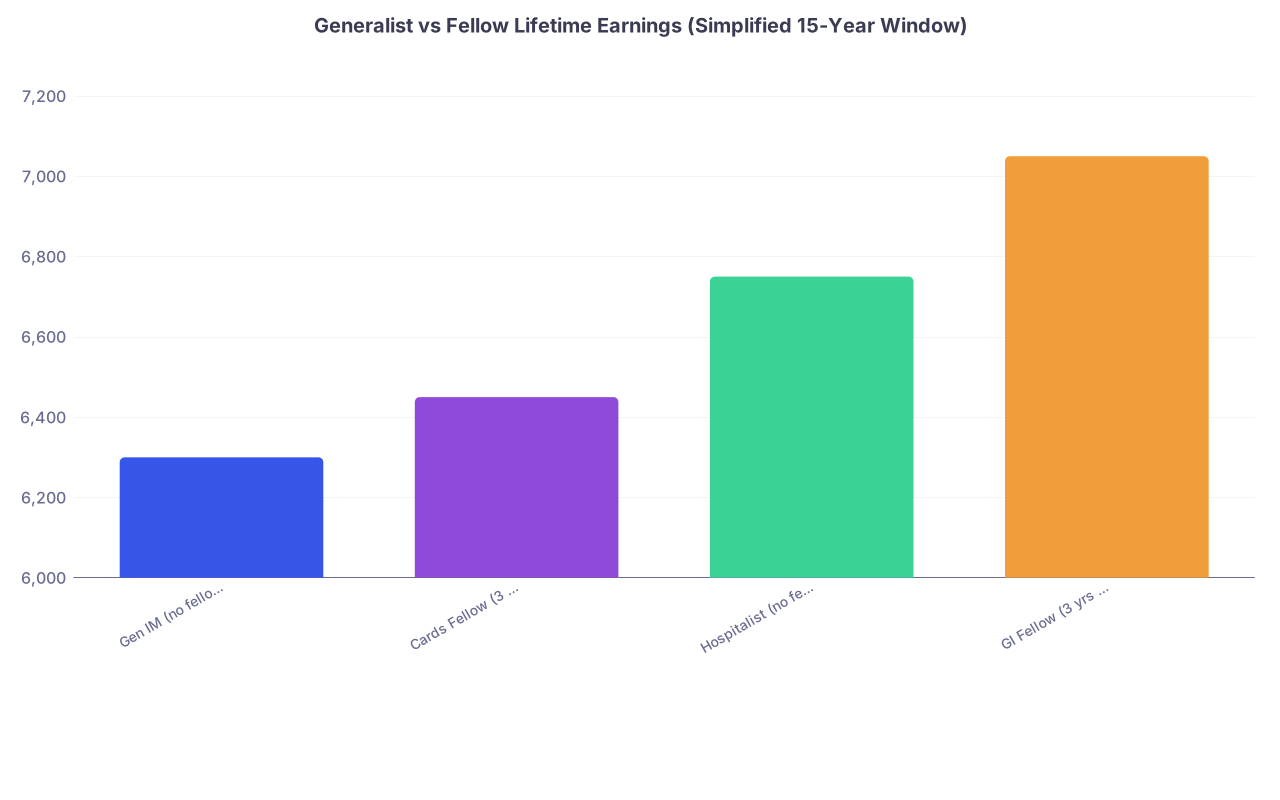
| Category | Value |
|---|---|
| Gen IM (no fellowship) | 6300 |
| Cards Fellow (3 yrs fellow) | 6450 |
| Hospitalist (no fellowship) | 6750 |
| GI Fellow (3 yrs fellow) | 7050 |
Numbers above are rough “thousands of dollars” over a 15‑year post‑residency equivalent horizon (including fellowship years), assuming realistic starting salaries and mild growth. Notice the gap is narrow—or reversed—for some paths once you factor the low‑pay years.
Let’s go specialty by specialty and name names.
Internal Medicine: When Fellowship Doesn’t Pay
Everyone knows the big earners: cardiology and GI. But that’s not most IM fellows.
The Quiet Losers: Endocrinology, Rheumatology, ID, Heme/Onc (in some markets)
Recent compensation surveys (think MGMA, Medscape, AMGA) consistently show these patterns:
| Role | Typical Range ($) |
|---|---|
| Hospitalist (no fellowship) | 280k–350k |
| Outpatient IM (no fellowship) | 240k–300k |
| Endocrinology | 220k–260k |
| Rheumatology | 250k–320k |
| Infectious Disease | 220k–260k |
| Hematology/Oncology | 350k–500k |
Yes, Heme/Onc can pay well. But the others? Endo and ID especially are notorious for lower compensation than well‑negotiated hospitalist or primary care jobs.
I’ve seen this play out over and over:
- Resident becomes hospitalist right out of IM: starts at $300k with a $20k sign‑on and loan repayment.
- Co‑resident goes to ID fellowship: 2 extra years at ~$70k, then finishes to a job offering $240k–$260k and heavy call for transplant, OPAT, HIV clinic, hospital consults.
Run that out 10–15 years and the hospitalist wins by a mile in pure dollars, even if the ID doc eventually creeps up in pay.
Why the Pay Gap?
Simple: weak billing leverage. Endocrinology and ID visits are time‑intensive, cognitively complex, and low-RVU. You’re not doing high-ticket procedures; you’re arguing with insurance about GLP‑1s or line infections.
If your main value is cognitive and system-level expertise, the US fee‑for‑service system just doesn’t reward you much more than a solid, high‑productivity hospitalist or PCP.
Pediatrics: Fellowship Can Be a Financial Trap
If you want a brutal example of “more training, similar or worse pay,” pediatrics is it.
General pediatrics doesn’t pay like orthopedics, but here’s the twist: many peds subspecialties also don’t pay. Some pay barely more than general peds… after 3 extra years of low-income training.
Rough patterns you’ll see in most surveys:
- General Peds: ~220k–260k
- Pediatric Hospitalist: ~230k–280k
- Many Peds Subspecialties (Endo, ID, Rheum, Heme/Onc in some settings): ~230k–300k
- Few Positive Outliers: NICU, some PICU and pediatric cardiology roles
You do three more years for peds endocrine, then step into a salary that is sometimes $10k–20k higher than your general peds colleagues. Sometimes not higher at all.
And again, you gave up three years of a $220k salary to earn $70k as a fellow. That’s roughly half a million in lost gross income, before even counting the compound growth if you’d been investing and paying debt earlier.
If you love the niche—great. But if you think “specialist = big raise,” you’re setting yourself up for disappointment.
Emergency Medicine: The Fellowship Prestige Trap
EM is another field where a lot of residents feel pressure to “differentiate” with a fellowship: ultrasound, critical care, EMS, toxicology, palliative, etc.
Here’s the not‑so‑secret truth: in community EM, many of those fellowships do almost nothing for your base pay. In some groups they actually box you into more academic/low‑RVU work that pays less.
You’ll see things like:
- EM attending in a busy community shop: $250–$325/hr
- EM + Critical Care in an academic center: similar or lower hourly rate, but more nights, more ICU call, more non-billable teaching/admin
There are exceptions—combined EM/CC hospitalist‑ICU hybrid gigs, locums, or specialty ICUs—but the blanket “fellowship = more money in EM” story is false.
What fellowships can do in EM:
- Increase job security in academic centers
- Let you carve out a niche you actually enjoy
- Create side gigs (ultrasound courses, EMS medical directorships, etc.)
But if your only metric is raw compensation? A lot of fellows would have been richer as high‑earning community EM physicians without extra letters after their name.
Psychiatry, Anesthesia, and Surgery: Not As Simple As People Think
Let’s hit a few other high‑interest areas.
Psychiatry
Here, the myth cuts both ways. People assume psych fellowships are all low‑pay academic tracks. Not always.
Child and adolescent psych can pay substantially more—especially in private practice or underserved areas. Addiction can open lucrative consultation or niche roles. Forensic psych can be highly paid if you build the right referral pipeline.
But many academic fellowship-heavy roles pay not much more than a well‑run, high‑efficiency general outpatient psych practice. Someone who does 3 years of general psych training and then goes straight into a cash‑pay or hybrid practice can absolutely out‑earn an academic subspecialist.
Anesthesiology
Anesthesia is the poster child for “it depends on market and model.”
Classic high‑pay subspecialties:
- Cardiac anesthesia
- Pain medicine (interventional, procedure‑heavy, non‑abusive prescribing patterns)
Neutral or negative ROI in many markets:
- Critical care (ICU pay often not much higher, sometimes lower, than OR)
- Peds anesthesia in academic children’s hospitals with lower RVUs
I’ve seen attendings skip cardiac and make very high incomes in bread‑and‑butter community anesthesia groups where the work is steady, overhead is low, and partnership track is real. Meanwhile, a cardiac‑trained colleague ends up salaried in a big system, making less per hour with more unpredictable burden.
Surgery
Surgical subspecialties are often assumed to be golden tickets. Vascular, CT, peds surgery, surg onc, etc.
Here’s the nuance:
- Orthopedic subspecialties (spine, sports, joints) and some ENT/plastics niches absolutely demolish generalist pay.
- General surgery → trauma/critical care can be a pay cut in many systems.
- Peds surgery can also be a mixed bag: high prestige, not always better pay than a busy general surgeon in a good market.
The operational environment matters more than the word “fellowship” on your CV.
The Hidden Monster: Lifetime Earnings and Time Value
The single biggest mistake residents make: looking only at final attending salaries, not the timeline.
Let me strip it down with a simple IM example.
Scenario A: Hospitalist, no fellowship
- Start working after 3 years of IM
- Salary: $300k/year starting, modest growth
Scenario B: Infectious Disease fellowship (2 years)
- 2 extra years at $75k instead of $300k
- Then ID attending at $250k–$260k
Very rough 10‑year comparison from end of IM residency:
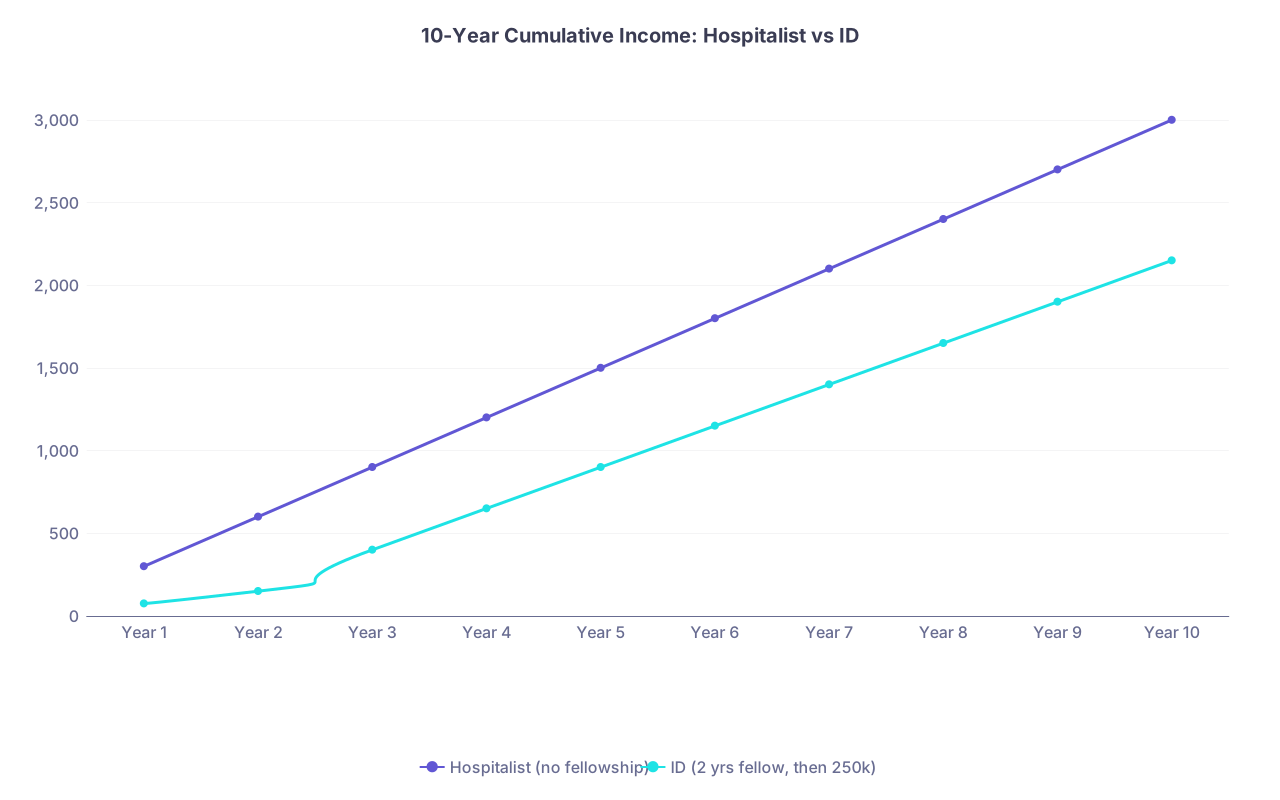
| Category | Hospitalist (no fellowship) | ID (2 yrs fellow, then 250k) |
|---|---|---|
| Year 1 | 300 | 75 |
| Year 2 | 600 | 150 |
| Year 3 | 900 | 400 |
| Year 4 | 1200 | 650 |
| Year 5 | 1500 | 900 |
| Year 6 | 1800 | 1150 |
| Year 7 | 2100 | 1400 |
| Year 8 | 2400 | 1650 |
| Year 9 | 2700 | 1900 |
| Year 10 | 3000 | 2150 |
Again, these are ballpark numbers, not contract offers. But the pattern is robust: it takes many years for a lower‑paid subspecialist to catch up to the early‑earning generalist. In some fields, they never do.
Add in:
- Earlier loan payoff and reduced interest
- Earlier investing and compound growth
- Possible path to partnership or equity
…and the “cool subspecialty” often loses badly in a spreadsheet.
When Fellowship Does Make Financial Sense
This isn’t an anti‑fellowship rant. Some fellowships are clearly positive ROI, especially in highest‑paid specialties.
Examples where fellowship often boosts pay significantly:
- GI vs general IM
- Interventional cardiology vs non‑procedural IM
- Interventional pain vs general anesthesia or PM&R
- Certain orthopedic subspecialties (spine, sports, hand, joints, etc.)
- High‑demand procedural radiology niches
But even with those, context matters:
- Employed vs private practice
- Geographic region and payer mix
- Group structure (partner vs forever associate)
- Academic vs community
You can do an “extremely lucrative” fellowship and still end up in a mediocre academic job that pays less than a hungry, RVU-heavy generalist in a lower cost-of-living city.
The letters after your name do not wire money into your bank account. Your practice environment does.
The Real Reasons To Do (Or Skip) Fellowship
Here’s the blunt version.
Bad primary reasons for fellowship:
- “I feel like I’m supposed to specialize.”
- “People will respect me more.”
- “I heard specialists make more money.”
- “I’m scared to be an attending yet.”
Better reasons:
- You actually enjoy that narrow field enough to live in it for decades.
- You understand the real compensation landscape and are OK with the trade-offs.
- You need it for the very specific job you want (e.g., academic subspecialty, niche procedural work).
- You’ve run the math and either a) the money does work out in your favor, or b) you don’t care because the work fit is that important.
If you’re on the fence, there’s a brutally clear exercise I push residents to do.
A Simple Framework: How To Decide Without Lying To Yourself
Make two honest columns for your base specialty: “No fellowship” vs “With fellowship.” And involve actual numbers, not vibes.
| Factor | No Fellowship | With Fellowship |
|---|---|---|
| Years to Attending | 0 | +1 to +3 |
| Starting Salary | ____ | ____ |
| Likely Ceiling | ____ | ____ |
| Geography Flex | High/Med/Low | High/Med/Low |
| Call Burden | Light/Mod/Heavy | Light/Mod/Heavy |
| You actually like the work? | Y/N | Y/N |
Then add one more thing: an estimated 10‑year income line for each path, including fellowship years. Doesn’t have to be perfect. Just realistic.
Finally, ask yourself:
- If fellowship paid exactly the same as generalist work, would I still do it?
- If no, you probably shouldn’t.
- If fellowship paid slightly less but I enjoyed it more, would I still do it?
- That’s the honest lifestyle trade‑off question.
Visualizing How Much Time You’re Trading
Most residents underestimate how long the “catch-up” period is after fellowship. Here’s a snapshot of how extra training years push back higher earning.
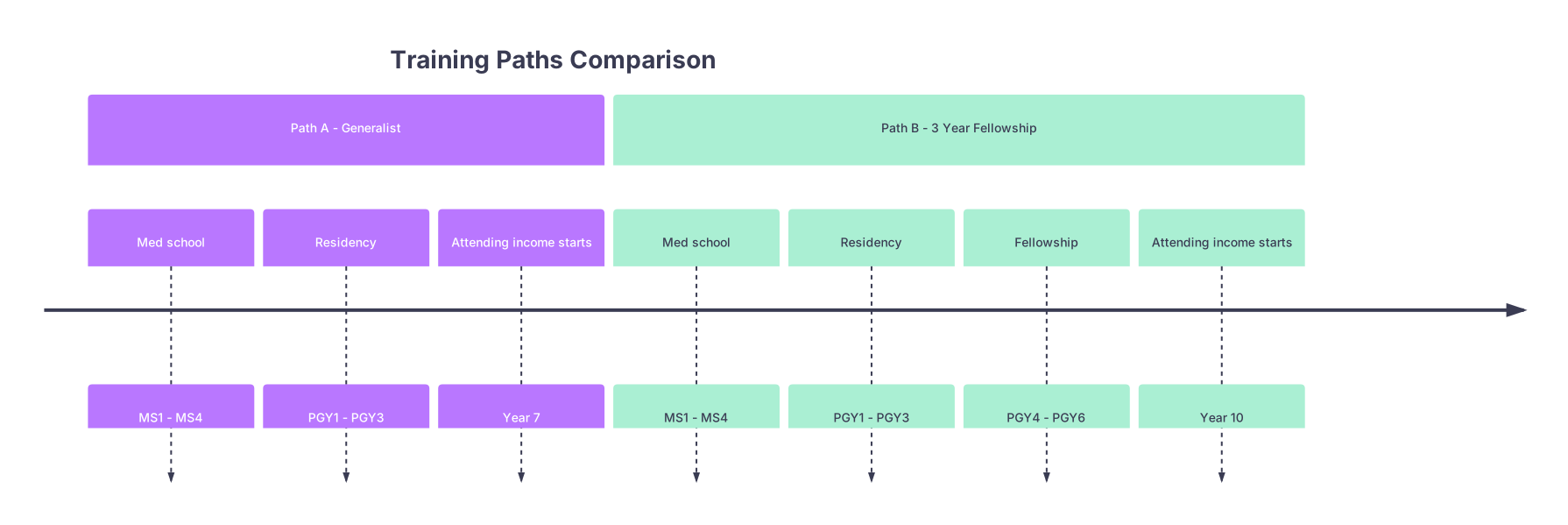
| Period | Event |
|---|---|
| Path A - Generalist - Med school | MS1 - MS4 |
| Path A - Generalist - Residency | PGY1 - PGY3 |
| Path A - Generalist - Attending income starts | Year 7 |
| Path B - 3 Year Fellowship - Med school | MS1 - MS4 |
| Path B - 3 Year Fellowship - Residency | PGY1 - PGY3 |
| Path B - 3 Year Fellowship - Fellowship | PGY4 - PGY6 |
| Path B - 3 Year Fellowship - Attending income starts | Year 10 |
Those three years aren’t filler. They’re the prime years when a lot of your peers are:
- Hitting peak RVUs
- Refining their practice style
- Paying off $300k+ of loans
- Starting families without 28‑hour calls
You don’t get that time back.
FAQ (Exactly 5 Questions)
1. Is it ever rational to do a lower-paying fellowship if I’ll earn less overall?
Yes—if you genuinely prefer that work and you understand the financial hit. Not everything has to be an ROI play. The problem is when people think it’s an ROI play and only discover years later they traded money and lifestyle for prestige or inertia.
2. I want to do ID/Endo/Rheum. Am I “making a mistake” financially?
You’re making a trade. Pure financial spreadsheets often favor hospitalist or primary care over these fellowships. If you go in knowing you’re trading income for the type of patients and problems you enjoy, that’s not a mistake. That’s clarity.
3. Doesn’t subspecialty training protect me from future market changes?
Not always. Markets shift in weird ways. Some subspecialties get oversaturated. Some new therapies or tech cannibalize old procedures. Generalist skills plus geographic flexibility can be more protective than a narrow niche locked to academic centers.
4. What about prestige and respect—don’t subspecialists get treated better?
Only sometimes, and it varies wildly by institution. In plenty of hospitals, hospitalists and generalists are the backbone and are treated accordingly. Banking on “respect” to justify 2–3 extra years of training and lower lifetime earnings is a weak strategy.
5. How do I actually find accurate pay data for my specific field and region?
Do not rely only on broad national surveys. Talk to recent grads from your program and similar programs. Ask about their real offers, RVU targets, bonus structures, and call expectations. Use MGMA/Medscape/etc. as a rough ceiling/floor, not gospel. And always adjust for cost of living and tax environment when comparing numbers.
Key points to walk away with:
- Fellowship does not automatically increase your pay; for many IM, peds, EM, and even some surgical/anesthesia subspecialties, it can lower lifetime earnings.
- The time cost—extra years of low pay and delayed attending income—is massive and often underestimated.
- The only good reason to do a questionable-ROI fellowship is because you truly want that work, even if it never pays more than being a well-compensated generalist.