
The myth that “cardiothoracic surgeons are all rich” is lazy and wrong.
The reality is sharper: LVADs and transplants can make you very well paid—or quietly cap your income—depending on how your practice and hospital are structured.
You want details. Let’s go there.
1. The Money Baseline: What CT Surgeons Actually Earn
Forget the brochure numbers for a second. Here is the real landscape for adult cardiothoracic (cardiac) surgery in the United States, as of the last few years.
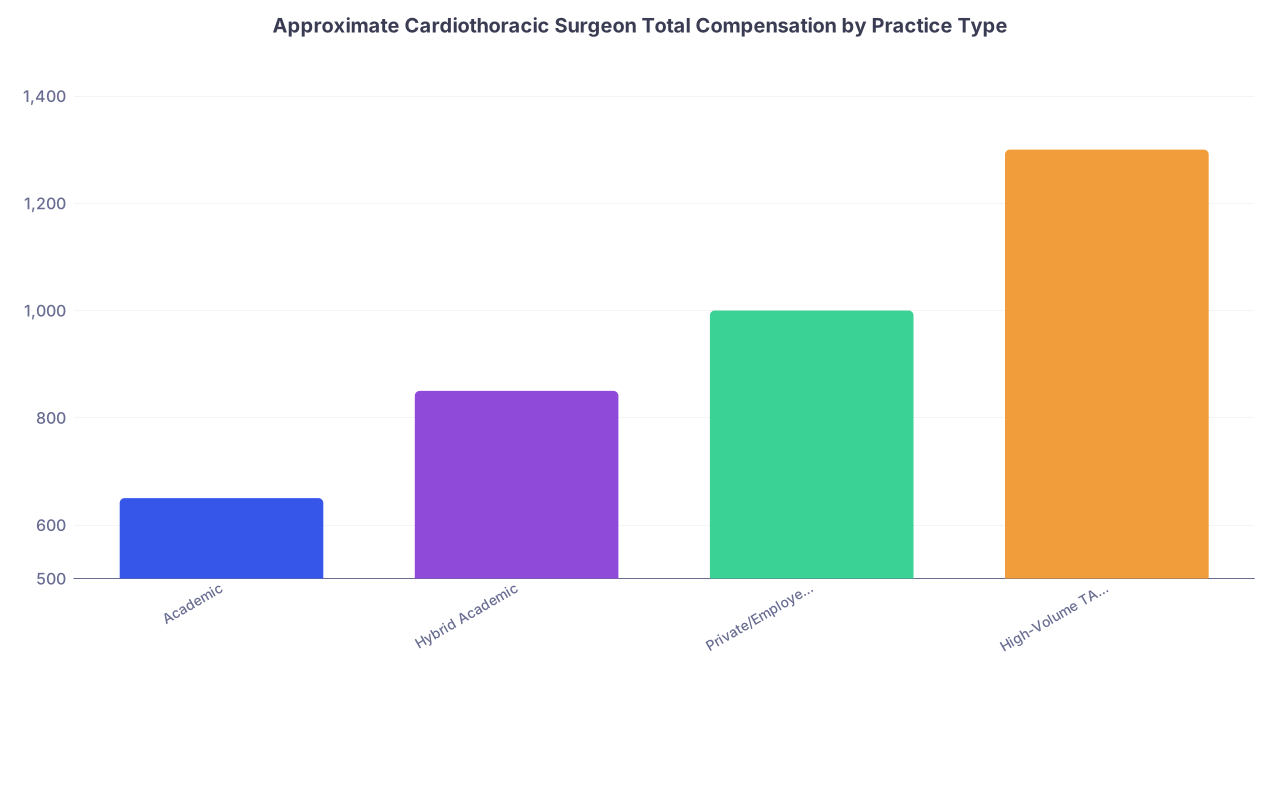
| Category | Value |
|---|---|
| Academic | 650 |
| Hybrid Academic | 850 |
| Private/Employed Community | 1000 |
| High-Volume TAVR/LVAD Center | 1300 |
Values in the chart are approximate total annual compensation in thousands (i.e., 650 = $650k).
Rough ranges:
- Academic cardiac surgery: about $550k–$900k
- Hybrid academic / quasi-private: $750k–$1.1M
- Employed community/practice groups: $800k–$1.4M+
- Outlier mega-producers in procedure-heavy centers: $1.5M+
Now, where do LVAD and transplant fit into that?
Short version:
- They rarely pay “better” on a pure per-RVU or per-hour basis.
- They often anchor you in resource-heavy centers where other high-paying work (CABG, valves, TAVR, structural) makes the real money.
- They change your leverage. Being “the transplant/LVAD person” can make you strategically indispensable—or quietly exploited—depending on leadership and contracts.
You want to understand this specialty? You have to understand LVAD/transplant economics, not just anatomy.
2. LVAD 101: What You Actually Do, and How It Pays
Left Ventricular Assist Devices are not magic boxes; they are time sinks with complex revenue trails.
What LVAD practice really looks like
In a serious LVAD program, your life includes:
- Advanced heart failure clinic with cardiology (selection, optimization)
- Implant cases (sternotomy or minimally invasive, often long OR time)
- Frequent returns to OR: bleeding, driveline revisions, pump thrombosis
- ICU dance: RV failure, arrhythmias, infections
- Long-term follow-up: driveline care, device interrogations, troubleshooting alarms
In practice, LVAD makes you:
- A surgeon + chronic disease manager
- On the hook for 24/7 “LVAD emergency” coverage
- Poorly insulated from medico-legal risk when a device patient crashes in some outside ED
So what does that do to your pay?
LVAD and RVUs: the reality
The initial LVAD implant is a high-RVU code, yes. But you do not live on implants alone.
The pattern is usually:
- LVAD implant: decent RVUs, long case, big hospital revenue
- Post-op and chronic follow-up: time-consuming, often poorly captured in billing
- Re-ops and complications: may be RVU-generating, but case timing is terrible (nights/weekends, low throughput)
The critical issue:
LVAD work shifts your case mix from “high-RVU per hour” to “moderate RVU with heavy time and call burden.”
| Feature | LVAD Implant | CABG / Valve (Standard Adult) |
|---|---|---|
| OR time (typical) | Longer, greater variability | More predictable |
| RVUs per case | High | Moderate to high |
| Cases per day potential | 1 (often) | 1–3 depending on complexity |
| Post-op time burden | Very high | High but more standardized |
| Long-term follow-up clinic load | High, device-specific | Moderate |
| Hospital strategic value | Very high (flagship program) | High |
From your perspective as a surgeon:
- If you are on a straight RVU model, LVAD often dilutes your effective hourly rate.
- If you are on a salary/bonus with “program director” style stipend, LVAD can bump total compensation somewhat, but not proportional to the lifestyle hit.
When LVAD helps your income
LVAD can help you financially in specific scenarios:
You are in a center where:
- CABG, valves, TAVR, structural heart are booming.
- LVAD program is bundled into the “advanced heart failure” marketing package.
- Administration is willing to pay a premium to be one of the regional LVAD centers.
Your contract has:
- A base salary plus a significant medical directorship/program director stipend for LVAD.
- Specific recognition of non-billable duties: call availability, QA, device committee work, outreach.
You use LVAD to:
- Cement your role as indispensable senior cardiac surgeon.
- Gain leverage when negotiating schedule, FTE, and future compensation.
But if the contract is lazy? You end up the LVAD workhorse, making similar or slightly more money than a colleague doing mostly CABGs and valves—but with much uglier nights and weekends.
3. Heart Transplant: High-Prestige, Mixed-Pay
Transplant is where people lose financial clarity and start talking prestige. Ignore that for a moment.
The actual work profile
Adult heart transplant practice includes:
- Late-night organ offers, frequent emergent cases
- Significant pre-op evaluation and listing discussions
- Coordination with:
- Heart failure cardiology
- Transplant ID
- Immunology
- Procurement teams and OPOs
- Long-term clinic with:
- Rejection surveillance
- Biopsies/caths (depending on institutional roles)
- Immunosuppression management (often cardiology-driven but you are still in the loop)
Schedule reality:
Transplant wrecks your circadian rhythm. Organ availability does not care about your blocked OR days.
How transplant is paid (surgeon side)
You get professional fees for:
- The transplant surgery itself (high-RVU procedure)
- Some perioperative and follow-up visits
- Occasionally participation in biopsies or related procedures, depending on how your institution splits roles
But there are big caveats:
Transplant volume is limited.
You are not doing 5 heart transplants a day. A busy center might hit 30–60 hearts per year per team, spread across multiple surgeons.ICU time and follow-up are massively undercompensated.
Yes, you bill E/M codes. No, they do not reflect the time you actually sink into these patients.Night/emergency bias.
Many of your transplants are off-hours, destroying work-life balance and limiting next-day productivity for elective cases.
So from a pure income-per-hour lens?
Transplant is not a straightforward financial win.
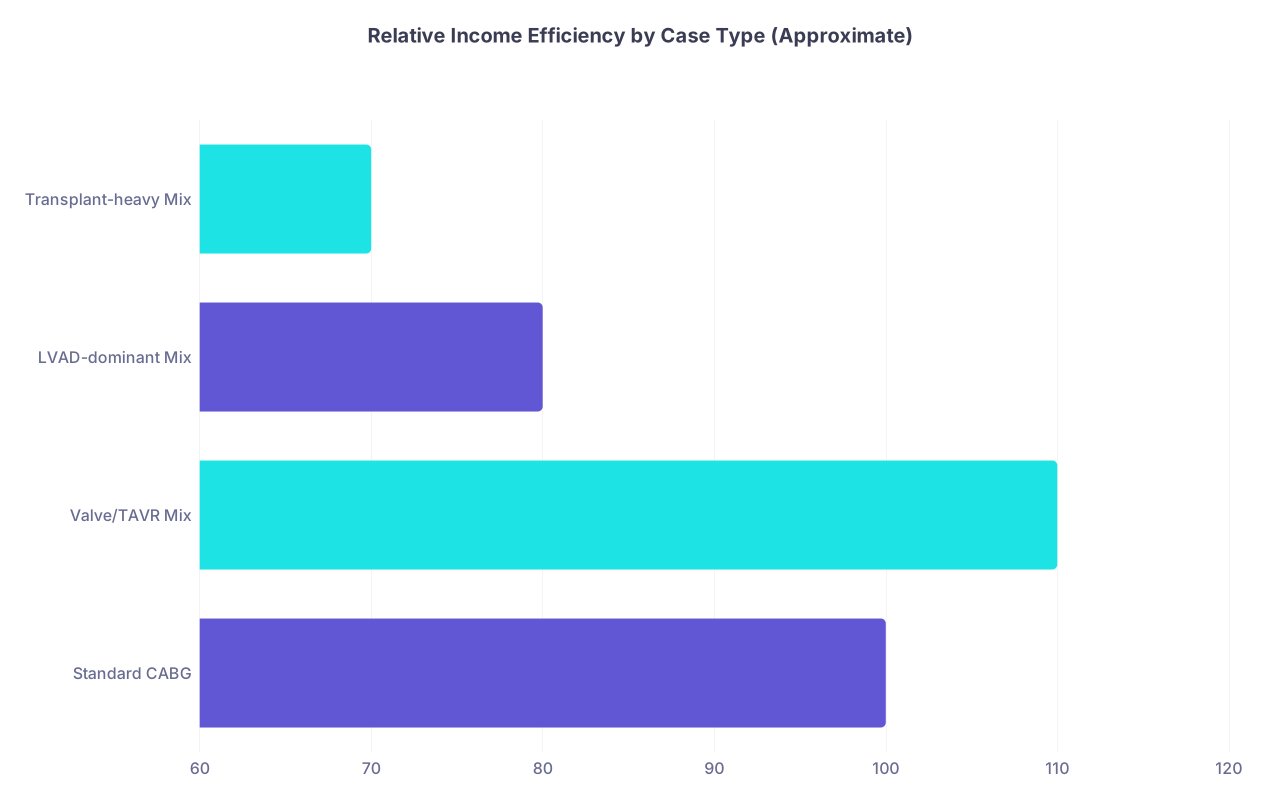
| Category | Value |
|---|---|
| Standard CABG | 100 |
| Valve/TAVR Mix | 110 |
| LVAD-dominant Mix | 80 |
| Transplant-heavy Mix | 70 |
Interpretation: CABG = baseline “100”; transplant-heavy practices often feel like “70” in income efficiency once you factor time and call.
Where transplant can still help you financially
You are not doing transplant for easy money. But it can still help in these ways:
- It anchors you in top-tier academic or quaternary centers, where:
- Base salaries can be high.
- You gain access to leadership roles: division chief, program director, transplant director.
- You often get:
- Stipends for transplant medical directorship.
- Highly protected FTE (partial release from constant grinding clinical RVUs) if leadership is sane.
- Being “the transplant person” gives you:
- Serious political capital.
- Leverage in contract negotiation if you are the only or main surgeon comfortable with the sickest cases.
But again, the pattern repeats:
The title and niche give you power; the raw RVUs often do not.
4. How LVAD/Transplant Shape Your Daily Life and Call
Let’s be blunt: LVAD and transplant do more damage to your schedule and sleep than to your income statement.
Call structure with LVAD and transplant
In a center with active LVAD/transplant:
- You are almost never truly “off.”
- There is often a separate call pool (transplant/LVAD vs general cardiac), but:
- Pools are small.
- Coverage expectations are brutal.
- Organ offers and LVAD emergencies ignore your weekend wedding plans.
So you end up with:
- Higher night and weekend case rates.
- Longer ICU management commitments.
- More frequent “I have to go in now” scenarios vs “I can schedule that for Tuesday.”
If you are comparing:
- Pure CABG/valve practice at a busy community hospital
- Versus LVAD/transplant-heavy at a quaternary center
The community job might:
- Pay within 10–20% of the transplant/LVAD job
- Have more predictable days, fewer off-hours cases
- Offer fewer prestige points but more intact life
This is exactly why some excellent surgeons intentionally avoid transplant and advanced heart failure work and focus on CABG, valves, and TAVR. They are not lazy. They are doing lifestyle and financial math.
5. Academic vs Private: Where LVAD/Transplant Fit Best Financially
You cannot talk about LVAD/transplant pay in a vacuum. The practice environment changes everything.
| Practice Type | LVAD Presence | Transplant Presence | Typical Pay Effect |
|---|---|---|---|
| Pure private community | Rare | Essentially none | Neutral; CABG/valve dominate pay |
| Employed community | Occasional LVAD (few) | Usually none | Slight bump if program exists |
| Regional tertiary | Active LVAD program | Sometimes limited hearts | Moderate leverage, mixed pay impact |
| Major academic center | Robust LVAD + heart tx | Full transplant program | High prestige, pay tied to role/leadership |
Rough sketch:
- 5–7 years general surgery
- 2–3 years CT surgery fellowship (traditional, I-6, or integrated formats)
- Optional:
- Additional heart failure / transplant fellowship
- Focused advanced heart failure experience at a high-volume center
The earlier you commit to advanced heart failure, the more your career drifts into:
- Academics
- Quaternary centers
- Program-building roles
And away from:
- Purely high-volume, high-RVU bread-and-butter CABG/valve practice in smaller markets
This is not inherently good or bad. Just reality.
8. How LVAD/Transplant Should Influence Your Career Decisions
Let me be very direct.
You should lean toward LVAD/transplant if:
- You genuinely enjoy:
- Complex physiology.
- Long-term patient relationships.
- ICU micromanagement.
- Multidisciplinary program building.
- You are comfortable with:
- Night calls that are not negotiable.
- A career anchored in large centers and academic-style institutions.
- Trading some income-per-hour for prestige and interesting cases.
- You want:
- Academic promotion.
- Leadership roles in heart failure, transplant committees, program design.
You should avoid being the LVAD/transplant person if:
- What excites you is:
- OR time.
- Efficient, high-volume surgery.
- Getting home at a decent hour sometimes.
- You prefer:
- Fewer unpredictable call disruptions.
- A simpler, procedure-dominant revenue model.
- You care more about:
- Top-quartile compensation.
- Geographic flexibility into community and regional markets.
A ruthless summary:
- LVAD/transplant is career-defining and often life-defining.
- It can support very good pay, but it rarely maximizes your income relative to work intensity.
- The real payoff is intellectual satisfaction, prestige, leadership opportunities, and being central to cutting-edge care for the sickest cardiac patients.
If you are chasing pure top-dollar? High-volume CABG/valve/TAVR in the right market usually wins.
FAQ – Cardiothoracic Surgery, LVAD, Transplant, and Pay
1. Are LVAD and transplant surgeons the highest paid within cardiothoracic surgery?
Not reliably. The highest paid within CT are often surgeons in high-volume community or system-employed roles doing mostly CABG, valves, and TAVR with efficient throughput. LVAD/transplant surgeons can be well compensated, but once you adjust for hours, nights, and call burden, they are not consistently at the top of the income-per-hour ladder.
2. Does doing LVAD and transplant guarantee a higher starting salary after fellowship?
No. Your starting salary depends more on the institution type and region than on whether you do LVAD/transplant. A new surgeon joining an academic transplant center with heavy LVAD involvement might start around $600k–$800k, while a colleague joining a large community cardiac group with mostly CABG/valve work might start similar or higher, even without transplant.
3. How do LVAD and transplant affect my call schedule long-term?
They make it heavier and more intrusive. Transplant and LVAD programs require 24/7 emergency coverage. Organ offers and device emergencies cluster at night and on weekends. You can spread this across a team, but the pool is usually small, so your effective “true off-call” time is limited compared to a non-transplant cardiac practice.
4. Can LVAD/transplant experience help me negotiate better compensation?
Yes, if you use it correctly. Being essential to a transplant/LVAD program gives you leverage to negotiate higher base pay, leadership stipends (medical directorships), dedicated support staff, and schedule concessions. If you do not explicitly negotiate, hospitals are very happy to market your expertise while paying you only marginally more than non-LVAD colleagues.
5. Is it possible to start in transplant/LVAD and later move to a pure CABG/valve practice?
It is possible but not always simple. Your CV and references will brand you as “advanced heart failure/transplant” and most offers will come from similar centers. You can pivot to general cardiac if you maintain robust CABG/valve volume and contacts in community or hybrid systems, but the longer you stay deeply embedded in transplant/LVAD, the more you are tied to that ecosystem.
6. If my primary goal is to maximize lifetime earnings in cardiac surgery, should I pursue LVAD and transplant?
Probably not as your primary driver. If maximum earnings are the true priority, you are better off targeting high-volume CABG/valve/TAVR practice in favorable markets, negotiating aggressively on RVUs and call, and avoiding the heaviest transplant/LVAD commitments. LVAD/transplant is a good fit if your priorities are clinical complexity, prestige, and leadership—while still earning a very strong (but not absolutely maximal) surgical income.
Key takeaways:
- LVAD and transplant make you strategically valuable but do not automatically maximize your income per hour.
- They lock you into high-acuity centers, heavier call, and more ICU/clinic work, with pay strongly dependent on leadership roles and negotiations.
- For pure top-dollar within cardiothoracic surgery, a high-volume CABG/valve/TAVR practice in the right system usually beats a transplant/LVAD-heavy career.