
Being the first in your family abroad isn’t “brave” or “inspiring” when you’re sitting alone in a tiny apartment after another rejection email. It just feels lonely. And exhausting.
Let’s not sugarcoat this: being an IMG in the residency application phase is one of the most isolating experiences in medicine.
The Specific Kind of Alone That IMGs Feel
You’re not just “far from home.” You’re far from people who even understand what you’re doing.
Your family thinks “doctor is doctor” and doesn’t get why observerships don’t pay, why you’re crying over something called ERAS, or why a single exam (Step 2) can make or break your future. You try to explain “preliminary vs categorical” or “SOAP,” and they respond with, “Don’t worry, you’ll be fine, you’re smart.”
You’re surrounded by people, but you’re not actually with anyone.
It feels like:
- Waking up in a new country and realizing everyone else here seems to know an unspoken set of rules you never got the manual for.
- Seeing U.S. grads talk casually about their away rotations, home programs, and letter writers they’ve known for years.
- Staring at your phone during interview season, watching WhatsApp groups explode with “Got another invite!” while you refresh your email so often Gmail thinks you’re a bot.
- Hiding your panic during a call with your parents because they can’t handle hearing how bad the odds are for IMGs this year.
You’re not paranoid. The stats really are rough.
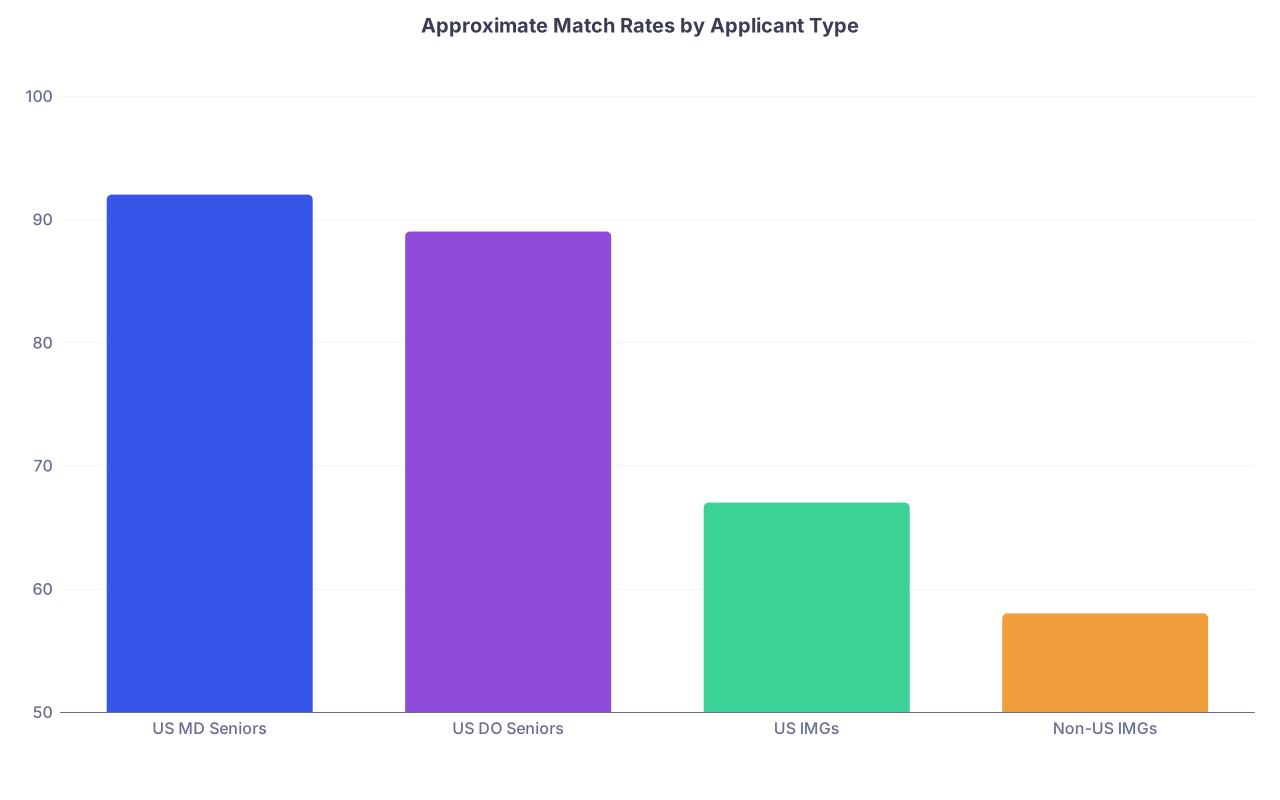
| Category | Value |
|---|---|
| US MD Seniors | 92 |
| US DO Seniors | 89 |
| US IMGs | 67 |
| Non-US IMGs | 58 |
So yes, when you say “I feel like the system isn’t built for me,” you’re right. It wasn’t.
But here’s the part your anxious brain keeps hiding from you:
People still match from where you are. Every year. From your country. With your accent. With gaps. With average scores.
You’re not asking for magic. You just want to not lose your mind from isolation before you even find out if you matched.
Let’s talk about that.
The Invisible Weight: How Isolation Shows Up in Real Life
The isolation isn’t just “I miss my family.” It seeps into everything.
You start doubting yourself in gross, subtle ways:
You’re doing an observership, and every time an attending says, “So how does it work where you trained?” you hear, “Prove you’re not a fraud.”
You overthink your accent on Zoom interviews. You rehearse answers a hundred times, then still log off thinking, “I sounded stupid. They definitely hated me.”
You avoid asking residents “dumb” questions about visa sponsorship or contracts because you don’t want to be labeled “the IMG who doesn’t get it.”
And when you go home after a long day, everyone you’d normally talk to about this is thousands of miles and several time zones away. So you either:
- Don’t message them, because you don’t want to worry them
- Or you do, but you downplay everything, because explaining the full chaos takes more energy than you have
So the stress has nowhere to go. It just bounces around inside your head.
The application phase makes this worse
The residency application cycle basically weaponizes isolation.
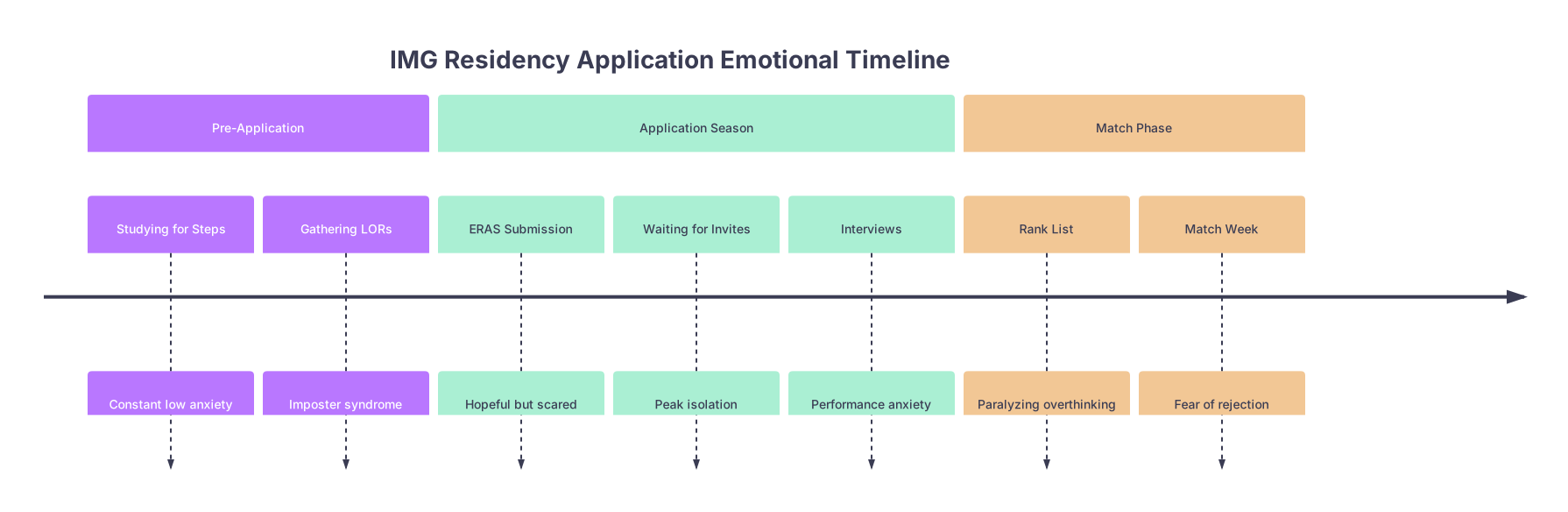
| Period | Event |
|---|---|
| Pre-Application - Studying for Steps | Constant low anxiety |
| Pre-Application - Gathering LORs | Imposter syndrome |
| Application Season - ERAS Submission | Hopeful but scared |
| Application Season - Waiting for Invites | Peak isolation |
| Application Season - Interviews | Performance anxiety |
| Match Phase - Rank List | Paralyzing overthinking |
| Match Phase - Match Week | Fear of rejection |
There’s this horrible window between submitting ERAS and hearing back where:
- You can’t change your scores
- You can’t rewrite your personal statement
- You can’t suddenly create more U.S. clinical experience
So you sit there with your brain cycling:
“What if I get nothing? What if I never match? What if going abroad was a mistake?”
That “what if I ruined my life” loop is brutal. And isolation turns up the volume.
You’re Not Overreacting: The Fear Is Rational (But Incomplete)
I’m not going to give you the fake pep talk: “Just stay positive!”
No. Your fear is grounded in reality.
You’re dealing with:
- Limited visa-sponsoring programs
- Some programs still quietly preferring U.S. grads
- Pressure from family back home who don’t understand “not matching” is… a thing
- Financial strain from exams, application fees, and unpaid electives that your family maybe helped with expecting you’d “definitely” get a residency
And you’re doing all that in a new country, often with:
- No extended family here
- No childhood friends
- No “home program”
- No one to say, “Yeah, this part sucks for all of us” in person
So no, you’re not “too sensitive.” You’re in a high-stress, low-support environment.
But your brain is doing this sneaky thing:
It’s taking “this is really hard” and turning it into “this is impossible for someone like me.”
That jump is where we push back.
Building a Fake “Home Team” Abroad (That Still Feels Real)
If you wait for comfort to just “appear,” you’ll be alone for most of the application season. You have to manufacture a support system. On purpose. Awkwardly. Bit by bit.
Here’s what I’ve seen actually work for IMGs who were first in their family abroad and felt completely on their own.
1. One small, ridiculously specific group
Generic “IMG support” groups can be chaos. Hundreds of people, constant panic posts, score flexing, fake humble brags: “Got 25 interviews, feeling scared.”
You don’t need that.
You need 3–7 people who are roughly in your lane. Similar specialty, similar step scores, similar visa issues, applying in the same cycle.
This is the kind of group that says:
- “I’m freaking out, I haven’t had an invite in 2 weeks”
- “Here’s my interview answer, can you tell me if I sound insane?”
- “Does this email to the coordinator sound desperate or okay?”
Find them in targeted places:
- Specialty-specific IMG groups (e.g., “IMG Internal Medicine Applicants 2025”)
- Alumni from your med school who matched in the U.S.
- People who commented on the same Reddit/Discord/Telegram threads you did, with similar stats
Then be the one who says:
“Hey, anyone want to form a small, quiet group to check in once or twice a week and help each other not lose it this season?”
Yes, it feels cringe. Do it anyway.
2. One honest conversation with family
Right now, your family may unconsciously be making things worse without realizing it—by pushing you for updates, or saying “Don’t worry, you’ll get it,” when what you hear is “If you don’t, you’ve failed.”
Have a real talk. Not a 1-hour TED talk. Just 10–15 minutes.
Something like:
“I need to explain this process a bit, because if I don’t match, it doesn’t mean I didn’t work hard. The system is very competitive, especially for international doctors. I might need more than one cycle. What would help me most isn’t pressure or constant questions, but encouragement that you’re proud of me no matter what happens.”
You’re not asking them to understand every detail of ERAS. You’re just lowering the pressure to “succeed at all costs, now or never.”
That alone can dial down your isolation a lot. Because then, if you don’t match this year, you’re not also carrying the shame fantasy of “I’ve disappointed my entire family and they’ll never see me the same.”
They might surprise you. Families can be frustrating, but they’re not always as harsh as the version in your head.
3. Structure your week so loneliness doesn’t eat everything
When you’re abroad, alone, with no fixed schedule during application season, the days blur. You stay in bed late. You doom-scroll other people’s interview invites. Suddenly it’s 3 a.m. and you hate yourself.
You don’t have to build some “5 am miracle routine.” Just make a skeleton of your week to fight that drifting.
| Day Type | Main Focus |
|---|---|
| 3 days/wk | Application tasks |
| 2 days/wk | Clinical/observership |
| 1 day/wk | Admin + life tasks |
| 1 day/wk | Complete rest |
On “application” days, you might:
- Work on updating your CV
- Practice interview answers
- Research programs and send a few targeted, non-desperate emails
- Do one thing for future cycles (in case you need a backup year): a short online course, QI project, or research outreach email
Then — and this matters — schedule something that puts you around humans, even if they’re strangers.
- Same coffee shop, same time, 3 days a week
- Same library corner
- Same gym class
You don’t need to talk to anyone. Just being a regular somewhere tricks your brain into feeling less exiled.
Coping on Interview Days When You Feel Like the Odd One Out
Interview days are where the “I’m the first in my family abroad” feeling hits hardest.
You log into Zoom or walk into a conference room and see people saying, “Oh yeah, Dr. Smith was my sub-I attending,” and, “I was torn between my home program and here.”
You’re like: “My home program is on another continent and my grandma thinks ‘residency’ is my dorm.”
Here’s how to get through it without spiraling.
1. Accept that you’ll feel “different” — and stop trying to erase it
You are different. You have a different path, different training system, different accent, different visa needs.
Trying to hide every part of that just makes you sound stiff and fake.
Programs don’t expect you to be a U.S. grad. If they invited you, they already know you’re an IMG, saw your school, saw your country, saw your visa status line, and still said, “Yes, we want to talk to this person.”
Your job in the interview is not to prove you’re secretly American. It’s to show that your “different” comes with value:
- You’ve seen diseases they’ve only read about
- You’ve worked in lower-resource settings
- You’ve had to adapt to completely new systems and languages
That screams resilience — if you let it come through.
2. Have 2–3 phrases ready for visa/IMG questions
This one causes so much stress you can feel people tense up through the screen.
You don’t need a legal lecture memorized. You just need calm, practiced sentences.
Something like:
“For visa, I’ll be needing J-1 / H-1B sponsorship. I’ve done some research on the process, and I’m very comfortable working with the program’s GME office to make it smooth. I’m committed to staying in the U.S. long term and building my career here.”
Or, for the “Why this program as an IMG?” angle:
“Coming from an international background, I’m specifically looking for a program that has experience training IMGs and values diversity in training paths. From your current residents’ profiles and what I’ve heard today, this seems like a place where people from different systems are supported to grow.”
You say that with a small, steady tone — not apologetic, not arrogant. Just factual. Like, “This is who I am, this is what I need, this is how I’ve thought it through.”

When You Don’t Match: The Worst-Case Scenario Your Brain Won’t Stop Replaying
Let’s talk about the thing that wakes you up at 3 a.m.: Not matching. Again, or for the first time.
The mental script goes like this:
“If I don’t match → I’ve failed → I’ve wasted my family’s money → Everyone back home will gossip → I’ll never be a real doctor → I ruined my life by going abroad.”
It’s so catastrophic it shuts you down. You don’t even want to plan a backup, because planning feels like “admitting I might fail.”
But here’s the harsh truth: Not planning for that scenario doesn’t stop it from existing. It just means if it happens, it hurts ten times more. And you feel even more alone.
So you quietly, privately, calmly sketch out:
- If I match → great, I go.
- If I don’t match → here’s my 6–12 month plan.
Not some vague “I’ll just improve my CV.” Actual steps.
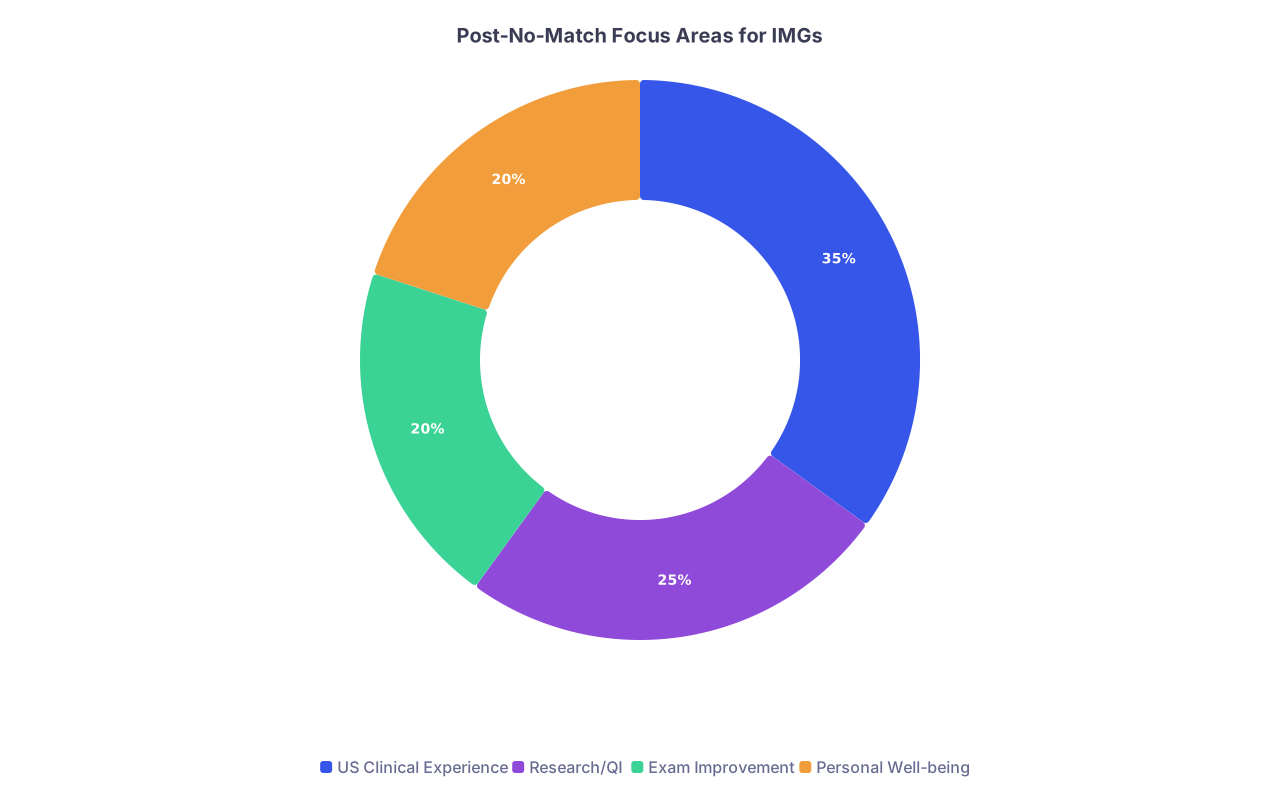
| Category | Value |
|---|---|
| US Clinical Experience | 35 |
| Research/QI | 25 |
| Exam Improvement | 20 |
| Personal Well-being | 20 |
You might not be able to get all of those. That’s okay. Even one or two, done well, change the next cycle.
But more importantly, a concrete plan gives your brain something solid to hold on to that isn’t just “eternal free fall.”
And then — this is crucial — you tell one person that plan. A friend. A mentor. Someone. So that if match day is bad, you’re not building everything from zero in a panic.
You’re Not “Too Soft” for This
I know what’s probably in your head:
“Everyone else seems to be handling this. Maybe I’m just weak. Maybe I’m not cut out for this system.”
No. You’re not soft. You’re overloaded.
You’re carrying:
Emigration. Cultural shock. Language adjustments. Visa stress. Family expectations. Financial pressure. A competitive exam process. And a new healthcare system.
All at once. With no built-in support.
If a U.S. grad had to move alone to your country, learn everything from scratch, carry their family’s expectations, and compete for limited spots in an unfamiliar specialty—while in a different language—you’d probably think, “Wow, that’s a lot.”
Treat yourself with that same level of fairness.

You’re allowed to feel lonely and still be serious about this dream. Those two things can coexist.
What You Can Actually Do Today
Not this week. Not “sometime.” Today. While all this anxiety is loud.
Pick one:
- Message one other IMG from your school, your year, or an online group and say: “I’m applying this cycle and feeling pretty overwhelmed. Do you want to check in once a week just to keep each other sane?”
- Schedule a 10–15 minute call with a family member and explain the process and what kind of support language actually helps you.
- Open a blank note and write: “If I don’t match, my 6-month plan is…” and list three realistic actions, not fantasies.
- Draft two short, calm sentences about your visa status and practice saying them out loud, just once.
That’s it. One thing.
You’re not going to fix the isolation in a day. But you can puncture the bubble a little.
Open your phone right now and send one message to one person — future co-resident, current friend, or family — that tells the truth about how hard this feels. That’s how you stop being the only one holding it.