
What if the very first thing your program director notices about you isn’t your CV, your Step scores, or your letters—just your accent?
Because that’s what it feels like, right? You walk into an interview or onto a ward, open your mouth, and you can almost hear your own brain screaming: “They noticed. They definitely noticed. They think I’m less competent now.”
The Fear You Won’t Say Out Loud
Let me just say it the way we actually think it:
“I’m an IMG. I already feel like I’m starting from behind. Now on top of that, my accent is going to make them think I’m slow, unsafe, or not smart enough. I’ll get fewer interviews, worse evaluations, and patients will ask for a ‘doctor who speaks better English’. And no one will say it’s because of my accent, but I’ll know.”
You’re not crazy for worrying about this.
You’re not dramatic.
You’re not “overly sensitive.”
People do judge accents. Not just in medicine. Everywhere.
I’ve heard US-born residents mock an attending with a foreign accent behind their back. I’ve heard nurses roll their eyes and say, “I can’t understand a word that new doctor says.” I’ve heard a patient say, “No offense, but I want an American doctor.”
So yeah. The fear isn’t made up.
But you’re also not doomed. And there’s a big difference between “people sometimes have bias” and “I will never be respected.”
Let’s break it down.
What PDs Actually Care About (That Your Brain Keeps Ignoring)
You know what your brain does? It latches onto the one thing you’re insecure about and acts like that’s the only factor that matters.
Accent. Accent. Accent.
But PDs are looking at a whole pile of stuff when they rank you. And they’re not subtle about it—many of them literally list it out at meetings and conferences.
| What PDs Actually Prioritize | What IMGs Obsess Over |
|---|---|
| Clinical competence | Accent |
| Reliability/work ethic | Country of graduation |
| Communication clarity | One awkward sentence |
| Teamwork & professionalism | Single bad interaction |
| Fit with program culture | Slight grammar errors |
Here’s the uncomfortable truth: your accent by itself is rarely the issue.
The problem is when PDs or attendings perceive:
- You’re hard to understand on a practical level (not just accented—unintelligible).
- You don’t check for understanding with patients.
- You avoid speaking up in rounds because you’re self-conscious.
- You get flustered and incoherent when questioned.
- You don’t adapt when someone clearly didn’t understand you.
So the story in your head is: “They hate my accent.”
What they’re usually thinking is closer to: “Can this person communicate clearly and safely with patients and the team?”
Those are related, but not the same.
Your accent is one data point. Your clarity, confidence, and ability to adjust? Much bigger ones.
Patients, Accents, and the Ugly Reality
Let me not sugarcoat it: some patients will judge you.
Some will:
- Ask where you’re “really from” three times.
- Speak to you loudly and slowly like you’re the one with a language problem.
- Look confused and then ask the nurse, “What did the doctor say?”
- Straight-up request another doctor.
It stings. It feels personal. It makes you want to talk less.
But here’s the pattern I’ve seen over and over:
The same patient who looks skeptical at your first “Good morning, I’m Dr. …” will relax within five minutes if:
- You speak clearly and slowly (not louder—slower).
- You summarize what they said: “So your chest pain started last night after dinner…”
- You repeat key points: “The biggest thing I’m worried about is your breathing. That’s why we’re doing the CT.”
- You ask: “Does that make sense? What questions do you have?”
You know what wins most patients over?
Not your grammar. Not sounding like a native speaker.
It’s when you look like you care, when you’re patient, when you listen, when you don’t rush, when you explain.
I’ve seen heavily accented IMGs become the most requested doctors in a clinic. Patients literally waiting longer just to see “Dr. [Name]” because “he listens to me” or “she explains everything.” Some even copy their accent when they talk about them—and they’re smiling while they do it.
Do some patients never get over it? Yes. Some just want a doctor who sounds like them. That’s their bias. It sucks. It’s unfair. But it’s not universal.
The Line Between “Accent” and “Unclear Communication”
This is where our anxiety goes sideways.
We say “my accent is bad” when what we really need to ask is: “Can people understand me easily, especially over the phone, when they’re sick, scared, or elderly?”
Two very different questions.
You do not need:
- To sound American/British/Canadian.
- To erase your background.
- To have perfect grammar.
You do need:
- To be understood without people constantly asking “What?” or “Say that again?”
- To be able to adjust when you see confusion on someone’s face.
- To communicate concisely on the phone, during pages, and in handoffs.
If you’re not sure how you’re doing there? Don’t trust your own brain. It’s biased against you.
Do this instead:
Ask 1–2 people you trust who will be honest, not polite.
“When I’m on the phone or presenting, is my accent ever a barrier to understanding me clearly?”Pay attention to how often people ask you to repeat yourself.
Once in a while is normal for everyone. Constantly? That’s a flag.Record yourself.
Present a patient. Explain a diagnosis. Listen to yourself like you’re the PD. Painful? Yes. Useful? Very.
If the honest answer is, “Sometimes it is hard to understand you” — that’s not a character flaw. That’s a skill gap you can work on.
PDs and the “Professional Communication” Filter
So what are PDs actually thinking when they hear you speak at an interview or over Zoom?
Something like this:
- “Can they communicate safely with my patients?”
- “Will nurses/consults have trouble understanding them on the phone at 3 AM?”
- “Will patients complain? Will this create tension with staff?”
- “Does this person seem confident and clear, or flustered and lost?”
Notice: Accent isn’t the only or even main issue. It’s clarity and professionalism.
Let me show you the difference between what we fear and what they actually react to.
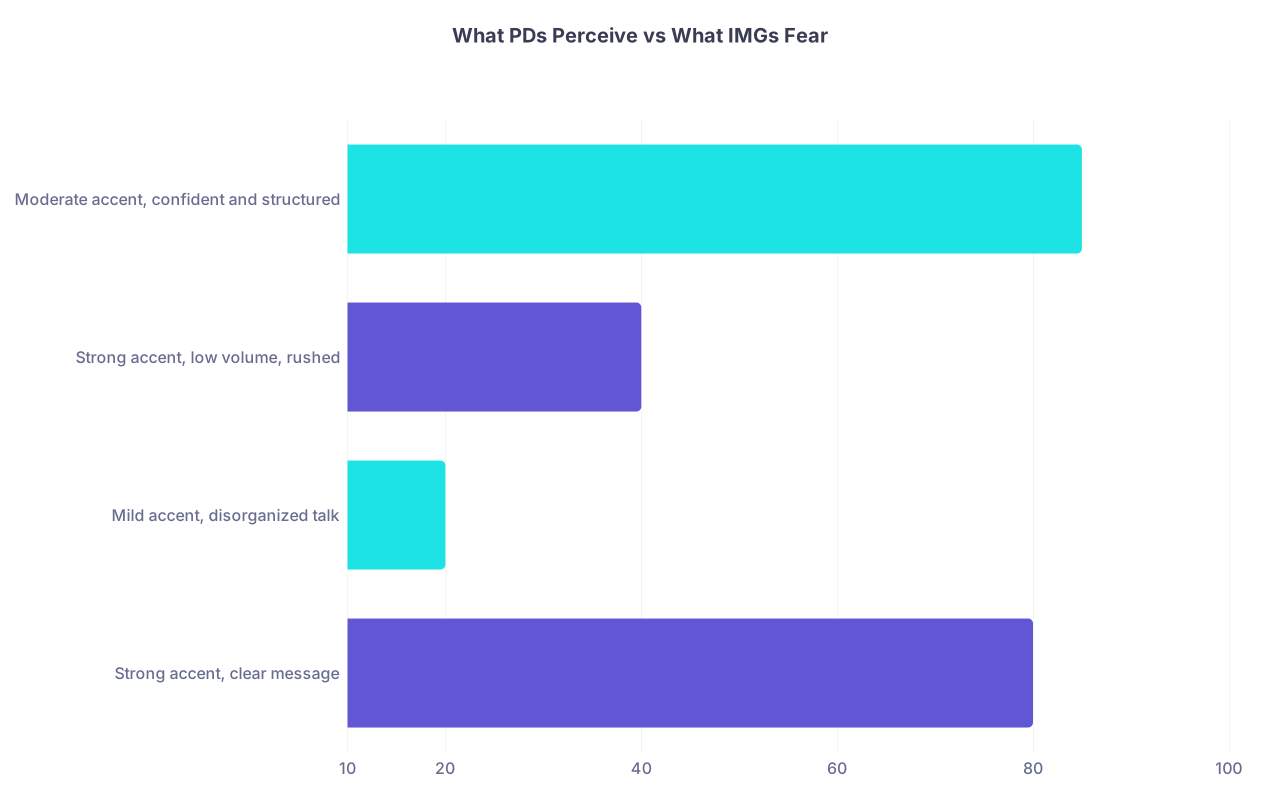
| Category | Value |
|---|---|
| Strong accent, clear message | 80 |
| Mild accent, disorganized talk | 20 |
| Strong accent, low volume, rushed | 40 |
| Moderate accent, confident and structured | 85 |
Interpretation (not perfect, but you get the idea):
- Strong accent + clear, structured communication → usually fine.
- Mild accent + rambling, disorganized answers → red flag.
- Strong accent + speaking too fast/quiet → fixable, but concerning.
- Moderate accent + confident, structured communication → PDs love this.
They remember your content and your presence far more than your phonetics.
I’ve seen PDs say things like:
- “Yeah, his accent is thick but he’s very clear and organized.”
- “I didn’t have trouble following her. She’s confident and explains herself well.”
- “Honestly, his communication is better than some of our US grads.”
So no, it’s not “no one cares about your accent.” Some do. But most care a lot more about whether you sound like a safe, thoughtful, trainable physician.
Concrete Things You Can Actually Control (Instead of Just Spiraling)
If you’re like me, you don’t want fluffy “be confident” nonsense. You want: What can I change by next week? Next month? Before interviews?
Here’s the stuff that actually moves the needle.
1. Pace and Pauses
Most IMGs with accents make one big mistake: they speed up when anxious.
It makes everything worse.
Try this in literally every conversation:
- Slow. Down.
- Full stop at the end of sentences.
- Shorter sentences. Not big complex ones.
Instead of:
“I reviewed his labs and he had some mild hyponatremia but otherwise labs were within normal limits and I think the plan is to continue fluids and monitor.”
Say:
“I reviewed his labs. He has mild hyponatremia. Everything else is normal. My plan is to continue fluids and monitor.”
Same content. Way easier to process.
2. Front-load the important words
Accent + long wandering sentence = people get lost.
Start with the main point:
- “I’m worried about a PE.”
- “Her blood pressure is dropping.”
- “The CT shows an acute bleed.”
Then explain.
This helps on calls with consults, updates to attendings, and especially with nursing staff.
3. Practice “phone voice” and “presentation voice”
In residency, so much of your evaluation lives in:
- Morning rounds
- Sign-out
- Calling consults
- Answering nurses
That’s where your accent will feel the most “on display.”
You don’t need to become a different person. You just need a clean, deliberate version of yourself for those moments.
Practice:
- Presenting a full H&P out loud, recorded.
- Explaining a diagnosis to a pretend patient (or your wall).
- Calling a pretend cardiology consult using SBAR (or similar structure).
Cringe? Yes. But this is exactly the kind of thing that separates “hard to follow” from “clear despite accent.”

4. Ask for targeted feedback (not vague reassurance)
Don’t ask: “Is my English okay?” People will just say yes.
Ask:
- “When I present, do I talk too fast?”
- “Was there anything you had to strain to understand?”
- “Are there any words I say that are confusing?”
Annoying? Yes. But this is how you move from vague shame to specific, fixable issues.
But What If They Do Judge Me?
Here’s the anxiety spiral:
“What if the PD has a bias against accents?”
“What if patients complain because they think I sound ‘foreign’?”
“What if I lose opportunities I deserve because of something I can’t fully change?”
Some will judge. Some already do. Some always will.
You’re not imagining that discrimination exists. It does.
But three things are also true:
A lot of program directors are IMGs themselves.
They had accents. They still do. They remember being judged. Many of them are actually protective of strong IMG candidates.Bias is rarely the only factor.
If you’re strong on paper and clearly competent in person, your accent might make someone hesitate for five seconds. Then they move on. They care more about whether you’ll show up, do the work, and not scare patients.Your accent becomes background noise once people trust you.
I’ve watched attendings with very strong accents go from “hard to understand” comments in their first year to “one of the best doctors here” three years later. Their accent didn’t change that much. Their authority and relationships did.
So yes, some doors might be harder to open.
But many will still open if you push with skill, not just effort.
Should You Try to “Lose” Your Accent?
That’s the other fear, right?
“If I really want to succeed, do I have to erase part of my identity?”
Here’s my blunt take:
Trying to completely erase your accent is usually a waste of energy and often makes you sound less natural.
Focusing on:
- Pronouncing critical medical words clearly
- Reducing a few confusing sounds
- Smoothing your rhythm and speed
—that’s smart.
Pretending you’re going to sound like a Chicago-born native in 6 months? That’s a fantasy, and a self-esteem trap.
You want intelligible, not “perfect.”
You want confident, not “flawlessly American.”
There’s nothing shameful about having an accent when you also have:
- Clear structure when you speak
- Enough calm to slow down
- Willingness to repeat and rephrase without embarrassment
That combination is way more powerful than some forced, half-fake accent you cobbled together from TV shows.
How to Handle Those Moments That Actually Hurt
Because they will come.
- The patient who says, “I want a doctor who speaks English better.”
- The nurse who acts like they can’t understand you but somehow understands everyone else.
- The co-resident who “jokes” about not understanding you.
Those moments make you want to shut up. To retreat. To say only the bare minimum.
That’s the one thing you can’t afford to do.
You need to stay visible. Vocal. Present.
Some ways to handle it without falling apart:
With patients:
“I want to make sure you feel comfortable and understand everything clearly. I’m happy to repeat or explain things in a different way. What part was unclear?”With staff:
“Let me repeat that more slowly. Tell me which part wasn’t clear.”
(Notice: you’re owning your communication and putting the burden on the specific content, not your identity.)With peers, if you can manage it:
“If you ever can’t understand me, just say so directly. I’d rather repeat than have you pretend.”
You’re not responsible for fixing everyone’s bias. You are responsible for not letting their bias convince you that you’re inherently less worthy.

| Stage | Activity | Score |
|---|---|---|
| Before Interviews | Worried about every word | 2 |
| Before Interviews | Avoids speaking up | 1 |
| Early Residency | Practices structured speech | 3 |
| Early Residency | Gets mixed feedback | 3 |
| Later Residency | Trusted by patients | 4 |
| Later Residency | Accent still present, but accepted | 5 |
When You’re Filling ERAS and Your Brain Won’t Shut Up
You’re thinking:
- “Will they screen me out just seeing my foreign name and school?”
- “On Zoom, will they judge me the second I introduce myself?”
- “Should I mention anything about communication skills in my personal statement, or will that just highlight the problem?”
Here’s what actually helps:
In your personal statement, briefly show (not whine) that you value communication. For example:
“Working with elderly patients in my internal medicine rotations taught me to slow down, repeat key points, and confirm understanding—skills that have become central to how I practice.”Don’t apologize for your accent in your interviews. Don’t start with, “Sorry, my English isn’t perfect.” You just trained them to see it as a problem.
Do own your journey if it comes up naturally:
“Coming from [country], I had to be very intentional about my communication—asking for feedback, practicing presentations, and focusing on clarity with patients. It’s actually made me more deliberate and patient when I talk to people.”
, Scores/Gaps](https://cdn.residencyadvisor.com/images/articles_svg/chart-residency-interview-concerns-among-imgs-7212.svg "Residency Interview Concerns Among IMGs")
| Category | Value |
|---|---|
| Accent/English | 35 |
| Visa | 20 |
| [USCE/LoRs](https://residencyadvisor.com/resources/img-residency-guide/i-have-no-us-contactshow-can-i-get-strong-lors-as-an-img) | 25 |
| Scores/Gaps | 20 |
You’re not the only one obsessing over this. A huge chunk of IMGs do.
And a huge number of them still match. Still advance. Still become attendings that medical students look up to.
The Perspective You’ll Only Believe Later
Right now, your accent feels like a giant spotlight over your head that everyone is staring at.
It’s not.
Most people are too busy worrying about their own performance, their own image, their own evaluations.
Over time, what they’ll remember about you isn’t:
- “She had a thick accent.”
It’s:
- “She always followed up on her patients.”
- “He was calm even when things got chaotic.”
- “She explained things really well to families.”
- “He was reliable on nights.”
Your accent will be part of you. It won’t be the headline of you.
And years from now, you might have a terrified IMG intern standing in front of you asking, “Do you think my accent will hold me back?”
You’ll probably say something like:
“It might make some days harder. But it won’t decide who you become as a doctor—unless you let it.”
And you’ll mean it, because by then, you’ll know what I’m asking you to trust now:
Years from now, you won’t remember who raised an eyebrow at your accent. You’ll remember the patients who trusted you anyway—and the fact that you learned to trust yourself first.