Crucial Steps to Take Before Enrolling in a Caribbean Medical School
The journey to becoming a physician is demanding, and the path you choose for your medical education can shape your career for decades. For many aspiring doctors—especially those facing challenges with GPA, MCAT scores, or limited seats in U.S. or Canadian schools—Caribbean medical schools can appear as an attractive alternative.
These international medical schools offer opportunities that might not be available domestically, but they also come with unique trade‑offs. Before you commit to a Caribbean program, it’s essential to approach the decision strategically. Thoughtful planning now can significantly influence your residency prospects, financial stability, and long‑term career satisfaction.
This student guide will walk you through the crucial steps to take before enrolling in a Caribbean medical school, including understanding the educational landscape, evaluating schools and finances, clarifying your career goals, and preparing for both the academic and personal transition.
Understanding the Caribbean Medical School Landscape
Before diving into applications, you need a clear, realistic picture of what Caribbean medical schools are, how they differ, and how they fit into the broader ecosystem of medical education and training.
Key Characteristics of Caribbean Medical Schools
Many Caribbean medical schools market themselves as U.S.-style institutions in tropical locations. While that’s partly true, the details matter.
1. Accessibility and Admissions Profile
- Caribbean medical schools generally have more flexible admission criteria than U.S. or Canadian schools.
- They may accept:
- Lower GPAs
- Lower or multiple MCAT attempts
- Non-traditional applicants or those changing careers
- This accessibility can be life‑changing for some students, but it also means:
- You may enter with a cohort that has a wider academic range.
- You will likely need strong self-discipline to keep pace in a rigorous curriculum.
2. Curriculum and Educational Model
Many established Caribbean schools use a U.S.-style, systems-based curriculum:
- Basic sciences (typically semesters 1–5) are usually taught on the Caribbean campus.
- Clinical sciences (semesters 6–10) are typically completed through clinical rotations in the U.S., Canada, or the U.K., depending on the school’s affiliations.
- Most programs are designed to prepare students for:
- USMLE Step 1 and Step 2 CK
- ECFMG certification
- Residency in the U.S. or other countries
However, quality and structure vary widely across institutions. Some have robust academic support, integrated board prep, and modern facilities; others may not.
3. Clinical Rotations and Hospital Affiliations
Your clinical rotations will heavily influence:
- Your clinical skills
- Your letters of recommendation
- Your competitiveness for residency
You should understand:
- Where the school’s core rotations (IM, surgery, peds, OB/GYN, psych, FM) are located.
- Whether these are in affiliated teaching hospitals or loosely arranged clerkships.
- If there is priority access to rotations vs. having to compete with other schools’ students.
- Whether they offer elective rotations in your areas of interest (e.g., emergency medicine, cardiology).
4. Residency Match Outcomes
Historically, international medical graduates (IMGs), including Caribbean graduates, face more challenges in the U.S. residency match process. This is especially true for:
- Competitive specialties (dermatology, plastic surgery, orthopedic surgery, etc.)
- Highly sought‑after geographic locations
That said, many Caribbean graduates successfully match into:
- Internal medicine
- Family medicine
- Pediatrics
- Psychiatry
- Other core specialties
You need to examine:
- Match rates for each school
- Specialty distribution of matched graduates
- Recent trends rather than relying on old data or marketing claims
Step 1: Research Caribbean Medical Schools Thoroughly
Not all Caribbean medical schools are equal. Comprehensive research is your most powerful tool to protect your investment of time, effort, and money.
Verify Accreditation and Eligibility for Licensure
Accreditation impacts your ability to:
- Take USMLE exams
- Obtain ECFMG certification
- Enter U.S. or Canadian residency programs
- Eventually get licensed in specific states
Key points to check:
- Is the school accredited by a body recognized as comparable to LCME standards, such as CAAM-HP or ACCM?
- Is the school listed in the World Directory of Medical Schools (WDMS) with an ECFMG eligibility note?
- Does the school meet ECFMG 2024+ accreditation requirements for certification?
- Are there any U.S. states that restrict licensure from that specific school (e.g., California, New York, Texas have more rigorous lists)?
Always confirm information on:
- ECFMG website
- World Directory of Medical Schools
- Individual state medical board sites
Evaluate Reputation Using Multiple Sources
Beyond accreditation, reputation matters for both educational quality and residency prospects.
Use multiple channels:
- Online forums: Student Doctor Network, Reddit (r/medicalschool, r/IMGreddit), and dedicated Caribbean medical school forums.
- School-specific groups: Official and unofficial Facebook or LinkedIn groups.
- Alumni networks: Try to speak with recent graduates (last 3–5 years).
Ask targeted questions:
- Did you feel prepared for USMLE Step 1/Step 2 CK?
- How organized were clinical rotations?
- What kind of academic support existed (tutoring, board prep, counseling)?
- Where did most of your classmates match for residency?
Analyze Curriculum, Support, and Outcomes
A strong medical education program should demonstrate:
- Structured, integrated curriculum aligned with USMLE content.
- Formal board prep support (question banks, NBME practice tests, dedicated review periods).
- Clear academic policies on remediation, leaves of absence, and progression.
Also look for:
- Average USMLE Step 1 and Step 2 scores (if provided).
- Attrition rates (students who do not graduate).
- On‑time graduation rates.
Consider Class Size, Faculty, and Learning Environment
- Class size: Larger intakes can mean more competition for faculty time and clinical rotation spots.
- Faculty:
- Are they full‑time or mostly adjunct?
- Do they have U.S., Canadian, or U.K. training?
- Are they active in research or medical education?
A school that invests in experienced faculty, modern facilities, and active learning will likely support your success more effectively.
Step 2: Assess Your Financial Situation Realistically
Caribbean medical school is a major financial commitment. The cost can sometimes approach or exceed that of private U.S. schools, especially when you factor in living expenses and travel.
Understand the Full Cost of Attendance
Go beyond the posted tuition. Calculate:
- Tuition and mandatory fees (per semester and full program)
- Housing (on‑campus vs. off‑campus)
- Utilities and internet
- Food and daily living expenses
- Books, exams, and resources (USMLE registration, question banks, review courses)
- Travel costs:
- Flights to and from the island
- Travel for clinical rotations, residency interviews
- Visa and immigration fees if applicable
Create a four-year (or longer) projected budget, including:
- Basic sciences period in the Caribbean
- Clinical years in the U.S./other countries (often more expensive living costs)
Explore Financial Aid, Scholarships, and Loan Options
Unlike many U.S. MD or DO schools, not all Caribbean medical schools qualify for:
- U.S. federal student loans (Title IV)
- Certain government-backed loan programs
You should:
- Confirm whether your target school participates in U.S. federal loan programs.
- Learn about private loans commonly used by students (and compare interest rates and repayment terms).
- Ask the school about:
- Institutional scholarships
- Merit-based awards
- Need-based assistance
- Payment plans
Be conservative: assume you might have limited income during and immediately after residency and consider how that affects loan repayment.
Build a Sustainable Budget and Contingency Plan
Develop a detailed budget that includes:
- Monthly expenditures
- Buffer for emergencies (health, travel, family situations)
- Unexpected academic delays (e.g., needing to retake Step 1 or extend rotations)
Consider:
- Working before matriculation to create a financial cushion.
- Tracking expenses closely from the first semester.
- Discussing long‑term financial planning with a financial advisor familiar with medical training.
A clear financial plan will reduce stress, allowing you to focus more fully on your medical education.
Step 3: Evaluate Your Career Goals and Long-Term Strategy
Your choice of medical school should align with your career aspirations and risk tolerance.
Clarify Your Specialty Interests and Flexibility
It’s normal not to know your exact specialty yet, but you should consider:
- Are you open to primary care specialties such as internal medicine or family medicine?
- Are you strongly determined to pursue highly competitive specialties (e.g., dermatology, neurosurgery, orthopedics)?
Because Caribbean graduates face additional barriers in the match, it is generally easier to:
- Match into less competitive specialties.
- Match into community-based programs rather than top-tier academic centers.
If your dream is a very competitive specialty or a specific academic center, be honest about:
- The extra effort and risk involved as an IMG.
- Whether you’re willing to adapt your goals if necessary.
Analyze Each School’s Residency and Career Preparation
Look beyond marketing brochures. For each school, ask:
- What are the recent match lists (last 3–5 years)?
- Do they publish specialty and location breakdowns?
- Are there advising services for:
- USMLE exam planning
- Specialty selection
- Application strategies (ERAS, NRMP)
- Personal statements and CVs
- Are there research, leadership, or community service opportunities that can strengthen your residency application?
Strong career preparation is critical. Ask current students:
- When does the school start talking about residency planning?
- Are there faculty mentors for your area of interest?
- How supported did they feel from MS1 to Match Day?
Consider Lifestyle, Environment, and Fit
Life in the Caribbean can be both beautiful and challenging. Reflect on:
- Climate and geography: Are you comfortable with heat, humidity, and potential storms/hurricanes?
- Distance from home: Will being far from family support be manageable?
- Island infrastructure: Availability of:
- Reliable internet
- Groceries and essentials
- Health services
- Safe and quiet study spaces
Imagine your day‑to‑day life for 1.5–2 years on the island. If you struggle with isolation, major climate changes, or lack of urban amenities, this should factor into your decision.
Step 4: Prepare Academically and Emotionally for the Transition
Even if admissions are more accessible, Caribbean medical school is not “easier.” The pace and volume of material are comparable to U.S. MD programs, and the stakes are high.
Strengthen Your Academic Foundation
Prior to matriculation:
- Review core premed sciences:
- General biology (cell biology, genetics, physiology)
- General and organic chemistry
- Biochemistry
- Physics basics
- Consider:
- Structured review programs or post-bacc work if your science foundation is weak.
- Using medical school prep resources (e.g., basic anatomy or physiology overviews).
Focus especially on:
- Study strategies: Active recall, spaced repetition, question-based learning.
- Time management: Balancing lectures, self-study, and USMLE preparation from day one.
If you struggled in undergrad:
- Identify what went wrong (study habits, time management, personal circumstances).
- Develop specific plans to address those issues before starting medical school.
Build Mental Resilience and Support Systems
Medical training—especially abroad—can be emotionally demanding. To prepare:
- Assess your current mental health honestly.
- Establish healthy coping strategies:
- Regular exercise
- Sleep hygiene
- Mindfulness or meditation practices
- Hobbies you can maintain abroad
- Explore mental health services:
- Does the school provide counseling or wellness services?
- Are there remote therapy options you can use from the island?
Talk with family and close friends about:
- The level of support you’ll need.
- How you’ll stay connected (scheduled calls, virtual check‑ins).
- How they can help when you’re stressed or overwhelmed.
Anticipate Cultural and Logistical Adjustments
Moving to another country includes adaptation to:
- New cultural norms and social expectations.
- Different approaches to time, bureaucracy, and service.
- Potential language differences, even if English is widely spoken.
Practical steps:
- Read about the island’s culture, laws, and safety recommendations.
- Join online groups of current or incoming students to ask day‑to‑day questions.
- Learn basics like:
- Local transportation options
- Banking and currency issues
- How to receive packages and mail
The better prepared you are, the smoother your first semester is likely to be.
Step 5: Visit (or Virtually Tour) the Campus When Possible
If you can, physically visiting the campus can be extremely informative. If not, push for a robust virtual experience.
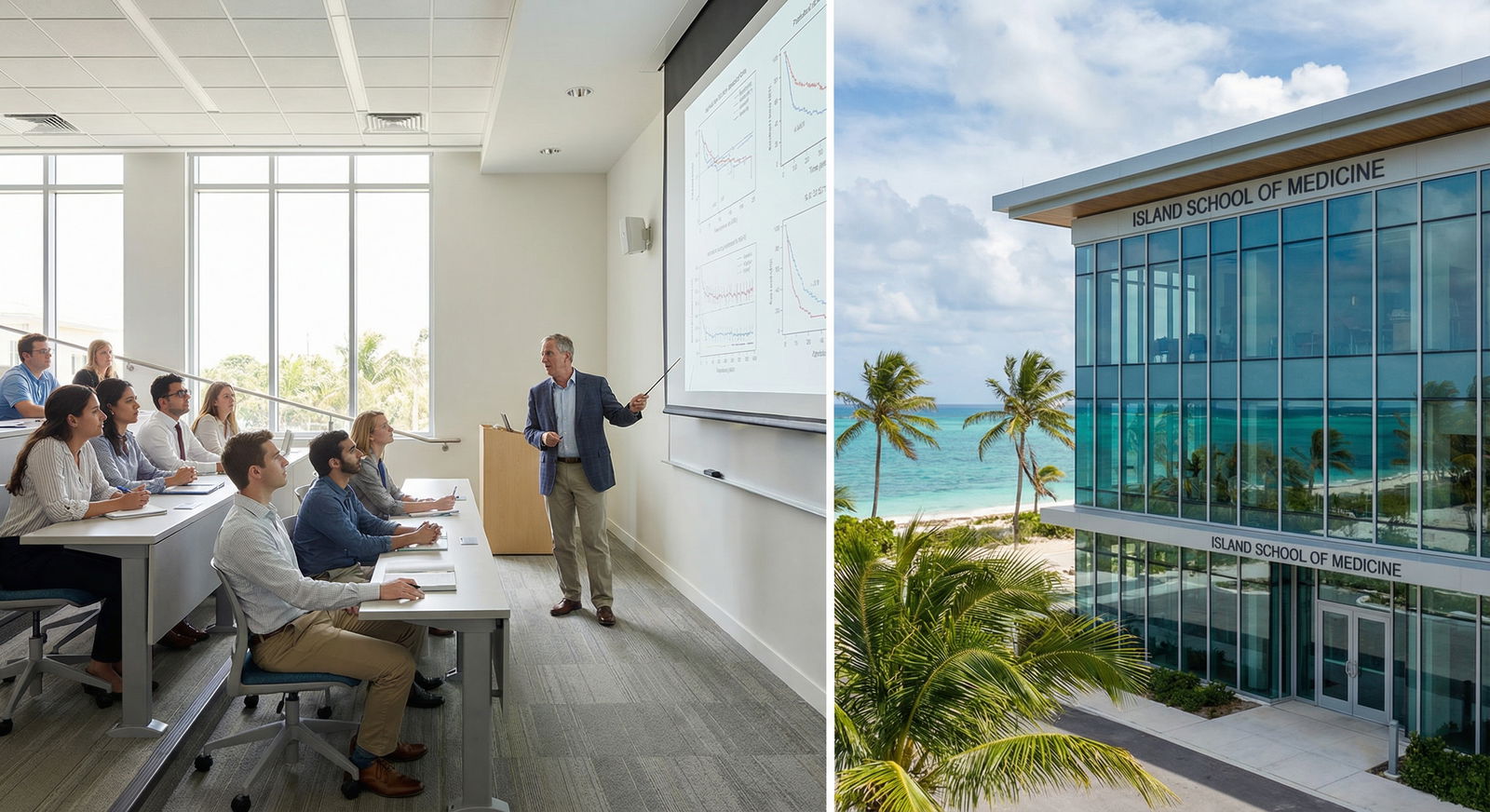
Assess Academic and Clinical Facilities
During a visit (or detailed virtual tour), look closely at:
- Lecture halls and small-group rooms
- Anatomy labs and simulation centers (standardized patient areas, mannequins, skills labs)
- Library resources, study rooms, and 24/7 access policies
- On-campus student support offices (academic support, counseling, financial services)
Ask:
- Are facilities modern and well maintained?
- Is there adequate space for the number of students?
- How is technology integrated (recorded lectures, learning platforms, Wi‑Fi reliability)?
Learn About Campus Culture and Student Life
Try to speak with current students without administration present. Ask them candidly:
- How supportive and responsive is the administration?
- Do they feel the school is transparent about academic policies and match outcomes?
- What is the stress level like, and how do students cope?
- Are there vibrant student organizations, interest groups, or wellness activities?
Additionally, explore:
- Housing areas where students live.
- Safety in the surrounding neighborhoods, especially at night.
- Access to:
- Grocery stores and pharmacies
- Public spaces for exercise
- Quiet places to study off campus
A good fit academically and socially can significantly impact your mental health and performance.
Step 6: Understand the Admissions Process and Strengthen Your Application
Once you’ve narrowed your list of Caribbean medical schools, focus on submitting the strongest possible application.
Know Each School’s Admissions Requirements
Carefully review:
- Required coursework and degree prerequisites.
- Minimum GPA and MCAT expectations (if applicable).
- Required documents:
- Official transcripts
- Letters of recommendation (who should write them?)
- Personal statement and secondary essays
- CV or activities list
- English language proficiency requirements for non-native speakers.
Create a personalized application timeline with:
- Internal deadlines (for drafting essays, requesting letters).
- Official school deadlines.
- Time allotted for potential interviews.
Craft a Compelling Personal Statement and Essays
Even with more flexible admissions, presentation matters:
- Clearly explain:
- Why you want to become a physician.
- Why a Caribbean medical school is the right path for you.
- What you’ve done to address any academic shortcomings.
- Highlight:
- Clinical exposure (shadowing, scribing, volunteering)
- Research or leadership experience
- Resilience and growth from challenges
Admissions committees want to see:
- Insight into your past performance.
- A realistic and mature understanding of the journey ahead.
- Demonstrated capacity to succeed in a demanding medical program.
Prepare Thoroughly for Interviews
If you’re offered an interview (virtual or in person):
- Research the school’s mission, values, and unique features.
- Be prepared to discuss:
- Why this specific school?
- How you plan to handle the rigor of medical education.
- How you’ve grown from any setbacks (e.g., low GPA or MCAT).
- Practice common medical school interview questions with a mentor or advisor.
Demonstrating honesty, self-awareness, and a clear plan can set you apart.
Step 7: Plan for the Transition and Early Logistics
Once you’re accepted, there’s still critical work to do before your first day of class.
Arrange Housing and Daily Living Essentials
Housing options may include:
- On‑campus residence halls or apartments
- Off‑campus apartments or shared houses with peers
Consider:
- Safety and distance from campus
- Cost and included utilities
- Quietness and suitability for long study hours
Create a checklist for:
- Bedding and basic furniture (if not provided)
- Kitchen essentials
- Study setup (desk, chair, reliable internet)
- Local cell phone plan and data coverage
Secure Health Insurance and Medical Care
Verify:
- Whether the school requires a specific student health insurance plan.
- What your policy covers on the island and during U.S.-based clinical rotations.
- Availability of:
- Local clinics or hospitals for routine care
- Emergency services
- Mental health providers (if needed)
Arrange necessary vaccinations and medical records before departure.
Understand Visa and Immigration Requirements
Depending on your citizenship and the school’s location, you may need:
- A student visa or study permit
- Proof of financial support
- Health clearances or background checks
Start this process early:
- Some documents can take weeks or months to obtain.
- Immigration delays can jeopardize your start date.
Confirm with both the school’s international office and the destination country’s official immigration website to avoid relying on outdated information.

Frequently Asked Questions About Caribbean Medical Schools
1. Are Caribbean medical schools accredited and recognized in the U.S.?
Many Caribbean medical schools are accredited by regional bodies such as the Caribbean Accreditation Authority for Education in Medicine and Other Health Professions (CAAM-HP) or the Accreditation Commission on Colleges of Medicine (ACCM), which are recognized as comparable to U.S. standards by organizations like ECFMG.
However, not all schools meet these standards. Before enrolling, you should:
- Confirm the school’s accreditation status on the World Directory of Medical Schools.
- Verify that its accreditation meets ECFMG certification requirements.
- Check whether the school is approved or recognized by U.S. state medical boards in states where you may want to train or practice (e.g., California, New York, Texas).
Without appropriate accreditation and recognition, you may face significant barriers to licensure and residency.
2. How competitive is admission to Caribbean medical schools?
Compared to U.S. and Canadian MD programs, Caribbean schools typically have:
- More flexible GPA and MCAT thresholds
- Greater openness to nontraditional applicants or those needing a second chance
That said, reputable Caribbean schools still look for:
- Strong upward academic trends
- Solid performance in science prerequisites
- Evidence of commitment to medicine (clinical experience, volunteering)
- Mature explanations for any academic difficulties
You should not assume that admission guarantees success. You’ll still need robust academic skills and discipline to thrive in the curriculum and on the USMLE.
3. What are the residency match prospects for graduates of Caribbean medical schools?
Residency match outcomes for Caribbean graduates vary significantly by:
- School
- Specialty
- Individual performance (USMLE scores, clinical evaluations, letters, research)
General trends:
- Caribbean IMGs can and do match into U.S. residency programs every year, most commonly in internal medicine, family medicine, pediatrics, and psychiatry.
- Matching into highly competitive specialties (e.g., dermatology, orthopedic surgery) is much more challenging and rare.
- Factors that improve your chances include:
- Strong USMLE scores
- High clinical performance
- Strong letters from U.S. attendings
- Thoughtful specialty selection and application strategy
When researching schools, prioritize programs that are transparent about their match lists and outcomes over multiple years.
4. How should I prepare for living abroad while attending a Caribbean medical school?
Preparation for living abroad is just as important as academic preparation. To ease the transition:
- Research your island’s culture, safety, cost of living, and healthcare system.
- Join online groups or chats for incoming students to get real‑time advice.
- Plan your budget carefully, including a cushion for unexpected expenses.
- Arrange reliable communication tools (local SIM card, international calling/texting, stable internet).
- Create a support system by scheduling regular check‑ins with family and friends.
Approach the move with flexibility and patience; cultural and logistical differences are normal and manageable with preparation.
5. What can I do now to strengthen my application and future success as a Caribbean medical student?
To enhance both your admissions profile and your readiness for medical school:
- Improve your academic record where possible (post‑bacc coursework, MCAT retake if beneficial).
- Gain clinical exposure: shadowing, scribing, volunteering in hospitals or clinics.
- Engage in service, leadership, or research experiences that demonstrate commitment and resilience.
- Develop strong study and time-management skills.
- Seek honest mentorship from physicians, advisors, or residents—especially those familiar with the Caribbean route or IMG pathway.
Each of these steps will help you present a stronger application and also position you for success once you begin your Caribbean medical education.
Thoughtful preparation before enrolling in a Caribbean medical school is an investment in your future. By deeply understanding the landscape, rigorously researching schools, planning your finances, clarifying your career goals, and preparing academically and emotionally, you can enter this path with clear eyes and a realistic, strategic plan for becoming the physician you aspire to be.