Introduction: Why Accreditation Matters for International Medical Students
For aspiring medical students considering International Medical Schools, few decisions are as consequential as where you choose to study. Beyond tuition costs, location, and curriculum style, one factor should be non‑negotiable: accreditation.
Accreditation is not just a bureaucratic label. It directly affects:
- Your eligibility for major licensure exams (USMLE, PLAB, AMC, MCCQE, etc.)
- Your competitiveness for Residency Placement in the U.S., Canada, the U.K., and elsewhere
- Your ability to secure visas, clinical rotations, and future Global Opportunities
- Your long‑term flexibility to practice medicine in multiple countries
This enhanced guide breaks down the accreditation process for international medical schools, explains who the major accrediting and regulatory bodies are, and shows you exactly how to use this information to protect your future career in medicine.
What Is Medical School Accreditation?
Accreditation is a formal, independent evaluation that confirms a medical school meets established standards of Medical Education quality, structure, and outcomes. It is performed by authorized national or regional agencies, often recognized by global organizations like the World Federation for Medical Education (WFME).
In practical terms, accreditation answers a few critical questions:
- Is the curriculum robust and current?
- Are graduates adequately prepared for clinical practice and residency training?
- Are there systems in place to monitor and improve educational quality?
Why Accreditation Is Especially Critical for International Medical Schools
Students at domestic schools often take accreditation for granted because it is handled by national agencies. For International Medical Schools, accreditation varies widely, and some schools operate with limited or no recognized accreditation.
For international applicants, accreditation influences:
- Whether your degree is recognized in your home country
- Whether you can sit for national licensing exams abroad
- How residency programs and employers perceive your training
Key Benefits of Attending an Accredited Medical School
Quality Assurance in Medical Education
Accredited schools must demonstrate:- A coherent, integrated curriculum (basic sciences + clinical skills)
- Qualified faculty with appropriate clinical and academic credentials
- Adequate clinical training environments
- Systems for monitoring student performance and program outcomes
Professional Recognition and Mobility
Graduating from an accredited school increases the likelihood your degree will be:- Accepted for licensing by medical councils
- Recognized by residency programs worldwide
- Seen as credible by employers and hospitals
Eligibility for Financial Aid and Loans
In some countries (e.g., the U.S.), students at certain internationally accredited schools may be eligible for:- Federal loans or support programs
- Private educational loans that require recognized accreditation
Expanded Global Opportunities
Accreditation helps unlock:- Elective rotations in other countries
- Fellowship and subspecialty training abroad
- The option to relocate professionally later in your career
Without solid accreditation, all of these pathways become more uncertain.
How the Accreditation Process Works: Step-by-Step
Accreditation follows a structured, multi-stage process. Understanding it helps you interpret what a school’s status really means.
Step 1: Initial Application and Eligibility
The medical school submits a detailed application to the accrediting agency, which typically includes:
- Mission and vision statements
- Governance and organizational structure
- Detailed curriculum (course outlines, sequencing, assessment methods)
- Faculty numbers, qualifications, and clinical affiliations
- Student support services (advising, counseling, academic support)
- Facilities (labs, simulation centers, libraries, teaching hospitals)
Some agencies also require proof of legal authority to operate as a degree‑granting institution in that country.
Step 2: Institutional Self-Study (Self-Assessment)
The school conducts an in‑depth self‑assessment against the accreditor’s published standards, often over 6–18 months. This process typically involves:
- Internal committees with faculty, administrators, and students
- Data collection on student performance, exam pass rates, and residency outcomes
- Analysis of strengths, weaknesses, and areas needing improvement
- Documentation of policies (admissions, progression, remediation, professionalism)
The result is a comprehensive self‑study report that is submitted to the accrediting body.
Step 3: External Site Visit (On‑Site Survey)
A team of trained peer reviewers (often experienced medical educators and clinicians) conducts an on‑site visit to verify and expand on the self‑study. They may:
- Observe lectures, small groups, labs, and clinical teaching
- Tour simulation labs, libraries, lecture halls, and hospitals
- Interview students across all years, recent graduates, and residents
- Speak with faculty, administrators, and support staff
- Review exam questions, OSCE stations, and exam result statistics
This stage is crucial because it tests whether the school’s documents match reality.

Step 4: Accreditation Decision and Status
Following the visit, the team writes a detailed evaluation report. The accrediting body then:
- Reviews the findings
- Identifies areas of compliance and non‑compliance
- Votes on the accreditation status
Common outcomes:
- Full Accreditation (for a fixed term, e.g., 5–8 years)
- Provisional/Conditional Accreditation (shorter term, with specific required improvements)
- Probation (serious concerns; school must correct deficiencies promptly)
- Denial or Withdrawal (if standards are not met)
For prospective students, it is essential to know:
- The current status (full, conditional, or probation)
- The validity period (when the current accreditation expires)
- Any restrictions or warnings noted by the agency
Step 5: Continuous Quality Improvement and Periodic Review
Accreditation is not a one‑time event. Schools must:
- Submit periodic reports on changes in curriculum, leadership, or resources
- Track and report outcomes (exam pass rates, residency match rates, graduation rates)
- Undergo a full re‑evaluation every few years
If a school fails to maintain standards, its accreditation can be downgraded or revoked—something that directly impacts current and future students.
Major Accreditation and Regulatory Bodies for International Medical Schools
Understanding who accredits (or recognizes accreditors) is critical—especially for those targeting Residency Placement in the U.S., Canada, the U.K., or other major systems.
1. World Federation for Medical Education (WFME)
The WFME does not accredit individual medical schools; instead, it evaluates and recognizes national or regional accreditation agencies.
Why WFME recognition matters:
- Starting in 2024, the Educational Commission for Foreign Medical Graduates (ECFMG) in the U.S. requires that international medical schools be accredited by an agency that is WFME-recognized for their graduates to be eligible for ECFMG certification and, ultimately, U.S. residency.
- WFME recognition signals that the accrediting agency’s standards are comparable to global norms.
Action step:
When checking a school, confirm that its accrediting agency appears on the WFME Recognized Accreditation Programme list.
2. Foundation for Advancement of International Medical Education and Research (FAIMER)
FAIMER is focused on improving global Medical Education and maintaining data on medical schools worldwide.
Key roles:
- Maintains the World Directory of Medical Schools (WDOMS) (developed with WFME).
- Each school listed has a note on its recognition status and whether its graduates are eligible for ECFMG certification (for U.S. practice) or other pathways.
Note:
The older IMED database mentioned in older resources has been replaced by WDOMS. Always verify a school in World Directory of Medical Schools, not legacy databases.
3. Accreditation Commission on Colleges of Medicine (ACCM)
The ACCM is an independent accrediting body that evaluates medical schools, particularly in the Caribbean and certain other regions.
Why ACCM matters:
- Its standards are modeled on U.S. and Canadian accreditation frameworks.
- Several jurisdictions (including some U.S. states and Canadian provinces) recognize ACCM accreditation as comparable to their own.
- Many Caribbean medical schools seek ACCM accreditation to support their graduates’ eligibility for U.S. and Canadian licensure.
If you are considering a Caribbean school, verify:
- Whether it is accredited by ACCM (or another WFME-recognized body)
- For how long accreditation is granted
- Any conditions placed on that accreditation
4. Educational Commission for Foreign Medical Graduates (ECFMG)
ECFMG does not accredit schools, but it plays a central role in pathways to U.S. residency for International Medical Graduates (IMGs).
Key functions:
- Verifies that your medical school is recognized by the appropriate authority in the country where it is located and, from 2024 onward, that it is accredited by a WFME-recognized agency
- Certifies IMGs who meet educational and examination requirements, allowing them to enter ACGME‑accredited residency programs in the U.S.
- Oversees exam pathways and documentation for IMGs seeking U.S. licensure
If your goal is U.S. Residency Placement:
- Confirm your school appears in the World Directory with an ECFMG‑eligible note.
- Confirm its accrediting agency is WFME-recognized.
5. National Medical Commission (NMC) – India
For Indian students, the National Medical Commission (NMC) is pivotal, even when studying abroad.
NMC responsibilities include:
- Regulating medical education within India
- Publishing lists of recognized foreign medical institutions or minimum standards foreign schools must meet
- Defining eligibility criteria for Indian citizens who graduate abroad and wish to return for practice (including requirements for screening exams like the FMGE/NExT)
Before enrolling in an international medical school, Indian students should:
- Check whether the school meets NMC’s current recognition guidelines
- Understand the requirements to practice in India after graduation
Key Factors Evaluated During Accreditation
Accrediting bodies look beyond infrastructure; they evaluate how effectively a school prepares you for real‑world practice and lifelong learning.
1. Curriculum Structure and Educational Quality
Accreditors assess whether the curriculum:
- Integrates basic sciences, clinical sciences, and professionalism
- Uses evidence‑based teaching methods (e.g., case‑based learning, simulation, OSCEs)
- Includes adequate clinical exposure in core specialties
- Covers public health, ethics, communication, and systems‑based practice
- Has clear learning objectives and sequenced progression
For you as a student, ask:
- How many weeks of clinical rotations are required?
- Are rotations supervised by board‑certified or appropriately trained physicians?
- Are there structured assessments and feedback during clinical training?
2. Faculty Qualifications and Development
Accreditors evaluate:
- Faculty credentials (degrees, board certification, clinical experience)
- Faculty-to-student ratios
- Availability of faculty for mentoring and academic support
- Opportunities for faculty development in teaching, assessment, and research
Red flags:
- Overreliance on part‑time or visiting faculty
- High turnover without stable leadership
- Lack of postgraduate qualifications among teaching staff in key subjects
3. Student Resources and Learning Environment
Quality Medical Education requires adequate:
- Libraries (physical and electronic) with up‑to‑date journals and textbooks
- Skills labs and clinical simulation centers
- IT infrastructure (learning management systems, online resources)
- Academic advising, mental health support, and career counseling
When researching schools, look for:
- Student satisfaction data (if available)
- Support programs for exam preparation (USMLE, PLAB, etc.)
- Policies on mistreatment, harassment, and learning climate
4. Assessment, Evaluation, and Outcomes
Accreditors examine:
Fairness, validity, and reliability of exams
Use of objective structured clinical examinations (OSCEs)
Systems for remediation and support for struggling students
Tracking of:
- Graduation rates
- Time to graduation
- Licensing exam pass rates
- Residency match rates by specialty and country
These outcome metrics are extremely important when you compare schools.
How Accreditation Impacts Students and Graduates
1. Eligibility for Licensing Examinations
Graduates from schools lacking appropriate accreditation may be ineligible for major exams such as:
- USMLE (United States)
- PLAB / UKMLA (United Kingdom)
- AMC exams (Australia)
- MCCQE (Canada)
- Country‑specific licensing or screening exams
Before you enroll, verify explicitly that graduates:
- Can sit for the relevant national exam in your desired country of practice
- Have a track record of doing so
2. Residency Placement and Career Trajectory
Residency programs often filter applicants based on:
- School accreditation status
- Perceived reputation and rigor of the institution
- Historical performance of graduates from that school
Consequences of weak or absent accreditation:
- Narrowed residency options
- Reduced competitiveness for desired specialties
- Additional scrutiny from program directors
Well‑accredited schools, by contrast, often publish:
- Residency match lists
- Specialty distribution
- Countries where their graduates successfully place
Review these carefully, focusing on recent years, not just success stories from a decade ago.
3. International Mobility and Long-Term Flexibility
If you train at a non‑accredited or poorly accredited school, you may:
- Be restricted to practicing in a limited number of countries
- Face challenges when trying to relocate mid‑career
- Encounter obstacles when applying for fellowships or academic positions abroad
If you anticipate a career with Global Opportunities—working in multiple healthcare systems, participating in global health, or pursuing academic medicine—strong and widely recognized accreditation is essential.
Real-World Case Examples: Successes and Cautionary Tales
Success Story: St. George’s University (SGU), Grenada
St. George’s University is often cited as an example of a Caribbean school that has strategically pursued robust accreditation and global recognition.
Key features:
- Accreditation by recognized agencies with standards comparable to U.S. and Canadian schools
- Consistent presence in the World Directory of Medical Schools
- Structured preparation for the USMLE and other licensing exams
- A strong track record of graduates matching into U.S. and U.K. residency programs across a range of specialties
For many international applicants who could not secure a domestic seat, SGU’s accreditation status and outcomes have made it a viable pathway into Residency Placement in competitive healthcare systems.
Cautionary Example: A Non-Accredited Caribbean School
In contrast, consider a hypothetical Caribbean medical school that failed to achieve or maintain accreditation:
- Graduates discovered late in their training that their school’s status did not meet ECFMG or certain national requirements.
- Some were unable to sit for the USMLE or faced additional hurdles for ECFMG certification.
- Residency applications were often rejected due to the school’s reputation and lack of recognized accreditation.
- Returning home to practice required additional exams, paperwork, and in some cases, repeating parts of their training.
The lesson is clear: accreditation status can make or break your career options. Always verify independently—do not rely solely on a school’s marketing claims.
How to Evaluate an International Medical School’s Accreditation Before You Apply
Here is a practical checklist to use before committing to any international medical program:
Confirm listing in the World Directory of Medical Schools (WDOMS)
- Search the school by name and country.
- Check notes regarding ECFMG eligibility and recognition dates.
Identify the accrediting agency
- Is it listed on the school’s website?
- Does it appear on the WFME-recognized accreditor list?
Check national recognition
- Is the school recognized by the country’s own Ministry of Health/Education or equivalent authority?
- For Indian students: does it meet NMC requirements?
Verify exam and licensure eligibility
- Do graduates sit for USMLE, PLAB/UKMLA, AMC, MCCQE, or home‑country exams?
- What are the pass rates?
Analyze residency and employment outcomes
- Does the school publish recent residency match lists and locations?
- Are graduates practicing in your target country and specialties?
Look for transparency
- Are accreditation reports or summaries publicly available?
- Does the school acknowledge any conditional or probationary status honestly?
If any of these elements are unclear or missing, proceed with extreme caution.
Frequently Asked Questions (FAQ)
1. How can I quickly check if an international medical school is properly accredited?
Start with these steps:
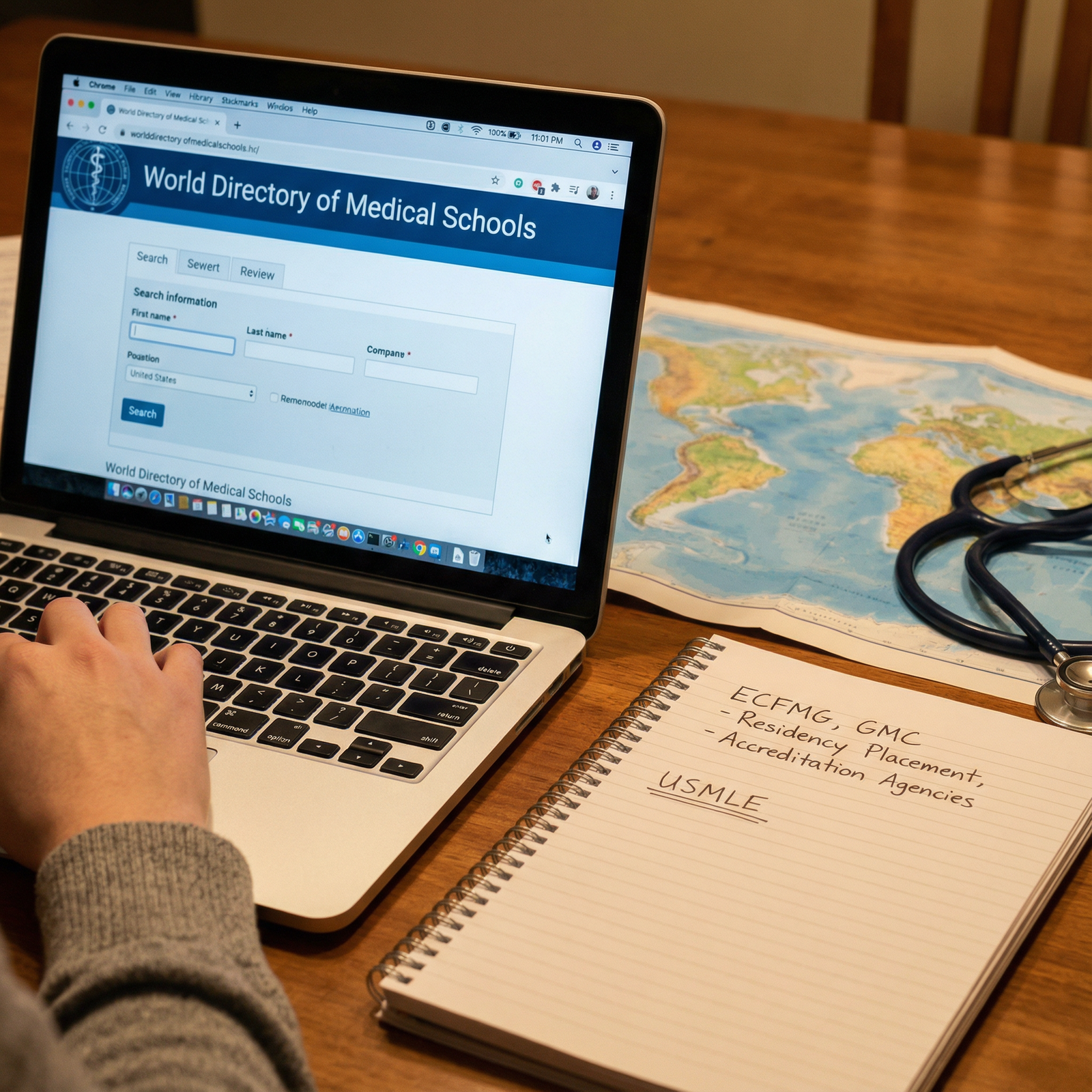
- Go to the World Directory of Medical Schools (WDOMS) and confirm the school is listed.
- On the school’s WDOMS entry, check the notes about recognition and ECFMG eligibility.
- Identify the school’s accrediting body and verify that agency on the WFME Recognized Accreditation Programme list.
- Cross‑check with the relevant national medical council in the country where you intend to practice (e.g., NMC for India, GMC for the U.K.).
If any of these checks fail or information is inconsistent, consider that a major red flag.
2. What’s the difference between recognition, listing, and accreditation?
- Listing: Being in a directory (like WDOMS) means the school is known to exist—it is not proof of quality or accreditation.
- Recognition: A national government or medical council acknowledges that the school can grant medical degrees within that jurisdiction.
- Accreditation: A formal evaluation by an independent agency confirming that the school meets defined educational standards.
You ideally want all three: listing in WDOMS, recognition in its home country, and accreditation by a WFME-recognized agency.
3. Can an accredited medical school lose its accreditation while I’m enrolled? What happens then?
Yes, schools can:
- Be placed on probation
- Have their accreditation shortened or revoked
If this happens:
- Accrediting bodies may allow current students to be “grandfathered” under specific conditions.
- ECFMG or national regulators may set cut‑off dates for when graduates remain eligible.
If you hear about accreditation concerns:
- Contact the accrediting agency directly.
- Request written confirmation of how your cohort will be treated.
- Re‑evaluate your options early; in extreme cases, students may transfer to other schools.
4. Are there risks in attending a school that is only provisionally or conditionally accredited?
Yes, there are added risks:
- Provisional/conditional status means the school has not yet fully met all standards or is too new to have complete outcome data.
- If the school fails to move to full accreditation, your eligibility for licensure exams or residency could be affected.
However, some newer schools with strong backing and transparent progress toward full accreditation can still be good options. You must:
- Review the conditions attached to their status.
- Understand the timeline and likelihood of achieving full accreditation.
- Consider how risk‑tolerant you are, given your long‑term plans.
5. How does accreditation influence my chances of matching into residency programs abroad?
Residency programs, especially in the U.S., Canada, and the U.K., use accreditation as a baseline filter:
- Many programs will not consider applicants from unaccredited or poorly accredited schools.
- Programs may prefer graduates from schools with a strong track record of high board exam pass rates and prior match success.
Accreditation does not guarantee a match, but without appropriate accreditation, your chances can drop dramatically—no matter how strong your individual performance is.
Choosing an international medical school is one of the most significant investments you will make in your life. Understanding accreditation—and verifying it independently—is essential to safeguarding your eligibility for exams, Residency Placement, and long‑term Global Opportunities in medicine. Take the time now to research thoroughly; your future self, and your future patients, will benefit from that diligence.