
How Chasing Hot Tips in the Doctors’ Lounge Derails Your Portfolio
What’s the most expensive sentence I hear doctors say about investing?
“Another cardiologist in our group doubled his money on this stock. I’m getting in tomorrow.”
You are not losing to Wall Street. You are losing to anesthesia workroom gossip. To the surgeon who “has a guy.” To the WhatsApp group that’s “crushing it in options.” That’s who is slowly draining your future freedom.
Let’s walk through how this happens, why physicians are especially vulnerable, and how to stop torching your portfolio with other people’s “can’t-miss” ideas.
Why Doctors Are Prime Targets for Bad Investment Behavior
You’re not dumb. Far from it. But your training sets you up for very specific investing mistakes.
Here’s the trap: in medicine, expertise is narrow and deep. In investing, people assume all smart professionals can just “figure it out.” They can’t. Not without scars.
I’ve seen some very predictable patterns in physician portfolios:
- The ENT who bought a “medical device startup” pitched by a partner. Lost $250,000. Still won’t talk about it.
- The hospitalist who allocated more to crypto than to her 401(k). She called it “catching up.” It was actually gambling.
- The surgeon who trusted a “family office” adviser who mostly sold high-fee private REITs and structured notes. Tax disaster. Liquidity nightmare.
None of these portfolios were ruined by index funds or boring 60/40 allocation. They were wrecked by stories. By tips. By ego.
And the most dangerous source isn’t Reddit. It’s the doctors’ lounge.
The Anatomy of a Doctors’ Lounge “Hot Tip”
You know this scene. You’ve lived it.
You’re post-call. Grabbing bad coffee. Someone says:
“Hey, did you guys see that AI company? I got in at $20, it’s at $60 now. My guy thinks it’s going to $200.”
Or:
“A group of us are buying into this surgery center / imaging center / hotel project. Insane returns. You should look at it before they close the round.”
Or the crypto version:
“Bro, you’re still in index funds? You’re missing the real money. We’re in early on this coin. Surgeon down the hall is already up 5x.”
Here’s what actually happens in those moments, whether you realize it or not:
You hear the upside, not the risk. Medicine trains you to identify rare risk in patients but ignore risk in markets when there’s a compelling success story.
You anchor on the colleague’s result. “They doubled their money” becomes your reference point, not “this could go to zero.”
You overweight the colleague’s intelligence. “He’s smart, so his investment must be smart.” That’s not how this works.
You underweight survivorship bias. You’re hearing from the one who won. The three who lost are silent or embarrassed.
If you let that cocktail mix with a high recent income and little formal investing education, you’ve got a portfolio time bomb.
The Core Problem: Strategy Drift, Not Just Bad Picks
The biggest mistake isn’t buying a particular bad stock.
It’s allowing your entire strategy to get hijacked by tips, trends, and one-off ideas. That’s called strategy drift, and it quietly wrecks long-term outcomes.
Here’s how that drift usually plays out for doctors:
Year 1–2:
“I’m maxing out my 401(k), maybe a Roth IRA. Mostly broad index funds. Seems boring but safe.”
Year 3–5:
“I added some sector funds my colleague mentioned. Also did this private real estate deal someone from fellowship recommended.”
Year 6–10:
“Now I’ve got one brokerage account at Fidelity, two at Robinhood, ‘a little’ crypto, two private funds, some vested hospital stock, and that surgery center investment I never get updates on.”
Year 10+:
You’re sitting with a financial adviser or CPA who says, “I have no idea what your actual allocation is until we organize this mess, and your tax situation is… not great.”
The damage isn’t just performance. It’s complexity. Taxes. Liquidity risk. And most importantly: you no longer know what game you’re playing.
At that point, the person managing your portfolio is basically: chaos.
Six Specific Ways Lounge Tips Sabotage a Physician’s Future
Let’s be concrete. Here’s how “just a few hot tips” morph into serious, measurable harm.
1. You End Up Concentrated Without Realizing It
You think you’re “diversified” because you own a bunch of different things.
But look under the hood and it’s all variations of the same risk.
| Situation | What You Think | What You Actually Have |
|---|---|---|
| Heavy in hospital stock + surgery center + med device startup | Diversified healthcare exposure | One sector, one regulatory regime |
| Primary home + 3 syndication deals + one REIT | Multiple properties | Highly correlated real estate risk |
| “A few” single stocks in tech and biotech | Sprinkling of growth | Concentrated in high-volatility, similar factors |
I’ve seen attendings with millions of net worth but 80–90% of it effectively exposed to healthcare reimbursement risk and real estate interest rate risk. That’s not wealth. That’s leveraged faith in two sectors.
And every new hot tip usually piles into what’s already familiar: more real estate, more medicine-adjacent stuff, more tech.
2. You Confuse Being Early With Being Right
Doctors love being “early adopters” of medical tech. That mindset does not translate to investing.
You hear: “We’re in early on this surgical robot company. Game-changing.”
Here’s the part nobody says out loud: early investors lose money all the time. The product can be excellent and the investment can still be terrible.
Being early in:
- The wrong company
- The wrong price
- The wrong capital structure
- The wrong cycle
…is just being wrong with more style.
In the lounge, people remember the one colleague who got in early on Tesla. They don’t see the graveyard of tiny biotech names that did multiple reverse splits then vanished.
3. You Underestimate Liquidity Risk (Until You Need Cash)
This one bites hard in mid-career.
A colleague pitches: “Illiquidity premium. You get higher returns because money is locked up. You’re a doctor, you don’t need it for years.”
Sounds sophisticated. Until:
- You want to cut back to 0.6 FTE
- You get sick or injured
- A malpractice suit freezes you psychologically
- Your spouse wants to move states
- Your kid gets into a wildly expensive program
And now? Fifteen to thirty percent of your net worth is trapped in:
- A surgery center that “might sell in 7–10 years”
- Real estate syndications with opaque updates
- Private funds with vague marks that can’t be sold easily
The day you’re tired of 12-hour shifts and Q3 call, you’ll wish more of your “investments” were actual liquid assets, not stories.

| Category | Value |
|---|---|
| Liquid (stocks/bonds/funds) | 45 |
| Semi-liquid (REITs, RSUs) | 20 |
| Illiquid (private deals, practices, syndications) | 35 |
If over a third of your net worth is locked up in illiquid stuff you joined from conversations with other doctors, that’s not clever. It’s risky.
4. You Ignore Taxes Until It’s Too Late
A “great return” after taxes can quietly become very average.
Common tax landmines from lounge-inspired investments:
- High turnover stock tips in taxable accounts → short-term capital gains at your highest marginal rate
- K-1s arriving in September from private deals, making filing a mess and surprise state filing obligations
- Phantom income from certain private structures you can’t access in cash
- Uncoordinated tax-loss harvesting because your accounts are scattered across platforms and advisers
Doctors are often in the worst tax bracket to be playing the hot-tip game. W-2 income high, limited deductions, and then layering high-tax, high-churn speculation on top? That’s self-sabotage.
5. You Confuse Social Proof With Due Diligence
“It must be good, five people in my group already invested.”
Painfully common. Completely wrong.
Five busy physicians copying each other is not “due diligence.” It’s an echo chamber with stethoscopes.
Actual due diligence (the kind almost nobody in the lounge is doing):
- Reading the full private placement memorandum or prospectus
- Understanding fees, carry, preferred returns, and waterfall structures
- Checking sponsor track record, prior deal outcomes, and conflicts of interest
- Evaluating how this fits with your total net worth, goals, and risk budget
If the investment was explained to you on a napkin between cases, assume no meaningful due diligence has happened. Assume you’re the mark until proven otherwise.
6. You Let Ego Run the Portfolio
This one stings, but it’s real.
There’s a status game in medicine around money:
- Who bought into which deal
- Who’s “crushing it” in the market
- Whose passive income “covers all their expenses”
So you feel pressure to have something interesting to say when finances come up. Index funds don’t make good stories. A “pre-IPO allocation” does.
People will blow six figures just to not be the boring one in the group. They will never call it that, but watch their behavior and you’ll see it.
Your portfolio is not a personality accessory. It’s your future call schedule reducer. Your early-retirement lever. Don’t turn it into a social flex toy.
The Physician-Grade Antidote: Boring, Structured, Defensible
You don’t fix lounge-tip chaos with “better tips.” You replace tips with a system.
Not a day-trading strategy. A framework that makes it hard to blow yourself up.
Here’s what that looks like in practice.
Step 1: Decide Your Real Job as an Investor
If you’re a full-time physician, your job is not:
- Timing the market
- Finding the next Tesla
- Outperforming hedge funds
Your actual job:
- Convert high, relatively stable income into long-term, diversified ownership of productive assets
- Minimize unforced errors (taxes, fees, concentration, leverage)
- Keep your behavior sane through market cycles
Anything that distracts from those three? Probably not your game.
Step 2: Pick a Core Portfolio You Don’t Touch Lightly
You need a default answer to “Where should money go?” that does not depend on who you talked to last week.
Something like:
- 60–90% of investable assets in:
- Broad stock index funds (US + international)
- High-quality bond funds / Treasuries, depending on risk tolerance and time horizon
Call this your “never cancel surgery for this” money. You rebalance periodically. You tax-loss harvest strategically. You don’t dump it all for a hot tip.
Step 3: Cap Your Speculation Explicitly
If you absolutely must play with lounge ideas, quarantine them.
Set a hard rule: “X% of my investable assets can go into speculative or illiquid stuff. The rest is off-limits.”
For many physicians, X should be between 5–10%. Not 40%. Not “whatever feels right.”
| Net Worth (excluding primary home) | Max Speculative / Illiquid Allocation |
|---|---|
| Under $500k | 0–5% |
| $500k–$2M | 5–10% |
| $2M–$5M | 10–15% |
| Over $5M | 15–20% (if you can stomach the risk) |
If a deal forces you above your cap? You say no. Or you sell something within your “play” bucket first. No exceptions.
Step 4: Force a Cooling-Off Period on Every Tip
Doctors are used to making urgent decisions. Investing is the opposite.
Create a mandatory pause rule:
- Hear a tip in the lounge
- Write it down
- Minimum 7 days before acting
- During those 7 days:
- Read at least one bearish or skeptical view on it
- Map out how it fits your total portfolio
- Confirm it does not violate your allocation or speculation caps
If a deal “won’t be available” in 7 days? Perfect. Let it go. Urgency is a classic sales tactic. Quality investments will almost always be there when you’re ready.
Step 5: Separate “Friends” From “Financial Professionals”
You absolutely should not let this happen:
- “My colleague’s financial adviser is amazing, he got them into this private deal. I’ll just use him too.”
No.
That adviser may:
- Specialize in high-commission products
- Have revenue-sharing agreements with the fund sponsors
- Be totally wrong for your situation and goals
You need your own screening process for advisers:
- Fee-only, not fee-based or commission-compensated
- Fiduciary, in writing
- Transparent fee structure you understand without a dictionary
- Willing to say “no” to your bad ideas, not just accommodate them
Your friends are not your vetting system. They’re just people who happened to be sold something before you.
How to Actually Use the Doctors’ Lounge Without Wrecking Yourself
You don’t have to become the weirdo who storms out whenever money is mentioned. You just need clear boundaries.
Use the lounge for:
- Ideas to research, not actions to take
- Learning what not to do by noticing how chaotic other people’s plans are
- Getting names of good CPAs, estate attorneys, or truly solid fee-only advisers
Do not use the lounge for:
- Deciding allocations
- Choosing individual stocks or crypto
- Committing to any private deal on the spot
- Measuring your progress against others’ cherry-picked stories
And never forget: nobody is giving you a full picture. They will tell you about their 12-bagger stock. They will not tell you:
- About the options account they blew up
- About the private fund that gated redemptions
- About the capital call they couldn’t meet
You’re comparing your full financial reality to their highlight reel. Dangerous game.
A Quick Reality Check on Returns
One more truth that doesn’t get said loudly enough in physicians’ circles:
You don’t need heroic returns to win.
You need:
- A high savings rate (yes, relative to income you can do this)
- Low costs
- Tax efficiency
- Time
A doctor who consistently saves 20–30% of gross income into a boring, diversified portfolio will almost always beat the colleague who:
- Saves 5–10%
- Chases hot tips
- Pays high fees and high taxes
- Constantly changes strategies
The hot-tip crowd has better stories. The boring crowd has actual freedom.
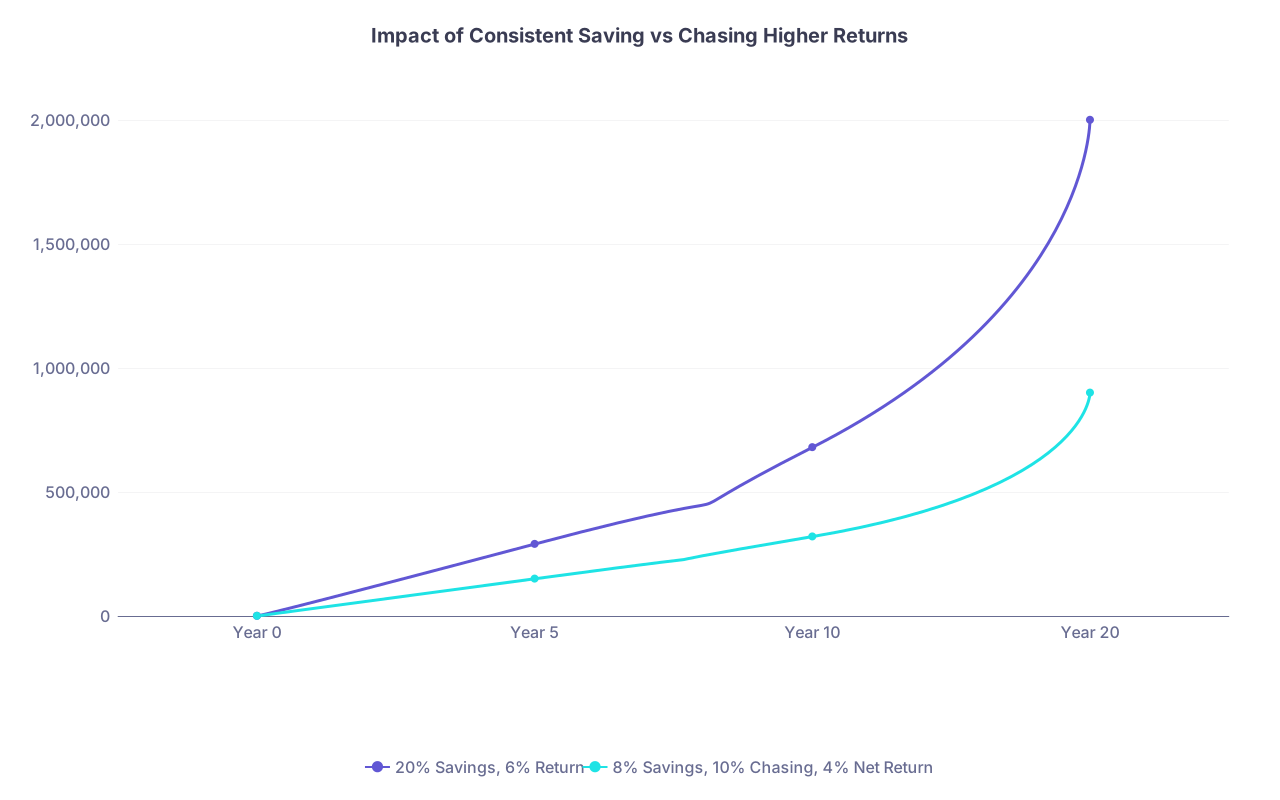
| Category | 20% Savings, 6% Return | 8% Savings, 10% Chasing, 4% Net Return |
|---|---|---|
| Year 0 | 0 | 0 |
| Year 5 | 290000 | 150000 |
| Year 10 | 680000 | 320000 |
| Year 20 | 2000000 | 900000 |
The numbers aren’t exact for your situation, but the pattern is: disciplined and dull beats sporadic and exciting.
Your Move: One Concrete Step Today
Do not just nod and move on.
Today, before your next shift or between cases, do this:
Pull up all your investment accounts—401(k), 403(b), brokerage, “fun” trading accounts, private deal summaries. On a piece of paper (yes, paper), list each holding and label it as one of:
- Core (broad index fund, bond fund, simple diversified holding)
- Speculative (single stock, crypto, options, sector bets)
- Illiquid (syndications, private equity, surgery center, practice buy-in)
Then calculate the percentages.
If your speculative + illiquid slice is more than you thought it was, you’ve already let the doctors’ lounge into your portfolio.
That’s your warning light.
Next step: decide—deliberately—what you want those percentages to be. Then make a plan, over the next 6–18 months, to move from “lounge-driven” to “strategy-driven.”
Start with that inventory. No tips. No new deals. Just the truth about what you already own.