
It’s 10:45 p.m. You just finished a brutal call shift, you’re eating cereal over the sink, and you realize you have no idea when your student loans are due, what your mortgage rate is, or how much is in “your” savings. Because your partner “handles all the money.”
And suddenly the thought hits:
“What if something happens? What if they leave? What if they die? What if they’ve been quietly wrecking our finances and I’ve been too tired and too trusting to notice?”
If that’s where your brain is spinning right now, you’re not alone. I’ve seen this exact scenario with residents, new attendings, even mid-career physicians who make more in a month than their parents made in a year—and still don’t actually control (or even see) their own money.
Let me be blunt:
As a physician, letting someone else fully control all the money without guardrails is risky. Even if they’re wonderful. Even if you love them. Even if it’s “just easier.”
This isn’t about not trusting your partner. It’s about not abandoning yourself.
Let’s walk through what you should actually be worried about (some of it’s valid, some of it’s your anxiety talking), and what you can do this month—not five years from now—to protect yourself.
The Quiet Risks When Your Partner Handles “Everything”
There are a few distinct categories of risk here. Some are emotional, some are legal, some are numbers-on-a-page scary.
1. Information asymmetry (they know everything; you know nothing)
If your partner controls:
- All the passwords
- All the accounts
- All the auto-pays
- All the investments
…and you can’t answer basic questions like:
- How much cash do we have if everything goes sideways tomorrow?
- Where is my direct deposit going?
- Who’s on the mortgage?
- What’s my disability policy, and where is the actual contract?
…you’re exposed. Even if your partner is a saint.
Because if they get hit by a bus tomorrow, you’re functionally blind. I’ve seen attendings with seven-figure incomes who couldn’t even log in to a single bank account when their spouse landed in the ICU.
That’s not “romantic trust.” That’s learned helplessness dressed up as convenience.
2. Legal exposure (you earn the money, but don’t control it)
You’re a high-earning, high-liability professional. Malpractice risk. Personal liability. Divorce risk. Disability risk. You know this on some level, but it’s very easy to shove it in the “future me will deal with it” folder.
When your partner handles all the money, and you don’t know:
- Which accounts are joint vs individual
- Who is on the title to the house
- Who is listed on which debts
- How your state treats marital property (community property vs separate property)
…you’re guessing about your own legal and financial safety.
Worst-case scenarios that actually happen:
- Partner secretly racks up $40k+ in credit card debt on joint accounts
- Refinances the house you “own together” into something predatory you never read
- Cashes out your retirement to “help with cash flow” and doesn’t tell you
- “Forgets” to pay your student loans → capitalization + late marks
Is every partner doing this? No. But the whole point of guardrails is to protect you from the one-in-a-hundred situation that blows up your life.
3. Emotional manipulation and financial abuse (yeah, the scary words)
There’s a spectrum.
On the mild end:
“You’re too busy, I’ll just handle the money.”
“We don’t need to talk about this every month, it stresses you out.”
On the toxic end:
“You don’t need to see the accounts.”
“I’ll give you an allowance.”
“You’re bad with money, remember when you overdrafted in med school?”
“If you leave, you’ll have nothing. I paid for everything.”
That’s not partnership. That’s control.
I’ve seen physicians with $300k+ incomes who literally had to ask permission to buy scrubs. If any part of your current situation even vaguely rhymes with that, your gut is not overreacting. You need a plan yesterday.
Step One: Get Visibility (No Drama, Just Facts)
You don’t have to stage a financial coup tonight. You do need to stop being in the dark.
Here’s the goal for the next 2–4 weeks:
You want a one-page snapshot of your financial life that you could explain to someone else without your partner in the room.
Things to collect (and yes, write them down):
- Every bank account (joint and individual) – institution + last 4 digits
- Every credit card – issuer, whose name, balance, limit
- All loans – student loans, mortgage, car, personal loans, HELOC
- All investment/retirement accounts – 401(k), 403(b), 457, IRA, brokerage
- Insurance – term life, disability, malpractice, umbrella, health
- Big recurring bills – rent/mortgage, utilities, childcare, tuition, etc.
If this list makes you sweat, that’s exactly why you need it.
You’re not accusing anyone. You’re saying, “I’m a physician with a huge financial footprint. It’s not safe or smart for me to not know anything. I want us both to be able to run things if something happens to either of us.”
If your partner is healthy, they’ll understand that. Maybe not immediately, but they’ll get there.
If they resist even this basic level of transparency? That’s data. Big, loud data.
Step Two: Make Sure You Can Access the Money You Earn
Bare minimum self-protection as a physician:
- You have your own individual checking account
- Your paycheck hits an account where you are an owner
- You know the login and can move money without asking
If right now your paycheck goes:
Hospital → Joint account you can’t log into → Partner “handles it”
…you’re incredibly exposed. One ugly fight, one affair, one midlife crisis, and you could theoretically find your card shut off, accounts drained, and “sorry, you’re not on this account” from your own bank.
You do not need to make this adversarial. You can say something like:
“I’ve been reading a lot about physicians and financial vulnerability. It’s stressing me out that if something happened to you, I’d be lost. I’d like my paycheck to go into an account that I can access directly, then we can automatically move X% to our joint bills account each month.”
Fair, reasonable, adult.
If they say that’s “unnecessary” or “you don’t need that” or “do you not trust me?”—that’s a red flag. Loving partners don’t need you to be financially dependent to feel secure.
Step Three: Understand the Legal Side (State Laws Are Not Your Friend)
Physicians live in a fun combo of:
- High income
- High debt
- High liability
- Often clinically exhausted → easy to sign things you don’t understand
Your state’s laws matter. A lot.
| Topic | What You Need To Know |
|---|---|
| Marital property | Is your state community or separate property? |
| House ownership | Whose name is on the title and mortgage? |
| Debt responsibility | Which debts are joint vs individual? |
| Divorce standards | How assets and retirement are usually divided |
| Prenup/postnup | Whether you have one and what it actually says |
If reading that table made your chest tighten, that’s normal. Most doctors have never read their own mortgage documents, much less thought about marital property law.
You don’t have to become a lawyer. But you should:
- Google: “[Your state] community property physician divorce assets”
- At some point, pay a real family law attorney for a 60–90 minute consult
- Actually read (or re-read) your prenup/postnup if you have one
You’re not “planning to divorce.” You’re acknowledging that your career is a multi-million-dollar asset and you should understand, at least roughly, how it would be treated if things go nuclear.
Step Four: Split Roles Without Surrendering Control
It’s fine if your partner is “the money person.” Every couple has roles. The problem is when the role becomes an excuse for you to know nothing.
The standard I push physicians toward is this:
- One person can be primary operator
- Both people are informed decision-makers
Translation: they can click the buttons; you know what buttons exist and why they’re being clicked.
Practically, this can look like:
- Monthly 30–45 minute “money meeting” where you review:
- Balances across major accounts
- Total debt + any big changes
- Investment contributions
- Upcoming large expenses
- Shared password manager (1Password, Bitwarden, etc.) with:
- All financial accounts
- Insurance policies
- Loan servicers
- Written “in case something happens” doc with:
- Account list, key contacts, advisors (if any)
Is this annoying after a 12-hour shift? Yes. Is it less annoying than discovering $50k of credit card debt and a cashed-out 401(k) in a divorce proceeding? Absolutely.
Step Five: Build a Personal Safety Net—Quietly If Needed
Here’s the part your anxious brain probably already jumped to: “What if they leave me? What if they’re cheating? What if I have to escape?”
Even if that’s not happening, it’s not crazy to have your own safety net. In fact, it’s smart.
Pieces of a basic personal safety net:
- Your own checking + savings account in your name only
- At least 3 months’ personal expenses saved (even 1 month is a start)
- A credit card solely in your name, that you actively use and pay
- Access to your own credit report from all 3 bureaus
- Copies (physical or digital) of key documents:
- License, passport, birth certificate
- Marriage certificate, prenup/postnup
- Loan docs, insurance policies, contracts
If you’re in a controlling or scary situation, you may need to do some of this quietly and with help from a therapist, lawyer, or even a domestic violence resource (financial abuse is abuse).
If you’re in a healthy relationship, you can say this out loud:
“I want my own small safety net. Not because I’m planning to leave, but because anything can happen and I don’t ever want either of us to be trapped.”
Healthy partners don’t need you to be trapped to feel loved.
Step Six: Take Back Some Cognitive Ownership (Even If You’re “Bad With Money”)
The number of physicians who tell me they’re “bad with money” is absurd. You made it through biochem and intern year. You can absolutely understand index funds and loan repayment plans.
The truth is usually:
- You’re tired
- You’re overwhelmed
- You’re afraid to see the real numbers
- You’ve outsourced your anxiety to your partner
You don’t need to become a hedge fund manager. But you should:
- Know your net worth (even if it’s negative right now)
- Know how much you’re investing per year
- Know your student loan strategy (PSLF? Refi? IDR?)
- Understand the basic accounts you own (401(k) vs Roth IRA vs taxable)
You’ll be shocked how much less scary this feels once you see the actual numbers. Anxiety loves mystery. Transparency kills a lot of the monster under the bed.
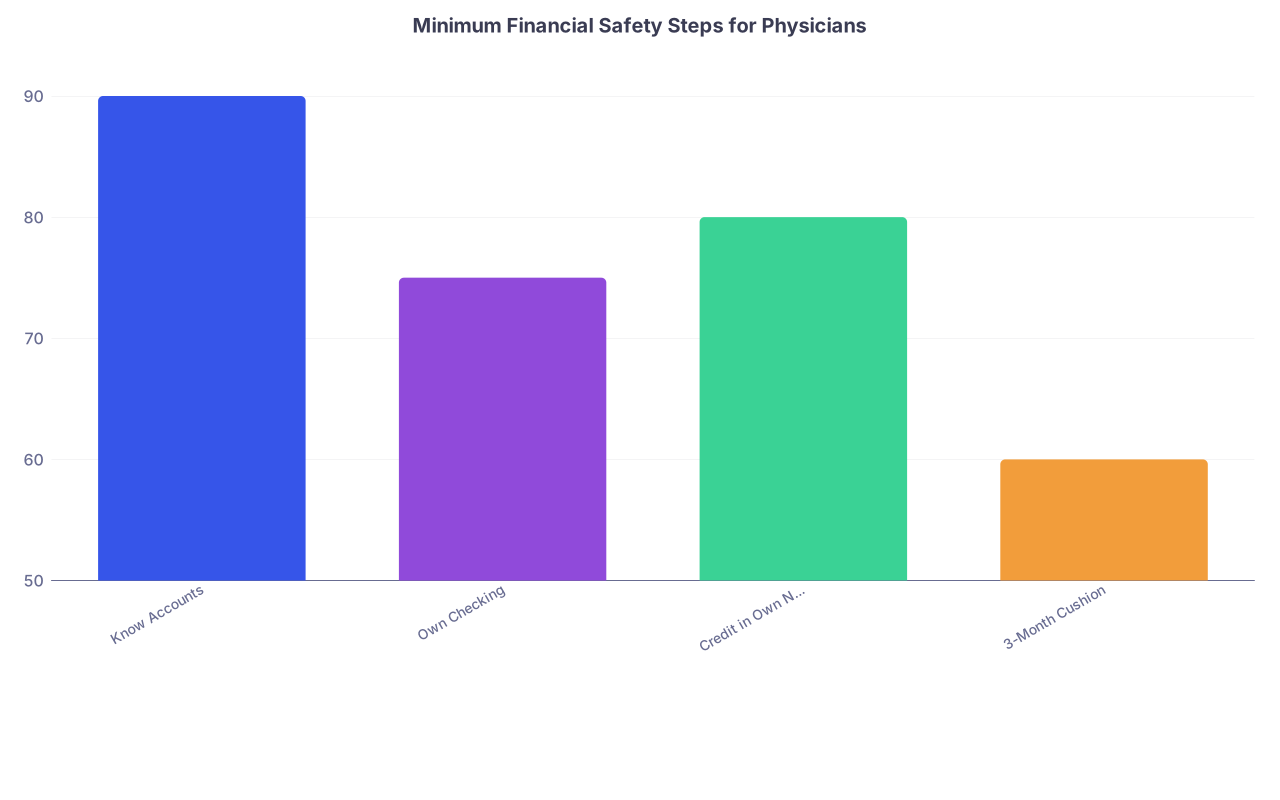
| Category | Value |
|---|---|
| Know Accounts | 90 |
| Own Checking | 75 |
| Credit in Own Name | 80 |
| 3-Month Cushion | 60 |
(Values represent rough “importance level out of 100” if I had to prioritize. They’re not scientific; they’re sanity-saving.)
What If Things Already Feel Off?
If any of this sounds familiar:
- Your partner shames you for asking about money
- You’re not allowed access to accounts
- You’ve found big financial secrets (hidden debt, secret accounts)
- You’re scared to bring any of this up
Then you’re not just in a “division of labor” situation. You might be in something more dangerous.
Your sequence then is different:
- Quietly document what you can (photos of statements, screens, mail)
- Open your own checking account (even with just $50 to start)
- Pull your credit reports from all 3 bureaus
- Book a confidential session with:
- A therapist who understands relationship and financial abuse
- Or an attorney (family law) in your state
- Or a domestic violence hotline / advocacy group if it’s truly bad
- Do not announce big moves until you have a plan and support
You are not being dramatic. You’re being prudent. The fact that you’re a physician doesn’t magically protect you from bad relational dynamics. If anything, the money and your exhaustion make you easier to control.

| Step | Description |
|---|---|
| Step 1 | Realize Partner Handles All Money |
| Step 2 | Gather Account Info |
| Step 3 | Ensure Own Checking Account |
| Step 4 | Set Up Monthly Money Meeting |
| Step 5 | Share Password Manager and Docs |
| Step 6 | Consult Lawyer or Therapist |
| Step 7 | Build Personal Safety Net |
| Step 8 | Review Plan Every 6 Months |
| Step 9 | Partner Supportive? |
If You Do Nothing, What’s the Real Worst-Case?
Your anxious brain likes catastrophes, so let’s name them:
Worst-case if you stay totally checked out and everything goes wrong:
- Divorce you didn’t see coming → you have no idea what’s where
- Partner drained accounts / racked up joint debt → you’re partially liable
- Loans mismanaged → extra years of payments, wrecked credit
- Partner dies suddenly → you don’t know where anything is, while grieving and working
- You become disabled → you never actually read your disability policy, benefits aren’t what you thought
Now compare that to the discomfort of:
- One awkward conversation
- A few evenings logging into accounts
- A 60-minute lawyer consult you pay a couple hundred bucks for
- Setting up one new bank account
The tradeoff is obvious when you actually line it up. The short-term awkwardness is tiny compared to the long-term disaster potential.
FAQ (Exactly 5 Questions)
1. My partner is great and trustworthy, I’m just exhausted. Am I overreacting?
No. You can trust them and still need protection. Physicians are uniquely vulnerable because you earn a lot, carry a lot of debt, and are often too tired to track the details. You don’t need to assume your partner will betray you to justify having access, knowledge, and your own account. That’s just being a competent adult.
2. How do I bring this up without sounding like I’m accusing them of something?
Blame it on your career and the horror stories. Try: “I’ve been reading about doctors getting financially wrecked because they didn’t know what was going on with their money. It scares me that I couldn’t run our finances for even a week if I had to. Can we set aside an hour to go over everything so we’re both on the same page?” If a partner can’t handle that level of conversation, that’s the red flag—not your question.
3. Is it okay to have my own separate money if we’re married? It feels... disloyal.
It’s not disloyal; it’s responsible. Think of it like disability insurance. You hope you never need it, but you’re reckless if you don’t have it. Joint accounts for shared bills and goals are great. Separate accounts for personal autonomy and safety are also great. Healthy couples can do both without spiraling into “you don’t love me.”
4. I discovered debt I didn’t know about. What now?
First, document everything: statements, terms, whose name, interest rates. Second, pause new big financial moves (no new house, no big joint purchases) until you have a clear picture. Third, have one focused “we’re on the same team, but we need transparency” conversation. If your partner is defensive but willing to work on it, consider a financial therapist or planner to help. If they minimize, lie, or blame you? That’s when you quietly talk to a lawyer and therapist before doing anything else.
5. Do I really need a lawyer if I’m not planning to divorce?
Not necessarily a full retainer, but a 60–90 minute consult with a family law attorney in your state can be worth its weight in gold. You’ll understand how your income, retirement, and debts are treated legally. It’s like getting a reading on your overall risk profile. You don’t go to an oncologist only when you’re terminal; you go to get clarity and options. Same idea here.
Today, don’t try to fix everything. Just do one thing.
Open a blank note on your phone and start a list titled “Our Accounts.” Write down every account you know exists—bank, loans, investments, credit cards. If your list is embarrassingly short, that’s your signal. This week, ask your partner to help you fill it in. That one small, slightly uncomfortable step is where your financial safety actually starts.