The worst thing you can do after a weak core clerkship is pretend it did not happen. The second worst thing is to panic and blindly “go for an easy specialty.” Both are mistakes. You can recover—if you are deliberate and stop lying to yourself about where you stand.
You are not the first student to get a mediocre IM eval, a weak shelf score, or a “below expected” in Surgery. I have seen students with borderline passes in core rotations match into solid residencies. Including competitive ones. But only the ones who stopped doing damage control and started doing strategy.
This is about that strategy.
Step 1: Diagnose the Damage – Precisely, Not Emotionally
You cannot fix “I did badly in clerkships.” Useless sentence. You can fix, “I honored FM, HP in Peds, barely passed IM with a weak shelf, and got a ‘needs improvement’ comment on organization.”
Break it down.
1. Collect the hard data
Pull everything:
- Grades for each core clerkship (IM, Surgery, Peds, OB/GYN, Psych, FM, Neuro if core at your school)
- Shelf scores and percentiles where available
- Narrative comments (especially negative or “concern” language)
- Any professionalism notes or remediation paperwork
- Class rank/quartile or decile, if your school reports it
Make a simple grid. Do not overcomplicate:
| Clerkship | Grade | Shelf Percentile | Key Concern |
|---|---|---|---|
| Internal Medicine | Pass | 25th | Disorganized, slow notes |
| Surgery | Pass | 30th | Quiet on rounds |
| Pediatrics | High Pass | 55th | Needs more confidence |
| Family Medicine | Honors | 70th | Strong with patients |
| OB/GYN | Pass | 35th | Limited participation in OR |
| Psychiatry | High Pass | 60th | Solid rapport |
Now you can see patterns instead of just feeling “behind.”
2. Identify the type of weakness
You are not “bad” at medicine. You probably have one or two of these specific problems:
Knowledge/Test-taking gap
- Shelf percentiles consistently <30
- Comments like “needs stronger knowledge base” or “below expected fund of knowledge”
Workplace performance gap
- Frequent comments on:
- organization
- time management
- slow notes
- passive on rounds
- not speaking up
- Frequent comments on:
Professionalism/behavioral flags
- Tardiness, missed pages, unprofessional comments, conflicts with staff
Single catastrophic rotation
- One really ugly rotation (e.g., IM Pass with remediation) while others are fine
Label it. Many students have a narrative that things are terrible when in reality they have:
- 1–2 mediocre rotations
- 1 poor shelf
- 1 comment that stings
That is fixable.
Step 2: Stop the Bleeding on Future Rotations
Before we even talk about leveraging “low-competition” specialties, you must stop generating more weak data points. No program wants a continuous downward slope.
1. Pick one performance variable to upgrade immediately
Do not try to fix everything at once. Choose the thing that hurt you most:
If your weakness is knowledge:
- Start a non-negotiable daily question set:
- 20–40 UWorld/AMBOSS questions per day related to current rotation
- Shelf exam: schedule a practice NBME 2 weeks before the test
- Start a non-negotiable daily question set:
If your weakness is work habits:
- Commit to:
- Note done by a specific time daily (e.g., all notes finished by 2 pm)
- Pre-rounding checklist in your pocket (vitals, labs, overnight events, plan for day)
- Commit to:
If your weakness is professionalism:
- Two rules:
- Show up 10–15 minutes earlier than your residents
- Over-communicate: text/call when you are delayed, verify expectations every morning
- Two rules:
You are not rebuilding your entire identity. You are fixing the most obvious crack first.
2. Tell your next attending what you are working on
Strong move, almost nobody does this.
On day 1 or 2 of the next rotation:
“On my last clerkship I got feedback that I was slow to speak up on rounds and my notes could be more organized. I am actively working on both. If you see ways I can improve these during this rotation, I would really appreciate direct feedback.”
That statement does three things:
- Shows insight
- Signals you are coachable
- Pre-frames your prior weakness as past tense, under active repair
Many attendings will lean in to help you. They will also be less likely to assume you are “just a weak student.”
Step 3: Understand What “Least Competitive” Actually Means
Here is where people go off the rails. They hear “Family Medicine is easy” or “Psych is a backup specialty” and decide that is their safety net. That is sloppy thinking.
Low-competition does not mean standards disappear. It means:
- Lower average Step scores
- More programs overall
- More community programs with flexible screening
But programs in these fields still reject people. A lot.
Look at a few examples.
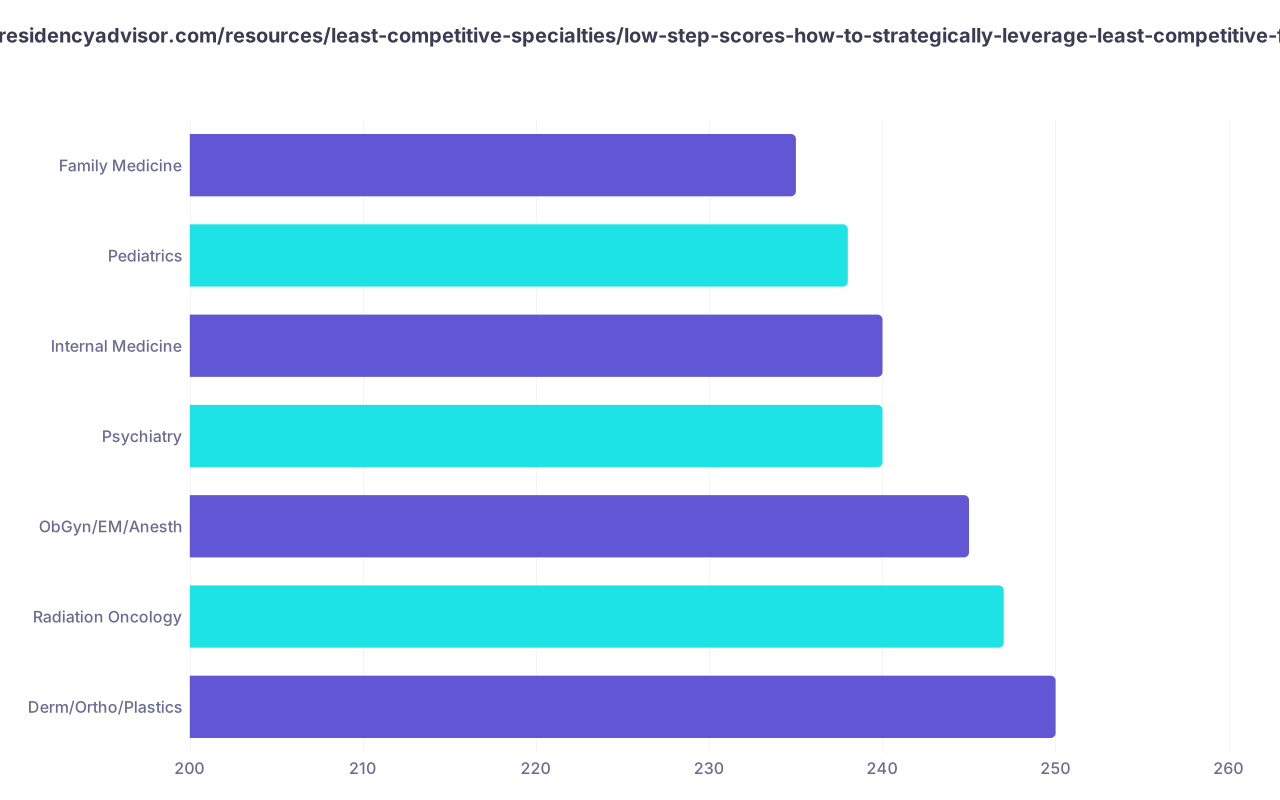
| Category | Value |
|---|---|
| Derm/Ortho/Plastics | 250 |
| Radiation Oncology | 247 |
| ObGyn/EM/Anesth | 245 |
| Psychiatry | 240 |
| Internal Medicine | 240 |
| Pediatrics | 238 |
| Family Medicine | 235 |
Numbers vary year to year and by data source, but the pattern holds:
- Ultra-competitive: 245–255+
- Mid-range: high 230s to mid 240s
- Lower-barrier specialties: low-to-mid 230s
So if you are sitting on:
- Step 2 CK 220–230
- A few pass grades in core rotations
- One ugly eval
You are not automatically unsafe. You are in the zone where smart strategy matters more than heroics.
Common “lower-competition” specialties (relatively speaking):
- Family Medicine
- Psychiatry
- Pediatrics (varies; university programs can be quite competitive)
- Community-based Internal Medicine
- Pathology
- PM&R (physical medicine & rehab) at some programs, though the field is heating up
“Least competitive” inside a specialty is usually:
- Community programs
- Non-metro areas
- Newer programs
- Programs with fewer residents per year
Using these options wisely does not mean you must settle. It means you build a floor under your match chances while still keeping reasonable stretch options.
Step 4: Decide If You Actually Need a “Lower-Competition” Strategy
Not everyone with a weak clerkship does.
You probably do not need to pivot to low-competition fields if:
- You have 1 weak core clerkship and the rest are HP/Honors
- Step 2 CK ≥ 240
- No professionalism flags
- Strong letters from at least two core specialties
You do need to think harder if:
- Multiple core passes in key fields (e.g., IM, Surgery, OB all Pass)
- Step 2 CK below ~230
- Narrative comments that raise concern (e.g., “requires close supervision”)
- Class rank bottom quartile
- Prior remediation or leaves
If that second bucket looks like you, this is where you start playing with a tiered specialty strategy.
Step 5: Build a Tiered Specialty Plan (Primary vs Safety vs Stretch)
I push students to stop thinking “Plan A vs Plan B.” That mindset kills nuanced strategy. You should be thinking in tiers:
- Tier 1: Primary specialty – The field you actually want and can realistically target with a smart list
- Tier 2: Intra-specialty floor – Less competitive programs within that specialty
- Tier 3: Cross-specialty safety – A second, less competitive specialty where your profile is above or at the median
Scenario A: Weak IM clerkship, but you still want IM
Let us say:
- IM Pass with 30th percentile shelf
- Peds HP, FM Honors
- Step 2 CK 230
- No major red flags
Your tiers could look like:
- Tier 1 (Primary): Internal Medicine
- Focus on: mid-tier university + strong community programs
- Tier 2 (Floor within IM):
- Heavier emphasis on:
- Community-based IM programs
- Midwestern/Southern states
- Non-coastal areas
- Heavier emphasis on:
- Tier 3 (Cross-specialty safety):
- Family Medicine programs in regions you’re open to
You are still “an IM applicant.” You just quietly create an FM safety net if your IM interview volume is poor.
Scenario B: Multiple weak cores, low Step 2, need rescue plan
Say:
- IM Pass, Surgery Pass, OB Pass
- FM HP, Psych HP
- Step 2 CK 220
- Few honors overall
Your tiers:
- Tier 1 (Primary): Psychiatry or Family Medicine (pick the one you like more)
- Tier 2 (Floor):
- Community programs, smaller cities, non-coastal, new programs in your chosen field
- Tier 3 (Cross-specialty):
- If primary is Psych → add some FM
- If primary is FM → may not even need cross-specialty if list is broad enough (60–80 programs)
Here is the core principle:
You do not declare to the world that you “settled for a backup specialty.” You simply construct a list that prevents catastrophic non-match.
Step 6: Use “Least Competitive” Fields Strategically, Not Desperately
Let us talk specifics. How to use lower-competition options, not just default into them.
1. Family Medicine as a stabilizer
Family Medicine is the most forgiving field numerically, especially in non-major cities.
You use FM wisely when you:
Apply to:
- Your home FM program
- FM programs in states that favor in-state or regional applicants
- Community-based, unopposed FM programs (no competing residencies)
Get 1–2 strong FM letters:
- From a core FM clerkship and/or a sub-I in FM
- Ask letter writers explicitly if they can “write a strong, supportive letter”
You do not use FM wisely when:
- You have never done an FM rotation and throw 5 FM applications at the wall in January
- Your PS screams “I always dreamed of Cardiology” and never mentions continuity of care, broad-based practice, or primary care interests
2. Psychiatry as a targeted backup
Psych has higher bars than people think, especially in urban and coastal areas. But many mid-tier and community psych programs are very attainable for students with uneven cores.
You use Psych wisely when:
- You have at least:
- One psych rotation (core or elective) with a good eval
- A psych letter that explicitly supports you for the field
- Your personal statement shows:
- Genuine interest in mental health
- Some reflection on your strengths in communication, patience, or alliance building
You do not use it wisely when:
- You have zero psych exposure
- You sound like you picked psych because you “do not like procedures” and “want lifestyle”
3. Pediatrics / Community IM / Pathology / PM&R
These are trickier. Competition varies widely by:
- Region
- Program type
- Size
Use them wisely by:
- Getting at least one targeted elective in that field
- Securing one letter from that specialty
- Making sure your application materials (PS, experiences) do not scream “I actually want something else and this is my consolation prize”
The underlying rule: backup specialties are not where you hide. They are where you demonstrate fit with less pressure on pure metrics.
Step 7: Fix the Narrative Problem in Your Application
Weak core clerkships raise one big question in a PD’s mind:
“Is this student actually unsafe, or just average with a few stumbles?”
Your job is to answer that with evidence.
1. Use MSPE and advisor letters to contextualize
Most schools describe clerkship performance in the MSPE. You cannot rewrite that. But you can:
- Ask your dean’s office how they will describe concerning issues
- Make sure there is no unexplained gap or half-story (no cryptic references to “issues” without resolution)
If you had remediation or major concerns:
- Ask your dean if they can include language like “successfully remediated” and “demonstrated improvement on subsequent rotations.”
- Strong idea: Get a confidential advisor letter (if allowed) submitted to ERAS that explicitly discusses your growth and current reliability.
2. Personal statement: do you mention weaknesses?
Depends on severity.
For mild issues (one weak rotation, no remediation):
- You do not need to highlight it. Focus on why that specialty fits you and where you are strong.
For moderate issues that PDs will clearly see:
- Brief acknowledgment can help:
- 1–2 sentences about “early clinical performance” followed by specifics on how you changed your approach and the better results that followed.
- Do not write a confessional essay.
- Brief acknowledgment can help:
Example:
“Early in third year I struggled with organization on my Internal Medicine rotation, which affected both my efficiency and my confidence. With specific feedback from my residents, I built a structured pre-rounding system and daily study schedule. On subsequent rotations in Pediatrics and Family Medicine, attendings remarked on my improved preparation and reliability, and I found that my clinical reasoning strengthened as my workflow stabilized.”
That is enough. Name the problem. Show the correction. Show the new data points.
Step 8: Strengthen the Parts of Your Application You Still Control
You cannot un-do a Pass in Surgery. But you are not out of moves.
1. Crush at least one sub-I or acting internship
Pick one of:
- Your target specialty
- A closely related core field
And:
- Treat it like a month-long audition:
- Show up early
- Know your patients inside out
- Take ownership of small but real tasks
- Volunteer for cross-coverage opportunities if appropriate
Ask for specific, daily feedback. Mid-rotation, ask directly:
“Is there anything that would prevent you from giving me a strong letter if I continue at this level or better?”
It is a gutsy question. And extremely clarifying.
2. Letters of recommendation: go quality > prestige
A lukewarm letter from Big Name University will not save you. A concrete, specific letter from an attending who watched you grind and improve can absolutely counteract a weak clerkship.
You want letters that say things like:
- “Started the rotation less confident but responded quickly to feedback”
- “By the end, was functioning at or above the expected level for a student”
- “Reliable, professional, and well-liked by staff and patients”
Those phrases are gold when someone is scanning past a Pass grade in IM or a low shelf score.
3. Step 2 CK as your redemption
If Step 1 is Pass/Fail (for recent cohorts), Step 2 is your only numeric proof you can handle exams at residency pace.
If you have not taken Step 2 yet:
- Make this your biggest academic priority.
- Use an honest baseline NBME → dedicated block (4–6 weeks) → serial NBME and UWorld reset.
- A jump from expected 220 to 235 does more damage control than any emotional explanation about your IM clerkship.
Step 9: Apply Broadly and Intelligently
Weak core clerkship + narrow application list = non-match. Every year I see that combination.
Use numbers.
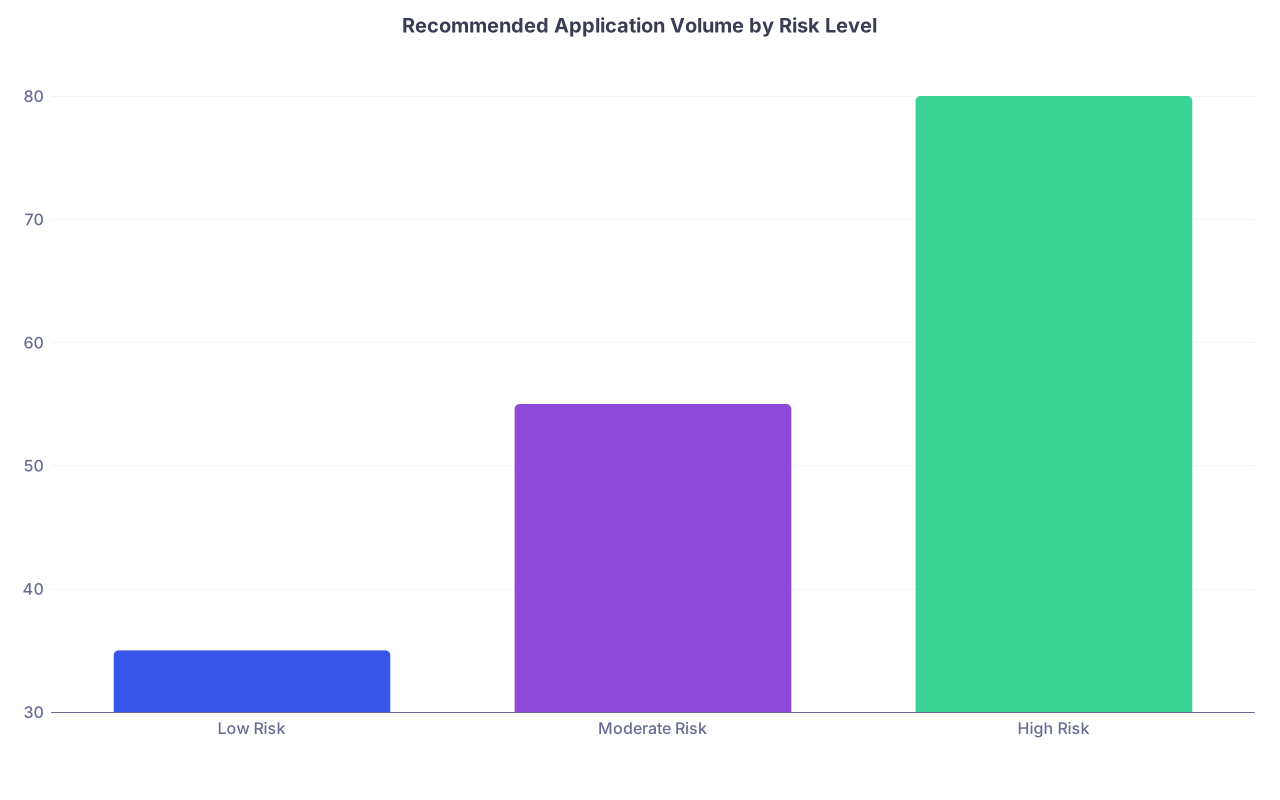
| Category | Value |
|---|---|
| Low Risk | 35 |
| Moderate Risk | 55 |
| High Risk | 80 |
Very rough estimates per specialty, but the principle stands:
Low risk (solid scores, mostly HP/Honors):
- 25–40 programs in moderate-competition fields
Moderate risk (a few weak cores, one low shelf, Step 2 near median):
- 40–60 applications in your primary specialty
- Optional 10–20 in a backup field if anxiety is high or you have regional constraints
High risk (multiple weak cores, low Step 2, remediation):
- 60–80 applications in a lower-competition primary specialty
- 20–30 in a backup if feasible and coherent
Prioritize:
- Programs in:
- States where your school places grads
- Regions where you have geographic ties
- Places where your Step 2 is at or above the published mean
De-prioritize:
- Ultra-competitive university programs in big coastal cities if your file is clearly weak. You can toss in 2–3 as lottery tickets. Not 25.
Step 10: Monitor and Adjust in Real-Time During Interview Season
One more tactical layer that very few students use: dynamic adjustment.
1. Track interview flow weekly
Simple spreadsheet:
- Program
- Specialty
- Date applied
- Interview invite? (Y/N, date)
| Program | Specialty | Applied Date | II Received | Status |
|---|---|---|---|---|
| Community IM A | Internal Med | 9/15 | 10/10 | Scheduled |
| Univ IM B | Internal Med | 9/15 | — | No response |
| FM C | Family Med | 9/20 | 10/25 | Scheduled |
| Psych D | Psychiatry | 9/20 | — | Rejected |
Patterns matter:
- If by mid–late October (for ERAS timeline) your interview count in your primary specialty is:
- 0–2: Strong signal to intensify backup specialty outreach and possibly send more applications
- 3–5: Concerning but salvageable; consider expanding your list to more community programs
- 6–10+: You are probably okay if the mix is reasonable
2. Use targeted communication, not spam
If interviews in your primary specialty are slow:
- Send personalized interest emails to:
- Programs in regions where you have any tie (family, lived there, undergrad)
- Places where your application could plausibly fit (do not email top-5 programs with a 220 and 4 passes asking for a shot)
Keep it short:
“I am a fourth-year at [School] with a strong interest in [Specialty]. I recently applied to your program and wanted to express my genuine interest, particularly in [specific feature of program]. My application shows some early inconsistency in core clerkships, but my subsequent rotations in [X/Y] and my Step 2 performance better reflect my current level. I would be grateful if you would consider my application for an interview.”
This will not magically create interviews everywhere, but it can move the needle at a handful of programs. Which can be the difference between matching and not.
Step 11: Mental Reset – Stop Carrying That One Rotation on Your Back
Weak core clerkship performance often hits your confidence harder than your actual match odds.
You start:
- Hanging back on rounds
- Apologizing for existing
- Over-explaining your failures to everyone
That behavior makes things worse.
Here is the blunt talk: residents and attendings care about how you are right now far more than how you were 14 months ago on one bad month of IM with a malignant senior.
Your job is to:
- Show up on each new service as the improved version of yourself
- Let your recent rotations, Step 2 score, and letters carry the story
- Talk about your weaknesses only when necessary and always linked to specific, visible growth
Stop confessing to every intern you meet that “I did horrible in IM.” It helps no one.
Step 12: What To Do Today
Do not just “feel better” after reading this. Change something.
Today, do three things:
Pull your clerkship data and map it.
Create that simple grid of cores, shelves, and key negative comments. Circle the true weak spots.Decide your tiered specialty plan.
On paper, write:- Primary specialty
- Floor strategy within that specialty
- Whether you need a cross-specialty safety field, and if yes, which one fits your real interests best
Email one person for targeted help.
Either:- Your advising dean
- A trusted attending in your target specialty
- A recent grad you know who matched with a similar profile
Subject line: “Help refining my specialty and application strategy after uneven clerkships.”
You do not fix a weak core clerkship by wishing it away. You fix it by turning it into one data point in a larger, stronger story. Open your own performance grid right now and look at it like a program director would: if this were an applicant, what would they need to show next to earn your trust? Then go build exactly that.