
The blunt truth: most reapplicants throw away good mentors and keep weak letters. They should do the opposite.
You’re not asking the right question if you’re thinking “replace all or only the weakest?” The real question is: “Which letters will measurably improve my application this cycle?” You keep or replace based on that—nothing else.
Let me walk you through how to decide, step by step.
The Short Answer: No, Do Not Auto‑Replace Everyone
Here’s the direct answer you’re looking for:
- You should keep strong, specific letters from people who know you well, even if they’re from last cycle.
- You should replace any letter that is generic, lukewarm, outdated in content, or from someone who barely knows you.
- You should add at least one new letter that reflects growth since your last application.
So: you’re not replacing “all” or “only one.” You’re rebuilding a smarter mix:
- Keep your best anchor letter(s).
- Replace your weakest letter(s).
- Add at least one fresh letter that screams “this applicant has improved.”
Let’s make that concrete.
Step 1: Diagnose Your Previous Letters Honestly
You probably never saw all of them. That’s annoying but normal. You can still infer quality.
Here’s how to triage your old LORs:
1. Look at writer type, not just name
Adcoms care about:
- Science faculty (core requirement for many schools)
- Non‑science faculty (for some schools)
- Clinical supervisors (physicians, PAs, NPs you worked closely with)
- Research mentors
- Long‑term service/volunteer supervisors
Who matters less:
- Major donors, “famous” people who barely know you
- Shadowing physicians who saw you 3 times and wrote 3 sentences
- Short‑term job supervisors with no depth of interaction
If one of your letters came from someone borderline irrelevant (e.g., the dentist you shadowed for 10 hours), that’s a prime candidate to cut.
2. Ask for direct feedback
Go back to your letter writers and say something like:
“I’m planning to reapply. I appreciate your support last cycle. I’m trying to understand where my application was weaker. Were you able to write a strong and detailed letter for me, or do you feel a new letter from someone else who knows me better now might be stronger?”
You’re listening for one of three vibes:
- “Your letter was very strong and I’d be happy to update it.” → Keep or update.
- “I wrote you a solid letter, but we didn’t work together very long.” → Consider replacing if you now have better options.
- Long pause, vague answers, or “I don’t remember too much about your work” → Replace.
3. Look at your rejection pattern
If you had:
- Good GPA/MCAT
- Reasonable school list
- Acceptable experiences
…and still struck out everywhere, letters become more suspicious.
No, you can’t prove they were weak. But if your personal statement and secondaries have since been cleaned up and your metrics were already competitive, I’d assume at least one of your letters wasn’t helping.
Step 2: Criteria For Keeping vs Replacing a Letter
Use this framework. Be ruthless.
| Decision | Letter Type | Relationship | Content Likely | Action |
|---|---|---|---|---|
| Keep | Science prof | Knew you well, >1 term | Specific, detailed | Keep or update |
| Keep | Research PI | 6–12+ months | Clear impact, growth | Keep or update |
| Maybe | Clinical supervisor | 2–3 months | Observational, moderate detail | Replace if stronger option |
| Replace | Shadowing doc | Few days/weeks | Generic, weak | Replace |
| Replace | Non‑science prof | Large lecture only | Knows only your grade | Replace |
A letter is worth keeping if:
- The writer knew you well (months, not weeks).
- They supervised your work or closely observed you.
- They can speak to specific behaviors: reliability, initiative, empathy, leadership, intellectual curiosity.
- They’re willing to update the letter to reflect your new activities.
It’s worth replacing if:
- The writer barely remembers you, or only knew you in a huge lecture.
- They did not see you in any meaningful responsibility.
- They’re hard to reach or clearly disengaged.
- You now have a better mentor in that same category (e.g., stronger science faculty who taught you later).
Step 3: How Many Letters Should Change When You Reapply?
Realistic target:
Do not change 100% of your letter writers unless:
- You moved, graduated, or lost contact with everyone; or
- Your first cycle letters were cobbled together in a panic and you now have much stronger relationships.
Do change at least 30–50% of your letters in some way:
- Brand‑new writers, and/or
- Major updates from existing writers that describe new roles and growth.
Rule of thumb:
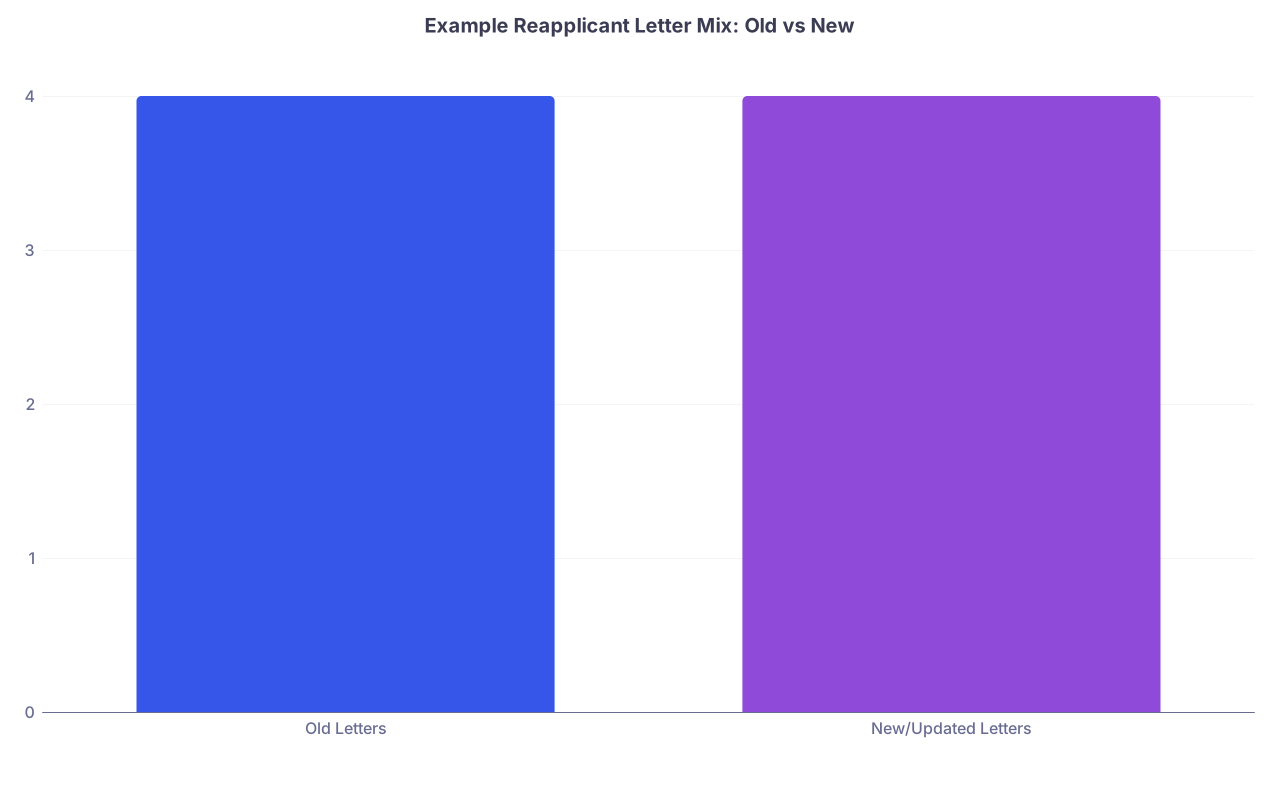
- If you submitted 4 letters last time, you want something like:
- 1–2 strong previous writers updating their letters.
- 1–2 new writers reflecting your growth since last cycle.
That combination tells the committee two things:
- People who knew you before still back you strongly.
- You’re not the same applicant—they see new strengths and maturity.
Step 4: Timing and “Staleness” – When Old Letters Become a Problem
You’re reapplying this upcoming cycle. Last cycle’s letters are not automatically “too old.”
A letter that’s 1–2 years old is fine if:
- You’re still in touch with the writer.
- Your core relationship with them hasn’t changed.
- The content is still representative of who you are.
However, if the letter is:
- 3+ years old,
- Based on a version of you from early undergrad, and
- You’ve grown significantly…
…it starts to feel stale.
Best move: ask the writer for a brief update letter, not a full rewrite. They can keep their original praise but add one paragraph about how you’ve progressed since then (more on what to ask them to write in a minute).
Step 5: Who You Absolutely Should Add or Prioritize as a Reapplicant
If you’re reapplying, adcoms want proof of trajectory, not just “still the same person but older.”
You should aggressively seek new letters from:
New clinical supervisors
Example: You worked as a medical assistant for the past year. The RN or MD who watched you problem‑solve with patients, show up on time, and handle stress—gold.New research mentors
If you’ve joined a lab, gotten a poster, or led a project, that PI’s letter will carry real weight.Service supervisors
Long‑term nonprofit, free clinic, crisis line, mentoring program. Someone who’s seen you show up for months and can vouch for your character.Stronger academics than before
If your old letter was from a lecturer who barely knew you, and now you have an upper‑level course with a faculty member who watched you dominate group work and visit office hours regularly—upgrade.
Step 6: How to Ask Old Mentors for Updated Letters (Without Making It Awkward)
You’re worried they’ll think you failed. Fine. They already know admissions is brutal.
Keep it simple and professional:
“Dr. Smith,
I hope you’re doing well. I wanted to thank you again for supporting my last medical school application with a letter. I unfortunately did not receive an acceptance this cycle. After feedback and reflection, I’m strengthening my application and plan to reapply this year.
Since we last worked together I’ve [briefly list growth: started working as an ED scribe, taken additional upper‑level science classes, increased my clinical volunteering, etc.].
Would you feel comfortable updating your letter of recommendation to reflect some of these recent experiences? I truly appreciated your support and would be grateful if you still feel you can write a strong letter on my behalf. I’m happy to send an updated CV and short summary of what I’ve been doing.
Thank you for considering this,
[Your Name]”
Key phrases:
- “reapply” (signals you’re persistent, not quitting)
- “strengthening my application” (shows insight)
- “if you still feel you can write a strong letter” (gives them an out if they can’t)
If they hesitate or decline—there’s your answer. Replace them.
Step 7: What You Want Letters To Say As a Reapplicant
Your letters now have a more specific job: they must highlight growth and readiness, not just “smart and nice.”
Ask your writers (old and new) to hit on:
- Reliability: showed up, followed through, handled responsibility.
- Improvement: got better at skills, took feedback, didn’t crumble under criticism.
- Fit for medicine: empathy, communication, teamwork, resilience.
- New roles you’ve taken: leadership, teaching, mentoring, project ownership.
For updated letters, politely suggest they mention:
- That they wrote you a letter previously.
- That they’ve seen you continue to develop since then.
- Concrete evidence that you turned a “gap” period into something meaningful, not aimless waiting.
Step 8: Common Letter Mistakes Reapplicants Make
I’ve seen the same errors again and again:
Keeping a clearly weak letter out of guilt
You owe your future more than you owe someone who barely remembers you but was “nice enough to write a letter.” Thank them. Move on.Panicking and adding extra letters just “because”
Most schools don’t want 8 letters. They want 3–5 good ones. A mediocre extra letter drags down the average.Not telling letter writers that you’re reapplying
Then their letters read like you’re a first‑time applicant. Missed opportunity for the “this person persisted and matured” narrative.Using all old letters, no new voices
This screams stagnation. You want your file to show: new roles, new trust, new advocates.Chasing prestige over substance
That “big name” department chair who met you twice? Useless compared to the unknown PI who supervised you for a year and can write 2 pages of specific praise.
Step 9: Putting It All Together – A Sample Reapplicant Letter Strategy
Say last cycle you had:
- Letter 1: Organic chemistry professor from a class of 200. Office hours twice.
- Letter 2: Volunteer coordinator at a hospital you worked at for 1 year.
- Letter 3: Shadowing physician you followed for 20 hours.
- Letter 4: Research PI for 6 months, weekly meetings.
You reapply with:
- Keep/Update: Letter 2 (volunteer coordinator) – they know you well and you’ve continued there.
- Keep/Update: Letter 4 (research PI) – you’ve since helped on a manuscript.
- Replace: Letter 1 with a new upper‑level physiology professor who taught you in a small class and watched you lead study groups.
- Replace: Letter 3 with a physician or supervisor from your new year‑long medical assistant job.
That’s a dramatically stronger set. Same you, but backed by better voices.
Quick Decision Checklist
Ask this about each existing letter:
- Did this person supervise me directly or work with me closely for >3 months?
- Could they tell specific stories about me if asked in an interview?
- Am I confident they like and respect me?
- Have we had any meaningful contact in the last year?
- Do I have someone stronger in the same category now?
If you’re not hitting at least 3–4 “yes” answers, that letter is probably a replacement candidate.
| Category | Value |
|---|---|
| Old Letters | 4 |
| New/Updated Letters | 4 |

| Step | Description |
|---|---|
| Step 1 | List Previous Letter Writers |
| Step 2 | Replace Letter |
| Step 3 | Request Updated Letter |
| Step 4 | Add At Least One New Letter Reflecting Growth |
| Step 5 | Strong Relationship? |
| Step 6 | Current Stronger Option? |
FAQ: Letters of Recommendation As a Reapplicant
1. Should I tell schools I’m reusing some of the same letter writers?
You don’t need to declare it explicitly; it’s obvious to them from the letter dates and content. What matters more is that at least some letters are clearly updated and that you’ve added new ones reflecting recent growth. If you’re worried about a specific school, you can mention in a secondary that mentors continue to support you and have updated their letters.
2. Are letters from a previous cycle automatically reused by AMCAS/AACOMAS/TMDSAS?
AMCAS generally doesn’t “auto‑forward” letters between cycles; you or your letter service (Interfolio, etc.) must resubmit or reassign them. That’s your opportunity to decide which to keep, which to drop, and which updated letters to upload. Always check each service’s current rules the year you apply.
3. Is it bad if one letter writer is the same but doesn’t update the letter?
Not ideal, but not fatal—especially if the original letter was strong and not too old (1–2 years). However, if you can, push politely for at least a short update paragraph. The more your file reflects growth, the better you look compared with your last version in their system.
4. I can’t get new science faculty letters. What do I do?
Then your job is to strengthen other areas: updated letters from your PI, clinical supervisor, or long‑term volunteer lead. Some schools are rigid about science letter requirements, but plenty will accept equivalent academic or research mentors. Check each school’s rules carefully and email admissions when in doubt. Do not lie or shoehorn a weak academic letter just to check a box.
5. What if my weakest letter is from someone powerful (e.g., department chair, dean)?
If they don’t know you well, that “power” is mostly imaginary. Committees can smell a name‑drop letter from a mile away. A detailed letter from a mid‑level faculty member who supervised you is more valuable than a vague paragraph from a dean. If you have a stronger option, replace the weak “big name.”
6. Bottom line: how many letters should change for a typical reapplicant?
For most reapplicants: keep/update 1–2 strong prior letters, replace 1–2 weaker ones, and add 1 new letter from a post‑application role (job, research, or volunteering). That usually means about half your letter set is different in some way—enough to show evolution without pretending you’ve become a completely new person in one year.
Key points to remember:
- Do not wipe your mentor slate clean. Keep your strongest advocates and upgrade the rest.
- Every letter you carry forward must still do work for you—specific, recent, and clearly positive.
- As a reapplicant, your letters must prove growth, not just repeat last year’s story with a new timestamp.