
Can You Switch Specialties After Starting Your Matched Residency?
You can switch specialties after starting residency—but it’s harder, slower, and messier than most people on Reddit make it sound.
Let me be blunt: the Match is not a jail sentence, but it is a contract. Changing specialties is possible, but it's not “just apply again next year lol.” There are rules, politics, money, and timing you have to get right—or you’ll burn bridges and maybe end up unmatched.
Here’s how this actually works in the real world.
The Core Answer: Yes, You Can Switch — But It’s Not Simple
Yes, residents do change specialties every year. Internal medicine to radiology. Surgery to anesthesia. OB/GYN to family medicine. It happens.
But you’re dealing with three realities:
Contracts and accreditation rules
You matched into a specific program and institution. You signed a contract. Your training has to meet ACGME requirements. You can’t just walk away on Friday and start a new specialty somewhere else on Monday.Program politics and reputation
Your current PD (program director) can either be your biggest ally or the main reason you never switch. Programs talk to each other. PDs share opinions. If you leave badly, that reputation follows you.Funding and positions
Residency spots are funded and capped. Programs don’t always have an “extra” PGY-2 radiology or PGY-1 psych seat lying around. You’re hunting for rare, off-cycle, or unfilled positions.
So yes: switching is possible. But it’s a project, not a quick pivot.
Common Switching Scenarios (And How Hard They Really Are)
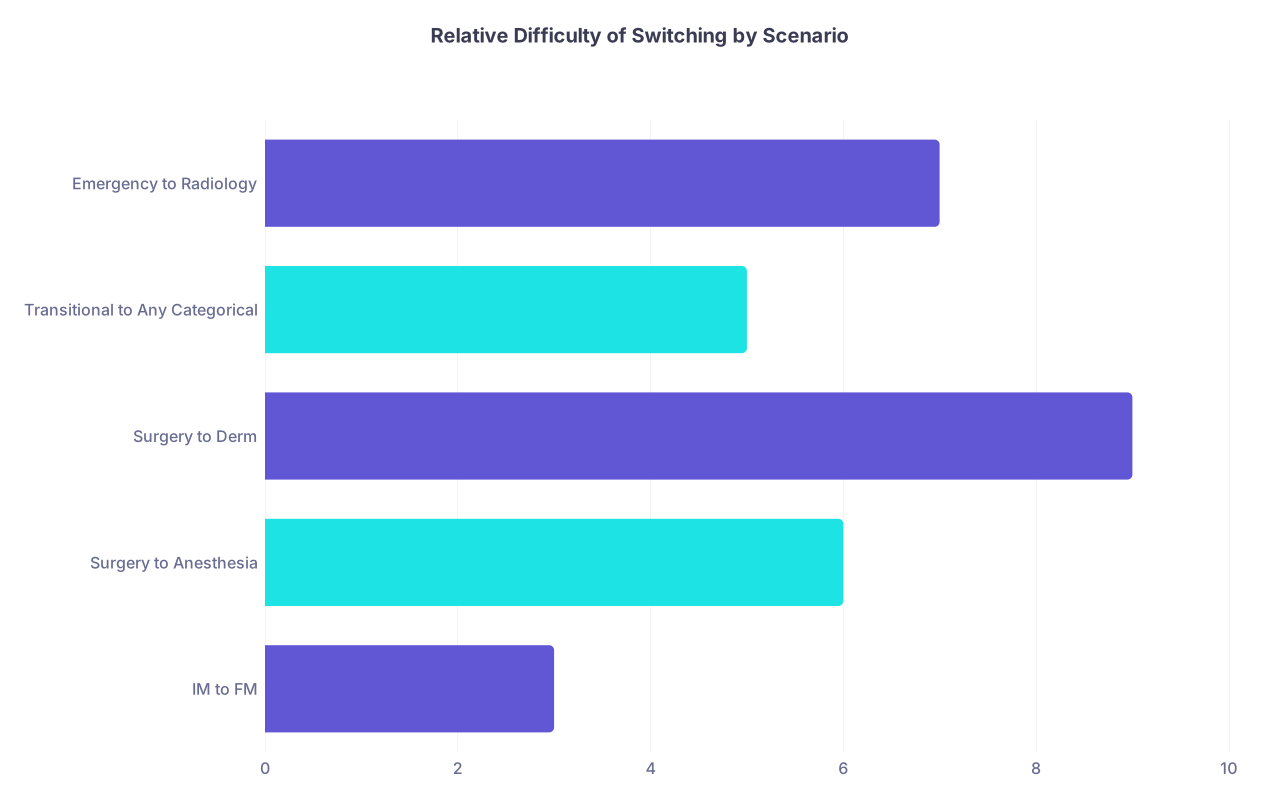
| Category | Value |
|---|---|
| IM to FM | 3 |
| Surgery to Anesthesia | 6 |
| Surgery to Derm | 9 |
| Transitional to Any Categorical | 5 |
| Emergency to Radiology | 7 |
(1 = easiest, 10 = hardest, obviously not scientific—but directionally correct.)
Scenario 1: Realizing Early “This Isn’t For Me” (First 3–6 Months)
This is the most common. You start intern year in something like surgery, EM, OB, or IM and realize you hate the day-to-day reality.
What you can do:
Stay professional and do your job well
Don’t tank your performance just because you’re unhappy. You’ll need strong evaluations and a PD letter to switch, ironically.Talk to your PD early, not secretly
The dumb move: quietly applying out behind their back. The smart move: honest, mature conversation once you’re sure this isn’t a temporary adjustment phase.Good script:
“I’m grateful for this opportunity and I’m committed to finishing this year strong. But as I’ve experienced the work, I’ve realized [X specialty] isn’t the right long-term fit. I’d really appreciate your guidance on exploring [target specialty].”Target a new specialty that actually fits your record
IM → Cards/Nephro/HemeOnc later is very realistic. Surgery intern → anesthesia or radiology is common. Surgery → derm is almost fantasy unless your CV is ridiculous.
Risk: If you bail too abruptly or act unprofessional (“I’m done, this is toxic, I quit”), you can kill your chances with future PDs.
Scenario 2: You’re in a Preliminary or Transitional Year
This is the “cleanest” situation, because prelim and transitional years are designed to feed into advanced specialties.
Two sub-situations:
You matched prelim/transitional + advanced (e.g., TY + derm) and now want something else
- Hardest part: you’re breaking out of an already-secured advanced spot.
- You’ll need to:
- Tell your advanced program PD you’re not coming.
- Decide if you’re going to reapply through ERAS for a different categorical or advanced program.
- Accept that you might have a gap year or need research/time off.
You matched into only a prelim/TY (no advanced spot)
- You can:
- Apply in the main Match to categorical programs.
- Or look for open PGY-2 categorical spots (less common).
- Your prelim year evaluations and letters become critical here.
- You can:
Scenario 3: PGY-2 or Later and You Want Out
This is where things get dicey.
You’re already a PGY-2 or PGY-3 and realize you want to switch from, say, surgery to IM, psych, FM, path, rad, or anesthesia.
What usually happens:
- You start asking around for off-cycle PGY-2 positions in your target specialty.
- You send cold emails to PDs: CV, personal statement, USMLE scores, explanation for switching.
- You may need to:
- Finish the year you’re in.
- Take a step back (e.g., repeat PGY-1 or PGY-2 in the new specialty).
- Accept loss of credit for some prior training.
Some fields are more open to this than others:
| More Open (Generally) | Less Open (Generally) |
|---|---|
| Family Medicine | Dermatology |
| Psychiatry | Plastic Surgery |
| Internal Medicine | Neurosurgery |
| Pathology | ENT |
| Pediatrics | Ophthalmology |
This isn’t absolute. Stellar applicant + good story can still pull off a “hard” switch. But if you’re leaving surgery burned out and with mediocre evaluations, derm is not going to scoop you up.
How the Actual Process of Switching Usually Works
Let’s walk through the real steps, not the fantasy version.

| Step | Description |
|---|---|
| Step 1 | Resident unhappy in specialty |
| Step 2 | Self assessment |
| Step 3 | Talk to mentors |
| Step 4 | Inform current PD |
| Step 5 | Identify target specialty |
| Step 6 | Search for open positions |
| Step 7 | Apply and interview |
| Step 8 | Negotiate start date and release |
| Step 9 | Reassess plan or reapply later |
| Step 10 | Offer received |
Step 1: Decide If This Is a Bad Rotation or a Bad Specialty
Plenty of interns hate parts of their year:
- ICU with a malignant attending
- 28-hour call q3
- One toxic senior making life miserable
That doesn’t automatically mean you chose the wrong field. Before you blow up your career path:
- Talk to seniors who are actually happy in the specialty.
- Ask, “What does your day look like as a PGY-3? As an attending?”
- Compare that to what you want long-term in life and medicine.
If you still feel dread thinking about doing this work for 30 years, that’s a sign.
Step 2: Quietly Explore Alternatives
Don’t start announcing to random coresidents that you’re jumping ship.
Do this instead:
- Reach out to faculty in the target specialty at your institution.
- Ask for an elective or shadow day if available.
- Get a realistic view of their schedule, call, lifestyle, and fellowship paths.
Be curious but discreet. Word gets around hospitals fast.
Step 3: Talk to Your Program Director
This is the scary step. But it’s necessary.
Bad approach:
“I hate it here. I’m leaving. I already applied out.”
Better approach:
“I’ve been thinking seriously about my long-term fit in [current specialty]. I’m committed to being a strong resident while I’m here, but I’ve realized I may be better suited to [target specialty] for [specific reasons]. I want to do this in a way that’s respectful to the program and to patients. Can we discuss the right timeline and next steps?”
Possible PD responses:
- Supportive and helpful (best-case; they may know open spots).
- Neutral but not obstructive.
- Defensive, angry, or obstructive (this happens).
If they’re hostile, you still keep doing good work. Your behavior becomes your counter-argument.
Step 4: Start Hunting for Open Spots
There are two main routes:
Directly into a new program (off-cycle spot)
You send:- Updated CV
- Personal statement explaining the switch (short, honest, not trashing current specialty)
- USMLE/COMLEX scores
- Letters (ideally including your current PD or a supportive faculty member)
Re-entering the Match
You apply through ERAS again for a future July start.
Yes, people do this.
Complications:- You may need time off or a research year.
- You might continue in your current program until you start the new one (if allowed).
- Or you may leave and have a gap.
Programs care about:
- Are you reliable?
- Are you running from something or toward something?
- Will you stick this time?
Step 5: Negotiate Timing and Release
Once you get an offer:
- Your new program will want a start date (usually July 1; sometimes off-cycle).
- Your current program needs to release you officially.
- Your GME office processes:
- Contract end date
- Credentialing/HR stuff
- ACGME transfer documentation
You might:
- Finish the current academic year, then switch.
- Leave mid-year if everyone agrees and there’s coverage.
Do not just no-call/no-show and vanish. That will haunt you.
How Much of Your Previous Training Counts?
Short version: it depends on overlap and the new specialty’s rules.
Examples:
- Surgery → Anesthesia: your surgical intern year can often count as an anesthesia clinical base year with some gaps or extra rotations.
- IM → Cardiology later: fully aligned; no “lost” time.
- EM → Psychiatry: less overlap; you might get partial credit, but expect to repeat some training.
- Surgery → Pathology: often start over as PGY-1 path.
Each specialty board and ACGME program has specific rules about credit for prior training. PDs know these; you don’t need to memorize them. Just expect that you may lose 6–12 months in the switch.
When Switching is a Good Idea vs a Terrible One
Switching can be smart when:
- You misjudged the day-to-day reality of the field.
- Your core values and life goals clearly don’t match the specialty.
- You’ve matured and realized what kind of doctor you actually want to be.
- You still like medicine, just not this version of it.
Switching is a bad idea when:
- You’re just burned out and would hate any job right now.
- You’re reacting to one bad rotation, attending, or hospital system.
- You’re chasing prestige or lifestyle without understanding the tradeoffs.
- You think another specialty will magically fix all your mental health or life problems.
A harsh truth:
Every specialty has miserable days. If you’re fundamentally miserable as a person right now, a switch alone won’t save you.
Practical Tips If You’re Seriously Considering Switching
Document everything good:
- Eval comments
- Procedures
- Teaching roles
- Quality improvement or research projects
Don’t badmouth your current field or PD in any written statement or interview.
Get at least one strong letter from:
- Your current PD, or
- A respected faculty member in your program.
Have a clear story: “I discovered that what I love most is [longitudinal patient care/procedures/diagnostics/acute resuscitation/etc.]. [New specialty] aligns better with that because [specific reasons]. I’m grateful for my current training; it’s made me a stronger clinician and confirmed my direction.”
Accept uncertainty: You may not land your dream specialty, in your dream city, on your ideal timeline. You’re choosing long-term fit over short-term comfort.
FAQ (Exactly 7 Questions)
1. Do I have to tell my current program before I apply out?
No one will arrest you if you don’t, but practically, you’ll usually need a PD or faculty letter. Blind-siding your PD is almost always a bad move. Programs talk. If you absolutely don’t trust your PD, involve a neutral mentor or GME office first, then plan carefully.
2. Can I break my Match contract and just quit?
You can always resign a job. You’re not legally forced to work. But if you walk out mid-year without notice or cooperation, you’ll make it much harder to get another residency. Most PDs will ask, “Why did you leave?” and they will call your old program.
3. Will switching specialties hurt my chances for fellowship later?
Usually not, if you switch early, do well in your new field, and have a coherent story. What hurts you more is poor evaluations, professionalism issues, or unstable behavior. A thoughtful switch with strong performance after is not a red flag for most fellowships.
4. Can I switch into a super competitive specialty like derm, plastics, or neurosurgery?
It happens, but it’s rare. You’d need:
- Excellent scores
- Strong research in that field
- Powerful letters
- A believable reason for the switch
Most residents who successfully switch into competitive fields were already competitive on paper and usually switch early.
5. Does any of my salary or signing bonus need to be repaid if I leave?
Check your contract. Some programs have relocation or signing bonuses that must be repaid if you leave before a certain date. Loan repayment or military scholarships have their own rules and penalties. Don’t guess—read your contract and, if needed, talk to HR or a lawyer.
6. Should I finish my current residency and then do a second residency later?
Some people do a full residency (e.g., FM or IM) then go back for another (e.g., anesthesia, radiology, psych). That’s a huge time and financial hit, but it can make sense if:
- You’re far along already (PGY-3/4).
- You’ll use both skill sets.
- You’re okay with extra years of training.
If you’re an early PGY-1–2, switching now is usually smarter than finishing then restarting.
7. Who should I talk to first if I’m thinking about switching?
In order:
- A trusted upper-level or recent grad from your program.
- A mentor or faculty in the specialty you’re considering.
- Then your PD, once you have a clearer sense of your plan.
You can also involve your institution’s GME office or a residency advisor if your school still provides support.
Key takeaways:
- Yes, you can switch specialties after starting residency—but it’s a structured, political, and sometimes slow process, not a casual decision.
- Your professionalism, your relationship with your current PD, and how clearly you can explain why you’re switching matter more than any single score or rotation.
- If you’re sure your current field is wrong long-term, it’s better to tackle the switch early and deliberately than to stay silently miserable for years.