

Approaching Faith, Values, and Ethics Questions With Professional Balance
What do you actually say when an interviewer asks, “How does your faith influence the way you’ll practice medicine?” and you know your real answer is complicated?
You’re not alone. These questions feel like a trap because they hit where you’re most vulnerable: identity, beliefs, and what you’ll actually do when patient care clashes with your values.
Let me be blunt: people blow interviews on this category more than on any “tell me about yourself” fluff. Not because they’re bad people, but because they either:
- Overshare personal beliefs in a way that sounds rigid or preachy
- Overcorrect and sound fake, spineless, or “I’ll just do whatever anyone says”
- Panic and ramble, giving unclear or contradictory answers
You need something in the middle: honest, grounded, professional.
Let’s go through exactly how to handle this—what to say, what not to say, and how to keep your center while still sounding like someone I’d trust with patients.
1. Understand What They’re Really Testing
They are not asking to evaluate your religion, your political party, or whether your ethics match theirs perfectly.
They’re looking for three things:
- Can you respect patients whose values are different from yours?
- Are you able to separate personal belief from professional obligation?
- When things get messy, do you have a framework more mature than “I’d just figure it out”?
I’ve seen applicants tank an otherwise strong interview with lines like:
- “I would never provide X because it’s against my beliefs.” (Full stop. No nuance.)
- “My faith guides everything I do, so if something conflicts, I can’t participate.”
- “I don’t really think my values matter; I’d just follow orders.”
All three read as red flags: either inflexible and potentially discriminatory, or so passive you’re not thinking like a professional.
Programs want this balance:
- You have a moral compass.
- You understand patient autonomy and professional ethics.
- You won’t impose your beliefs on vulnerable people.
- You can work with colleagues who don’t think like you.
Hold that as the north star as we go through scenarios.
2. Build a Core “Values + Professionalism” Script
Before we dive into specific questions, you need a backbone answer you can adapt. Something that captures:
- What grounds you
- How you handle differences
- How you keep patient care central
Think of it as your 60–90 second “who I am when things get ethically messy” summary. Here’s a template you can personalize:
Start with your anchor
- This might be faith, personal values, life experience, or a mix.
- Keep it concrete and not preachy.
Explicitly acknowledge patient autonomy and diversity
- Show that you understand medicine is pluralistic.
State how you handle conflicts
- Not “I’d never” and not “I’d just ignore my beliefs.”
- Show a process: reflection, supervision, ethics resources, non-abandonment.
Example (modify it to fit you):
“My personal values are shaped a lot by my [faith/background/family], especially around respect for life and dignity. At the same time, I see medicine as a profession where my role is to care for patients with many different beliefs, not to make moral judgments about them.
If my personal values ever felt in tension with what a patient wanted, I’d use the tools available—talking with supervisors, consulting ethics resources, and making sure that the patient isn’t abandoned or pressured. My goal would be to practice in a way that’s consistent with my integrity but clearly grounded in patient autonomy and professional standards.”
That kind of answer calms interviewers down. You sound like someone who has thought about this and won’t create chaos on the wards.
Write your own version of that. Don’t memorize word-for-word, but know the structure.
3. When They Ask Directly About Faith
Scenario: You’re in an MMI or traditional interview and they ask:
- “How does your faith influence your approach to medicine?”
- “Do you see your religious beliefs affecting your clinical decisions?”
- “Tell me about a time your beliefs were challenged.”
Here’s how to balance honesty and professionalism depending on your situation.
If you are religious and it’s important to you
You don’t need to hide it. But you do need to show you understand boundaries.
Bad answer versions I’ve heard:
- “My faith comes before everything, so if medicine conflicts, my faith wins.”
- “I see medicine as a way to bring people to [religious concept].”
Those are non-starters for most programs.
Better structure:
- Say what your faith gives you (motivation, compassion, service mindset).
- Make a clear statement separating motivation from imposition.
- Show what you’d do if conflict emerges.
Example:
“My faith is a big part of why I was drawn to medicine. The emphasis on service and caring for the vulnerable really shaped my desire to work with underserved patients.
In practice, though, I don’t see my role as a physician as bringing my religious views into the clinical space. I see it more as an internal compass for how I treat people—with respect, humility, and honesty.
If there were ever a serious tension between my beliefs and a patient’s request, I’d use institutional resources like ethics consultation and make sure the patient has access to care without feeling judged or pressured by me.”
That hits the balance: your faith is real and meaningful, but not a weapon.
If you’re not religious or are unsure
You don’t need to fake having faith, and you don’t need to sound dismissive.
Your job is to show respect for religious patients and colleagues.
Example:
“I’m not religious myself, but I’ve taken care of and volunteered with people for whom faith is central to how they cope with illness. I respect that deeply.
My own values come more from [family background, personal experiences, philosophy, etc.], especially around autonomy and justice. In practice, I’d want to understand what matters most to a patient—including their beliefs—and work with chaplains or spiritual care when that’s important to them.
I don’t have to share a belief to respect its importance in someone’s life.”
If they press: “So without religion, where do your ethics come from?”
Give a clean, grounded answer:
“From a mix of things—my upbringing, exposure to suffering in my community, and formal ethics frameworks I’ve studied. I take professional codes like the AMA and institutional policies seriously. For me, consistency, empathy, and respect for autonomy are non-negotiables, regardless of religious belief.”
Notice the theme: you keep turning back to patient-centered care and professional standards.
4. Classic Ethics Scenarios: What They Want to Hear
You’re going to get some version of these in MMI or ethics stations:
- “A patient asks for something you’re morally opposed to. What do you do?”
- “How would you handle a teen requesting birth control whose parents disagree?”
- “A terminally ill patient in a state with legal MAiD asks for your help. What do you do?”
Let’s strip these down to what they’re actually scoring you on.
Core principles you must show (explicitly or implicitly)
You do not need to recite “autonomy, beneficence, non-maleficence, justice,” but your answer should functionally show them.
You should demonstrate:
- Respect for patient autonomy
- Commitment to non-abandonment
- Awareness of legal/professional constraints
- Willingness to seek help when unsure
Let’s do a concrete walk-through.
Example scenario: You object to abortion on personal grounds
Question: “If you were a physician in a setting where abortion is legal and a patient requests one for a non-life-threatening reason, but you personally oppose abortion, what do you do?”
Bad answers I’ve heard:
- “I would refuse and tell them why I think it’s wrong.”
- “I’d just do whatever they want; my beliefs don’t matter.”
Both signal immaturity. You’re either willing to judge and block care, or you treat your own integrity as irrelevant, which often backfires later.
A mature, balanced answer might look like:
“This is something I’ve thought about seriously. Personally, I’m uncomfortable performing elective abortions. At the same time, I recognize that patients have legal rights and don’t come to me for my personal moral views.
If I were in that situation, I would be transparent with my institution and supervisors in advance, so patients aren’t put in a position where their care is delayed. I would make sure the patient is informed of all options in a neutral, non-judgmental way and ensure a timely referral to a provider who can care for them.
I would not abandon the patient or lecture them. My job is to support their well-being within the boundaries of both my conscience and professional guidelines. And if I were unsure about how to proceed ethically or legally, I’d seek guidance from the ethics committee rather than making a unilateral decision.”
Key moves:
- You acknowledge your belief.
- You don’t impose it.
- You mention planning ahead so patients aren’t penalized for your belief.
- You highlight non-abandonment and institutional processes.
That’s what “professional balance” looks like.
5. Handling Loaded or Polarizing Questions
Sometimes the question isn’t about abstract ethics. It’s about controversial topics tied to values:
- “What’s your view on physician-assisted dying?”
- “How do you feel about treating transgender patients requesting hormones?”
- “Do you think doctors should be able to refuse to prescribe contraception?”
You’re not in a debate club. You’re auditioning to be a safe, thoughtful clinician.
Aim for this structure:
- Acknowledge complexity
- Ground yourself in patient-centered care and professional standards
- Share your perspective with humility
- Show you can still care well for people who disagree with you
Example: “What’s your view on physician-assisted dying?”
“I see physician-assisted dying as one of the most complex areas in medicine. On one hand, there’s profound suffering and a desire for autonomy at the end of life; on the other, there are concerns about vulnerability, coercion, and what it means for the physician’s role.
Personally, I feel [cautious/supportive/uneasy but open to learning—whatever is true for you], but I also recognize that as a trainee and later as a physician, I’ll be functioning within a specific legal and institutional framework. My first priority would be to make sure patients receive excellent palliative care, honest communication, and aren’t abandoned in their suffering.
If I ever felt morally conflicted, I’d seek supervision and ethics guidance, and ensure any transitions of care are done in a way that respects the patient and doesn’t leave them without options.”
You’re allowed a stance. What matters more is that you show:
- You won’t turn the clinical space into a battlefield for your ideology.
- You know how to function within systems and laws, not above them.
6. Responding When They Push Your Edges
Some interviewers test your composure more than your content. You give a balanced answer, and they push harder:
- “So are you saying your beliefs might prevent patients from getting care?”
- “What if no one else is available—would you still refuse?”
- “Isn’t that just imposing your morality?”
Do not get defensive. Do not backpedal into something you don’t believe just to please them.
Here’s how to hold your line and stay professional.
Stepwise approach:
- Stay calm. Short pause.
- Acknowledge the concern behind their question.
- Reaffirm your two commitments: patient care and integrity.
- Clarify your process, not your ideology.
Example:
“I understand the concern—no one wants a patient to be denied care because of a clinician’s personal beliefs. That would be unacceptable to me as well.
That’s why I think it’s critical to be proactive. If I know there are areas where I have moral discomfort, I’d be upfront with my institution so systems are in place to prevent delays in care.
In a genuine emergency where a patient’s life was at stake and I was the only one available, my professional obligation to the patient would come first. In non-emergent situations, I’d work within policy to ensure safe handoff rather than abandonment.”
You’ve just told them: I’m not a martyr to my beliefs, but I’m also not reckless. That’s the adult answer.
7. Practical Preparation: How to Actually Get Ready
You cannot improvise these answers well under stress if you’ve never thought them through. Here’s a focused prep plan.

| Step | Description |
|---|---|
| Step 1 | Identify Core Values |
| Step 2 | Write 60-90s Values Script |
| Step 3 | List Likely Hot Topics |
| Step 4 | Draft Example Responses |
| Step 5 | Mock Interviews with Pushback |
| Step 6 | Refine for Clarity and Balance |
Concrete steps:
- Write out your 60–90 second “values + professionalism” script.
- Identify 3–4 areas where your beliefs might be tested:
- Reproductive health
- End-of-life care
- Gender-affirming care
- Contraception / adolescent confidentiality
- For each, draft:
- What you actually believe. Don’t lie to yourself.
- How you’ll explain that in one or two sentences.
- How you’ll show you won’t abandon or pressure patients.
- Practice with someone who can be a bit aggressive:
- “So are you discriminating?”
- “So you’d just follow the law even if you thought it was wrong?”
- “So your faith matters more than the patient?”
Then refine your phrasing so you don’t sound flustered or rigid.
Do not memorize full paragraphs. Memorize anchors:
- “Respect for autonomy”
- “Non-abandonment”
- “Seek supervision/ethics guidance”
- “Plan ahead so patients aren’t harmed by my limitations”
Those phrases are your safety net.
8. Quick Comparison: Balanced vs Problematic Responses
| Scenario | Problematic Answer Snippet | Balanced Answer Snippet |
|---|---|---|
| Faith in medicine | “My faith always comes first in every decision.” | “My faith shapes my compassion, but I don’t impose it.” |
| Conscientious objection | “I’d refuse and tell them it’s wrong.” | “I’d ensure timely referral and avoid abandoning them.” |
| Non-religious applicant | “Religion doesn’t matter; I just follow science.” | “I’m not religious, but I respect how faith guides patients.” |
| End-of-life care | “I’d never participate, no matter what.” | “I’m cautious, and I’d use ethics and legal guidance.” |
| Polarizing topic (e.g., contraception) | “That’s just immoral, so I wouldn’t help.” | “I have reservations, but I won’t judge or block access.” |
Print something like this and glance at it the week before your interview. It reminds you what “balanced” actually sounds like.
9. Special Case: Religious vs Secular Schools
You should slightly tune your emphasis based on context—but without changing your core ethics.
At secular/public schools
Emphasize:
- Respect for pluralism
- Professional codes and legal frameworks
- Clear boundaries between personal belief and clinical care
You can still mention faith, but keep it framed as your motivation and internal compass, not your rulebook for patients.
At religiously affiliated schools
You still should:
- Respect autonomy
- Avoid imposing beliefs
- Recognize diversity among patients and students
But you can more openly connect mission and faith:
“One reason I’m drawn to a Jesuit/Catholic/faith-based institution is that the emphasis on [service, social justice, care for the marginalized] aligns with how I see my values in medicine. At the same time, I know patients will come from all backgrounds, and my job is to meet them where they are, not where I am.”
Do not assume a religious school wants rigid dogma. Many are just as wary of inflexibility as secular ones.
10. How to Stay Centered When You’re Anxious About These Topics
The fear underneath all this is often: “If they really knew what I believed, I’d be rejected.”
Here’s the hard truth: You cannot contort yourself into someone else’s ethics for an entire career. That breaks people.
Your job in the interview is not to confess every theological or philosophical detail of your worldview. Your job is to demonstrate:
- You will treat every patient with dignity.
- You won’t use the exam room as a pulpit or a soapbox.
- You understand the structure and expectations of the profession.
- You have enough insight to see where your edges might be—and enough maturity to handle them responsibly.
If your actual stance is, “I will refuse common, legally accepted, standard-of-care treatments in non-emergent and emergent situations, and I feel strongly about telling patients they’re wrong,” then yes—many schools will see that as incompatible with training. And they should.
But most applicants aren’t there. They’re just scared to admit the tension.
Sit with that tension before the interview. Decide what ethical line you won’t cross, what you’re willing to revisit, and how you’ll keep patients safe in the middle of it.
Once you’ve done that, the questions stop feeling like traps and start feeling like conversations you’re already having with yourself.
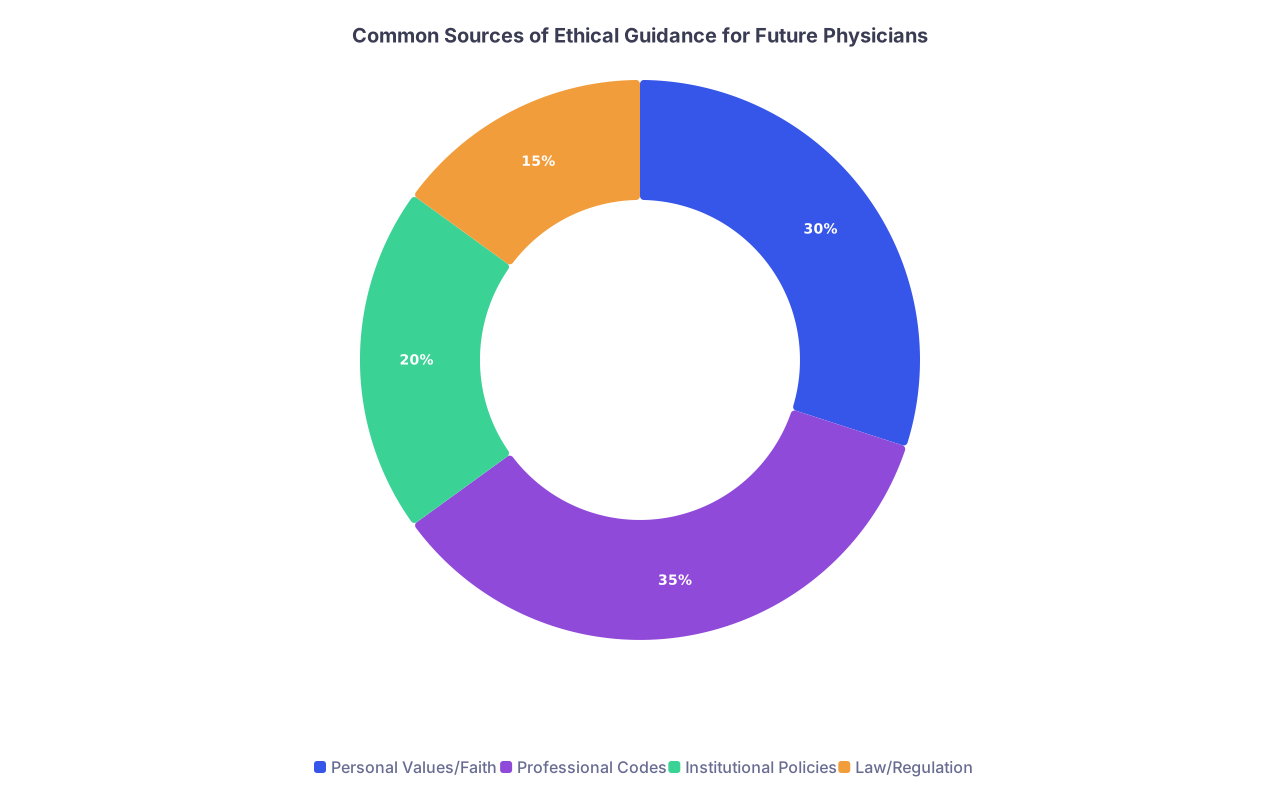
| Category | Value |
|---|---|
| Personal Values/Faith | 30 |
| Professional Codes | 35 |
| Institutional Policies | 20 |
| Law/Regulation | 15 |



| Step | Description |
|---|---|
| Step 1 | Clinician feels value conflict |
| Step 2 | Pause and reflect |
| Step 3 | Discuss with supervisor |
| Step 4 | Consult ethics committee or policy |
| Step 5 | Arrange referral if appropriate |
| Step 6 | Ensure non-abandonment and follow-up |


