

What If I Don’t Have Questions to Ask at the End of My Interview?
It’s 3:42 PM. You’re on Zoom with a faculty interviewer at a med school you really like. You made it through the “Tell me about yourself,” the ethics scenario, the “Why medicine?” speech without totally imploding.
Then they hit you with it:
“So… what questions do you have for me?”
Your brain: complete static.
You stare at the little blinking cursor in the chat. Your mind is screaming, “I SHOULD HAVE PREPARED QUESTIONS,” but all you’ve got is, “Nope, I’m good,” which you are 99% sure is the worst possible answer on earth.
And now you’re spiraling:
Does not having questions mean I’m not interested? Are they going to write in my file, “Applicant had NO QUESTIONS, clearly dead inside”? Did I just tank an otherwise decent interview because I didn’t ask some magical insightful thing?
Let’s walk through this like I’m sitting next to you on the couch after that interview.
You’re not the first one this has happened to. You’re definitely not the last. And no, this alone doesn’t destroy your chances. But it can send a subtle signal you probably don’t want to send—if you handle it badly.
So let’s unpack the worst-case scenarios, what interviewers actually think, and what you can do both in the moment and before your next interview so you’re not stuck in that frozen, mind-blank panic again.
Is It Actually Bad If I Don’t Have Questions?
Let me be blunt: saying “No, I’m all set” with zero follow-up is… not great.
Will it single‑handedly get you rejected? Almost never. But here’s what it can suggest to an interviewer who’s seen hundreds of applicants:
- You didn’t prep deeply
- You’re not that curious
- You’re a little passive about your own education
- You might just be going through the motions
Interviewers want to see you behaving like a future colleague: engaged, thoughtful, taking ownership of your training. People like that have questions. Not because they’re trying to impress anyone, but because they actually care what their next 4+ years will look like.
However. There’s a very different scenario that also looks like “no questions,” and interviewers see this a lot too:
You did your research.
They already answered most of what you were going to ask.
You’re overwhelmed and tired and can’t remember what hasn’t been covered.
That doesn’t make you lazy or uninterested. It makes you human and stressed. And most interviewers get that.
The real issue isn’t “Do you have questions?” It’s “Do you show that you’re actively engaging with this place and this person?”
If you can show that—even with minimal or improvised questions—you’re fine.
What Interviewers Actually Infer When You Have No Questions
Let me decode what’s happening on their side of the table (or Zoom screen).
Interviewers use your questions to assess:
- How you think
- What you value
- How seriously you’re taking this decision
- Whether you’re picturing yourself there long‑term
They’re not waiting for some brilliant, Nobel‑level question. They just want to see your brain is turned on.
Here’s roughly how the “no questions” thing can land:
| What You Do | What Many Interviewers Think |
|---|---|
| No questions at all | Maybe not very reflective / engaged |
| One generic question (forced) | Nervous, maybe underprepared, but fine |
| 1–3 thoughtful, specific questions | Interested, engaged, mature |
| Long list, not listening to answers | Trying too hard, a bit performative |
The sweet spot is a few specific, genuine questions that show you’re thinking like a future medical student / physician, not a high schooler on a campus tour.
You don’t have to dazzle them. You just have to not look like you’re mentally checked out.
What To Do If You Freeze and Have No Questions (In the Moment)
Let’s say it’s too late. You’re in the chair. Your brain is empty. Here’s exactly how to get yourself out of that hole without looking clueless.
1. Use the “Reflect + Narrow” Move
Instead of panicking, buy yourself half a second and frame it like this:
“Honestly, you’ve actually answered a lot of my main questions throughout our conversation, especially about [pre‑clinical curriculum / research / advising]. I think the one thing I’m still curious about is…”
Then grab one of these:
- “What do you think students here appreciate most about the program that doesn’t show up on the website?”
- “If you could change one thing about the program for students, what would it be?”
- “How would you describe the culture among students here—more collaborative, more independent, somewhere in between?”
That sounds thoughtful, not desperate.
2. Ask Them About Their Experience
When in doubt, stop trying to invent some fancy operational question and ask about their actual life. People love talking about themselves.
You can say:
- “How has your experience been working with students from this school?”
- “Why did you decide to stay here / come here as faculty?”
- “What kind of student do you think thrives the most at this school?”
This works with faculty, residents, students—anybody.
3. Recycle What They Already Said
If they mentioned something earlier—new curriculum, wellness initiatives, early clinical exposure—hook onto it:
“You mentioned earlier that the curriculum changed recently. How have students responded to that so far?”
Boom. You’re showing you listened and you care how it actually plays out.
4. Use a “Decision‑Making” Question
If you truly feel like everything else is covered, fall back to the meta‑question:
“I’m applying to a range of schools with different strengths. When you talk to prospective students, what do you think they should pay attention to when deciding if this program is the right fit for them?”
This turns the end of the interview into you seeking mentorship, which is rarely a bad look.
How To Prep So You Never End Up Question‑less Again
Let’s be honest: the “no questions” anxiety usually comes from two things:
- You didn’t have a clear plan for this part of the interview.
- Stress erased whatever vague ideas you had.
So you fix it by having a system instead of vibes.
Step 1: Build a Small Question Bank (Not 30, Just 8–10)
You don’t need a novel. You need a tight little set of questions that you can adapt to any school and any interviewer.
Aim for questions in these buckets:
- Curriculum / clinical exposure
- Support / advising / mental health
- Student culture / community
- Outcomes / residency prep
- Interviewer’s personal experience
Example question bank:
- “How does the school support students who are struggling academically or personally?”
- “What opportunities are there for early clinical exposure in the first year or two?”
- “How would you describe the student culture here? Competitive, collaborative, mixed?”
- “How accessible are mentors or advisors when students are making big decisions—like specialty choice or research?”
- “For students interested in [primary care / surgery / research], what resources here are especially strong?”
- “What do you think sets your students apart when they apply for residency?”
- “What’s one thing you think applicants often misunderstand about this school?”
You print this. Or write it in a small notebook. Or have it in a doc right next to your Zoom window. This is your safety net.
Step 2: Customize 2–3 Questions Per School
You don’t have to rewrite your life for each program. Just tweak.
Look at their website for 10–15 minutes and move from generic to specific:
Generic:
“How is the curriculum structured?”
Better:
“I saw you recently moved to a systems‑based curriculum with [X feature]. How has that changed students’ day‑to‑day experience?”
Generic:
“Are there research opportunities?”
Better:
“I noticed you have a strong focus on [global health / health disparities / basic science]. How easy is it for first‑ or second‑year students to get involved in those projects?”
That shift—generic to specific—is the difference between “lazy” and “engaged.”
Step 3: Physically Put the Questions In Front of You
I don’t trust anyone’s brain under interview stress. Not even very smart people.
You’re not failing if you glance at your notes and say:
“I wrote down a few questions while I was researching the program, if that’s okay.”
That actually shows preparation, not weakness.
Stick your question bank:
- Inside your portfolio for in‑person
- In a small notebook you put on the table
- In a Notes app window or doc you keep open under your Zoom
You’re allowed to look. You don’t have to pretend you memorized everything like a robot.
How Many Questions Should You Actually Ask?
Another anxiety trap: worrying if you’re asking too many, too few, the wrong type, etc.
Simple guideline:
- Aim for 1–3 questions per interviewer
- Prioritize genuine curiosity over performance
- Watch the clock and their energy
If you’re at the end of a 30‑minute one‑on‑one and they say, “We have a few minutes left for questions,” 1–2 questions is perfect. If it’s a student panel or Q&A session, you can ask more.
Red flags to avoid:
- Rapid‑firing a list of 7 questions when they clearly need to move on
- Asking stuff clearly answered on the homepage (“Do you have pass/fail?” when it’s in giant letters on the site)
- Overly transactional questions too early (“How many students fail Step 1?” “What percent match into derm?”) without any context or nuance
You don’t have to be perfect. Just not oblivious.
Worst‑Case Scenario: I Already Said, “No, I Don’t Have Any Questions”
Alright, this is probably where your brain keeps looping.
You had an interview. They asked. You panicked. You said, “No, I think I’m good.” And now you’re catastrophizing: Did I just ruin it?
Here’s the honest take:
- If the rest of your interview was solid, this is a small ding at most, not a fatal blow.
- Interviewers care way more about how you answered their questions than whether you asked three of yours.
- They’ve 100% seen amazing students with no questions and mediocre students with rehearsed “great” questions.
You can’t go back and fix that specific moment. But you can:
- Fix it for every future interview (question bank + notes ready).
- If you’re writing a thank‑you email, you can subtly show engagement:
Instead of:
“Thank you for your time.”
Try:
“Thank you again for speaking with me about [program]. I’ve been thinking more about what you said regarding [curriculum / student support / research], and it made me even more excited about the possibility of training here.”
That doesn’t erase the “no questions” moment, but it pushes a more engaged impression back to the top of their mind.
Quick Visual: Where to Focus Your Limited Energy
You’ve only got so many brain cells on interview day. Put them where they matter most.
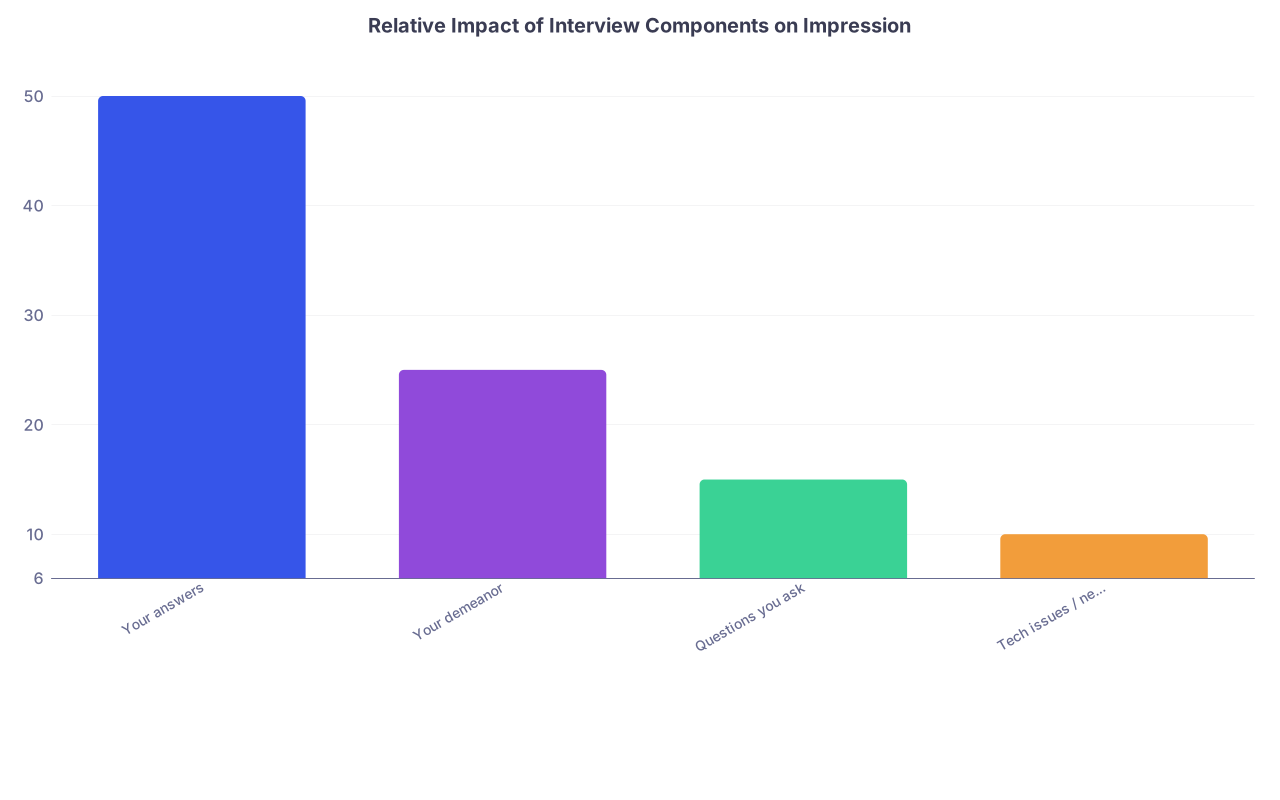
| Category | Value |
|---|---|
| Your answers | 50 |
| Your demeanor | 25 |
| Questions you ask | 15 |
| Tech issues / nerves | 10 |
The questions you ask matter, but not nearly as much as how you answered everything else. This is perspective. Use it.
A Simple Question Framework You Can Steal
If you don’t want to overthink it, use this 3‑question structure for each interviewer:
One about their experience
- “What do you enjoy most about working with students here?”
One about students / support / culture
- “How do you see the school supporting students’ well‑being and avoiding burnout?”
One about fit / advice
- “For someone like me, with an interest in [X], are there particular aspects of this school you think I should pay attention to?”
You can rotate versions of these depending on what feels natural.
What You Can Do Today So You Don’t Spiral Again
Not next week. Today. While you’re still in this slightly panicked headspace.
- Open a blank doc or notebook.
- Write at the top: “INTERVIEW QUESTION BANK.”
- Draft 8–10 questions using the categories above—curriculum, support, culture, outcomes, interviewer’s experience.
- For your next upcoming school, pull up their website and tweak 2–3 questions to be school‑specific.
- Put that list somewhere you can physically access during your next interview.
And then, seriously, stop punishing yourself for the one time you said, “No, I don’t think I have any questions.” You learned from it. That’s the whole point.
FAQ (Exactly 5 Questions)
1. Will having zero questions automatically get me rejected?
No. If your overall interview was strong, “no questions” is a minor negative, not a deal‑breaker. It might make you seem less engaged, but people get admitted all the time despite this. Use it as a learning point, not a prophecy.
2. Is it okay to say, “You answered most of my questions already”?
Yes—if you follow it with at least one specific question or reflection. For example:
“You actually answered a lot of what I was wondering about, especially around clinical exposure. I think my remaining question is…”
Just ending at “No, you answered everything” with nothing else makes you look done, not thoughtful.
3. Can I look at notes when I ask my questions?
Yes. Absolutely. Tons of applicants do this. You can even say, “I wrote down a few questions while I was preparing, if you don’t mind me checking my notes.” That reads as prepared, not unprofessional.
4. What if my question sounds dumb or obvious?
If it’s truly on the homepage in giant letters, skip it. But most questions you’re labeling as “dumb” are probably just… normal. As long as you’re genuinely curious and not asking, “How do I get a higher Step score?” in a weird way, you’re fine. The bigger red flag is no curiosity at all.
5. Should I ask the same questions to every interviewer?
You can reuse the themes, but don’t ask the exact same question to four people in one day if they’re clearly giving you overlapping info. Mix it up a bit. Use faculty for curriculum, residents/students for culture, administrators for structure/support. Rotate within your question bank.
Open a new document right now and type: “My Interview Question Bank.”
Get three questions on the page. Just three. Once they exist in writing, your brain doesn’t have to carry all the pressure alone.


