

One bad rotation almost never ruins your residency chances—what ruins people more often is how they react to it.
I know that’s not what your 2 a.m. brain is telling you. Your 2 a.m. brain is replaying that attending’s comment. The so-so evaluation. The awkward mini-CEX. The day you blanked on a pimp question in front of the whole team and felt your soul leave your body.
Let’s talk about all of that. Honestly. No sugarcoating, but no doom either.
What “One Bad Rotation” Actually Means On Paper
Here’s the part that’s easy to forget when you’re spiraling: programs don’t see your life; they see your file.
They see patterns, trends, context. Not that one afternoon you almost cried in the stairwell.
Most “bad rotations” fall into a few buckets:
- Below-average eval in one clerkship
- One low shelf exam score
- A harsh narrative comment
- A pass where you wanted honors
- A professionalism flag or remediation (this is a different category and more serious, but still not always fatal)
From a residency program’s perspective, they’re looking at a pile of stuff:
- Your overall clerkship performance
- Step 1 (if they see it) and Step 2 CK
- Class rank/quartile if your school gives it
- Letters of recommendation
- Personal statement
- Any red flags (fails, leaves of absence, professionalism issues)
That one bad rotation? It’s a data point. Not a verdict.
Let me show you what I mean.
| Component | Typical Impact Level (Low/Med/High) |
|---|---|
| Step 2 CK Score | High |
| Overall Clinical Grades | High |
| Single Bad Rotation | Low–Medium (depends on pattern) |
| Strong Letters | High |
| Research (for some specialties) | Medium–High |
See it? “Single bad rotation” is rarely the main character. It’s background noise—unless it fits into a larger pattern.
The Worst-Case Scenarios Your Brain Is Inventing (And What’s Actually True)
Let’s go straight into the anxiety pit. These are the exact thoughts people don’t say out loud but absolutely think.
“If I didn’t honor this core rotation, I’ll never match this specialty.”
No. That’s not how this works.
Is it ideal to honor your core rotation in your intended field? Sure. Is it a requirement? At many places, no.
Plenty of people match internal medicine without honoring medicine. Plenty of surgeons didn’t honor surgery. Pediatrics, EM, OB, psych—same story.
Programs care much more about the whole pattern:
- Did you generally improve over the year?
- Did you do better in your sub-I or audition rotation in that specialty?
- Do your letters say “This student is excellent and I’d gladly take them as a resident”?
One bad rotation doesn’t erase a great sub-I with a strong letter.
“This one toxic attending’s eval is going to destroy my MSPE.”
Probably not.
Every school builds the MSPE (Dean’s Letter) differently, but most do one of two things with outlier stuff:
- They average evals so one weirdo doesn’t dominate.
- They filter or summarize narrative comments so the worst line isn’t the only thing that shows up.
Also, almost every program director I’ve ever heard talk about this says some version of: “We know some evals are…unbalanced.” They’ve seen the over-the-top harsh ones. You are not the first student to get destroyed by an attending on a power trip.
Does a brutal eval feel awful? Yes. Does it automatically tank your entire residency application? No.
When One Rotation Really Can Hurt You
Let me not gaslight you. There are situations where a rotation legitimately matters a lot more.
Here’s when that “one rotation” actually carries more weight:
Sub-I / Acting Internship in your chosen specialty
If you blew off your medicine sub-I and want to do IM, yeah, that’s a problem. Same for surgery, OB, EM, etc. Those rotations are like a probation period—programs read those evals very carefully.Repeated pattern in the same domain
Bad eval in medicine, bad eval in family, mediocre eval in EM, and they all say some version of “slow, disorganized, needs hand-holding.” That’s not “one bad rotation.” That’s a theme.Professionalism or safety issues
Being late once and getting scolded? Annoying, but survivable. Charting something you didn’t do, screaming at nurses, going AWOL on call? Very different story. Those things can absolutely follow you into residency.Failing the shelf and barely passing the rotation
A single shelf failure is often recoverable if everything else is solid and you pass on remediation. Multiple fails or repeated barely-passing performance? That starts to stand out.
If your “bad rotation” fits into one of those categories, it’s not the end, but you do have to be more proactive and strategic. You can’t just “hope it disappears.”
How Programs Actually Interpret a Blip vs. a Pattern
I want you to picture a PD reading your file. Not your nightmare version, but a real, overworked human being with 250 applications open in ERAS.
They don’t have time to psychoanalyze every mediocre eval. They scan for patterns.
Let me spell this out clearly.
| Scenario | Likely Interpretation |
|---|---|
| One weak rotation, others strong | “Off month, normal human.” |
| Early bad rotation, later ones stronger | “Growth, figured it out.” |
| Core rotation average, sub-I strong | “Improved when responsibility increased.” |
| Same concern repeated across rotations | “Possible real issue, worth flagging.” |
| One brutal eval among many positive ones | “Personality clash / harsh grader.” |
They’re not assuming you’re incompetent because you didn’t impress one attending in November of third year.
What they care most about: How do you perform when you know what you want and you’re closer to residency level? That’s where sub-Is, away rotations, and later clerkships really matter.
What You Should Do Right After a Bad Rotation (Instead of Just Spiraling)
If you’re coming off a rotation that feels like a car crash in slow motion, here’s how to handle it in a way that protects your future self.
1. Get out of your own head and get specific
“Everything was terrible” is not data. It’s anxiety.
You need evidence:
- Were your evals truly bad or just not as glowing as your friends’?
- Was the shelf exam low, average, or actually a fail?
- Were there concrete comments about knowledge, work ethic, communication, or professionalism?
Ask for a debrief. Sit down with your clerkship director or advisor and say plainly:
“This rotation didn’t go the way I hoped. I want to understand where I went wrong and how I can improve before sub-I’s and residency applications.”
Uncomfortable? Yes. Worth it? Absolutely.
2. Decide if this is a “fixable blip” or a “needs-a-plan” issue
Your school advisor has seen hundreds of students’ records. They usually know what’s catastrophic vs. what just feels catastrophic.
Ask them direct questions:
- “Is this likely to limit what specialties I can apply to?”
- “If I crush my sub-I, does this get mostly overshadowed?”
- “How have students with evals like this done in the past?”
You need real precedent, not just your imagination.
3. Build a clear improvement plan
Residency programs love growth arcs. They don’t need you to be perfect in January of third year. But they want to see:
- You took feedback seriously
- You changed your behavior
- It actually worked
That might look like:
- Being obsessive about pre-rounding and notes on the next rotation
- Showing up 10 minutes earlier than you think you need to—every day
- Asking for mid-rotation feedback and then visibly acting on it
You want future attendings writing things like: “She was extremely receptive to feedback and improved rapidly over the month.”
That kind of line erases a lot of earlier damage.
How To Talk About A Bad Rotation If It Comes Up
The question that haunts people: “What if they ask about it in an interview?”
First: they usually don’t, unless it’s something obvious (fail, LOA, major professionalism flag). Most PDs aren’t cross-examining minor clerkship blips.
But if it does come up, you need a grown-up, non-defensive answer.
The rough template:
- Briefly own it
- Name what you learned
- Show how you changed and what the results were
Example:
“On my surgery clerkship, I got feedback that I seemed hesitant and not proactive in the OR. That was hard to hear, but fair. I was intimidated and I stayed too quiet. On my next rotations I started asking early what tasks I could own, and I actively sought out procedures and feedback. By the time I did my sub-I, I was much more comfortable stepping into responsibilities, and my evals reflected that growth.”
Notice what’s missing:
- Trashing the attending
- Making 14 excuses
- Pretending it didn’t hurt
You’re allowed to be human. You’re not allowed (in their eyes) to be someone who can’t take feedback.
When You Actually Need To Adjust Your Specialty Plans
Here’s the nightmare scenario your brain jumps to: “Because of this one bad rotation, I can’t do the specialty I want.”
Most of the time, this is false.
But sometimes, with ultra-competitive fields, you do have to be realistic. Not just about one rotation, but the whole picture.
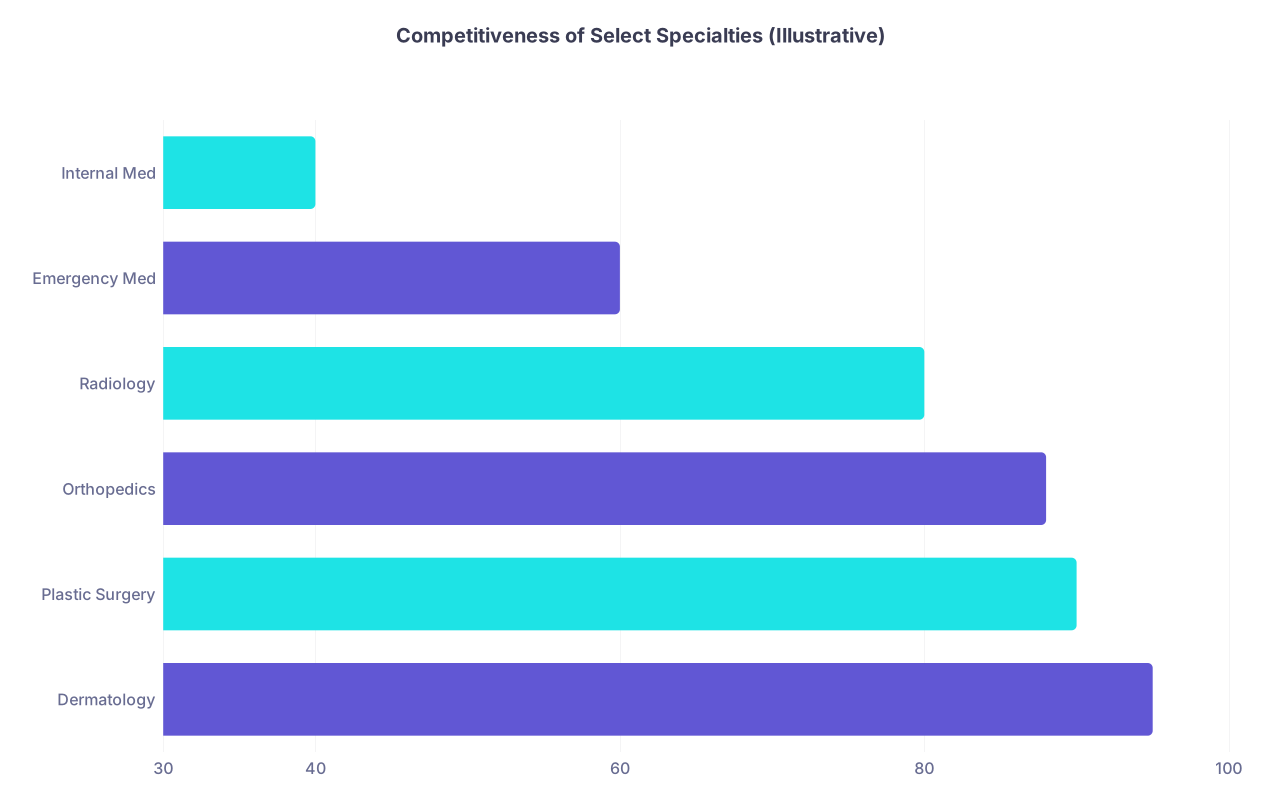
| Category | Value |
|---|---|
| Dermatology | 95 |
| Plastic Surgery | 90 |
| Orthopedics | 88 |
| Radiology | 80 |
| Emergency Med | 60 |
| Internal Med | 40 |
If you’re going for derm, plastics, ortho, ENT, neurosurg, etc., they’re not just looking for “good.” They’re selecting from “ridiculously strong.” In that context:
- Multiple average evals in your own specialty
- No honors in the core relevant rotation
- Weak or lukewarm letters
- Mediocre Step 2
…that combination might push you to consider slightly less cutthroat fields.
But again—that’s not because of one bad rotation. It’s because of the total composite.
If you’re worried about this, sit down with someone who will not BS you: specialty advisor, PD at your home program, or that one brutally honest faculty member everyone’s slightly afraid of but secretly respects. Ask:
“With my current record, am I competitive for [X]? If I do [Y and Z] over the next year, does that change? And if not, what’s a reasonable backup?”
Agonizing conversation. Worth having.
Protecting Your Mental Health So One Rotation Doesn’t Break You
Here’s the part people underestimate: it’s not just your application at risk; it’s your sanity.
One horrible month can warp how you see yourself. You start rewriting your whole story as “I’m actually incompetent and everyone finally saw it.”
I’ve watched classmates do this to themselves. They go from engaged and curious to silent and terrified to make a mistake. And then performance actually does get worse, because they’re learning less and hiding more.
A few things that help interrupt that spiral:
- Talk to at least one person who’s not on your rotation: a therapist, mentor, or older student. Someone who can remind you of the bigger picture.
- Pull up your past wins. Shelf scores, good eval comments, compliments from residents—whatever you’ve got. You are not defined by your worst evaluator.
- Set a “postmortem limit.” Give yourself 1–2 hours to process, cry, rant, and review what went wrong. Then write down 3 specific things you’ll change on the next rotation and move on. No endless replay.
You’re going to have rotations where you feel brilliant and rotations where you feel like a liability. Neither extreme is the full truth of your abilities.
What Actually Stays With You Years Later
I want to zoom out for a second.
In five years, as a resident, what will matter more to your patients and colleagues?
- That one internist in your third year thought you “lacked urgency”?
- Or that you learned how to hear criticism, adjust fast, ask for help, and keep showing up?
Programs don’t need people who’ve never had a bad month. They need people who don’t completely fall apart when they do.
You’re allowed to be shaken. You’re not doomed.
FAQ (Exactly 4 Questions)
1. I failed one shelf exam. Is that a huge red flag for residency?
It’s not great, but by itself it’s not usually fatal. Programs care about what you did after. Did you pass on remediation? Did your later shelves improve? If you failed one shelf, passed the rotation, and everything else is solid—especially Step 2 and later clerkships—most PDs will see it as a stumble, not a pattern.
2. My attending clearly didn’t like me. Can I ask my school not to use their evaluation?
Sometimes. Some schools will remove or contextualize an outlier eval, especially if it’s wildly inconsistent with the rest of your performance or contains unprofessional comments. Talk to your clerkship director or student affairs. Don’t demand they erase it, but you can calmly say, “This feels like an outlier compared to my other rotations—how is this handled in the MSPE?”
3. I got a ‘Pass’ instead of ‘Honors’ in the core rotation for my intended specialty. Should I give up on that field?
No. A single Pass doesn’t eliminate you. It just means the rest of your application needs to be strong: sub-I performance, letters, Step 2, maybe some relevant research depending on the field. Programs don’t sit around rejecting people because they were one tier lower than perfect on one clerkship.
4. Will I have to explain this bad rotation in every interview?
Usually not. Most interviewers are glancing at your Step scores, overall clinical performance, and your letters. They’re not dissecting every clerkship line. You’re more likely to be asked about obvious things—an exam fail, LOA, or big gap. If the rotation was just “meh” and not a true red flag, it often doesn’t come up at all.
Years from now, you won’t remember the exact wording of that painful evaluation. You’ll remember whether you let it define you, or whether you used it as the moment you quietly decided, “I’m going to get better than this.”


