

You’ve just finished wards for the day. It’s 7:15 p.m. You’re walking out of the hospital, exhausted, when you realize: you barely understood half of what was going on with that complicated heart failure/COPD/sepsis train wreck in room 12.
And now you’re wondering:
Am I supposed to go home and read about every single patient like it’s a mini-rotation syllabus? Or is that overkill when I also have UWorld, Anki, and NBME exams breathing down my neck?
Here’s the answer you’re looking for: you should absolutely read about your patients. But not the way most students think they “should.” There’s a smart, sustainable way to do it that helps you on the wards and for exams without turning your life into an endless homework loop.
Let’s break it down.
The Core Rule: Depth Over Breadth, and Always with a Time Cap
You do not need to read extensively on every single patient you see.
What you should do is:
- Pick a small number of high-yield patients each day (usually 1–3).
- Read targeted material for 20–40 minutes total per day, max.
- Make that reading directly tied to decisions/questions that actually came up on rounds.
If you’re doing hours of patient-related reading every night, you’re probably:
- Burning out
- Sacrificing question banks (which are essential for exams)
- Reading too broadly in a way that doesn’t stick
Your job is to treat patient reading as a booster to your question-bank learning, not a replacement or a new full-time job.
Why Bother Reading About Patients at All?
Because patient-driven reading does three things question banks can’t fully do:
It makes the information stick.
You will never forget the pathophys of hepatorenal syndrome once you watched a real patient’s creatinine climb while the team debated albumin vs fluids vs pressors.It makes you look better on the team.
When your senior asks, “What’s the first-line treatment for NSTEMI in this patient?” and you can answer clearly because you read a short guideline summary last night, you immediately stand out.It builds real clinical reasoning.
Question banks force you into multiple choice thinking. Patient reading forces you to think:- Why are we giving this drug and not that one?
- What’s the next step if this fails?
- What’s the actual evidence behind what we’re doing?
But here’s the catch: you only get these benefits if you keep it focused and sustainable.
A Simple Framework: The “3-Patient” Rule
Here’s a concrete framework that I’ve seen work well for a lot of students:
Each day, aim to read in detail about 1–3 patients. That’s it.
Pick patients that:
- Represent common exam topics (COPD, CHF, DKA, pneumonia, PE, GI bleed, sepsis, preeclampsia, etc), or
- Have a decision point that confused you (why this antibiotic, why not anticoagulate, why discharge vs ICU, etc), or
- Are core to the team’s focus (that one train-wreck everyone’s talking about)
Then, for each of those 1–3 patients, do 10–15 minutes of targeted reading:
- 1–2 UpToDate sections or a guideline summary, OR
- A short chapter section in a review book (Step-Up to Medicine, Case Files, Blueprints, etc), OR
- A quick board-style review of the condition in a trusted resource
Total time: around 20–40 minutes per day.
That’s enough to:
- Make you sharper on rounds tomorrow
- Tie that condition into your exam brain
- Not destroy your ability to do UWorld/Anki
How to Split Your Time: Question Banks vs Patient Reading
You’re not wrong to worry that patient reading might cannibalize your board prep.
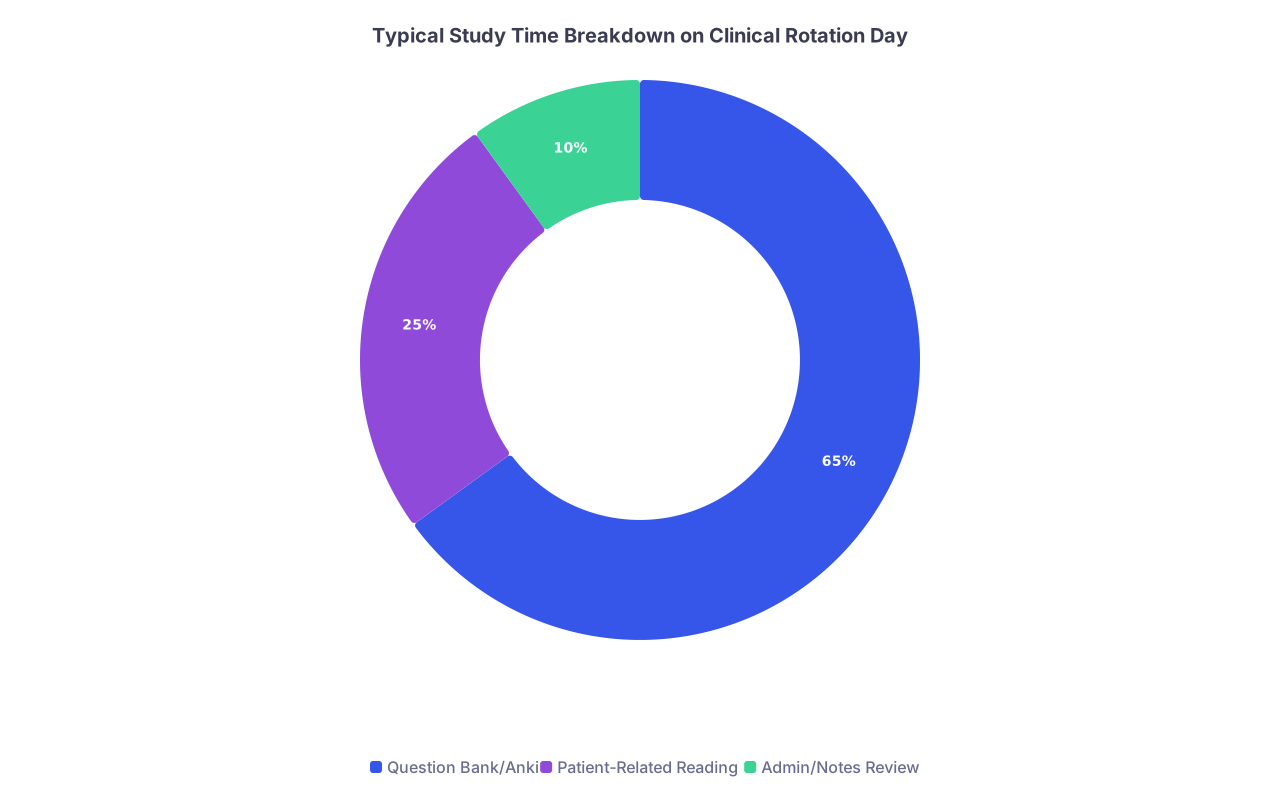
So here’s a realistic breakdown for a normal weekday on a busy rotation.
| Category | Value |
|---|---|
| Question Bank/Anki | 65 |
| Patient-Related Reading | 25 |
| Admin/Notes Review | 10 |
For an average clinical day where you can squeeze in 1.5–2.5 hours of “study” outside the hospital:
- 60–70% → Question banks / Anki / formal exam prep
- 20–30% → Patient-focused reading
- 5–10% → Reviewing notes, updating sign-outs, loose ends
If you’re in the thick of Step 2 CK prep, tilt even harder toward questions. On the flip side, on a chill outpatient rotation with short hours, you can lean more into patient reading without guilt.
But the non-negotiable point:
Question banks remain your primary exam-prep activity. Patient reading is there to amplify, not replace, that.
What Exactly Should You Read About a Patient?
You don’t need to reinvent the wheel. You’re not writing a textbook. You want to answer very specific questions that came up for this patient.
Use this quick checklist for each “chosen” patient:
Diagnosis basics
- Definition and essential pathophys
- Most common causes
- Typical presentation (tie it to what you actually saw)
Workup
- Must-do tests vs “nice-to-have”
- Red flags that change management (e.g., in a GI bleed: hypotension, dropping Hgb, history of liver disease)
Management
- First-line treatment
- Clear next steps if first-line fails or is contraindicated
- Criteria for ICU vs floor vs discharge
One nuance specific to your patient
- How CKD changes dosing
- Why anticoagulation was held
- Why surgery was delayed
This is where the real learning happens.
That’s it. You’re not studying the entire disease chapter. You’re studying the slice relevant to that human being you saw today.
Best Resources for Patient-Driven Reading
Use fast, clinical, high-yield sources. Not 40-page PDFs.
| Resource | Best Use Case |
|---|---|
| UpToDate | Quick clinical deep dives, guidelines |
| Step-Up to Med | Core IM conditions at exam level |
| Case Files | Outpatient + inpatient cases + questions |
| Online MedEd | Bread-and-butter frameworks |
| Pocket guides | On-the-fly ward questions |
And yes, UpToDate can be a black hole. So set rules:
- Only read 2–3 sections max per patient (“Summary and Recommendations” is gold)
- Don’t scroll every subheading at midnight
- If you find yourself on page 7 of “Pathogenesis,” you’ve gone too far
How This Looks in Real Life: 3 Quick Scenarios
Scenario 1: Medicine Rotation – CHF Exacerbation
You admitted a 68-year-old with CHF exacerbation, CKD, and AFib. You were lost when the resident started talking about preload, afterload, and cardiorenal syndrome.
Your patient reading tonight:
- UpToDate: “Overview of the management of acute decompensated heart failure” (summary section only)
- Focus on:
- Indications for IV diuresis
- How to monitor response (daily weights, ins/outs, creatinine)
- When to consider inotropes or ICU
Result:
Tomorrow, when your attending asks, “How will you know if our diuresis is working?” you’ll have a clean, confident answer.
Scenario 2: OB/GYN – Preeclampsia Patient
You saw a 31-year-old G2P1 with severe preeclampsia at 34 weeks, on magnesium. You kind of know the buzzwords but not the real management steps.
Your reading:
- One OB review chapter section or Online MedEd video on preeclampsia
- Learn:
- Diagnostic criteria (what’s “severe”?)
- When to deliver vs try to buy time
- Why magnesium, and what toxicity looks like
Now both your shelf and your next preeclampsia patient make more sense.
Scenario 3: Surgery – Post-op Fever
Your patient is POD2 from a colectomy and spiked a fever. The team ordered blood cultures, CXR, urine culture, everything. You’re not sure why.
Your reading:
- Quick review of “post-op fever: 5 W’s” in a surgery review book
- Focus on:
- Timing-based differential (wind, water, wound, walking, wonder drugs)
- Workup priorities and when not to panic
You now both understand the shotgun workup and can crush that inevitable shelf question.
How Much Is Too Much? Red Flags You’re Overdoing It
You’ve crossed the line from “smart reading” to “inefficient martyrdom” if:
- You’re spending >1 hour/night on patient reading regularly
- Your question bank progress has stalled
- You’re re-reading deep theory that doesn’t change what you do tomorrow
- You’re reading UpToDate chapters like novels
If that’s you, scale back. Go back to the 3-patient, 30–40 minute rule. Protect your question time ruthlessly.
How to Make Patient Reading Stick (Without Extra Work)
You don’t need to create a parallel note-taking universe. Just add tiny bits of structure to make it memorable.
Try this:
- For each patient you read about, jot down 3 bullet points:
- 1 diagnosis takeaway
- 1 management rule of thumb
- 1 “this patient specifically taught me…” insight
You can:
- Put these in your phone notes
- Write them in a small notebook
- Or mentally rehearse them before bed or on the commute
Optional: turn key points into 1–2 Anki cards if you’re already using Anki heavily:
- “First-line treatment for acute decompensated HF with pulmonary edema?”
- “Diagnostic criteria for severe preeclampsia?”
But only if you’re already in that ecosystem. Don’t start a brand-new system just for this.
Tailoring by Rotation: You Don’t Do the Same on Every Service
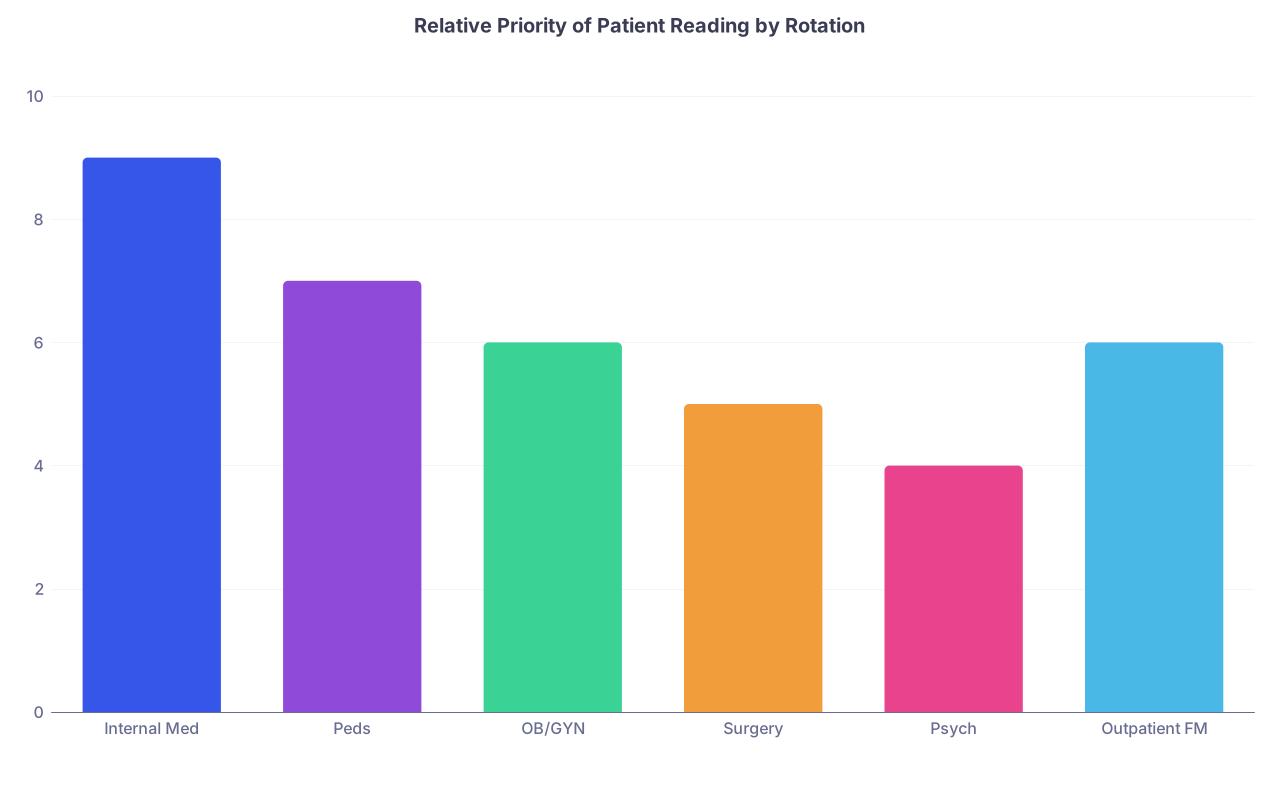
Not all rotations are created equal. Some justify more patient reading; some don’t.
| Category | Value |
|---|---|
| Internal Med | 9 |
| Peds | 7 |
| OB/GYN | 6 |
| Surgery | 5 |
| Psych | 4 |
| Outpatient FM | 6 |
On a 1–10 scale (10 = highest priority for patient reading):
Internal Medicine (8–9)
Tons of complex, guideline-based management. Patient reading here pays off massively.Pediatrics (6–7)
Growth, vaccines, age-based dosing. Good to read, but core concepts repeat a lot.OB/GYN (6)
High yield but narrower; focused reading on preeclampsia, labor, bleeding, infections is enough.Surgery (5–6)
Read more about the disease and complications than the technical surgery itself. Post-op management is where you shine.Psych (4–5)
You can get a lot from a small set of conditions and meds. Deep guidelines less critical day-to-day.Outpatient FM (6)
Great for bread-and-butter medicine: HTN, DM, hyperlipidemia, depression, screening guidelines.
Adjust your intensity accordingly.
When Question Banks Should Win, Even Over Patient Reading
There are times when you should bluntly choose UWorld over UpToDate, even if you feel guilty ignoring your patients’ problems for a night:
- You’re <3–4 weeks from a shelf or Step exam and behind on questions
- You consistently miss the same topic in QBank and haven’t caught up
- You’re on an easier service this week and your learning is mostly exam-driven
And that’s fine.
Clinical learning is a long game. You will see CHF, pneumonia, and preeclampsia again. You will not get a second shot at this exam.
When in doubt:
- Minimum 20 minutes of patient reading/day keeps you clinically engaged
- The rest can go to pure exam prep during crunch time
How to Start This Tonight
Don’t overcomplicate it. Here’s one concrete thing you can do today:
- Think of one patient from today that confused you the most or came up repeatedly on rounds.
- Open UpToDate or a trusted clinical resource.
- Set a 15-minute timer on your phone.
- Read only:
- Diagnosis overview
- Initial management
- One nuance relevant to that specific patient
- Write down three bullet points you want to remember for tomorrow.
That’s it. You’ve just done exactly the right amount of reading about your patients—enough to learn, not enough to drown.
Tomorrow, pay attention to how much more confident you feel presenting that patient or answering a simple follow-up question. That feedback loop is what you’re really building.
Open your patient list right now, pick one name, and commit: who are you going to read about for 15 minutes tonight?


