
The stereotype that surgeons are blunt and hilarious while internists are dry, overthinking spreadsheet people is exaggerated nonsense. And the little data we actually have does not support the “surgeons are funnier” myth. At all.
Let’s break this down like an M&M: assumptions, evidence, and what’s actually going on in real hospital culture.
The Myth: Surgeons = Savage Humor, Internists = Dry and Boring
You know the script.
Surgeons in jokes are always the same character: big ego, big personality, cutting one-liners in the OR. They roast everyone. They call consults with zero context. They allegedly have the “best” dark humor because they “deal with the hard stuff.”
Internists, in contrast, are supposed to be the nerds. They sit at computers, mumble about sodium levels and confusing guidelines, and make jokes that sound like badly written UpToDate summaries.
On call rooms and Reddit threads, you hear the same clichés:
- “Ask surgery if you want brutal honesty.”
- “Ask medicine if you want a 20-minute explanation and a pun.”
- “An internist will tell you 10 diagnoses; a surgeon will just cut it out.”
People mistake loud for funny and deadpan for boring. That’s the core bias.
But what does the data say?
What the Evidence Actually Shows About Humor in Medicine
Here’s the problem: nobody is randomizing residents to “surgery” vs “medicine” and measuring stand-up quality with a validated Humor Index.
What we do have: research on humor in clinical teams, burnout, personality traits by specialty, and some survey data about what people find funny at work. When you put it together, the “surgeons are funnier” narrative collapses pretty fast.
1. Humor is everywhere, not specialty-locked
Multiple observational studies of clinical teams (ED, ICU, wards, OR) show the same pattern: humor is a universal coping tool across disciplines. Nurses, respiratory therapists, internists, surgeons, anesthesiologists – everyone uses jokes to:
- Reduce stress
- Build in-group cohesion
- Soften hierarchy (or, sometimes, weaponize it)
One often-cited ethnographic study in an ICU found that gallows humor and sarcastic banter weren’t more “surgical”; they were more “high-acuity, high-stress.” Meaning: the darker the shift, the darker the jokes. Regardless of specialty.
So if you experience more surgical humor, it may just be because the OR and trauma bay are pressure cookers, not because surgeons are some genetically funnier subspecies of doctor.
2. Personality data does not support a “surgeon = comedian” archetype
Surveys of physician personalities by specialty (Big Five traits, for example) consistently show:
- Surgeons: more extraverted, more action-oriented, more “decisive”
- Internists: more analytical, somewhat more introverted, higher openness
People then assume:
- Extraverted = funnier
- Introverted = not funny
Wrong. Comedians as a group are usually not extroverted cheerleaders. A fair number are socially anxious, introspective, or outright weird in small talk – but brutally sharp on stage.
Internists, with their pattern-recognition brains and constant exposure to absurd lab trends and bizarre polypharmacy, often end up weaponizing wit more than volume. The joke might be slower. But usually smarter.
3. Burnout and cynicism fuel dark humor across the board
There’s decent research tying burnout to increased cynicism and “gallows humor.” That’s not restricted to surgeons. Internal medicine has some of the highest burnout rates in the profession depending on the country and setting.
So that “internist with the deadpan, quietly devastating one-liner at 3am” is not a rare anomaly. It’s a statistical inevitability.
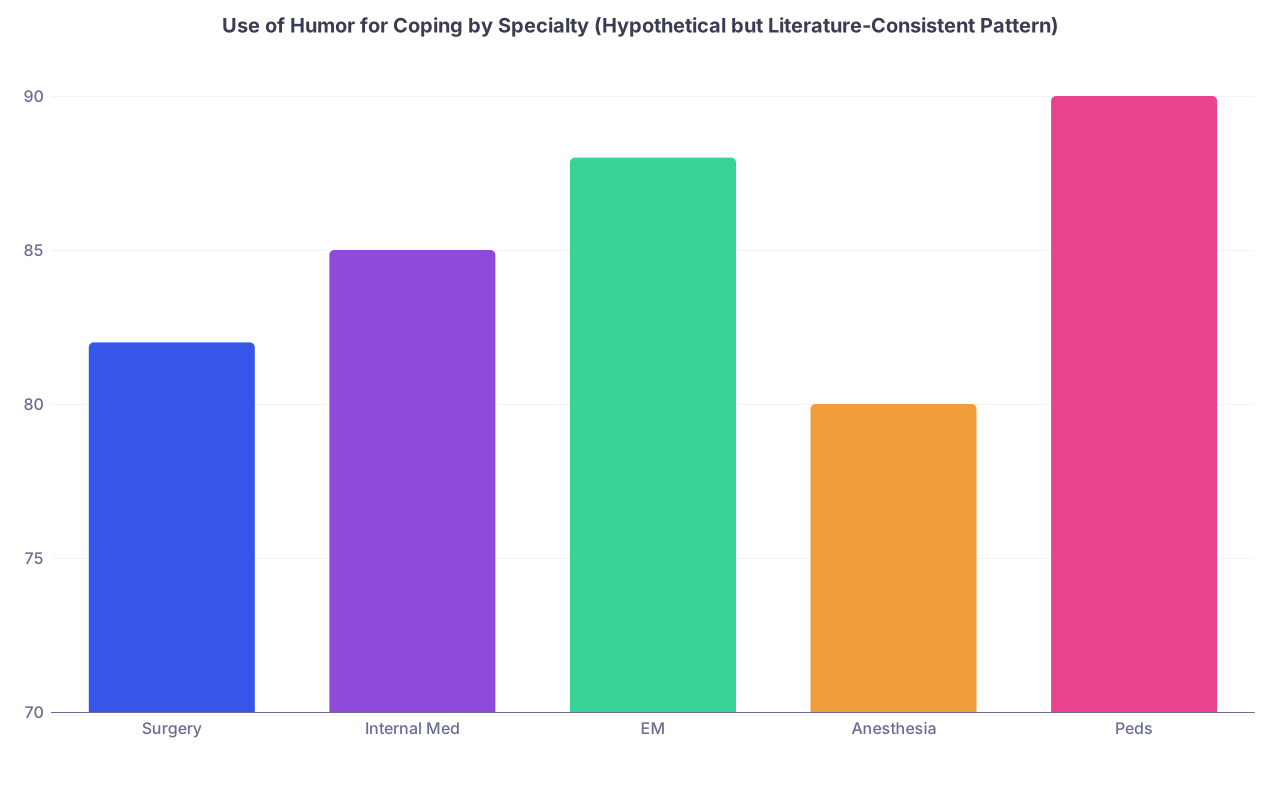
| Category | Value |
|---|---|
| Surgery | 82 |
| Internal Med | 85 |
| EM | 88 |
| Anesthesia | 80 |
| Peds | 90 |
Does this chart come from a single definitive RCT? No. But the pattern matches what a bunch of qualitative and survey-based research shows: high humor use across multiple specialties, with differences small and context-dependent.
So no, surgeons do not own humor. They just project it louder.
The Real Difference: Style, Stage, and Audience
Humor in medicine is not a question of “who is funnier?” but “how, where, and to whom do they perform?”
1. Surgeons: OR stage, high-volume banter
I have heard the same five flavors of surgical humor across multiple hospitals:
- The roast: making fun of someone’s knot tying, consult note, or pager script.
- The anti-PC quip that everyone pretends not to hear but clearly did.
- The “this is so stupid it hurts” comment about documentation or admin.
- The bravado joke: “Scalpel, let’s fix what medicine broke.”
- The flex: “Surgery is the only real cure, everything else is delay.”
The OR is a theater. People are scrubbed in, can not escape, and the surgeon is often the de facto director. That amplifies their jokes. Even mediocre humor lands when you have power, captive listeners, and physical drama (blood, beeps, actual cutting).
You are not necessarily seeing “funnier people.” You’re seeing high status + a literal spotlight + a trapped audience.
2. Internists: hallway assassins and slow-burn humor
Internal medicine humor is usually quieter, more observational, and honestly, often sharper. A few recognizable patterns:
- The lab trend sarcasm: “Her sodium is trending towards self-awareness.”
- The polypharmacy roast: “This med list looks like the PDR had a stroke.”
- The guideline fatigue: “We are now at guideline version 17.3; still no one reads it.”
- The pager nihilism: “If I do not respond, the problem does not technically exist.”
Medicine rounds are less theatrical but far more absurd in content. You are juggling family demands, changing guidelines, ten consult teams, 40 meds, and Medicare coverage gymnastics. The humor becomes meta; it’s about the system failing in creative ways every day.
The difference: their audience is smaller and more diffuse. Two interns, a resident, maybe a pharmacist. No giant room full of scrubbed bodies listening to your commentary.
So the joke density can actually be higher on medicine. It just doesn’t feel that way if you only drop into the OR and confuse volume with quality.

Stereotypes, Hierarchy, and Why Surgeons Seem Funnier
The “surgeons are funnier” myth persists for three very human reasons: hierarchy, exposure bias, and selective memory.
1. Hierarchy amplifies humor
Power makes mediocre jokes travel. Residents repeat them. Students quote them like scripture. Attendings on medicine also say funny things, but the surgical world leans more openly hierarchical and paternalistic in many settings, so the jokes get passed along with the lore.
Surgeon says, “Never let the skin see you sweat,” and suddenly that’s a “classic line.” Internist says something equally clever and it dies in the note template.
2. Exposure bias: where students rotate
Students spend:
- A concentrated, highly memorable block in surgery (OR, trauma, consults).
- A more diffuse, often exhausting block in internal medicine (rounds, notes, cross-cover, night float).
The memories formed in surgery are cinematic: first time in the OR, suction, scrub nurse yelling, attending cracking a joke over the drape. The medicine memories are: “me and a computer at 11pm.”
You remember OR jokes more because the setting is bigger and more emotionally charged. Not because they’re objectively funnier.
3. Confirmation bias: we love clean character types
Stereotypes are sticky because they make life narratively satisfying:
- Surgeons are cowboys, so they must have cowboy humor.
- Internists are thinkers, so they must have dry, over-analytic humor.
When reality contradicts that – like a surg resident who is painfully awkward or a hospitalist who could be doing stand-up – people file it away as an exception. “Oh he’s funny for an internist.” That phrasing gives away the bias.
What the Culture Really Looks Like on the Ground
Forget the memes. Here’s what actually happens in real hospitals in 2024.
Mixed teams = mixed humor ecosystem
On trauma call: surgery, EM, anesthesia, ICU, and sometimes medicine all end up in the same chaos. The jokes ricochet across disciplines. I’ve watched:
- An anesthesiologist deadpan something that kills the entire room.
- A med resident drop a clinical pun so sharp the scrub tech had to pause.
- A surgeon try a joke that absolutely bombs and hangs in the air for ten long seconds.
The “funny surgeon / boring internist” binary simply doesn’t describe how these interactions work.
Dark humor is not a surgical monopoly
End-of-life discussions on medicine. Sepsis train wrecks. Failing livers. Chronic patients readmitted for the fifth time this month. Internal medicine lives in long-term tragedy. Their dark humor can be brutal – and often more psychologically sophisticated.
In many ICUs, the most incisive gallows humor comes from med critical care and nurses, not the operating surgeons dropping in to “tune up the abdomen and bounce.”

| Step | Description |
|---|---|
| Step 1 | Overnight admit disaster |
| Step 2 | Morning medicine rounds |
| Step 3 | Subtle observational jokes |
| Step 4 | Consult surgery |
| Step 5 | OR or procedure |
| Step 6 | High volume banter |
| Step 7 | ICU signout |
| Step 8 | Shared dark humor across teams |
Notice something: humor moves with the patient and the stress level, not just with the specialty label.
Future of Medicine: Why This Stereotype Will Probably Die Out
The old-school caricature of the “alpha surgeon” and the “meek internist” is already cracking.
1. Team-based care is diluting the old caricatures
Modern practice – hospitalists, intensivists, advanced practice providers, interdisciplinary rounding – gives many more people the “stage” to be funny or charismatic. The surgeon’s voice is no longer the only voice in the room.
As that flattens, people start to realize humor was never unique to surgery. It was just amplified by structure.
2. Younger trainees don’t buy the old comedy script
Watch current residents on TikTok, Instagram, and YouTube:
- Some of the funniest medical content creators are internists, hospitalists, or IM residents mocking EMR clicks and JNC-8.
- Plenty of surgeons are on there too, but their humor is not consistently “better.” It’s just another style.
You are seeing what happens when you remove hierarchy from the distribution system. Funny is funny. Specialty is incidental.
3. Patients and professionalism are forcing some evolution
The worst forms of “humor” – punching down at patients, blatant sexism, cruelty disguised as a joke – are being called out more. That affects every specialty, but hits the “old-school surgical persona” especially hard.
As that behavior becomes less acceptable, the field has to rely less on shock and more on actual wit. And when that happens, internists are not starting from behind.

So… Are Surgeons Funnier Than Internists?
No. They’re louder, more visible, and often have a better-lit stage. That’s it.
If you forced a blind “comedy contest” without white coats, scrubs, or context labels, and had mixed audiences rate who was funnier, you’d almost certainly end up with overlap so massive that the specialty label would explain almost nothing.
Here’s the useful reframing:
Surgeons and internists are not different amounts of funny. They’re different genres.
- Surgeons skew toward roast-comic, high-energy, live-performance humor. Big room, bold lines, quick hits.
- Internists skew toward writer’s-room humor. Observational, layered, sometimes slower, often smarter on the second listen.
Both are deeply shaped by their environment:
- The OR when the clamp is on the aorta.
- The ward at 2am with five pagers going off and a creatinine that refuses to cooperate.
Humor is not a surgical instrument. It is a coping mechanism that everyone in healthcare uses to stay afloat.
| Aspect | Surgery Style | Internal Medicine Style |
|---|---|---|
| Volume | High, projected | Lower, conversational |
| Typical Setting | OR, trauma bay, big rounds | Hallways, workroom, bedside |
| Common Target | Colleagues, systems, themselves | Systems, guidelines, absurd complexity |
| Vibe | Roast, bravado, quick hits | Observational, meta, slow-burn |